Wayground logo

Free Printable Worksheets

Font size

S
M
L
XL
Worksheets

Anatomy - JtMovementsMusExpr/MandibleTMJ

Total questions: 109

Worksheet time: 2hrs 44mins

Name
Class
Date
1.
#4?
a)
sternocleidomastoid
b)
temporalis
c)
zygomaticus
d)
massester
2.
#7?
a)
temporalis
b)
trapezius
c)
platysma
d)
massester
3.
#9?
a)
orbicularis oculi
b)
zygomaticus
c)
buccinator
d)
orbicularis oris
4.
This circular muscle surrounds the mouth
a)
Orbicularis Oris
b)
Orbicularis Oculi
c)
Zygomaticus Major
d)
Rectus Superioris
5.
This muscle aids in chewing by keeping food between the cheek and teeth, it is named based on location.
a)
Buccinator
b)
Masseter
c)
Zygomaticus Major
d)
Lateral Pterigoid
6.
This muscle originates at the cheekbone and draws the corners of the mouth up when you smile
a)
Orbicularis Oris
b)
Zygomaticus Major
c)
Buccinator
d)
Masseter
7.
This muscle is named for the chewing action it produces
a)
Buccinator
b)
Masseter
c)
Lateral Pterygoid
d)
Medial Pterygoid
8.
What muscle allows you to bow your head?
a)
sternocleidomastoideus
b)
splenius capitis
c)
platysma
d)
trapezius
9.
What muscle allows you to smile?
a)
Triangularis
b)
Orbicularis oris
c)
Quadratus labii superioris
d)
Zygomaticus
10.
What muscle is the agonist (prime mover) for mastication?
a)
temporalis
b)
internal pterygoid
c)
masseter
d)
buccinator
11.

Hey, wanna make eye contact? These muscles around your eye help you bat your eyes; closes the eyelids and enables you to wink at the special person!

a)

Orbicularis Oris

b)

Orbicularis Oculi

c)

Corrugator

d)

Frontalis

12.

Contraction of this muscle enables you to kiss! #smooches

a)

Orbicularis Oris

b)

Orbicularis Oculi

c)

Corrugator

d)

Occipitals

13.
Which muscle allows you to smile?
a)
zygomaticus
b)
orbicularis oculi
c)
orbicularis oris
d)
buccinator
14.
What is the action of the masseter?
a)
To raise the eyebrows
b)
To close the eyes
c)
To close the jaw
d)
To blow bubbles
15.
The masseter is a chewing muscle. What is the other chewing muscle?
a)
frontalis
b)
buccinator
c)
sternocleidomastoid
d)
temporalis
16.
Which muscle allows you to bow your head?
a)
sternocleidomastoid
b)
buccinator
c)
zygomaticus
d)
frontalis
17.
What is the insertion of the sternocleidomastoid?
a)
sternum
b)
clavicle
c)
mastoid process
d)
mandible
18.
What muscle allows you to wink or squint?
a)
orbicularis oris
b)
frontalis
c)
orbicularis oculi
d)
triangularis
19.
What muscle allows you to raise your eyebrows?
a)
orbicularis oculi
b)
frontalis
c)
occipitalis
d)
temporalis
20.
What muscle allows you to sneer?
a)
frontalis
b)
orbicularis oris
c)
quadratus labii inferioris
d)
quadratus labii superioris
21.
This circular muscle surrounds the mouth
a)
Orbicularis Oris
b)
Orbicularis Oculi
c)
Zygomaticus Major
d)
Rectus Superioris
22.
This muscle is named for its origin on the side of the head and it inserts on the mandible.
a)
Occipitofrontalis
b)
Temporalis
c)
Inferior Oblique
d)
Lateral Rectus
23.
Which muscle allows you to play CHARGE on the trumpet when it is in fact time to charge?
a)
orbicularis oculi
b)
orbicularis oris
c)
buccinator
d)
zygomaticus
24.
What is the muscle that allows you to do a top view duck face? 
a)
temporalis
b)
orbicularis oris
c)
orbicularis oculi
d)
buccinator
25.
Name the muscle.
a)
Occipitalis
b)
Temporalis
c)
Frontalis
d)
Orbicularis Oris
26.

Which muscle is labeled 2

a)

orbicularis oculi

b)

platysma

c)

frontalis

d)

occipitals

27.
What is the origin of the frontalis?
a)
occipital bone
b)
cranial aponeurosis
c)
temporal bone
d)
zygomatic bone
28.
What is the insertion of the orbicularis oculi?
a)
tissue around lips
b)
tissue around eyes
c)
tissue around the nose
d)
occipital bone
29.
Which muscle allows you to play CHARGE on the trumpet when it is in fact time to charge?
a)
orbicularis oculi
b)
orbicularis oris
c)
buccinator
d)
zygomaticus
30.
What is the origin of the buccinator?
a)
frontal bone
b)
temporal bone
c)
maxilla and mandible
d)
skin around mouth
31.
a)
Temporalis
b)
Frontalis
c)
Occipitals
d)
Corrugator
32.
two bones, side-by-side that make up the bridge of the nose; 
a)
sphenoid bones
b)
zygomatic bones 
c)
lacrimal bones 
d)
nasal bones 
33.
a)
Maxilla
b)
Mandible
c)
Parietal
d)
Occipital
34.
a)
Zycomatic foramen
b)
Zygomattic arch
c)
Zygomatic process
d)
Zygomatic bone
35.
a)
Maxilla
b)
Frontal
c)
Mandible
d)
Sphenoid
36.
a)
Mandible
b)
Parietal
c)
Temporal
d)
Sphenoid
37.
a)
Zygomatic
b)
Temporal
c)
Parietal
d)
Lacrimal
38.

This means to move around looking for basic human needs

a)

Nomadic

b)

Gatherers

c)

Traveler

d)

Homeless

39.

The Torah is the holy book of:

a)

Christianity

b)

Islam

c)

Buddhism

d)

Judaism

40.

An archeologist studies all of the following EXCEPT

a)

fossils

b)

bones

c)

artifacts

d)

stars

41.

This structure, found in England, was started in the Neolithic Age and finished in the Bronze Age.

a)

Aleppo

b)

Jericho

c)

Catalhoyuk

d)

Stonehenge

42.

Belief in multiple gods is known as

a)

Monotheism

b)

Zoroasterism

c)

Polytheism

d)

Buddhism

43.
In the Paleolithic, people were
a)
farmers
b)
fisherman
c)
hunters and gatherers 
d)
construction workers
44.

This face is expressing...

a)

Anger

b)

Hapiness

c)

Excitement

d)

Sadness

45.

This face is expressing...

a)

Sadness

b)

Confused

c)

Nervous

d)

Determined

46.

This face is expressing...

a)

Anger

b)

Pride

c)

Tired

d)

Sadness

47.

This face is expressing...

a)

Determination

b)

Annoyed

c)

Sad

d)

Angry

48.
What attaches muscle to bone?
a)
tendons 
b)
ligaments
49.
What attaches bone to bone?
a)
tendons 
b)
ligaments
50.
The _______ is where the muscle meets the bone that DOESN'T move
a)
Origin
b)
Insertion
c)
Flexor
d)
Exensor
51.
The _______ is where the muscle meets the bone that DOES move
a)
Origin
b)
Insertion
c)
Flexor
d)
Exensor
52.
________ are muscles that bend joints and pull limbs toward the body
a)
origins
b)
insertions
c)
flexors
d)
extensors
53.
________ are muscles that straighten joints.
a)
origins
b)
insertions
c)
flexors
d)
extensors
54.
Muscles that initiate actions are called 
a)
the agonist
b)
the protagonist
c)
the antagonist
d)
the villian
55.
When a muscle contracts, it _______
a)
gets longer
b)
gets shorter
c)
gets thinner
d)
grows hair
56.
The action of the sternocleidomastoid is the
a)
Pull the head sideways
b)
Extend the head
c)
Abduct the head
d)
Adduct the head
57.
The Insertion of the sternocleidomastoid muscle is the
a)
Temporal Bone
b)
Sternum
c)
Clavicle
d)
Sternum and Clavicle
58.
The origin of the sternocleidomastoid is the
a)
Temporal Bone
b)
Sternum
c)
Clavicle
d)
Sternum and Clavicle
59.
a)
Mentalis
b)
Platysma
c)
Sternoclidomastoid
d)
Risorius
60.
Identify the joint action being performed.
a)
Extension
b)
Flexion
c)
Abduction
d)
Adduction
61.
Identify the joint action being performed.
a)
Extension
b)
Flexion
c)
Abduction
d)
Adduction
62.
Identify the joint action being performed.
a)
Extension
b)
Flexion
c)
Abduction
d)
Adduction
63.
Identify the joint action being performed.
a)
Extension
b)
Flexion
c)
Abduction
d)
Adduction
64.
Identify the joint action being performed.
a)
Circumduction
b)
Lateral Rotation
c)
Medial Rotation
d)
Eversion
65.
Identify the joint action being performed.
a)
Circumduction
b)
Lateral Rotation
c)
Medial Rotation
d)
Eversion
66.
Identify the joint action being performed.
a)
Circumduction
b)
Lateral Rotation
c)
Medial Rotation
d)
Eversion
67.
Identify the joint action being performed.
a)
Inversion
b)
Eversion
c)
Plantarflexion
d)
Dorsiflexion
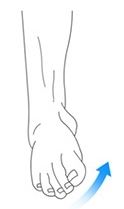
68.
Identify the joint action being performed.
a)
Inversion
b)
Eversion
c)
Plantarflexion
d)
Dorsiflexion
69.
Identify the joint action being performed.
a)
Inversion
b)
Eversion
c)
Plantarflexion
d)
Dorsiflexion
70.
Identify the joint action being performed.
a)
Inversion
b)
Eversion
c)
Plantarflexion
d)
Dorsiflexion
71.
Identify the joint action being performed.
a)
Pronation
b)
Supanation
c)
Inversion
d)
Eversion
72.
Identify the joint action being performed.
a)
Pronation
b)
Supanation
c)
Inversion
d)
Eversion
73.
Moving a part forward (thrusting the head forward).
a)
protraction
b)
retraction
c)
elevation
d)
supination
74.
Movement away from the mid-line is called _____________.
a)
abduction
b)
adduction
c)
internal rotation
d)
external rotation
75.
Turning the hand so that the palm is upward or facing anteriorly (in anatomical position).
a)
supination
b)
pronation
c)
flexion
d)
dorsiflexion
76.
Moving a part so that its end follows a circular path (moving a finger in a circular motion without the the hand).
a)
circumduction
b)
rotation
c)
opposition
d)
retraction
77.
Turning the foot so the plantar surfaces faces medially.
a)
plantar flexion
b)
eversion
c)
inversion
d)
dorsiflexion
78.
flexing the foot at the ankle, bending foot upward
a)
flexion
b)
dorsiflexion
c)
retraction
d)
inversion
79.
extending the foot at the ankle, bending the foot downward
a)
plantar flexion
b)
dorsiflexion
c)
hyperextension
d)
elevation
80.
excessive extension of the parts of a joint, beyond anatomical position
a)
dorsiflexion
b)
inversion
c)
hyperextension
d)
supination
81.
moving a part away from the midline
a)
abduction
b)
adduction
c)
inversion
d)
pronation
82.
moving a part towards the midline
a)
abduction
b)
adduction
c)
eversion
d)
inversion
83.
moving a part around an axis
a)
rotation
b)
circumduction
c)
inverion
d)
eversion
84.
moving a part so the end follows a circular path
a)
depression
b)
elevation
c)
circumduction
d)
rotation
85.
turning the hand so the palm is down
a)
pronation
b)
protraction
c)
supination
d)
retraction
86.
turning the hand so the palm is up
a)
pronation
b)
supination
c)
adduction
d)
abduction
87.
turning the foot so the sole faces laterally
a)
eversion
b)
inversion
c)
extension
d)
flexion
88.
turning the foot so the sole faces medially
a)
eversion
b)
inversion
c)
adduction
d)
abduction
89.
raising a part
a)
elevation
b)
depression
c)
inversion
d)
eversion
90.
lowering a part
a)
elevation
b)
depression
c)
pronation
d)
supination
91.
Ohio
a)
Columbus
b)
Annapolis
c)
Nashville
d)
Raleigh
92.
Which State is this?
a)
Ohio
b)
Maryland
c)
North Carolina
d)
Georgia
93.
Tennessee
a)
Richmond
b)
Nashville
c)
Tallahassee
d)
Columbia
94.
Which State is this?
a)
South Carolina
b)
Virginia
c)
West Virginia
d)
Florida
95.
Kentucky
a)
Annapolis
b)
Frankfort
c)
Charleston
d)
Columbus
96.
Which State is this?
a)
Georgia
b)
Florida
c)
Maryland
d)
North Carolina
97.
Virgina
a)
Frankfort
b)
Charleston
c)
Richmond
d)
Tallahassee
98.
Which State is this?
a)
Tennessee
b)
South Carolina
c)
Florida
d)
Kentucky
99.
Which State is this?
a)
Ohio
b)
Maryland
c)
North Carolina
d)
Virginia
100.
Georgia
a)
Annapolis
b)
Columbus
c)
Columbia
d)
Atlanta
101.
Which State is this?
a)
Kentucky
b)
Maryland
c)
West Virginia
d)
Ohio
102.
Maryland
a)
Annapolis
b)
Tallahassee
c)
Charleston
d)
Frankfort
103.
Which State is this?
a)
West Virginia
b)
Maryland
c)
Kentucky
d)
Georgia
104.
South Carolina
a)
Columbus
b)
Columbia
c)
Nasville
d)
Richmond
105.
Which State is this?
a)
Tennessee
b)
West Virginia
c)
Virginia
d)
Florida
106.
Florida
a)
Tallahassee
b)
Charleston
c)
Frankfort
d)
Annapolis
107.
Which State is this?
a)
Kentucky
b)
Maryland
c)
Ohio
d)
Florida
108.
North Carolina
a)
Columbus
b)
Atlanta
c)
Annapolis
d)
Raleigh
109.
Which State is this?
a)
South Carolina
b)
North Carolina
c)
Florida
d)
Georgia