wayground logo

Free Printable Worksheets

Font size

S
M
L
XL
Worksheets

1107 Final Review

Total questions: 86

Worksheet time: 1hrs 11mins

Name
Class
Date
1.

which of the following terms refers to the order in which amino acids are linked together in a protein.

a)

Primary

b)

Secondary

c)

Tertiary

d)

Quaternary

2.

The chain of amino acids folds and coils on itself

a)

Primary

b)

Secondary

c)

Tertiary

d)

Quaternary

3.

The entire polypeptide forms a three-dimensional structure

a)

Primary

b)

Secondary

c)

Tertiary

d)

Quaternary

4.

Two or more polypeptides attached together and work as one unit

a)

Primary

b)

Secondary

c)

Tertiary

d)

Quaternary

5.
What is the monomer of proteins?
a)
amino acids
b)
polypeptides
c)
nucleotides
d)
monosaccharides
6.
What is the monomer of a protein?
a)
amino acid
b)
monosaccharide
c)
fatty acid
d)
nucleic acid
7.
The tertiary structure folding in proteins is primary due to the interactions of....
a)
the 'R' groups
b)
the 'P' groups
c)
the 'A' groups
d)
the 'S'
8.
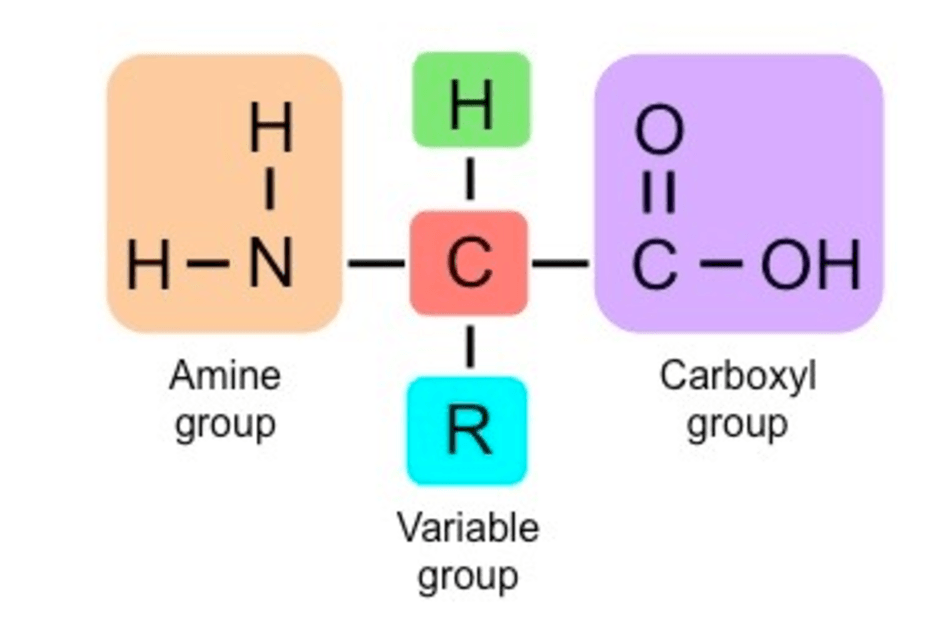
What is the name of this molecule?
a)
amino acid
b)
nucleotide
c)
monosaccharide
d)
triglyceride
9.
Water-repelling
a)
hydrophobic
b)
myoglobin
c)
coagulation
d)
gluten
10.
1.  Which of the following statements best describes a water molecule?
a)
Water has an overall positive charge
b)
Water has an overall negative charge
c)
The uneven sharing of electrons causes a slightly positive and negative side.
d)
The even sharing of electrons.
11.
What are the nucleotides made of?
a)
Sugar, Phosphate, nitrogen base
b)
Phosphate, Adenine, nitrogen base
c)
Thymine, Adenine, Cytomine
d)
Phosphate, Nitrogen, Adenine
12.
Which of the following units are repeatedly joined together to form a strand of DNA? (This is the MONOMER of DNA.) 
a)
amino acids
b)
nucleotides
c)
fatty acids
d)
polysaccharides
13.
Which sequence of DNA bases would pair with this partial strand
ATG TGA CAG
a)
ATG TGA CAG
b)
TAC ACT GTC
c)
GTA AGT GAC
d)
CAT TCA CTG
14.
The enzyme that unzips the DNA to prepare for replication
a)
helicase
b)
replicase
c)
polymerase
d)
synthase
15.
order of replication
a)
3, 2, 1, 4
b)
2, 1, 4, 3
c)
2, 3, 1, 4
d)
3, 4, 1, 2
16.
What is true about the central dogma?
a)
Introns stay inside the nucleus, exons exit the nucleus in the form of pre-mRNA
b)
Introns stay inside the nucleus, exons exit the nucleus in the form of mRNA
c)
The two ribosomes are composed of only protein
d)
None of the above.
17.

In which part of the cell does this process take place

a)

at the ribosomes

b)

in the nucleus

c)

in food vacuoles

d)

on the chromosome

18.

What is structure V?

a)

amino acid

b)

codon

c)

gene

d)

DNA molecule

19.

Which of the structures are composed of RNA?

a)

II and IV

b)

I and V

c)

III and V

d)

III and IV

20.

This process is

a)

monoploidy

b)

transcription

c)

replication

d)

translation

21.

What would the amino acid sequence be for TAGTGATTTAAT?

a)

met-asn-phe-his

b)

gly-arg-ser-pro

c)

ser-ala-glu-gly

d)

ile-thr-lys-leu

22.
When an extra base is inserted into the DNA sequence of a gene, the protein doesn't work. Which explains why?
a)
the base increases rate of translation
b)
the base causes DNA to be transcribed in opposite direction
c)
the inserted base causes the codons in the sequence to be incorrect for the desired protein
d)
the base signals enzymes to translate DNA rather than RNA
23.

Why are insertion and deletion mutations so harmful?

a)

They shift all of the codons from the mutation on down the line, which changes the amino acid sequence

b)

Insertion and deletions are not any more harmful than substitution mutations.

24.

Genetic mutations can be...

a)

beneficial, harmful, or neutral

b)

beneficial only

c)

harmful only

d)

neutral only

25.
The cell below is in a _________ solution.
a)
Hypotonic
b)
Hypertonic
c)
Isotonic
26.
There is a high concentration of carbon dioxide outside the cell and a high concentration of oxygen inside the cell. Which direction will the carbon dioxide move.
a)
out of the cell
b)
Into the cell
c)
stay the same
d)
the membrane is not permable to carbon dioxide
27.
In the given scenario what will happen to the organism.  A fresh water fish is placed in salt water what 
a)
water will leave out of the fish through the gills and though urine
b)
water will enter the fish through gills and the fish will swell
c)
water will move in and out of the fish equally
28.

In the given scenario what will happen. A plant is placed in a solution with a high concentration of salt for a period of 48 hours.

a)

The plant will gain water and become ridgid

b)

water will move in and out of the cell equally.

c)

the plant will lose water causing it to wilt

29.

What are the differences between active and passive transport?

a)

Active does not need energy and passive uses ATP (energy). Active moves from high to low, while passive moves from low to high.

b)

Active uses ATP (energy) and passive does not need energy. Active moves from high to low, while passive moves from low to high.

c)

Passive does not need energy and active uses ATP (energy). Active moves from high to low, while passive moves from low to high.

d)

Active uses ATP (energy) and passive does not need energy. Passive moves from high to low concentration, while active moves from low to high concentration.

30.
The sodium potassium pump usually pumps
a)
potassium out of the cell 
b)
sodium out of the cell 
c)
sodium into the cell 
d)
both potassium and sodium into the cell 
31.

What are 3 types of active transport?

a)

Diffusion, Osmosis and Facilitated diffusion

b)

Facilitated diffusion, Endocytosis and Exocytosis

c)

Sodium/potassium Pump, Endocytosis, and Exocytosis

d)

Sodium/potassium pump, Facilitated diffusion, and Endocytosis

32.

operator region in lac operon is

a)

adjacent to promotor

b)

binding site to promotor

c)

swich on/off site of operon

d)

all of the above

33.

regulation of operon by repessor is referred to as

a)

negative regulation

b)

positive regulation

c)

both a and b

d)

neutral regulation

34.

in lac operon inducer is

a)

lactose

b)

glucose

c)

galactose

d)

all of the above

35.
A protein that binds to the operator and blocks the RNA polymerase
a)
regulator
b)
repressor
c)
activator
d)
corepressor
36.
The "on/off" switch for an operon is called the
a)
promoter
b)
repressor
c)
operator
d)
gene
37.
What is the name of the stretch of DNA where RNA polymerase binds?
a)
operator
b)
promoter
c)
enhancer
d)
origin
38.
What is the role of operons in prokaryote gene expression?
a)
It makes the genes prokaryotes be turned on
b)
It accounts for the regulation of gene activity in response to the needs of the cells
c)
To make DNA for the gene
d)
To make the gene turn of and off
39.
The lac operon genes only become expressed if:
a)
lactose binds to the repressor
b)
glucose binds to the repressor
c)
lactose binds to the operator
d)
the repressor binds to the operator
40.
What type of operon is the trp (tryptophan) operon?
a)
inducible
b)
repressible
c)
positive control
d)
promoible
41.
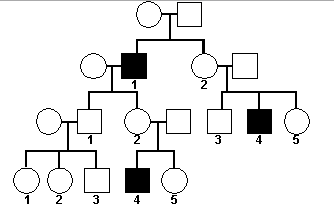
What type of heredity is shown in the pedigree?
(hint: check your notes - "modes of inheritance")
a)
Sex-Linked Dominant
b)
Sex-Linked Recessive
c)
Autosomal Dominant
d)
Autosomal Recessive 
42.
What gender has an X and a Y chromosome?
a)
male
b)
female
c)
transgender 
d)
all of the above
43.
How many generations are shown in this pedigree?
a)
1
b)
2
c)
3
d)
4
44.
Which individual in the first generation is a carrier?
a)
The male
b)
The female
c)
individual 1
d)
None of the above
45.
How many kids did the mother and father from the first generation have?
a)
2
b)
4
c)
5
d)
6
46.
In the second generation-how many people are carriers of the trait?
a)
2
b)
3
c)
5
d)
6
47.
How many people in this whole pedigree have the trait/disease?
a)
2
b)
3
c)
4
d)
6
48.
Behavioral changes of individuals of a species that allow for better survival. (Acquired traits)
a)
Variation
b)
Adaptation
c)
Behavior
d)
Environment
49.
The theory of evolution by natural selection means that what is changing over time?
a)
The inherited traits of a population.
b)
The acquired traits of a population.
c)
Hair color and eye color
d)
Attractive features.
50.
Why do frogs and other organism reproduce so many eggs or offspring?
a)
so that their babies can have friends to play with
b)
the more offspring the more likely the offspring will survive
c)
the more offspring the less likely offspring will survive 
d)
the more offspring the less competition
51.
Almost all adaptations started off as?
a)
selective breeding
b)
physiological
c)
structural
d)
mutation
52.
The differences among a species, like different bird beaks, are called
a)
genes.
b)
variations.
c)
traits.
d)
theories.
53.
Why are advantageous traits more likely to be passed onto offspring?
a)
Because they are more likely to survive and reproduce.
b)
Because they come from dominant alleles.
c)
Because they come from recessive alleles.
d)
Because the trait is an acquired phenotype.
54.
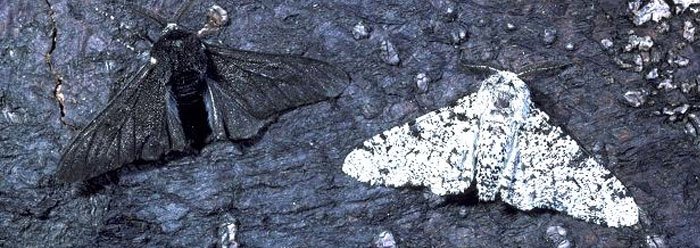
The trees these moths used to live on were white, but have been covered in soot from coal factories. Which moth will be more successful in this environment?
a)
Dark moth
b)
Light moth
c)
Both will be equally successful
d)
Neither will be successful
55.
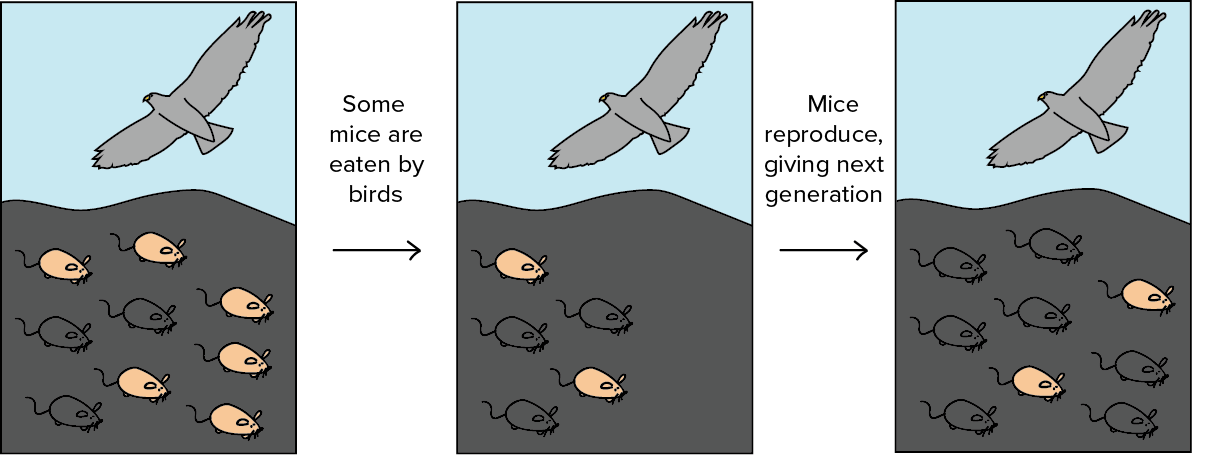
Why is the mouse population changing over time?
a)
The light mice can reproduce more successfully than the dark mice
b)
The hawks eat more dark mice than light mice because the dark mice taste better
c)
The hawks eat more light mice than dark mice because they can see the light mice more easily
d)
The hawks eat more dark mice than light mice because they can see the dark mice more easily
56.
Where do adaptations come from?
a)
The individual organism decides to adapt
b)
Mutations that give an organism an advantage in its environment
57.
Which best describes the role of mutations in natural selection?
a)
Mutations help an organism to better survive in their environment
b)
An organism may acquire a helpful mutation by interacting with the environment
c)
A mutation may result in an adaptive trait that makes an organism more likely to survive and reproduce
d)
Organisms with certain traits are more likely to win competitions for mutations
58.
Mutations are important because they bring about
a)
death of the organism in which they develop
b)
genetic variation needed for a population to evolve
c)
benefits for the individual, not for the population
d)
Hardey-Weinberg equilibrium within a population
59.

If the frequency of two alleles in a gene pool is 90% A and 10% a, what is the frequency of individuals in the population with the genotype Aa?

a)

0.81

b)

o.09

c)

0.18

d)

1.01

60.

If a population experiences no migration, is very large, has no mutations, has random mating, and there is no selection, which of the following would you predict?

a)

The population will evolve, but much more slowly than normal

b)

The makeup of the population's gene pool will remain virtually the same as long as these conditions hold.

c)

The composition of the population's gene pool will change slowly in a predictable manner.

d)

Dominant alleles in the population's gene pool will slowly increase in frequency while recessive alleles will decrease.

e)

The population probably has an equal frequency of A and a alleles.

61.

Which of the following is NOT a condition that must be met for Hardy-Weinberg equilibrium?

a)

Large population size

b)

No mutations

c)

No immigration or emigration

d)

Dominant alleles are more frequent than recessive alleles

e)

No natural selection

62.

In a population that is in Hardy-Weinberg equilibrium, the frequency of the homozygous recessive genotype is 0.09. What is the frequency of individuals that are homozygous for the dominant allele?

a)

0.7

b)

o.21

c)

0.42

d)

0.49

e)

0.91

63.

In humans, Rh-positive individuals have the Rh antigen on their red blood cells, while Rh-negative individuals do not. If the Rh-positive phenotype is produced by a dominant gene (A), and the Rh-negative phenotype is due to its recessive allele (a), what is the frequency of the Rh-positive allele if 84% of a population is Rh-positive?

a)

0.04

b)

0.16

c)

0.48

d)

0.60

e)

0.84

64.
In the Hardy-Weinberg Equation, q2 is the frequency of what?
a)
The recessive allele 
b)
the dominant allele
c)
the recessive genotype
d)
the dominant genotype
65.
What does the variable q represent?
a)
Frequency of the heterozygote genotype
b)
Frequency of the homozygous recessive genotype
c)
The frequency of the recessive allele
d)
The frequency of the dominant allele 
66.
Which Hardy-Weinberg equation represents the genotype frequencies in a population?
a)
p + q = 1
b)
p2 + 2pq + q2 = 1
c)
p2 + pq2 + q2 = 1
d)
p + 2pq + q3 = 1
67.
Genetic drift is likely to be seen in a population
a)
That has a low mutation rate
b)
In which natural selection is occurring
c)
That is very small
d)
For which environmental conditions are changing
68.

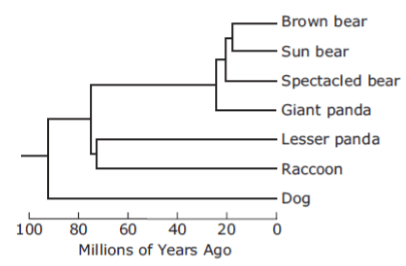
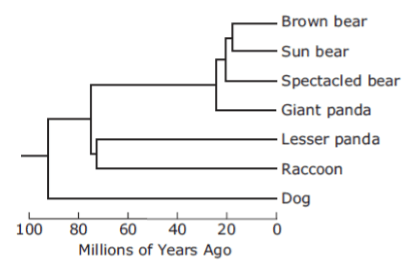
Based on this phylogenetic tree, which statement is true?

a)

Lesser pandas are more genetically similar to giant pandas than they are to raccoons

b)

Brown bears are more genetically similar to giant pandas than they are to sun bears

c)

Lesser pandas are more genetically similar to raccoons than they are to giant pandas

d)

The bear species are all more genetically similar to dogs than they are to giant pandas
69.

Who is the closest relative to the brown bear?

a)

Giant panda

b)

Dog

c)

Lesser panda

d)

Sun bear

70.

Which is the most recent common ancestor for the giant panda and the raccoon?

a)

A

b)

B

c)

C

d)

None of these are correct

71.

Which of these is the most recent common ancestor between the sun bear and the spectacled bear?

a)

A

b)

B

c)

C

d)

None of these are correct

72.

Which organism is the most distantly related to all the others?

a)

Raccoon

b)

Dog

c)

Giant Panda

d)

Sun Bear

73.

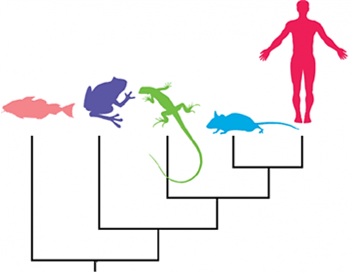
According to this phylogenetic tree, which creature is the least related out of all pictured?

a)

Fish

b)

Frog

c)

Salamander

d)

Human

74.
Feature shared by two or more organisms because they are descended from a common ancestor.
a)
Homology
b)
Synapomorphy
c)
Symplesiomorphy
d)
Homoplasy
75.
Which of the following statements is correct based on the information shown in this cladogram?
a)
the turtle and the frog are more similar to each other than the turtle and the bass
b)
frogs have existed for a longer time that bass
c)
the frog is more closely related to the bass than to the leopard
d)
the bass is exinct
76.
Using the cladogram:  a common ancestor of amphibians and ray-finned fish would have
a)
a bony skeleton
b)
four limbs
c)
scaly skin
d)
eggs with shells
77.
The two extant species that are closely related to each other are __.
a)
A and B
b)
B and C
c)
C and D
d)
D and E
78.

Who is most closely related to Taxidea taxus?

a)

Lutra lutra

b)

Panthera pardus

c)

Canis latrans

d)

Canis lupus

79.

Which of these animals does not have/produce an amniotic egg?

a)

Turtle

b)

Leopard

c)

Lamprey

d)

All three of these animals produce the amniotic egg

80.

What is the name for the "trait" shown on these tree, such as "egg shells" and "four limbs"?

a)

Derived characteristics

b)

Trait nodes

c)

Branching elements

d)

Harmonious changes

81.

According to this image, when did the ancestors of Indohyus and Pakicetus diverge?

a)

52 million years ago

b)

56 million years ago

c)

25 million years ago

d)

47 million years ago

82.

Occurs when stable environment favours the intermediate phenotype

a)

Directional selection

b)

Disruptive selection

c)

Stabilizing selection

d)

Inbeeding

83.

A balanced polymorphism exist through disruptive selection in seed cracker finches from Cameroon in which small and large billed birds specialized in cracking soft and hard seeds, respectively. If long term climatic change resulted in all seeds becoming hard, what type of selection would then operate on the finch population?

a)

Sexual selection

b)

Stabilizing selection

c)

Directional selection

d)

Disruptive selection

84.

Occurs when changing environment favours one extreme phenotype

a)

stabilizing selection

b)

Directional selection

c)

Disruptive selection

d)

Outbreeding

85.
What type of selection?
a)
Directional 
b)
Stabilizing
c)
Disruptive
86.

Human babies don't do well if they are born too small. If they are too big, complications can occur during birth. Babies of average size are best. Which type of natural selection is this?

a)

stabilizing

b)

directional

c)

disruptive

d)

none of the above