wayground logo

Free Printable Worksheets

Font size

S
M
L
XL
Worksheets

Biology Unit 1 Review

Total questions: 95

Worksheet time: 1hrs 14mins
Name
Class
Date
1.
Which of the following is not a characteristic of a Prokaryotic cell?
a)
unicellular
b)
floating DNA
c)
very small
d)
complex
2.
Which of the following is a characteristic of both Eukaryotic and Prokaryotic cells?
a)
ribosomes
b)
nucleus
c)
membrane bound organelles
d)
simple
3.
Eukaryotic cells are complex.
a)
true
b)
false
4.
Prokaryotic cells include bacteria.
a)
True
b)
False
5.
Unicellular means
a)
single-celled
b)
unicycle
c)
multi-celled
d)
united cells
6.
Which type of cell?
a)
Prokaryote
b)
Eukaryote
7.
Has membrane bound organelles
a)
Prokaryote
b)
Eukaryote
c)
both
8.
Which of the following is found inside a prokaryote?
a)
cytoplasm
b)
DNA
c)
ribosomes
d)
all of these
9.
Both prokaryotes and eukaryotes have a nucleus.
a)
True
b)
False
10.
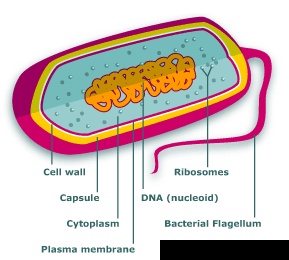
What kind of cell is this?
a)
Eukaryotic
b)
Prokaryotic
11.
All living things are made of...
a)
atoms 
b)
cells 
c)
bacteria 
d)
plants 
12.
What is multicellular? 
a)
one cell 
b)
no cells 
c)
many cells 
d)
no nucleus 
13.
Plants and animal cells are examples of ___ cells 
a)
prokaryotic cells 
b)
eukaryotic cells 
14.
These cells have DNA surrounded by a nuclear membrane...
a)
Eukaryotic
b)
Prokaryotic
c)
Neither
d)
Both prokaryotic and eukaryotic
15.
Animal, fungi, plant, and protista cells are all examples of which type of cell?
a)
Eukaryotic
b)
Prokaryotic
c)
Both prokaryotic and eukaryotic
16.
Prokaryotic cells are older than Eukaryotic cells
a)
Flase
b)
True
17.
Prokaryotic cells do not have
a)
Cell Membrane
b)
Cytoplasm
c)
Nucleus
18.
Which of these structures do prokaryotes and eukaryotes share?
a)
Nucleus
b)
Cell Wall
c)
Ribosomes
19.
What kinds of organisms contain prokaryotic cells?
a)
Fungi
b)
Plants
c)
Bacteria
20.
This type of cell can be unicellular or multicellular
a)
bacteria
b)
prokaryotic
c)
eukaryotic
21.
Which is true of prokaryotic and eukaryotic cells?
a)
Prokaryotic cells are larger than eukaryotic cells.
b)
Eukaryotic cells do not have nuclei, and prokaryotic cells do have nuclei.
c)
Prokaryotic cells lack membrane-bound organelles, and eukaryotic cells contain membrane-bound organelles.
d)
Eukaryotic cells are simpler than prokaryotic cells.
22.

Which type of cells has a chloroplast?

a)

Prokaryote

b)

Plant Cell

c)

Animal Cell

23.

All of the following contain a cell wall except:

a)

prokaryotes

b)

animal cells

c)

plant cells

d)

bacteria

24.

Which does only eukaryotic cells contain?

a)

nucleus

b)

DNA

c)

cell membrane

d)

ribosomes

25.

Which organelle is photosynthetic?

a)

cell wall

b)

chloroplast

c)

mitochondria

d)

vesicle

26.
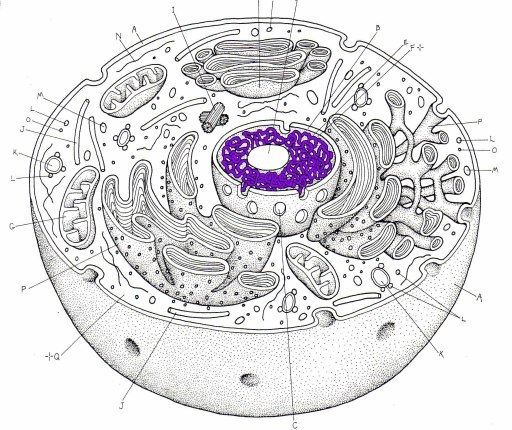
This is a picture of:
a)
Prokaryote
b)
Eukaryote
27.
control, read, and direct the cell using DNA instructions
a)
nucleus
b)
mitochondria
c)
endoplasmic reticulum
d)
lysosome
28.
Controls what enters/leaves a cell
a)
cell membrane
b)
Nuclear membrane
c)
cell wall
d)
cytoplasm
29.
releases energy for cells to use, most common in animal cells
a)
mitochondria
b)
ribosomes
c)
lysosomes
d)
nucleolus
30.
packages proteins for delivery
a)
Endoplasmic reticulum
b)
ribosomes
c)
golgi apparatus
d)
lysosomes
31.
collect sunlight which it converts to sugars
a)
chloroplasts
b)
cytoplasm
c)
cell wall
d)
mitochondria
32.
hold/store water, mainly found in plant cells
a)
nuclolus
b)
ribosomes
c)
golgi bodies
d)
vacuoles
33.
break down (digest) worn out cell parts, mostly in animal cells
a)
cytoplasm
b)
lysosomes
c)
mitochondria
d)
vacuoles
34.
jello-like material, fills the space between cell organelles, is where many chemical reactions occur
a)
cytoplasm
b)
chromatin
c)
chloroplast
d)
cell membrane
35.
Transportation network for the cell, moves materials around in the cell
a)
Lysosome
b)
Nuclear Membrane
c)
Endoplasmic Reticulum
d)
Centriole
36.
What am I?
a)
mitochondria
b)
lysosomes
c)
chloroplast
d)
endoplasmic reticulum
37.
What am I?
a)
cell wall
b)
mitochondria
c)
cytoplasm
d)
chloroplast
38.
What am I?
a)
vacuole
b)
ribosome
c)
endoplasmic reticulum
d)
golgi apparatus
39.
What am I?
a)
Nucleus
b)
Golgi Body
c)
Mitochondrion
d)
Plasma Membrane
40.
a)
produces ribosomes
b)
contains genetic information
c)
stores food, water, wastes and other materials
41.
a)
found only in plants
b)
contains chlorophyll
c)
produces energy
42.
a)
controls what enters and exits the cell
b)
contains chlorophyll
c)
thick and rigid
43.
a)
contain DNA
b)
used in photosynthesis 
c)
give plants their taste
44.
a)
site of protein synthesis by ribosomes
b)
where ribosomes are made
c)
gel-like fluid
45.
a)
makes ribosomes
b)
storage for water
c)
breaks down worn out cell parts
46.
a)
site of protein synthesis by ribosomes
b)
filled with gel-like fluid
c)
used to break food down
47.
a)
contains DNA
b)
digests worn out cell parts
c)
produces energy
48.
a)
where ribosomes are made
b)
receives proteins from ER and distributes them
c)
assembles amino acids into proteins
49.
a)
produces energy a cell needs
b)
where ribosomes are made
c)
packages amino acids and moves them out of the cell
50.
a)
assembles amino acids to create proteins
b)
control center of the cell
c)
capturesenergy from sunlight
51.
a)
control center of the cell
b)
captures energy from sunlight
c)
found in plant and animal cells
52.
A phospholipid has 2 parts. What are they called? 
a)
Hydrophilic Head, Hydrophobic Tail 
b)
Hydrophobic Head, Hydrophilic Tail 
53.
"Water Loving"
a)
Hydrophobic
b)
Hydrophilic 
c)
Hydroelectric 
d)
Hydroloric
54.
"Water Fearing" 
a)
Hydrophobic
b)
Hydrophilic 
c)
Hydroelectric 
d)
Hydroloric
55.
Describes the arrangement of the cell membrane as bendable and made of many parts. 
a)
The Fluid Mosaic Model 
b)
The Major Mobility Model 
c)
The Crazy Cell Model
d)
The Maze Model
56.
___________ allow cells to recognize each other and act like ID tags. 
a)
Carbohydrates 
b)
Proteins
c)
Phospholipids 
d)
Cholesterol
57.
___________ form the two layers of the cell membrane. 
a)
Carbohydrates 
b)
Proteins 
c)
Phospholipids 
d)
Cholesterol
58.
It forms a boundary between the inside of the cell and the outside of the cell. 
a)
Cell Membrane
b)
Lipid Cleric Layer
c)
Membrane Gate
d)
Protein Receptors 
59.
A white blood cell engulfing a bacteria is an example of:
a)
endocytosis
b)
exocytosis
c)
cotransport
d)
facilitated diffusion
60.
Which shows a cell in hypotonic solution?
a)
1
b)
2
c)
3
d)
It depends on the cell
61.
Which of the following processes includes all others?
a)
osmosis
b)
facilitated diffusion
c)
passive transport
d)
transport of an ion down its eletrochemical gradient
62.
What is NOT TRUE about the cell membrane?
a)
It controls what enters and leaves the cell
b)
Semipermeable
c)
Phospholipid bilayer
d)
Contains digestive enzymes
63.
What does "bilayer" mean?
a)
one layer
b)
two layers
c)
laminated
d)
bilateral
64.
What is embedded in the phospholipid bilayer?
a)
Proteins
b)
Salt
c)
Water
d)
Worms
65.
What forms the channels and pumps in the phospholipid bilayer?
a)
Carbohydrates
b)
Proteins
c)
Hydrophilic heads 
d)
Lipids
66.
True or False:  Regulating what enters and leaves the cell helps the cell maintain homeostasis. 
a)
True
b)
False
67.
Hydrophobic region of the cell membrane?
a)
E
b)
B
c)
C
d)
68.
Hydrophilic portion of cell membrane?
a)
A
b)
C
c)
D
d)
69.
What does a cell need to transport particles by active transport?
a)
Sun
b)
Wind
c)
Energy
d)
Channels
70.
Osmosis uses a channel protein called AQUAPORIN.  What type of transport is this? *Think!
a)
Diffusion
b)
Facilitated Diffusion
c)
Active Transport
d)
Endocytosis
71.
What is one major difference between passive and active transport?
a)
Passive transport uses energy; active transport does not.
b)
Both types of transport use energy.
c)
Active transport uses energy; passive transport does not.
d)
No difference. They are both the same.
72.
Small, non-polar molecules like COand O2 and NO can pass through the cell membrane using what type of transport?
a)
Diffusion
b)
Osmosis
c)
Facilitated Diffusion
d)
Endocytosis
73.

___________ are internal structures inside a cell that carry out a specific function.

a)

Organelles

b)

Organs

c)

Lipids

d)

Proteins

74.

___________ transport does not require energy because it moves down a concentration gradient.

a)

Active

b)

Passive

75.

___________ is the movement of particles from areas of high concentration to areas of low concentration.

a)

Active transport

b)

Hydrophobic

c)

Diffusion

d)

Isotonic

76.

Which of the following is the movement of water molecules across a membrane?

a)

Lipid bilayer

b)

Active transport

c)

Hydrophilic

d)

Osmosis

77.
What do viruses need to reproduce?
a)
they need genetic material
b)
They need a host cell
c)
They need  bacteria
d)
They need insulin
78.
A(n) _____ is a virus that enters a bacterial cell.
a)
endospore
b)
decomposer
c)
plasmid
d)
bacteriophage
79.
When a virus invades a living cell, its _______
takes over the cell's functions.
a)
outer coat
b)
genetic material
c)
core
d)
cytoplasm
80.
What part of the phage is the DNA?
a)
A
b)
B
c)
C
d)
D
81.
True or False
The flu is caused by a virus.
a)
true
b)
false
82.
Antibiotics kill viruses
a)
True
b)
False
83.
What part of a virus is the protein capsule that houses the genetic material (DNA/RNA)?
a)
tail
b)
nucleus
c)
capsid
d)
glycoprotein
84.
Which viral life cycle kills its host cell by lysing?
a)
lytic
b)
mitosis
c)
lysogenic
d)
S phase
85.
Which viral life cycle allows viral genetic material to lay dormant while the host cell reproduces?
a)
lytic
b)
mitosis
c)
lysogenic
d)
S phase
86.
Which of these is an animal virus?
a)
Tobacco mosaic virus
b)
bacteriophage
c)
influenza
87.
Viruses are...
a)
prokaryotic
b)
eukaryotic
c)
non-living
d)
endospores
88.
Viruses...
a)
use a host to reproduce
b)
breath oxygen
c)
grow
d)
eat food
89.
Which of the following is not a bacterial shape?
a)
bacilli
b)
spirilla
c)
spacecraft
d)
cocci
90.
Why do you need to get a flu shot every year?
a)
the flu virus mutates from year to year
b)
your immune system doesn't keep immunity for more than a year
c)
viruses mutate faster every year
d)
vaccines get stronger each year
91.
Reasons that viruses are considered to be nonliving is because
a)
They are not cellular
b)
They cannot reproduce on their own
c)
They cannot make proteins
d)
all of the above
92.
Which can be treated with antibiotics?
a)
Virus
b)
Bacteria
c)
Mutagen
d)
Parasite
93.
Viruses 
a)
have many cells
b)
are misfolded proteins
c)
are a protein coat around genetic material
d)
endospores
94.
Viruses can reproduce on their own
a)
False
b)
True
95.
What is the main function of the projections on the surface of a virus?
a)
They aid in respiration
b)
They help the virus grow
c)
They help the virus invade its host by attaching to specific sites on the host
d)
They help the virus digest food molecules