wayground logo

Free Printable Worksheets

Font size

S
M
L
XL
Worksheets

Bio Test 2 Review

Total questions: 121

Worksheet time: 2hrs 19mins

Name
Class
Date
1.
Which of the following are true of the cell cycle?
a)
The cell spends most of its time dividing 
b)
The cell spends most of its time growing
c)
Replication of DNA occurs at M 
d)
Cells enter G0 after M
2.
When is DNA replicated during the cell cycle?
a)
During the G1 phase
b)
During the G2 phase 
c)
During the S phase
d)
 During the M phase
3.
What best describes the genetic material shown in photograph E.
a)
The chromosomes are in anaphase
b)
The chromosomes are in metaphase 
c)
DNA is possibly being replicated
d)
The genetic material is around the poles and cytokinesis is occurring 
4.
All of the following are true of the cell cycle shown in the diagram except ___.
a)
A, B, and C represent interphase
b)
DNA is replicated at B 
c)
Cytokinesis and new daughter cells are found at E
d)
Mitosis and cytokinesis are represented by D 
5.
In DNA replication, complementary base pairing occurs between ___.
a)
Cytosine and uracil 
b)
Adenine and guanine
c)
Adenine and uracil
d)
Adenine and thymine
6.
What best describes the genetic material shown in photograph A. 
a)
The chromosomes are in anaphase
b)
The chromosomes are in metaphase
c)
DNA is possibly being replicated 
d)
The genetic material is around the poles and cytokinesis is occurring
7.
All of the following are true about DNA replication except ___.
a)
It is semiconservative
b)
It occurs during the S-phase of the cell cycle 
c)
It allows daughter cells to have exact copies of the genetic code
d)
It reduces the chromosome number by half for the production of gametes
8.
Replication of DNA 
a)
Produces mRNA and tRNA molecules
b)
Produces only new DNA 
c)
Produces two molecules, each of which is half new and half old DNA joined lengthwise to each other
d)
Generates excessive DNA, which eventually causes the nucleus to divide
9.
DNA polymerase 
a)
Is an enzyme 
b)
Adds new nucleotides to the template strand 
c)
Proofreads DNA strands to see that they are correct 
d)
All of these are functions of DNA polymerase
10.
In DNA replication, three of the four choices listed below are correctly paired.  Select the exception.   A.  A – C B.  C – G C.  A – T D.  T – A
a)
A-C
b)
C-G
c)
A-T
d)
T-A
11.
Identify this process.
a)
Replication
b)
Transcription
c)
Translation
d)
Proof reading 
12.
When, during the cell cycle, does this occur?
a)
During G1 
b)
During S
c)
During G2
d)
During M
13.
.  In step b, the original strands have separated because ___.
a)
DNA polymerase has stopped functioning
b)
Hydrogen bonds between the bases have broken
c)
Water hydrolyzes the bases into their subunits
d)
Bases naturally repel each other
14.
When step d is completed, the two DNA molecules formed will be ___.
a)
Identical to each other but not to the parent 
b)
 Identical to the parent but not to each other 
c)
Identical to each other and to the parent
d)
Different from each other and from the parent 
15.
The ability of the genetic material to ___ provides the genetic variability required for evolution to occur in a population.
a)
Store information
b)
Be replicated
c)
Undergo changes
d)
 All are correct 
16.
Which is a characteristic of cancer?
a)
rapid and uncontrolled cell growth
b)
 cell growth delayed at the G1 checkpoint. 
c)
cell growth delayed at the G2 checkpoint. 
d)
damage to a cell’s cytoplasm
17.
Why do cancer cells not respond properly to cell signals and controls?
a)
damage to a cell’s cytoplasm
b)
damage to a cell’s sister chromatids 
c)
damage to a cell’s DNA
d)
damage to a cell’s wall and membrane 
18.
.  Cancer is a disorder in which some cells have lost the ability to control their ___.
a)
size
b)
spindle fibers
c)
growth rate
d)
surface size
19.
Which of the cells depicted in the line graph are most likely cancerous?                  
 
a)
Line A
b)
Line B
c)
Line C
d)
Line D
20.
The genetic code is nearly universal. That means, with few exceptions, the same codons code for the same amino acids in all organisms. What does the near universality of the genetic code suggest? 
a)
All life-forms can reproduce with one another
b)
All life-forms have the same number of genes. 
c)
All life-forms have a common evolutionary ancestor. 
d)
All life-forms arose about the same time in Earth’s history.
21.
The intersection of the left, top, and right nitrogenous bases indicates which amino acid a mRNA codon represents.  This is true for all organisms.  This indicates that the ___.
a)
The genetic code is universal. 
b)
We, as organisms, differ only in our sequence of bases
c)
The genetic code determines the sequence of amino acids making up a protein 
d)
 All of the above
22.
What do all of these organisms have in common?
a)
Universal genetic code
b)
Components that make up the genetic code
c)
Traits that are determined by genes that are translated into proteins
d)
Organisms have all of above in common 
23.
Organisms have all of the following in common except ___. 
a)
Traits that are determined by genes that are translated into proteins
b)
Sequence of nitrogenous bases in the genetic code 
c)
A universal genetic code
d)
The same components that make up the genetic code
24.
 Which sequence depicts the correct order of protein synthesis within a cell? 
a)
DNA → mRNA → amino acids → proteins
b)
DNA → amino acids → mRNA → proteins
c)
 DNA → mRNA → proteins → amino acids
d)
DNA → proteins → amino acids → mRNA
25.
The figures show four process involving DNA and RNA.  Which figure shows the process of transcription?
a)
Figure A
b)
Figure B
c)
Figure C
d)
Figure D
26.
Which molecule is paired with its correct role in protein synthesis? 
a)
Nucleus – forms peptide bonds 
b)
Ribosome – carries DNA instructions
c)
mRNA – joins amino acids 
d)
 tRNA – transfers amino acids
27.
Which best describes the interaction between DNA and RNA during protein synthesis?
a)
RNA carries the code to the nucleus where DNA translates the code into a protein
b)
DNA travels to the ribosome where RNA translates the code into a protein 
c)
RNA carries the code from DNA in the nucleus to the ribosome for protein synthesis
d)
DNA travels to the cytoplasm while RNA remains in the nucleus 
28.
During the process of protein synthesis, a section of the DNA molecule is copied into which other molecule?
a)
nucleic DNA 
b)
cytoplasmic DNA
c)
messenger RNA
d)
transfer RNA
29.
Which molecule carries amino acids to the ribosomes?
a)
mRNA
b)
tRNA
c)
DNA
d)
ATP
30.
What best describes the genetic material shown in photograph B. 
a)
The chromosomes are in anaphase
b)
The chromosomes are in metaphase
c)
DNA is possibly being replicated 
d)
The genetic material is around the poles and cytokinesis is occurring
31.
The passing of traits from parent to offspring 
a)
Heredity 
b)
Genetics 
c)
Hybrid 
d)
Probability 
32.
 which is heterozygous ?  
a)
Tt
b)
TT
33.
Which is homozygous ?
a)
Zz
b)
SS
34.
the genetic makeup of an organism
a)
heterozygous
b)
punnet square
c)
genotype
35.
what predicts the outcome
a)
genetic engineering
b)
punnet square
c)
probability
36.
An offspring will receive how many alleles from each parent to determine a specific trait?
a)
one
b)
two
c)
three
d)
five
37.
having two of the same genes for the trait (sometimes called purebred).
a)
homozygous
b)
hetrozygous
c)
protein
d)
chromosome
38.
having two different genes for a trait (sometimes called hybrid).
a)
protein
b)
homozygous
c)
heterozygous
d)
genotype
39.
Complex molecule that carries genetic information that defines an organism's traits. It is stored in the nucleus.
a)
DNA
b)
protein
c)
RNA
d)
glucose nucleic acid (GNA)
40.
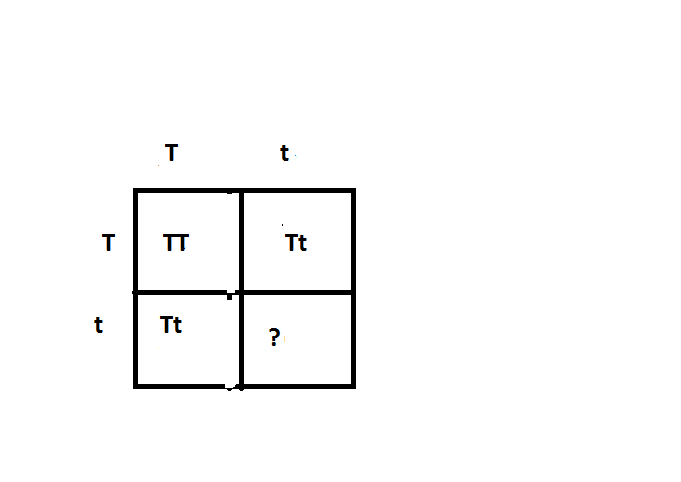
T - tall and t = short
In the punnett square below, what belongs in the missing square
a)
tt
b)
Tt
c)
Bb
d)
TT
41.
B = brown fur  b = white fur
In the punnett square, what is the probability for white fur? 
a)
0%
b)
25%
c)
50%
d)
75%
42.
What you see, or the physical appearance.
a)
Genotype
b)
Phenotype
c)
Homozygous
d)
Heterozygous
43.
If B = brown hair and b = blonde hair, what is the probability of brown hair?
a)
25%
b)
50%
c)
0%
d)
75%
44.

A male and female have a child that has three copies of chromosome 18. Although both parents are unaffected, their doctor claims that the disorder associated with having an extra chromosome 18 is the result of a chromosomal mutation in cells that carry inherited material. Which argument supports this claim?

a)

A mutation occurred when crossing over caused chromosome 18 to be replicated twice during meiosis, allowing one parent to donate two copies of chromosome 18 to the child.

b)

A nondisjunction mutation was caused by the improper separation of the genetic material during meiosis, allowing the gamete of one parent to donate two copies of chromosome 18 to the child.

c)

A substitution mutation during replication allowed the genetic material of chromosome 18 to replace the genetic material of a nearby chromosome, causing the child to have three copies of chromosome 18.

d)

An insertion mutation during replication allowed the genetic material of chromosome 18 to be inserted into the genetic material of another chromosome, causing three copies of chromosome 18 to be made.

45.

This Punnett square shows the inheritance of flower color in snapdragon flowers. Which statement BEST explains the inheritance of flower color in snapdragons?

a)

The allele for pink flower color is dominant because heterozygous individuals display this trait.

b)

The alleles for white flower and red flower color are dominant because they are expressed in homozygous individuals.

c)

The alleles for flower color show incomplete dominance because both alleles are partly expressed in heterozygous individuals.

d)

The alleles for flower color show codominance because both alleles are completely expressed in heterozygous individuals.

46.

Which description explains the role of the tRNA in the process shown in this model?

a)

The model delivers amino acids to the ribosome so that they can be added to the developing peptide.

b)

The model recognizes the stop codon of a developing peptide so that no new amino acids are added.

c)

The model signals the release of the peptide from the ribosome once all of the amino acids have been added.

d)

The model scans the developing peptide to make sure that the sequence of the amino acids matches the mRNA.

47.

Which statement correctly uses the model to explain how mitosis maintains genetic continuity?

a)

The chromosomes in cell 1 are the same as in cells 6 and 7.

b)

Crossing-over occurs in cell 4, which increases the genetic diversity in cells 6 and 7.

c)

When the nuclear membrane reforms in cell 5, each nucleus becomes diploid in number.

d)

The independent assortment that is represented in cell 2 ensures that cell 3 has the correct number of chromosomes.

48.

Non-Mendelian genetics patterns where alleles blend their traits

a)

Incomplete Dominance

b)

Complete Dominance

c)

Co-Dominance

d)

Dominant Traits

49.

Non-Mendelian genetics where alleles mix their traits but they are not blended

a)

Dihybrid Traits

b)

Simple Dominance

c)

Incomplete Dominace

d)

Co-Dominance

50.

Red hair (R) is dominant over blond hair (r). What is the probability of two heterozygous, red-haired parents producing a blond hair child?

a)

0% probability

b)

25% probability

c)

50% probability

d)

100% probability

51.
Genetic variation can arise from a random change in the DNA of a gene.  The change is called a(n)
a)
mutation
b)
gene flow
c)
gene pool
d)
allele
52.
Mutations are important because they bring about
a)
death of the organism in which they develop
b)
genetic variation needed for a population to evolve
c)
benefits for the individual, not for the population
d)
Hardey-Weinberg equilibrium within a population
53.
Which of the following best describes a DNA molecule?
a)
double helix
b)
contains ribose
c)
made of amino acids
d)
contains Uracil
54.
Which sequence of DNA bases would pair with this partial strand
ATG TGA CAG
a)
ATG TGA CAG
b)
TAC ACT GTC
c)
GTA AGT GAC
d)
CAT TCA CTG
55.
Which of the following units are repeatedly joined together to form a strand of DNA?
a)
amino acids
b)
nucleotides
c)
fatty acids
d)
polysaccharides
56.
In a molecule of double-stranded DNA, the amount of Adenine present is always equal to the amount of
a)
cytosine
b)
guanine
c)
thymine
d)
uracil
57.
Why is DNA important?
a)
it is very small and very complicated
b)
it's in everything
c)
it serves as the blueprint for traits of all living things
d)
because we eat it every day for energy
58.
Which organelle is DNA usually found in?
a)
cell membrane
b)
vacuole
c)
chloroplast
d)
nucleus
59.
A process in which DNA has the unique ability to make an exact copy of itself.
a)
Replication
b)
Translation
c)
Transcription
60.
In what phase of the cell cycle does DNA replication take place?
a)
G1
b)
S
c)
G2
d)
M
61.
Which two bear species are most closely related?
a)
Bear 1 and Bear 2
b)
Bear 1 and Bear 3
c)
Bear 2 and Bear 3
d)
There’s no way to tell
62.

In a report explaining how the structures of DNA and RNA lead to the expression of information in a cell, a student included the following statement: Each strand of the original DNA molecule becomes one strand in each of the new DNA molecules. Each of the other strands in the new DNA molecule is constructed from nucleotides.


In which section of the student's report does this statement belong?

a)

the section describing how replication occurs

b)

the section describing the process of transcription

c)

the section describing the synthesizing of proteins

d)

the section describing how translation occurs in cells

63.

Trisomy 22 is a genetic disorder in humans that results when chromosome 22 does not separate during meiosis in one parent. Some cases of trisomy 22 result from chromosome 22 not separating during meiosis I. In such cases, how many copies of chromosome 22 are found in each of the four gametes produced after meiosis II?

a)

All four gametes have one copy of chromosome 22.

b)

All four gametes have two copies of chromosome 22.

c)

Two gametes each have one copy of chromosome 22, and two gametes each have two copies of chromosome 22.

d)

Two gametes each have two copies of chromosome 22, and two gametes have no copies of chromosome 22.

64.

When offspring produced by sexual reproduction move into different environments, new species sometimes emerge over time. Which characteristic of sexual reproduction allows this result to occur?

a)

number of offspring produced

b)

speed with which offspring are produced

c)

size of the offspring produced

d)

diversity of the offspring produced

65.

Camellias are small trees with roselike flowers. A certain variety of camellia has two alleles for flower color, one for white flowers and one for red flowers. A camellia homozygous for white flowers is crossed with a camellia homozygous for red flowers. Which of these outcomes would indicate that the alleles for flower color are codominant?

a)

25% of the offspring have red flowers.

b)

50% of the offspring have pink flowers.

c)

25% of the offspring have white flowers.

d)

100% of the offspring have flowers with alternating red and white patches.

66.
Name the phase:
a)
Prophase
b)
Metaphase
c)
Anaphase
d)
Telophase
67.
Name the phase:
a)
Prophase
b)
Metaphase
c)
Anaphase
d)
Telophase
68.
Name the phase:
a)
Prophase
b)
Metaphase
c)
Anaphase
d)
Telophase
69.
Name the previous phase.
a)
Prophase
b)
Metaphase
c)
Anaphase
d)
Telophase
70.

Nucleic acids are involved in protein synthesis within the cell. Which order correctly describes the sequence of nucleic acids involved in this process?

a)

DNA → mRNA → rRNA →tRNA

b)

DNA → mRNA → tRNA →rRNA

c)

DNA → rRNA → mRNA →tRNA

d)

DNA → rRNA → tRNA →mRNA

71.
What is the function of a nucleic acid?
a)
Stores genetic information
b)
Stores energy
c)
Quick source of energy
d)
Builds structures
72.
Which statement describes how complementary strands of DNA are linked?
a)
each sugar in one strand is paired with a complementary base in the other strand. 
b)
Each sugar in one strand is pained with a complementary phosphate in the other strand
c)
Each phosphate in one strand is paired with a complementary phosphate in the other
d)
Each base in one strand is paired with a complementary base in the other 
73.
In a pedigree, what shape represents a male?
a)
circle
b)
square
c)
triangle
d)
diamond
74.
Photograph of chromosomes grouped in ordered pairs
a)
pedigree
b)
Punnett Square
c)
Venn Diagram
d)
Karyotype
75.
How many girls in this family express this recessive disorder?
a)
4
b)
5
c)
6
d)
7
76.
Down Syndrome is also known as...
a)
Trisomy 21
b)
Monosomy 23
c)
Cri-du-chat
d)
Mauvaise-réponse
77.
Which statement is NOT true about Karyotypes
a)
Chromosomes (pairs 1-22) are arranged by size
b)
Sex chromosomes are found at the end
c)
A normal karyotype has 46 chromosomes or 23 pairs
d)
Having missing or extra chromosomes does not indicate a disorder
78.
A method of separating DNA fragments according to their size and charge using an electric current passed through a gel containing the samples a
a)
Chromosome
b)
DNA Probe
c)
Electrophoresis
d)
Restriction Enzyme
79.
Most human cells have how many chromosomes 
a)
23
b)
24
c)
46
d)
48
80.
Bob was found dead in his home.  Crime scene analysis showed signs of a struggle.  Blood was collected from the crime scene, the victim, and three suspects.  Which suspect likely committed the crime? 
a)
Sue
b)
Lisa
c)
John
d)
None of these
81.
Based on these results whose blood was found in the blood stain at the crime scene?
a)
Bob
b)
Sue
c)
John
d)
Lisa
82.
What type of bonds hold the two strands of DNA together?
a)
Hydrogen bonds
b)
Covalent bonds
c)
Dipole-Dipole bonds
d)
Ionic bonds
83.
DNA cutting "scissors" are
a)
Bacteriophages
b)
Restriction Enzymes
c)
DNA Enzymes
d)
Plasmids
84.
This image is an example of which DNA Technology process?
a)
PCR
b)
Blotting
c)
Gel Electrophoresis
d)
Cloning
85.
What shape are plasmids?
a)
linear
b)
circular
c)
double helix
d)
square
86.
T5- The unpaired nucleotides produced by the action of restriction enzymes are referred to as
a)
sticky end.
b)
base sequence.
c)
single strands.
d)
restriction fragments.
87.
T6- Which technology below would probably be the most important to a person who had diabetes and had to take insulin every day? 
a)
using recombinant DNA to produce human hormones from bacteria
b)
 testing parents for genetic disorders before they have children
c)
engineering fruits and vegetables that resist insects and other pests
d)
C. developing ways to identify criminals through DNA fingerprinting
88.
T6- This picture shows how what is made?
a)
Recombinant DNA
b)
PCR
c)
Gel Electrophorisis
d)
Clones
89.
T6- In order to insert a human gene into plasmid, both must 
a)
code for the same gene product.
b)
be cut by the same restriction enzyme.
c)
originate from the same type of cell.
d)
have identical sequences.
90.

Which of the following is a circular piece of DNA from bacteria that can hold a foreign gene?

a)

plasmid

b)

restriction enzyme

c)

ligase

d)

protein expression

91.

Why are plasmids sometimes given an antibiotic resistance gene?

a)

So that scientists can make antibiotic resistant bacteria and make more money for pharmaceutical companies.

b)

So that scientists can create super bugs.

c)

So that scientists can identify which cells have the plasmid.

d)

So that scientists can kill the bacteria.

92.
Restriction enzymes are found in nature inside:
a)
viruses
b)
bacteria
c)
animals
d)
plants
93.

A student performed a gel electrophoresis experiment. The results are represented in the diagram

below. Compared to the fragments at the top of the gel, the fragments at the lower end are

a)

larger, and move slower

b)

larger, and move faster

c)

smaller, and move faster

d)

smaller, and move slower

94.
The work done to map out the entire genomic sequence in humans was called
a)
gene mapping
b)
the Human Genome Project
c)
Operation Transposon
d)
Genome Sequence Project (GSP)
95.
What is a genome?
a)
The complete set of genetic material present in a cell or organism
b)
A garden ornament 
c)
The sum of all human material.
d)
A totally unique set of genetic material not shared with anything else
96.
The ABO blood group is made up of
a)
three alleles.
b)
two alleles.
c)
identical alleles.
d)
dominant alleles.
97.
The failure of chromosomes to separate during gamete formation in called
a)
nondisjunction
b)
alleles
c)
point mutation
d)
cloning
98.
The X and Y chromosomes are called the
a)
extra chromosomes.
b)
phenotypes.
c)
sex chromosomes.
d)
All of the answers are correct.
99.

The _________ allele is the one that "wins"

a)

awesome

b)

recessive

c)

dominant

d)

DNA

100.

DNA codes for ________

a)

genes

b)

stuff

c)

cells

d)

idk

101.

An allele is a . . .

a)

section of DNA that codes for a specific trait

b)

section of the cell that codes for a specific trait

c)

different form of the same trait

d)

a trait

102.

Which is a trait for Mr. Tenni?

a)

He is bald

b)

He likes math

c)

He loves pandas

d)

He is funny

103.
What is Gregor Mendel's nick name?
a)
"Mr. Heredity"
b)
"Greggy"
c)
"Gene Finder"
d)
"Father of Genetics"
104.
What does genotype mean?
a)
The physical charactersitics of an organism
b)
What an organism looks like
c)
How tall an organism is
d)
The genetic makeup of an organism
105.
Two of the same alleles for a trait: 
a)
heterozygous
b)
homozygous
106.
Two different alleles for a trait: 
a)
heterozygous
b)
homozygous
107.
The physical makeup of an organism, or its traits: 
a)
genotype
b)
phenotype
c)
Punnett Square
d)
probability
108.
The genetic makeup of an organism: 
a)
genotype
b)
phenotype
c)
Punnett Square
d)
probability
109.
The cells produced via meiosis are called:
a)
sex cells
b)
somatic cells
c)
body cells
d)
skin cells
110.
Unlike mitosis, meiosis in male mammals results in the formation of
a)
one haploid gamete
b)
three diploid gametes
c)
four diploid gametes
d)
four haploid gametes
111.
If the Diploid number of Carrots is 18, the haploid number is
a)
18
b)
9
c)
27
d)
36
112.
The chromosomes that pair up during meiosis, are called __________ chromosomes.  
a)
homozygous 
b)
asexual
c)
homologous
d)
genes
113.
Identify the phase.
a)
Metaphase I
b)
Metaphase II
c)
Prophase I
d)
Anaphase II
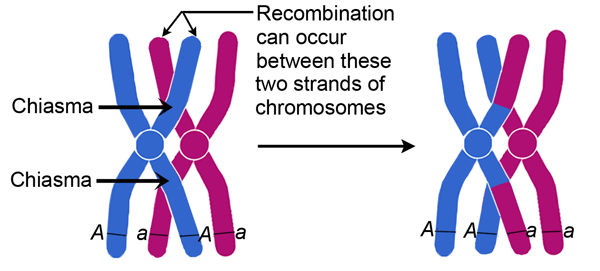
114.
This image shows chromosomes during Prophase 1. Which of the following correctly describes the process shown?
a)
segregation of sister chromatids
b)
condensation and segregation of alleles
c)
mutationin which the DNA content of the gene is altered
d)
crossing - over in which alleles are exchanged
115.

At the end of mitosis you have _____ cells

a)

identical

b)

different

c)

identical twins

d)

variety

116.
products of meiosis are genetically
a)
different
b)
identical
117.
Human eggs and sperm are _____, and each has ____ chromosomes.
a)
diploid, 23
b)
diploid, 46
c)
haploid, 23
d)
haploid, 46
118.
The process of crossing over occurs in what phase of meiosis?
a)
anaphase 1
b)
prophase 1
c)
prophase 2
d)
telophase 1
119.
If a somatic (body) cell in a butterfly contains 24 chromosomes, a butterfly egg would contain
a)
3
b)
6
c)
12
d)
24
120.
What phase is represented?
a)
metaphase 1
b)
metaphase 2
c)
anaphase 1
d)
anaphase 2
121.
What phase is represented?
a)
metaphase 1
b)
metaphase 2
c)
anaphase 1
d)
anaphase 2