Wayground logo

Free Printable Worksheets

Font size

S
M
L
XL
Worksheets

chemistry exam

Total questions: 111

Worksheet time: 3hrs 8mins

Name
Class
Date
1.

Which of the following is NOT a property of ionic compounds?

a)

They conduct electricity when molten

b)

They conduct electricity when in solution

c)

They have high boiling points

d)

They are insoluble in water

2.
What is the charge on a Hydrogen ion?
a)
+1
b)
1
c)
2
3.
What is the charge on an Aluminium ion?
a)
3
b)
+3
c)
+2
d)
+1
4.
What is the charge on a chloride ion?
a)
-1
b)
1
c)
+2
d)
+1
5.
What is the charge of Neon?
a)
0
b)
+1
c)
-1
d)
1
6.
How many valence electrons does hydrogen have?
a)
1
b)
2
c)
3
d)
4
7.
How many valence electrons does calcium have?
a)
2
b)
4
c)
6
d)
7
8.
A(n) _________ is an ion with a positive (+) charge.
a)
anion
b)
cation
c)
ion
d)
solute
9.
What is the charge on a Hydrogen ion?
a)
+1
b)
1
c)
2
10.
What is the charge on an Aluminium ion?
a)
3
b)
+3
c)
+2
d)
+1
11.

An ionic bond is the attraction between a positive ion and a negative ion.

a)

True

b)

False

c)

Dont know

12.

The diagram represents a substance with ionic bonding.

a)

True

b)

False

c)

Dont know

13.

The formula for potassium cyanide is

a)

KCN

b)

K2(CN)2

c)

CNK

d)

PCN

14.

Ionic compounds with only TWO elements involve

a)

the sharing of electrons.

b)

the transfer of electrons.

c)

the sharing of protons.

d)

the transfer of protons.

15.
Covalent bonds actually "share" electrons?
a)
true
b)
false
16.
How are covalent bonds formed?
a)
Sharing of electrons
b)
Transfer of electrons
17.
How are ionic bonds formed?
a)
Transfer of electrons
b)
Sharing of electrons
18.
How do covalent bonds form?
a)
Donating & receiving valence e- between atoms.
b)
Opposite slight charges attract each other between compounds.
c)
Scientists are still not sure how they form.
d)
Sharing valence e- between atoms.
19.
What two types of atoms make a covalent bond?
a)
2 Nonmetals
b)
1 Nonmetal and 1 Metal
c)
2 Metals
d)
2 Noble Gases
20.
Which of the following is NOT formed by a covalent bond?
a)
K2S
b)
H2O
c)
I2
d)
CO2
21.
Which of the following describes the strength of a covalent bond?
a)
Middle - Each atom shares an octet
b)
Middle - One atom gains an octet & the other loses.
c)
Weakest - it only forms because of another bond forming
d)
Strongest - each atom receives a "permanent" octet.
22.
What do we call a covalent bond where electrons are shared UNEVENLY or UNEQUALLY?
a)
Ionic
b)
Polar Covalent
c)
Nonpolar Covalent
d)
Van der Waals Force
23.

If sodium and oxygen formed a bond, it would be classified as --

a)

polar covalent

b)

nonpolar covalent

c)

ionic

d)

metallic

24.

Which electrons are involved in a chemical bond?

a)

Valence electrons

b)

Inner shell electrons

c)

Electrons are not involved in bonding

25.

What is the charge of the aluminum ion?

a)

+13

b)

+3

c)

-3

d)

Cannot be determined

26.

What is the oxidation number of fluorine?

a)

7

b)

-7

c)

-1

d)

1

27.

What is the correct chemical formula for potassium sulfate?

a)

K2S

b)

K2SO4

c)

KS

d)

KSO4

e)

K4SO

28.
2. Which of the following elements are not found as diatomic molecules?
a)
a) Hydrogen
b)
b) Chlorine
c)
c) Helium
d)
d) Nitrogen
29.
1. Which statement best describes 'Electronegativity'?
a)
a) The ability of an atom to attract electrons.
b)
b) The ability of an atom to lose electrons.
c)
c) The ability of an atom to bond with metals.
d)
d) The ability of an atom to attract other atoms.
30.
3. Which of the following elements are not found as diatomic molecules?
a)
a) Iodine
b)
b) Oxygen
c)
c) Bromine
d)
d) Lithium
31.
4. Which of the following statements is most accurate regarding melting and boiling points?
a)
a) Substance with simple covalent bonding have higher melting and higher boiling points than substances with ionic bonding.
b)
b) Substance with simple covalent bonding have higher melting and lower boiling points than substances with ionic bonding.
c)
c) Substance with simple covalent bonding have lower melting and higher boiling points than substances with ionic bonding.
d)
d) Substance with simple covalent bonding have lower melting and lower boiling points than substances with ionic bonding.
32.
Is Hydrogen considered a metal or a non-metal?
a)
Metal
b)
Non-metal
33.
What two types of atoms make a covalent bond?
a)
2 Nonmetals
b)
1 Nonmetal and 1 Metal
c)
2 Metals
d)
2 Noble Gases
34.
How are covalent bonds explained?
a)
When one atom takes the other atom's electron
b)
When the atom shares an electron with an another atom
c)
When the two nucleus merge
d)
When the neutrons leave the nucleus
35.
In chemical compounds, covalent bonds form when
a)
the electronegativity difference between two atoms is very large.
b)
electrons are completely transferred between two metals.
c)
pairs of electrons are shared between two nonmetal atoms.
d)
two nonmetal atoms are attracted to each other by opposite charges.
36.
What region of the periodic table contains atoms that form covalent bonds?
a)
the left side
b)
the middle
c)
the right side
d)
top left
37.
What two types of atoms make a covalent bond?
a)
2 Nonmetals
b)
1 Nonmetal and 1 Metal
c)
2 Metals
d)
2 Noble Gases
38.
How are covalent bonds explained?
a)
When one atom takes the other atom's electron
b)
When the atom shares an electron with an another atom
c)
When the two nucleus merge
d)
When the neutrons leave the nucleus
39.
What region of the periodic table contains atoms that form covalent bonds?
a)
the left side
b)
the middle
c)
the right side
d)
top left
40.
Are the atoms more stable when they are bonded together or when they are apart? 
a)
Bonded Together
b)
Apart
41.
Study the electron dot diagrams for lithium, carbon, fluorine, and neon. Choose the statement that correctly identifies the most stable of the elements.
a)
Lithium is the most stable element because it has to lose only one electron to achieve a stable configuration.
b)
Carbon is the most stable element because it can form four bonds
c)
Fluorine is the most stable element because it has to gain only one electron to achieve a stable configuration
d)
Neon is the most stable element because its highest occupied energy level is filled.
42.
A binary covalent bond exists between
a)
2 metals
b)
1 metal and 1 nonmetal
c)
2 nonmetals
d)
Any 2 elements
43.
What is the correct chemical formula for Nitrogen Triiodide?
a)
NI3
b)
N3I3
c)
NOI
d)
NeI3
44.
What is the correct name for C4H6?
a)
Carbon Hexahydride
b)
Pentacarbon Pentahydride
c)
Hexacarbon Tetrahydride
d)
Tetracarbon Hexahydride
45.
What is the chemical formula for Tetraphosphorous Pentachloride ?
a)
4P5Cl
b)
PCl
c)
P4Cl5
d)
none of the above
46.
What is the chemical formula for Fluorine trisulfide ?
a)
S3F
b)
FS3
c)
FS
d)
none of the above
47.
How many elements are in C6H12O6?
a)
1
b)
2
c)
3
d)
4
48.
How many atoms of carbon (C) are in  C6H12O6?
a)
3
b)
6
c)
12
d)
24
49.
Solve the equation
a)
d = 3
b)
d = 7
c)
d = -7
d)
d = -3
50.
The substances listed on the right side of a chemical equation are the
a)
Yields
b)
Reactants
c)
Products
d)
Precipitates
51.
CaCO3 represents a chemical
a)
Symbol
b)
Formula
c)
Subscript
d)
Reaction
52.

What is the percent composition of Benzene, C6H6?

a)

C = 50%

H = 50%

b)

C = 85.7 %

H = 14.3%

c)

C = 92.3%

H = 7.7%

d)

C = 71.9%

H = 28.1%

53.

How many moles are in 225 g of CO?

a)

28.01 mole

b)

4.82 x 1024 mole

c)

6,302,25 mole

d)

8.0357 mole

54.
In chemistry, a "mole" is:
a)
The mass of an atom
b)
A unit of measurement to count particles
c)
based on the volume of a substance
d)
The number of atoms
55.
What is the Mr of NaOH?
a)
23
b)
44
c)
40
d)
18
56.
Mr for Na2CO3 is
a)
100
b)
106
c)
74
d)
90
57.
How many moles are there in 8g of hydrogen molecules?
a)
8
b)
4
c)
16
d)
0.25
58.

Which compound below has the smallest molar mass?

a)

CO

b)

CO2

c)

H2O

d)

H2O2

59.

Balance the following reaction:

Mg(s) + HCl(aq) --> MgCl₂(aq) + H₂(g)

a)

1,2,1,2

b)

2,1,1,2

c)

1,2,1,1

d)

1,2,2,2

60.

Ammonia can be manufactured by the Haber process. In the Haber process, nitrogen combines with hydrogen to form ammonia.


xN2 + yH2 → zNH3


What is the value of x, y and z?

a)

x = 1, y = 1, z = 2

b)

x = 1, y = 3, z = 2

c)

x = 2, y = 1, z = 2

d)

x = 2, y = 3, z = 2

61.

The reaction between hydrochloric acid and aluminium oxide is represented by the equation shown below.


Al2O3 + xHCl → yAlCl3 + zH2O


Which values for x, y and z are correct for balancing the chemical equation?

a)

x = 3, y = 1, z = 3

b)

x = 6, y = 1, z = 6

c)

x = 6, y = 2, z = 3

d)

x = 12, y = 4, z = 6

62.

Magnesium reacts with water to produce magnesium hydroxide and hydrogen gas.


Which of the following shows the balanced chemical equation for this reaction?

a)

Mg + H2O → MgOH + H2

b)

Mg + 2H2O → Mg(OH)2 + H2

c)

2Mg + H2O → MgOH2 + H2

d)

2Mg + 2H2O → Mg(OH)2 + 2H2

63.

PCB are toxic organic compounds. They can be removed by reaction with calcium oxide to form non-toxic compounds calcium chloride, carbon dioxide and water.


PCB + calcium oxide → calcium chloride + carbon dioxide + water


From the above reaction, what can we deduce for the elements found in PCB?

a)

carbon and chlorine only

b)

carbon and hydrogen only

c)

carbon, hydrogen and chlorine

d)

hydrogen and chlorine only

64.

The electronic configurations of the elements, S and T, are 2,8,2 and 2,6 respectively.


What is chemical formula of the compound formed from S and T?

a)

ST

b)

ST3

c)

S2T6

d)

S6T2

65.

Gallium oxide has the formula Ga2O3.

What is the formula of gallium nitrate?

a)

GaNO3

b)

Ga(NO3)2

c)

Ga(NO3)3

d)

Ga3NO3

66.
How many atoms of carbon (C) are in C6H12O6?
a)
3
b)
6
c)
12
d)
24
67.
How many Sodium (Na) are in 6NaCl?
a)
1
b)
12
c)
6
68.
How many Aluminum are in Al2O3?
a)
3
b)
2
c)
5
69.
How many O's are in Al₂(SO₄)₃
a)
4
b)
12
c)
7
d)
24
70.
Number of H in 3(NH₄)₂CrO₄
a)
4
b)
2
c)
8
d)
24
71.
Which of the following shows the correct way to balance the chemical equation?
Fe + O2 -> Fe2O3
a)
4Fe + 3O2 -> 2Fe2O3
b)
2 Fe + 3O2 -> Fe2O6
c)
4 Fe + O6 -> 2Fe2O3
d)
None of the options are correctly balanced.
72.
Which of the following reactions is balanced?
a)
2CH4 + O2 -> CO2 + H2O
b)
CH4 + 2O2 -> CO2 + H2O
c)
CH4 + 2O2 -> CO2 + 2H2O
d)
None of the chemical equations are balanced.
73.
Ice melting
a)
Chemical Change
b)
Physical Change
74.
Water freezing
a)
Chemical Change
b)
Physical Change
75.
Blue liquid and yellow liquid mixed to make a green liquid
a)
Chemical Change
b)
Physical Change
76.
Baking soda and vinegar combine to make carbon dioxide
a)
Chemical Change
b)
Physical Change
77.
which one is the definition of chemical property?
a)
a property or characteristic of a substance that is observed during a reaction where the chemical composition of a substance is changed
b)
any change that results in the formation of new chemical substances
c)
combustibility
78.
what is the definition of physical change?
a)
any change that results in the formation of new chemical substances. 
b)
rusting
c)
changes affecting the form of a chemical substance, but not its chemical composition.
d)
any property that is measurable, whose value describes a state of a physical system
79.
compounds are chemically bounded together 
a)
False
b)
true
c)
I don't know?
80.
Can an element be broken down into a simpler substance 
a)
yes 
b)
No
81.
Are there any compounds on the periodic table 
a)
yes there are many 
b)
no because only elements are on the periodic table
c)
I think they are?
82.
Which one has more than one type of atom in it
a)
Element
b)
Compound 
83.
which one only has one type of atom In it.
a)
Element
b)
compound
84.
Which of the following represents an element?
a)
H2O
b)
H2
c)
NaCl
d)
CaCO3
85.

Which of the following is not a compound?

a)

CO

b)

H

c)

NaCl

d)

CO2

86.
Salt has a chemical formula of NaCl.  Salt is a...
a)
Compound
b)
Element
c)
Mixture
d)
None of the Above
87.
What cannot be broken down into other substances?
a)
Compound
b)
Mixture
c)
Solids
d)
Element
88.
What is made up two or more elements that are chemically combined?
a)
Element
b)
Mixture
c)
Compound
d)
Solids
89.
What cannot be broken down into other substances?
a)
Compound
b)
Mixture
c)
Solids
d)
Element
90.
__________ are the building blocks of matter.
a)
Elements
b)
Compounds
c)
Mixtures
d)
Solutions
91.
__________ are elements bonded together that have chemically combined.
a)
Elements
b)
Compounds
c)
Mixtures
d)
Colloids
92.
_________ are elements that have not chemically combined.
a)
Elements
b)
Compounds
c)
Mixtures
d)
Table Salt
93.
What is the chemical symbol for Gold?
a)
G
b)
Go
c)
Au
d)
Ag
94.
What is the chemical symbol for Potassium?
a)
P
b)
Po
c)
K
d)
Pt
95.
What is the chemical symbol for oxygen?
a)
O
b)
Ox
c)
Oy
d)
Og
96.
Who was the creator of the periodic table?
a)
Dmitri Mendeleev
b)
Niels Bohr
c)
Ernest Rutherford
d)
Albert Einstein
97.
At higher temperatures
a)
particles in an object have less energy
b)
particles in an object move faster
c)
a gas contracts
98.
A gas
a)
has a definite shape but no definite volume
b)
has a definite volume but no definite shape
c)
has fast-moving particles
99.
Freezing
a)
Solid to gas
b)
Liquid to solid
c)
Gas to solid
d)
Liquid to gas
100.
Which state of matter has tightly packed molecules?
a)
solid
b)
liquid
c)
gas
101.
Particles (molecules) in a ______________________ have more energy than the other states of matter.
a)
gas
b)
solid
c)
liquid
102.

Particles of a liquid

a)

are tightly packed together and stay in a fixed position.

b)

are free to move around one another but still touch.

c)

decrease in volume with increasing temperature.

103.
What term describes a solid changing to a gas?
a)
Deposition
b)
Sublimation
c)
Evaporation
d)
Freezing
104.
Which has a greater distance between particles?
a)
Solid
b)
Liquid
105.
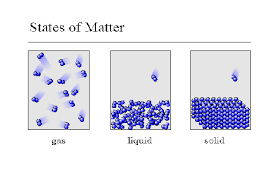
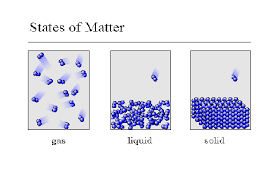
Which state of matter has particles arranged like this?
a)
solid
b)
liquid
c)
gas
106.
Which of the following statements describes a solid?
a)
It has a fixed shape
b)
It takes the shape of it's container
107.

Which state of matter is the most compressible?

a)

Gas

b)

Liquid

c)

Solid

108.
This is testing ___________
a)
relative density
b)
solubility
c)
mass
d)
conductivity 
109.
The water is ______ dense than the boat
a)
more
b)
less
110.
The blue ball has ________ mass than the red one.
a)
less
b)
more
111.
More dense than the corn oil, but less dense than the water...
a)
glycerin
b)
wood
c)
plastic
d)
copper wire