
 Worksheets
Unit Test -Chemistry of Life
Total questions: 83
Worksheet time: 49mins
All matter is made of building blocks called _____________.
energy.
atoms.
electrons.
compounds.
The central region of an atom where neutrons and protons are present is called _________.
nucleus
electron cloud
core
center
An atom with atomic number 6 would have how many electrons ?
6
12
3
cannot be determined
What is the atomic number and name for an element with three protons?
2 - Helium
1 - Hydrogen
3 - Lithium
6 - Carbon
Nucleotides consists of a phosphate group, a nitrogenous base, and a _______________.
6 carbon sugar
5 carbon sugar
fatty acids
glycerol
R group
A pure substance that consists entirely of one type of atom
atom
element
molecule
compound
A substance formed by the chemical combination of two or more elements in definite proportions
atom
element
compound
molecule
What kind of bond forms when one kind of atom gives or transfers electrons to another kind of atom?
Chemical bon
Ionic bond
Covalent bond
Electron bond
Large bodies of water do not quickly fluctuate (change) in temperature. Why?
Water is a solvent.
Water has a high heat capacity.
Water acts as a buffer.
Water is non-polar.


________ is the tendency of molecules of the same kind to stick to one another.
Cohesion
Adhesion
Solution
Polar molecule
Water is a universal solvent because it...
can be found anywhere.
freezes when it gets cold.
floats when frozen.
dissolves most substances.
A material composed of two or more elements or compounds that are physically mixed together but not chemically combined
compound
molecule
mixture
A mixture of water and non-dissolved materials
compound
mixture
solution
suspension
Any compound that releases hydrogen ions into solution
Acid
Base
Alkaline
Buffer
Any compound that produces hydroxide (OH) ions in solution.
acid
base
buffer
Weak acids or bases that can react with strong acids or bases to prevent, sharp, sudden changes in pH
Acids
Bases
Alkalines
Buffers


Living organisms use which macromolecule to store and transmit genetic information?
Fat
Protein
Sugar
Nucleic acid
Which two organic compounds have only Carbon, Hydrogen, and Oxygen?
Carbohydrates/Nucleic Acids
Lipids/Carbohydrates
Proteins/Nucleic Acids
Carbohydrates/Proteins
Organic molecules that always contain carbon, oxygen and hydrogen, often in a 1:2:1 ratio
carbohydrates
proteins
nucleic acids
lipids

What is the primary function of carbohydrates in your body?
Speed up chemical reactions.
Source of immediate energy.
Help to store energy.
Build cell walls in plants.
Macromolecules are made up of smaller subunits called ____ to form ____.
polymers, monomers
monomers, polymers
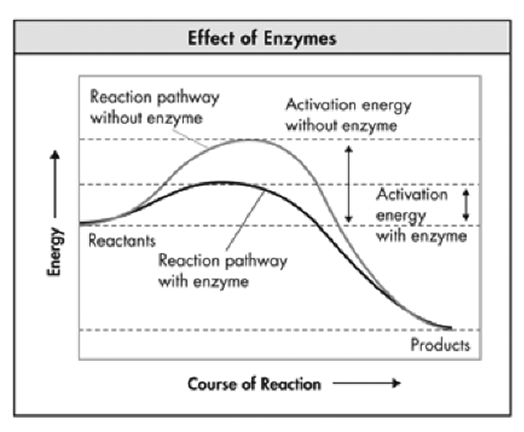
The graph shows how enzymes affect reactions in cells. Which statement best summarizes the information shown in the graph?
Enzymes increase the energy of the reactants.
Enzymes decrease the energy level of the products.
Enzyme decrease the activation energy of the reaction.
Enzymes reverse the direction of the reaction.
Any element or compound that is acted upon by an enzyme is called a(n)?
Coenzyme
Substrate
Vitamin
Polypeptide
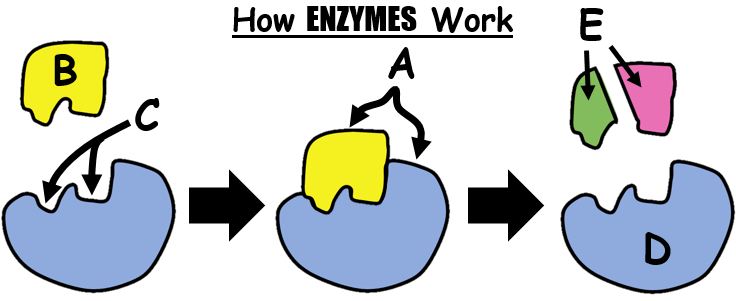
In the diagram, what is letter A?
product
substrate
enzyme-substrate complex
active site
What happens when enzymes are heated to a high temperature?
The enzymes work faster.
The shapes of the enzyme are destroyed and denatured.
The enzymes' amino acid sequence changes.
The enzymes remain the same.
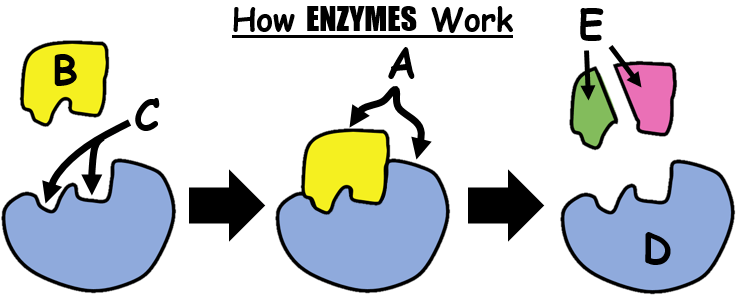
Letter D is called __________.
active site
enzyme
substrate
products
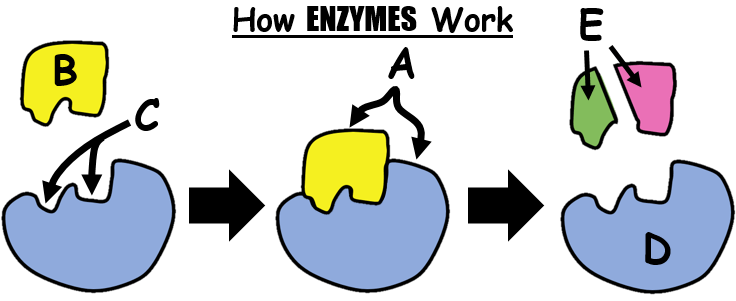
Letter B is called __________.
active site
enzyme
substrate
products
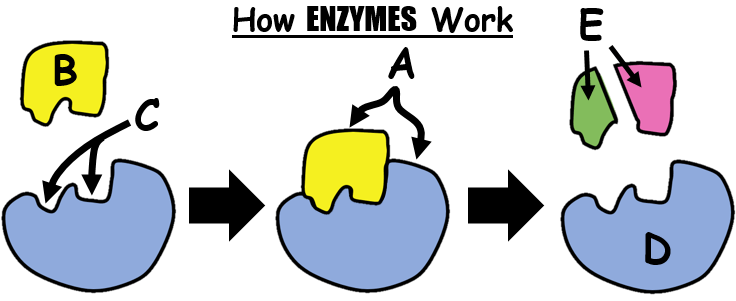
Letter C is called ____________.
active site
enzymes
substrate
products
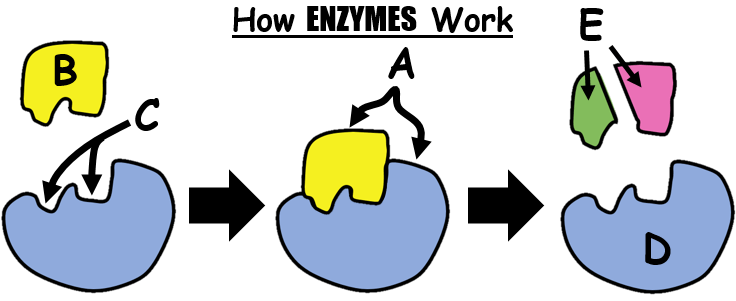
Letter E is ______________.
active site
enzyme
substrate
products
Li
Lead
Lithium
Litium
Litterium
This is not an element
P
Phosphor
Phosphorous
Prosperous
Phosforous
Phosphorus
F
Florine
Flourine
fluorine
Fluorine
Floorine
Be
Beryllium
Beerium
Beryllum
Berylium
Berylum
Chlorine
CL
C
cl
cL
Cl
Sodium
S
So
Sd
Si
Na
Potassium
P
Po
Pt
Ps
K
Nitrogen
Ni
Nt
N
Nr
Ng


Composed of mostly protons and neutrons in the nucleus. – Also called Mass Number
Atomic Mass
Atomic Number
Neutrons
Isotopes
Atoms of the same element with a different number of neutrons are called___________.
ions
electrons
isotope
protons
A charged atom is called _____________.
Ion
Isotope
nucleus
Neutron

