wayground logo

Free Printable Worksheets

Font size

S
M
L
XL
Worksheets

Nervous System

Total questions: 134

Worksheet time: 1hrs 13mins

Name
Class
Date
1.

What is the largest part of the brain?

a)

Hypothalamus

b)

Cerebellum

c)

Cerebrum

d)

Brain Stem

2.

Which is controlled by conscious thought?

a)

voluntary actions

b)

breathing

c)

heart rate

d)

digestion

3.

Basic unit of the nervous system; another name for nerve cell.

a)

brain stem

b)

axon

c)

dendrite

d)

neuron

4.

Nerves that branch out from the spinal cord and connect to rest of body.

a)

Central Nerves

b)

Peripheral Nerves

c)

Cerebellum

d)

Synapse

5.

Connects the brain to the spinal cord.

a)

cerebrum

b)

cerebellum

c)

brain stem

d)

midbrain

6.

Bundle of nerves that begins at the brain stem and continues down the center of the back.

a)

axon

b)

nerve fiber

c)

spinal cord

d)

brain stem

7.

Part of brain that coordinates muscle movements.

a)

brain stem

b)

cerebrum

c)

cerebellum

d)

spinal cord

8.

What is the function of the nervous system

a)

pumps blood

b)

provide support to muscles

c)

communicate with and react to the environment

d)

provides oxygen to all the cells in the body

9.

What are the two main parts of the central nervous system?

a)

brain and spinal cord

b)

patella and phalanges

c)

heart and lungs

d)

stomach and pancreas

10.

Which of the following is not a nervous system function?

a)

Receives information from internal and external environments

b)

Responds to stimuli

c)

Maintains balance in the body

d)

Shapes and supports the body

11.

When you touch something hot, what is the path of the message?

a)

brain, nerve, spinal cord

b)

nerve, spinal cord, brain

c)

spinal cord, nerve, brain

d)

brain, spinal cord, nerve

12.

Which part of the body is the "control center"?

a)

brain

b)

spinal cord

c)

nerve endings

d)

vertebrae

13.

The human brain is made of 100 billion neurons. Each neuron has a nucleus that contains genes. Many neurons bind together to form a nerve.

a)

tissue

b)

system

c)

organ

d)

cell

14.

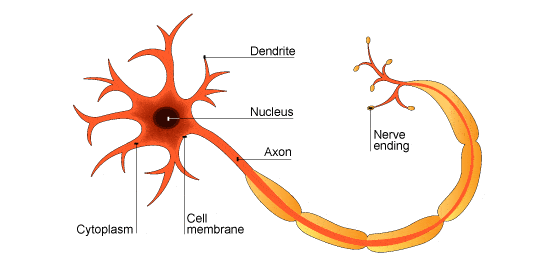
As organisms get more complex, cells become specialized to perform specific functions in the body. What is the function for the cell shown?

a)

contract and shorten movement

b)

provide coverage and protection

c)

carry impulses around the body

d)

connects parts together

15.

What level of structure is represented by the diagram?

a)

organ

b)

organ system

c)

cell

d)

tissue

16.

Humans feel hungry when their empty stomachs contract and glucose levels in their body drop. Both of the situations stimulate neurons that send messages to the brain which are interpreted as hunger. What body systems are involved in this process as described?

a)

digestive, muscular, integumentary, and respiratory

b)

digestive, excretory, integumentary, and skeletal

c)

circulatory, excretory, nervous, and skeletal

d)

circulatory, digestive, muscular, and nervous

17.

Which system is responsible for the overall control of all the internal processes that occur in the body?

a)

muscular system

b)

nervous system

c)

digestive system

d)

skeletal system

18.

The urinary bladder is a muscular organ of the excretory system that collects urine excreted by the kidney. How does the nervous system help the urinary system in excretion?

a)

it signals the urinary bladder to absorb more water from the urine.

b)

It signals the urinary system to collect waste from the different parts of the body.

c)

It signals the urinary bladder to hold and release urine at appropriate times.

d)

It signals the urinary bladder to allow more urine to flow from the ureters.

19.

Which 2 body systems interact and initiate movement?

a)

muscular and nervous system

b)

skeletal and muscular system

c)

respiratory and nervous system

d)

circulatory and nervous system

20.

Which structure in the diencephalon relays information going to the cerebrum?

a)

Pineal body

b)

Hypothalamus

c)

Thalamus

d)

Pituitary gland

21.

The motor system is divided into which two systems?

a)

Input, output

b)

Sympathetic, parasympathetic

c)

Motor, sensory

d)

Somatic, autonomic

22.

Which division of the autonomic nervous system is called the resting and digesting division?

a)

Preganglionic branch

b)

Post ganglionic branch

c)

Parasympathetic branch

d)

Sympathetic branch

23.

Which part of the neuron is responsible for cell metabolism?

a)

Body

b)

Axon

c)

Dendrite

d)

Synapse

24.

Myelin is a lipid insulation produced by the...

a)

astrocytes

b)

ependymal cells

c)

microglia

d)

oligodendrocytes

25.

The nerves going to the upper limbs join the spinal cord at the ____ region.

a)

cervical

b)

thoracic

c)

sacral

d)

lumbar

26.

The third, innermost layer of the meninges is called the...

a)

pia mater

b)

arachnoid mater

c)

dura mater

d)

epidural mater

27.

Impulses are conducted rapidly if _____ is present.

a)

myelin

b)

spinal fluid

c)

niacin

d)

iron

28.

A _____ is a pool of blood between any of the layers of the meninges and the skull.

a)

concussion

b)

hematoma

c)

hemorrhage

d)

contusion

29.

This type of glia cell attacks microbes and removes debris.

a)

Neurilemma

b)

Astroglia

c)

Microglia

d)

Oligodendrocyte

30.

The outer layer of the meninges is the...

a)

arachnoid mater

b)

pia mater

c)

dura mater

d)

choroid plexus

31.

Nerves that originate in the spinal cord.

a)

Central Nervous System

b)

Spinal Nerves

c)

Cranial Nerves

d)

Nervous Nerves

32.

Nerves that originate in the brain.

a)

Cranial nerves

b)

Spinal nerves

c)

Vagus nerve

d)

Peripheral nerves

33.

The nervous system is made of these three parts:

a)

Brain, Spinal Cord, and Nerves

b)

Brain,Tendons, and Ligaments

c)

Brain, Heart and Lungs

d)

Spinal Cord, Vertebrae and nerves

34.

Part of the brain that controls sleep?

a)

cerebrum

b)

cerebellum

c)

brain stem

d)

spinal cord

35.

What part of your brain controls breathing?

a)

cerebrum

b)

cerebellum

c)

brain stem

d)

spinal cord

36.

What part of your brain controls balance?

a)

cerebrum

b)

cerebellum

c)

brain stem

d)

spinal cord

37.

The central nervous system is made up of what parts?

a)

Brain and spinal cord

b)

Brain only

c)

Nerves only

d)

Nerves and spinal cord

38.
What is another word for autonomic?
a)
voluntary
b)
involuntary
c)
central 
d)
brain
39.
The nervous system subdivision that is composed of the brain and spinal cord.
a)
Autonomic Nervous Sytem
b)
CNS
c)
PNS
d)
Somatic Nervous System
40.
Subdivision of the PNS that controls voluntary activities such as activation of skeletal muscles.
a)
Autonomic Nervous System
b)
CNS
c)
PNS
d)
Somatic Nervous System
41.
Subdivision of the PNS that controls involuntary activities, such as regulating cardiac and smooth muscle glands.
a)
Autonomic Nervous System
b)
CNS
c)
PNS
d)
Somatic Nervous System
42.
The afferent division of the PNS is also called the ______ division.
a)
motor
b)
sensory
c)
somatic
d)
autonomic
43.
The efferent division of the PNS is also called the _____ division.
a)
Motor
b)
Sensory
c)
Brain
d)
Spinal Cord
44.

What do axons do?

a)

Passes messages away from the cell body to other neurons, muscles, or glands.

b)

Receive messages from other cells and sends those electrical signals to the cell body.

c)

Covers the axon of some neurons and helps speed neural impulses.

d)

Form junctions with other cells.

45.

What do dendrites do?

a)

Passes messages away from the cell body to other neurons, muscles, or glands.

b)

Receive messages from other cells and sends those electrical signals to the cell body.

c)

Covers the axon of some neurons and helps speed neural impulses.

d)

Form junctions with other cells.

46.
a signal molecule that transmits nerve impulses across synapses
a)
neuron
b)
neurotransmitter
c)
nerve
d)
action potential
47.
What is structure labeled B in the picture?
a)
Dendrite
b)
Axon
c)
Cell Body
d)
Axon Terminal
48.
What is structure labeled D in the picture?
a)
Dendrite
b)
Axon
c)
Cell Body
d)
Axon Terminal
49.

What is structure labeled A in the picture?

a)

Nucleus

b)

Dendrite

c)

Synapse

d)

Myelin Sheath

50.

This part of the brain coordinates movement and balance.

a)

Cerebrum

b)

Cerebellum

c)

Amygdala

d)

Hippocampus

e)

Prefrtonal Cortex

51.
a)
Frontal Lobe
b)
Brain Stem
c)
Cerebellum
d)
Occipital Lobe
52.
a)
Frontal Lobe
b)
Parietal Lobe
c)
Temporal Lobe
d)
Occipital Lobe
53.
a)
Frontal Lobe
b)
Parietal Lobe
c)
Occipital Lobe
d)
Temporal Lobe
54.
a)
Frontal Lobe
b)
Parietal Lobe
c)
Occiptal Lobe
d)
Temporal Lobe
55.
a)
Frontal Lobe
b)
Parietal Lobe
c)
Temporal Lobe
d)
Occipital Lobe
56.
Regulates the amount of light entering the eye and gives the eye its color.
a)
Iris
b)
Lens
c)
Pupil
d)
Retina
57.
The clear tissue that covers the front of the eye.
a)
Lens
b)
Pupil
c)
Iris
d)
Cornea
58.
What is letter E?
a)
Vitreous humor
b)
Retina
c)
Cornea
d)
Optic nerve
59.
What is letter G?
a)
Sclera
b)
Retina
c)
Lens
d)
Vitreous humor
60.
This part of the eye carries the message from your eye to the part of your brain that controls vision. 
a)
cornea
b)
lens
c)
optic nerve
d)
retina
61.

Which sense works together with our sense of smell?

a)

taste

b)

sight

c)

hearing

d)

touch

62.

Which word refers to the sense of smell?

a)

Olfactory

b)

Gustatory

c)

Auditory

d)

respiratory

63.
The five basic tastes the tongue can detect
a)
Sweet, Spicy, Sour, Salty, Umami
b)
Sweet, Bitter, Sour, Salty, Spicy
c)
Sweet, Bitter, Sour, Salty, Umami
d)
Sweet, Bitter, Spicy, Salty, Umami
64.

Skin "feels" the following

a)

heat, cold, pain, pressure

b)

pain and tickling

c)

heat, cold, temperature

65.

Nerve endings send messages to the brain through the

a)

nose

b)

foot

c)

spinal cord

66.

A small space between nerve cells.

a)

dendrite

b)

axon

c)

synapse

d)

neurotransmitter

67.

An involuntary, automatic response to a stimulus.

a)

reflex

b)

behavior

c)

medulla

d)

pons

68.

As organisms get more complex, cells become specialized to perform specific functions in the body. What is the function for the cell shown?

a)

contract and shorten movement

b)

provide coverage and protection

c)

carry impulses around the body

d)

connects parts together

69.

Controls Reflexes

a)

Spinal Cord

b)

Medulla

c)

Cerebellum

70.

Controls Body Temperature

a)

Pans

b)

Brainstem

c)

Hypothalamus

71.

Controls Sleep

a)

Medulla Oblongata

b)

Brainstem

c)

Spinal Cord

72.

Stores Memories

a)

Cerebrum

b)

Cerebellum

c)

Medulla

73.

Which nervous system is protected by bone?

a)

Peripheral Nervous System

b)

Outer Nervous System

c)

Central Nervous System

74.

Which of these would be a response from the SYMPATHETIC nervous system?

a)

Heart rate increases

b)

Breathing rate slows

c)

Blood flows to intestines

d)

Blood pressure decreases

75.

Select all of the below responses that are PARASYMPATHETIC

a)

Blood diverts to digestive system

b)

Pupils constrict

c)

Heart rate increases

d)

Breathing rate decreases

76.

True or False: The autonomic system controls our MANUAL control of the body.

a)

True

b)

False

77.

The brain has four lobes. Which is not a lobe of the brain?

a)

Occipital

b)

Temporal

c)

Cerebral

d)

Parietal

78.

Which lobe controls voluntary movement and "thinking"?

a)

Frontal lobe

b)

Parietal lobe

c)

Occipital Lobe

d)

Temporal Lobe

79.

The occipital lobe controls...

a)

Vision

b)

Smell

c)

Taste

d)

Movement

80.

Which lobe processes memories?

a)

Temporal

b)

Occipital

c)

Parietal

d)

Frontal

81.

The parietal lobe controls our reading of...

a)

temperature

b)

pressure

c)

thirst

d)

sight

82.

Select the two parts of the brain that are not part of the cerebrum

a)

cerebellum

b)

brain stem

c)

sulcus

d)

corpus callosum

83.

Which animals do not have a brain?

a)

jellyfish

b)

flies

c)

lizards

d)

cats

84.

Which structure exists in order to protect and "insulate" the axon?

a)

Myelin Sheath

b)

Dendrites

c)

Cell Body

d)

Nucleus

85.

Which system is for fight or flight?

a)

Sympathetic

b)

Parasympathetic

86.

Which system is for resting and digesting?

a)

Parasympathetic

b)

Sympathetic

c)

Somatic

87.

The largest part of the neuron is the...

a)

cell body

b)

dendrites

c)

axon terminal

d)

nucleus

88.
Around what age does your brain stop developing?
a)
12 years old
b)
16-17 years old
c)
Middle 20's
d)
50 years old
89.

What are deeper than sulci and separates the brain?

a)

Gyri

b)

Meninges

c)

Fissures

d)

Kittens

90.

The part of the brain that controls emotion, behavior and memory?

a)

Prefrontal cortex

b)

Right brain

c)

Limbic

d)

Left brain

91.

The front part of the brain that controls decision making?

a)

Frontal cortex

b)

Temporal lobe

c)

Occipital lobe

d)

Prefrontal cortex

92.

How many layers are there to the meninges?

a)

5

b)

7

c)

3

d)

2

93.
Which of the following pairs correspond the most typical functional and structural neuron groupings
a)
bipolar=motor
b)
unipolar=motor
c)
bipolar=sensory
d)
multipolar=association
94.
After a stimulus is received by a receptor, an impulse is directly transmitted to which of the following
a)
integration center
b)
afferent neuron
c)
efferent neuron
d)
effector
95.
Effectors may be all of the following EXCEPT:
a)
cardiac muscle
b)
glands
c)
smooth muscles
d)
sensory cells
96.
Which neurons act to connect a sensory neuron to a motor neuron? 
a)
interneuron
b)
afferent 
c)
efferent
d)
motor
97.
Which of the cells below is responsible for maintaing homeostasis in the blood supply to the brain by forming the blood brain barrier? 
a)
ependymal cells
b)
astrocytes
c)
microglial cells
d)
schwann cells
98.
A group of nerve cell bodies located outside of the CNS are called 
a)
ganglion
b)
nucleus
c)
nerve
d)
tract
99.
Which part of the brain controls breathing?
a)
neurons
b)
medulla
c)
cerebellum
d)
cerebrum
100.

Four lobes of the cerebrum are

a)

frontal, middle, left, right

b)

frontal, pons, hindbrain, left

c)

parietal, temporal, frontal, occiptal

d)

frontal, temporal, left, right

101.
The 3 layers of meninges from superficial to deep are
a)
dura mater, arachnoid mater, pia mater
b)
pia mater, arachnoid mater, dura mater
c)
arachnoid mater, pia mater, dura mater
d)
dura mater, pia mater, arachnoid mater
102.
Where is CSF located within the meninges?
a)
epidural space
b)
subdural space
c)
subarachnoid space
d)
subpia space
103.
Structures within the brain stem which arouse you from sleep.
a)
choroid plexus
b)
reticular formations
c)
circle of Willis
d)
basal ganglia
104.
Part of the brain stem that relays signals for voluntary movement are relayed to the cerebellum.  It also helps to regulate breathing.
a)
midbrain
b)
pons
c)
medulla oblongata
d)
reticular formations
105.
Elastic and collagen fibers which adheres to the brain and spinal cord.
a)
dura mater
b)
pia mater
c)
arachnoid mater
106.
The diencephalon is composed primarily of ____________.
a)
the cerebellum and the brain stem
b)
the brain stem and hippocampus
c)
the thalamus and hypothalamus
d)
the midbrain and the pons
107.
Part of the brain stem that relays signals for voluntary movement are relayed to the cerebellum.  It also helps to regulate breathing.
a)
midbrain
b)
pons
c)
medulla oblongata
d)
reticular formations
108.
The expanding and contracting opening in the iris of the eye.
a)
Eye lid
b)
Eye lashes
c)
Iris
d)
Pupil
109.
Each of the second pair of cranial nerves, transmitting impulses to the brain from the retina at the back of the eye.
a)
Optic Nerve
b)
Eye strand
c)
Blood cord
d)
Pupil
110.
The contractile, circular diaphragm forming the colored portion of the eye and containing a circular opening, the pupil, in its center.
a)
Eye ball
b)
Pupil
c)
Iris
d)
Colored portion of the eye
111.
By changing its shape, the lens changes the focal distance of the eye. 
a)
Lens
b)
Fovea
c)
Eye
d)
Retina
112.
The part of the tunic of the eye, between the choroid coat and the iris,consisting chiefly of the ciliary muscle and the ciliary processes.
a)
Iris
b)
Tunic
c)
Ciliary Body
d)
Left Lens
113.
The innermost coat of the posterior part of the eyeball that receives the image produced by the lens, is continuous with the optic nerve,and consists of several layers, one of which contains the rods and cones that are sensitive to light.
a)
Eye cord
b)
Pupil
c)
Retina
d)
Dot
114.

A clear fluid that helps the cornea keep its rounded shape, found in the anterior chamber

a)

aqueous humor

b)

choroid

c)

cornea

d)

optic nerve

115.

The thick, clear jelly that helps give the eyeball its round shape

a)

pupil

b)

lens

c)

vitreous humor

d)

retina

116.
The association area of the ___________ lobe processes visual information.
a)
Occipital lobe
b)
Temporal lobe
c)
Frontal lobe
d)
Parietal lobe
117.
Involved in controlling attention, spatial perception and bodily awareness, for example: touch, pressure and pain.
a)
Occipital lobe
b)
Parietal lobe
c)
Frontal lobe
d)
Temporal lobe
118.
Enables the understanding of the meaning of words.
a)
Wernicke's area
b)
Broca's areas
c)
amygdala
d)
hippocampus
119.
The part of the brain that controls higher mental activities such as learning, perception, memory  and making decisions.
a)
cerebellum
b)
cerebrum
c)
thalamus
d)
midbrain
120.
The part of the brain that controls coordination, balance, and equilibrium
a)
cerebrum
b)
thalamus
c)
cerebellum
d)
medulla oblongata
121.
Separates the two hemispheres
a)
longitudinal fissure
b)
transvere fissure
c)
corpus callosum
d)
hippocampus
122.
Part of limbic system that plays a major role in the consolidation of memory.
a)
amygdala
b)
hypothalamus
c)
hippocampus
d)
pons
123.
Lobe involved with making decisions, planning, reasoning, and carring out voluntary body movements.
a)
Frontal Lobe
b)
Parietal Lobe
c)
Occipital Lobe
d)
Temporal Lobe
124.
Contains the primary motor cortex?
a)
Temporal Lobe
b)
Parietal Lobe
c)
Occipital Lobe
d)
Frontal Lobe
125.
Contains the primary somatosensory cortex?
a)
Frontal Lobe
b)
Occipital Lobe
c)
Temporal Lobe
d)
Parietal Lobe
126.
Receives and processes  auditory information and involved in language comprehension?
a)
Frontal Lobe
b)
Temporal Lobe
c)
Occipital Lobe
d)
Parietal Lobe
127.
Receives and processes visual information.
a)
Frontal Lobe
b)
Temporal Lobe
c)
Occipital Lobe
d)
Parietal Lobe
128.
Person with this condition has speech that makes sense, but the person has difficulty speaking (non-fluent).
a)
Broca's Aphasia
b)
Wernicke's Aphasia
c)
Visual Agnosia
d)
Neglect Syndrome
129.
The split-brain procedure involves the cutting the part of the brain that connents and allowsd the two hemispheres of the brain to communicate.
a)
Cerebral Cortex
b)
Cerebellum
c)
Corpus Callosum
d)
Caudate Nucleus
130.
Hemisphere that is associated with verbal and mathematical abilities.
a)
Left
b)
Right
131.
Damage to the prefrontal cortex would most likely result in diminished (lowered)
a)
planning abilities
b)

auditory abilities

c)

sensory abilities

d)

visual abilities

132.
The amygdala, the hypothalamus and the hippocampus are a part of
a)
limbic system
b)
cerebral cortex
c)
hindbrain
d)
forebrain
133.
Which lobe of the brain is this?
a)
Frontal
b)
Parietal
c)
Occipital
d)
Temporal
134.
Which brain lobe is this?
a)
left frontal
b)
right occipital
c)
left parietal
d)
right temporal