Wayground logo

Free Printable Worksheets

Font size

S
M
L
XL
Worksheets

CBA 2 Review

Total questions: 86

Worksheet time: 5hrs 31mins
Name
Class
Date
1.
What biomolecule do enzymes belong to? 
a)
Carbohydrate
b)
Lipid
c)
Nucleic Acid
d)
Protein
2.
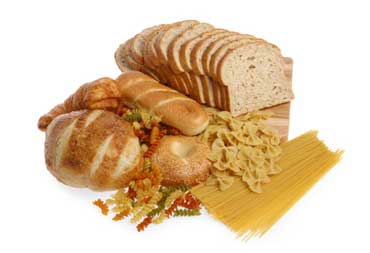
Which biomolecule is found in pasta and bread?
a)
Lipid
b)
Protein
c)
Nucleic Acid
d)
Carbohydrate
3.
Which biomolecule is a main source of quick energy?
a)
Nucleic Acid
b)
Protein
c)
Lipid
d)
Carbohydrate
4.
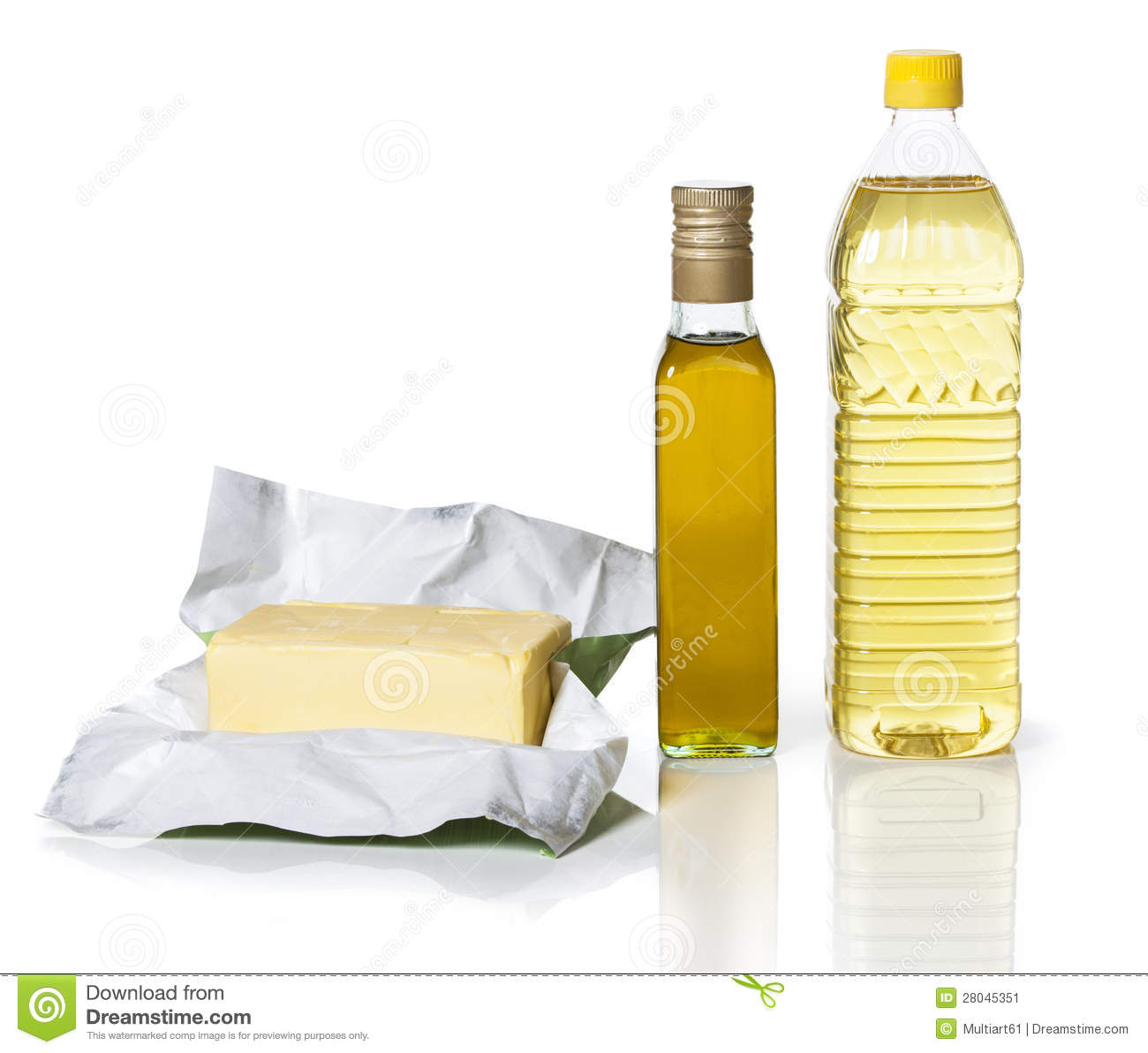
Which biomolecule is found in fats, oils, and waxes and is a source of long-term energy? 
a)
Proteins
b)
Nucleic Acid
c)
Lipids
d)
Carbohydrate
5.
What is the function of a nucleic acid?
a)
Stores genetic information
b)
Stores energy
c)
Quick source of energy
d)
Builds structures
6.
Which biomolecule is responsible for insulation and energy storage?
a)
Protein
b)
Nucleic Acid
c)
Lipid
d)
Carbohydrate
7.
Which of the following is the smallest unit of life that can carry out all life functions?
a)
the mitochondria
b)
the vacuoles
c)
the nucleus
d)
the cell
8.
Which structures are found in every living cell?
a)
cell membrane and cytoplasm
b)
chloroplasts and mitochondria
c)
a cell wall and nucleus
d)
chloroplasts and cell wall
9.
Which cell structure is found in plant and animals cells and controls what can come into or leave a cell?
a)
cell membrane
b)
cytoplasm
c)
nucleus
d)
vacuole
10.
What is the function of the cell nucleus found in both plant and animal cells?
a)
to produce energy
b)
to control cell activity
c)
to remove waste products
d)
to allow molecules to enter the cell
11.
Cell organelles that are responsible for digesting food, worn out organelles and other cellular wastes are called ___________________.
a)
Mitochondria
b)
Vacuoles
c)
Lysosomes
d)
Chlororplasts
12.
What is one basic function of the vacuoles?
a)
circulating oxygen
b)
producing food
c)
controlling cell processes
d)
storing water
13.
Chloroplasts in plant cells allow the plant to perform a function that animal cells cannot do.  What is the main function of the chloroplasts found in plant cells?
a)
to absorb light energy and manufacture food
b)
to remove waste materials by active transport
c)
to manufacture chemical energy from food
d)
to control the shape of the cell
14.
All cells need energy to function.  Which cell organelle is responsible for producing energy in the cell?
a)
chloroplasts
b)
mitochondria
c)
nucleus
d)
vacuoles
15.
What is the function of a cell wall?
a)
to protect and support the cell
b)
to perform different functions in each cell
c)
to prevent water from passing through it
d)
to prevent oxygen from entering the cell
16.
Cells with a nucleus and membrane-bound organelles are called ____________________.
a)
prokaryotes
b)
eukaryotes
c)
bacteria
d)
protists
17.
The basic unit of structure and function in a living things.
a)
chloroplast
b)
nucleus
c)
cell
d)
cell membrane
18.
The gradual change in species over time is...
a)
Evolution
b)
Nucleotide 
c)
Adaptation
d)
Natural Selection
19.
Darwin wrote that organisms with traits that are best suited to the environment will ________________
a)
increase in number
b)
become extinct
20.
What characteristic did Darwin observe about the finches on the Galapagos Islands?
a)
Their feathers 
b)
Genotypes 
c)
Their beaks
d)
Their body sizes
21.
Another word for adapt is ____________.
a)
change
b)
create
22.
Which term refers to the process by which individuals that are better suited to the environment survive and reproduce therefore passing down their genes to their offspring? 
a)
Evolution 
b)
Variation 
c)
Adaptation
d)
Natural Selection 
23.
When an organism completely dies out, it is called.....
a)
Adaption
b)
Extinction
c)
Fossilization
d)
Mutation
24.
Genetic differences between organisms of the same species
a)
Variation
b)
Adaptation
c)
Behavior
d)
Environment
25.
What is the advantage of having different shaped beaks?
a)
To look different from other species.
b)
To be able to eat the food readily available in the environment.
c)
To protect itself against predators.
d)
To protect itself against prey.
26.
The struggle for existence against other members of an organisms species is
a)
Competition
b)
Natural Selection
c)
gene flow
d)
genetic drift
27.
Remains of ancient organisms are called
a)
Extinctions
b)
Fossils
c)
Mutations
d)
Variations
28.
A group of similar organisms that can mate with each other and produce fertile offspring is called a species.  
a)
True  
b)
False
29.
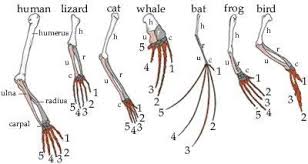
Some organisms that share a common ancestor have features that have different functions, but similar structures.  These are known as
a)
vestigial structures
b)
analogous structures
c)
homologous structures
d)
fossil structures
30.
Two organisms that are closely related would have
a)
very similar DNA sequence
b)
exactly the same DNA sequences
c)
no proteins in common
d)
completely different DNA sequence
31.
Genetic variation can arise from a random change in the DNA of a gene.  The change is called a(n)
a)
mutation
b)
gene flow
c)
gene pool
d)
allele
32.
Mutations are important because they bring about
a)
death of the organism in which they develop
b)
genetic variation needed for a population to evolve
c)
benefits for the individual, not for the population
d)
Hardey-Weinberg equilibrium within a population
33.
True or False: All living things are made of one or more cells.
a)
True
b)
False
34.
Fungi are a type of...
a)
decomposer
b)
producer
35.
What is the genus name here:
Canis lupus
a)
Canis
b)
lupus
36.
True or False: All cells have DNA.
a)
True
b)
False
37.
Choose the correct way to write the scientific name for humans:
a)
homo sapiens
b)
Homosapiens
c)
Homo sapiens
d)
Homo Sapiens
38.
Which kingdom do humans belong to?
a)
Plantae
b)
Fungi
c)
Animalia
d)
Protista
39.
The scientific name for an organism is made from the:
a)
class and family name
b)
genus and species name
c)
domain and kingdom name
d)
kingdom and phylum name
40.
The 8 levels of classification, most broad to most specific.
a)
Domain, Genus, Family, Order, Class, Phylum, Kingdom, Species
b)
Domain, Species, Kingdom, Genus, Phylum, Family, Class, Order
c)
Domain, Kingdom, Phylum, Class, Order, Family, Genus, Species
d)
Order, Kingdom, Species, Domain, Phylum, Family, Class, Genus
41.
Cladograms are constructed by grouping organisms together based on their____________ characteristics.
a)
shared
b)
different
c)
similar
d)
opposite
42.
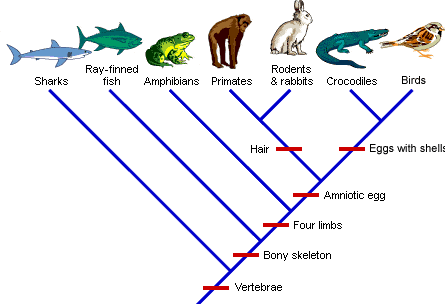
According to this cladogram, sharks are MOST closely related to which organism? 
a)
Amphibians
b)
Ray finned fish
c)
Crocodiles
d)
Birds
43.
What is the most specific level of classification?
a)
Family
b)
Domain
c)
Species
d)
Carolus Linnaeus
44.
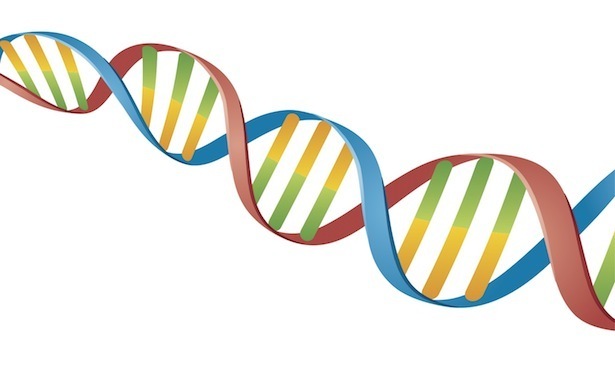
Which of the following best describes a DNA molecule?
a)
double helix
b)
contains ribose
c)
made of amino acids
d)
contains Uracil
45.
In a molecule of double-stranded DNA, the amount of Adenine present is always equal to the amount of
a)
cytosine
b)
guanine
c)
thymine
d)
uracil
46.
Which sequence of DNA bases would pair with this partial strand
ATG TGA CAG
a)
ATG TGA CAG
b)
TAC ACT GTC
c)
GTA AGT GAC
d)
CAT TCA CTG
47.
Which organelle is DNA usually found in?
a)
cell membrane
b)
vacuole
c)
chloroplast
d)
nucleus
48.
Why is DNA important?
a)
it is very small and very complicated
b)
it's in everything
c)
it serves as the blueprint for traits of all living things
d)
because we eat it every day for energy
49.
A process in which DNA has the unique ability to make an exact copy of itself.
a)
Replication
b)
Translation
c)
Transcription
50.
In what phase of the cell cycle does DNA replication take place?
a)
G1
b)
S
c)
G2
d)
M
51.
What will most likely be the result if all of the mitochondria are removed from a plant cell? 
a)
It will be unable to carry out respiration. 
b)
It will lose water through osmosis.  
c)
It will break down ribosomes in the cell
d)
It will be unable to photosynthesize.
52.
What process best explains how a nerve cell and a muscle cell can both develop from the same fertilized egg?
a)
differentiation
b)
natural selection
c)
selective breeding
d)
genetic engineering
53.
During strenuous exercise, body temperature increases. The body responds to the increase in temperature by sweating, which helps to reduce the body temperature. Which is demonstrated in this situation?
a)
excretion
b)
metabolism
c)
homeostasis 
d)
synthesis
54.
Before mitosis begins, which happens before the nucleus starts dividing?
a)
The cytoplasm separates.
b)
The DNA replicates. 
c)
The sister chromatids separate. 
d)
The homologous chromosomes cross over. 
55.
The passing of traits from parent to offspring 
a)
Heredity 
b)
Genetics 
c)
Hybrid 
d)
Probability 
56.
 which is heterozygous ?  
a)
Tt
b)
TT
57.
What is the function of autotrophs in the carbon cycle?
a)
to use oxygen to produce glucose 
b)
to take in excess water
c)
to use carbon dioxide to produce glucose
d)
to feed on herbivores 
58.
Two different populations of birds live in the same area and eat the same types of food. Which most likely describes the relationship between these two populations of birds? 
a)
competition
b)
mutualism
c)
parasitism
d)
predator-prey
59.
What will most likely happen if the human population continues to grow at current rates?
a)
There will be fewer natural resources available for future generations.
b)
There will be an increase in nitrogen levels in the atmosphere. 
c)
There will be a decrease in water pollution. 
d)
There will be an increase in the number of strong hurricanes. 
60.
A sea turtle has washed up on a remote section of a beach. This is known as a “stranding.” Stranding occurs when a dead, sick or injured sea turtle washes up on the shoreline. Which statement best explains why “stranding” should be reported immediately to local authorities? 
a)
The information can be very useful to biologists and managers who are trying to protect the species.
b)
The information can be very useful to protect sea turtles from predators. 
c)
The information can be very useful to local fishermen who try to catch fish that sea turtles eat. 
d)
The information can be very useful to tourists who may want to keep sea turtles as pets.
61.
Which statement best describes the relationship that exists among proteins, DNA, and cells?
a)
Proteins combine to produce cells, which produce DNA
b)
Proteins are made up of DNA, which determines the cells that are produced. 
c)
DNA is made up of proteins, which tell a cell how to function. 
d)
Cells contain DNA, which controls the production of proteins.
62.
Why is meiosis important for sexual reproduction?
a)
It allows the zygote formed from fertilization to have triple the chromosome number of the organism. 
b)
It allows gametes to have twice the original number of chromosomes of the organism.
c)
It allows gametes to have half the original number of chromosomes of the organism. 
d)
It allows the zygote formed from fertilization to have half the original number of chromosomes of the organism. 
63.
Which process produces the most variation within a species? 
a)
Asexual reproduction
b)
Sexual reproduction
c)
mitosis
d)
cloning
64.
Which technique would most likely be used by forensic scientists?
a)
gene cloning
b)
gene therapy
c)
DNA fingerprinting
d)
karyotyping
65.
Which is one reason scientists produce transgenic organisms?
a)
to create new species of organisms 
b)
to control microorganisms in the soil
c)
to prevent habitats from being destroyed
d)
to treat certain types of diseases
66.
The use of pesticides on crops has been a common farming practice for decades. What has been the greatest effect of natural selection through the use of pesticides on certain insect populations? 
a)
Natural selection has been altered because the insects and their predators are killed. 
b)
The rate of selection is increased because the pesticides do not kill the insects that are naturally resistant to it. 
c)
The rate of selection has decreased because the pesticides kill only young insects. 
d)
The pesticides have altered natural selection by causing the insect DNA to spontaneously mutate.
67.
What type of organic molecules are enzymes? 
a)
carbohydrates
b)
lipids 
c)
nucleic acids
d)
proteins
68.
A freshwater plant is placed in a container of saltwater. What will most likely happen to the cells of the plant?
a)
They will swell because water will move into them.
b)
They will swell because salt will move into them
c)
They will shrink because water will move out of them.
d)
They will shrink because salt will move out of them.
69.
How does the amount of energy resulting from fermentation compare with that of aerobic respiration? 
a)
Aerobic respiration results in less energy.
b)
Aerobic respiration results in more energy.
c)
Each process results in equal amounts of energy.
d)
Each process results in variable amounts of energy.
70.
This diagram shows a plant cell. Which structure is found in a plant cell but is absent in an animal cell? 
a)
1
b)
2
c)
3
d)
4
71.
Which best explains why muscle cells are different from blood cells? 
a)
A mutation occurs during the development of muscle cells but not in blood cells.
b)
Different genes are activated in muscle cells than in blood cells. 
c)
Muscles cells experience different environmental influences than blood cells. 
d)
Muscle cells are produced by the brain, but blood cells are produced by the heart.
72.
During which phase of the cell cycle is the cell growing and preparing for cellular division? 
a)
cytokinesis
b)
anaphase
c)
prophase
d)
interphase
73.
The males of a bird species do a “dance” and “sing a song” each spring. What is the main purpose of these behaviors? 
a)
to scare off young birds
b)
to imprint young birds
c)
to clean their feathers
d)
to attract female birds
74.
The yucca plant releases a strong scent at night when the yucca moth is active. The yucca moth, attracted by the scent, gathers pollen from the yucca flower. The yucca moth then deposits her eggs and the pollen on another plant. This ensures that the plant will be cross-pollinated and that the yucca moth larvae have a steady food supply. Which relationship does this BEST illustrate?
a)
commensalism
b)
mutualism
c)
parasitism
d)
predation
75.

All children born with a certain lethal genetic disease die within a few years of birth. Nonetheless, the disease continues to occur within human populations. What is the most likely explanation of this fact?

a)

The mutation for the disease continually recurs in human populations.

b)

People with the allele for the disease mate randomly with people with and without the allele.

c)

The disease is caused by a dominant allele; therefore, if one chromosome has the allele, the person will have the disease.

d)

Parents can be carriers of the disease without being affected by the disease; therefore, the allele stays in the population

76.

In a forest, the color of tree bark gradually darkens over many years due to industrial pollution. A population of light-colored insects hides from predators during the day on the tree trunks. Which effect would the change in tree color most likely have on a dark-colored gene in the insect population?

a)

Mutations wills be more likely to produce the dark-colored gene

b)

The dark-colored gene will shift from recessive to dominant

c)

The frequency of the dark-colored gene will rise in the population

d)

Offspring will be more likely to inherit the dark-colored gene if one of their parents has the gene

77.

Which observation could best be used to indicate an evolutionary relationship between two species?

a)

They have similar base sequences.

b)

They have similar fur color.

c)

They inhabit the same geographic regions.

d)

They occupy the same niche.

78.

Which fossil provides the most compelling evidence of the theory of evolution?

a)

A fossil of a shelled marine organism unlike any alive today

b)

A fossil of an ancient tree with flower and seed parts very similar to those in trees today

c)

A fossil of a dinosaur nest and an adult showing evidence of parental care

d)

A fossil of an animal with some characteristics of reptiles and some characteristics of birds

79.

Ancestral birds and mammals share a common ancestor that was terrestrial, however, mammals and fish do not. Today, penguins (which are birds) and seals (which are mammals) have forelimbs adapted for swimming. Fish have fins adapted for swimming. What term best describes the relationship of the bones in the forelimbs of penguins and seals, and what term best describes the flippers and fins of penguins and fish.

a)

Homologous; homologous

b)

Analogous; homologous

c)

Homologous; analogous

d)

Analogous; analogous

80.

For centuries, living things were classified into two kingdoms, Plantae and Animalia. In 1876, Ernst Haeckel proposed a "tree of life" model that added a new kingdom, Protista, resting on a base of organisms he called Moneres. Around 1980, scientists proposed a six-kingdom system that discarded the tree of life model but kept Protista as a kingdom.


How do protists differ from plants and animals?

a)

protists usually lack DNA

b)

protists produce their own food

c)

protists are usually unicellular

d)

protists have many nuclei in each cell

81.

According to the chart below, which two organisms are most similar and closely related?

a)

Organisms 1 and 2

b)

Organisms 2 and 3

c)

Organisms 1 and 3

d)

Organisms 3 and 4

82.

Convergent evolution is the development of body structures that have similar functions but have evolved independently. Which pair of structures best illustrates convergent evolution?

a)

the paw of a grizzly bear and the paw of a polar bear

b)

the tail of a great white shark and the tail of a blue whale

c)

the neck bones of a giraffe and the neck bones of a cat

d)

the tail of a crocodile and the tail of a horse

83.

Use the table to answer the question.

a)

Sharks and seals both have live births and probably have a common ancestor different from seals.

b)

All three groups have such unique properties that it is unlikely they have a common ancestor.

c)

Sharks and dolphins have similar features and probably have a common ancestor different from seals.

d)

Seals and dolphins have similar bones and probably have a common ancestor different from sharks.
84.
What is another name for natural selection?
a)
survival of the smartest
b)
survival of the fastest
c)
survival of the biggest
d)
survival of the fittest
85.
What is this an example of?
a)
vestigial structures
b)
embryology
c)
homologous structures
d)
fossil record
86.

This is a structure that was inherited but has lost most of its original function

a)

homologous

b)

analogous

c)

vestigial

d)

homozygous