wayground logo

Free Printable Worksheets

Font size

S
M
L
XL
Worksheets

A Level computer science re-cap

Total questions: 145

Worksheet time: 2hrs 53mins

Name
Class
Date
1.
Assembly language is a
a)
High Level Language
b)
Low Level Language 
c)
Machine Language
d)
Programming Language
2.

What are the two parts of most instructions

a)

Numeric and Nmunics

b)

Up and Down

c)

Start and End

d)

Opcode and Operands

3.
Registers are___
a)
Secondary Storage
b)
High speed storage areas in the CPU
c)
External Storage 
d)
Storage that are slower than cache
4.
What is the purpose of Memory Address Register
a)
Holds the memory location of data that needs to be accessed
b)
Holds data that is being transferred to or from memory
c)
Where intermediate arithmetic and logic results are stored
d)
Contains the address of the next instruction to be executed
5.
What is the purpose of Memory Address Register
a)
Holds the memory location of data that needs to be accessed
b)
Holds data that is being transferred to or from memory
c)
Where intermediate arithmetic and logic results are stored
d)
Contains the address of the next instruction to be executed
6.
What is the purpose of Memory Data Register
a)
Holds the memory location of data that needs to be accessed
b)
Holds data that is being transferred to or from memory
c)
Where intermediate arithmetic and logic results are stored
d)
Contains the address of the next instruction to be executed
7.
What is the purpose of Instruction Register
a)
Holds the memory location of data that needs to be accessed
b)
Holds data that is being transferred to or from memory
c)
Where intermediate arithmetic and logic results are stored
d)
Contains the current instruction during processing
8.
What is the purpose of Accumulator
a)
Where intermediate arithmetic and logic results are stored
b)
Holds data that is being transferred to or from memory
c)
Where intermediate arithmetic and logic results are stored
d)
Contains the current instruction during processing
9.
What is the purpose of Program Counter
a)
Where intermediate arithmetic and logic results are stored
b)
Holds data that is being transferred to or from memory
c)
Contains the address of the next instruction to be executed
d)
Contains the current instruction during processing
10.
What is the purpose of the CPU?
a)
To process all the data and instructions.
b)
To turn the computer on.
c)
To create PowerPoint presentations.
d)
To provide power to the computer.
11.
Carries out the calculations and logical decisions.  The results of its calculations are stored in the accumulator.
a)
CPU
b)
Control Unit
c)
Arithmetic and Logic Unit
d)
Memory Address Register
12.

CPU clock speed is measured in

a)

Megabytes

b)

Joules

c)

bits

d)

Gigahertz

13.
A processor with 6 cores is called a
a)
quad core processor
b)
hex core processor
c)
6 giga-core processor
d)
super core processor
14.
Clock speed is:
a)
Number of times the computer is used
b)
Number of instructions a computer can handle per second
c)
Time on a computer
15.

What happens if you increase the number of cores

a)

CPU can process instructions quicker

b)

CPU can process more instructions at the same time

c)

CPU will explode

16.

Which of these describes the number of instructions a CPU can process per second?

a)

Clock Speed

b)

Control Unit

c)

Memory

17.
A technique used by the CPU to line up code instructions so that several pipelines can run faster.
a)
Overlock
b)
Streamlining
c)
Pipelining
d)
Storage
18.
Which of these is not a step in the FDE cycle?
a)
Instructions are fetched from main memory
b)
Instructions are decoded in the control unit
c)
The decoded instruction is executed
d)
The ALU decodes the instructions
19.
What does MAR stand for?
a)
Main Address Register
b)
Memory Address Register
c)
Massive Address Register
d)
Minimal Age Readable
20.
The location of where data can be found in the computer memory is called the?
a)
Address
b)
Coordinates
c)
Register
d)
Cache
21.
The small high speed storage areas within the memory and processor are known as..?
a)
Registers
b)
Addresses
c)
Cache
d)
Buses
22.
Which of the following is a different computer architecture to Von Neumann's?
a)
Yale
b)
Harvard
c)
Stanford
d)
MIT
23.
The stages required for processing are known as the....
a)
Fetch-Execute-decode
b)
Process-decode-fetch
c)
Fetch-Decode-Execute
d)
Process
24.
What happens during the fetch stage?
a)
The CPU fetches data and instructions from main memory and stores them in its own registers.
b)
The CPU fetches instructions from the hard drive.
c)
The CPU fetches instructions from the ROM
d)
The CPU fetches data and instructions from the registers
25.
What happens at the decode step of the fetch-decode-execute cycle?
a)
The CPU works out what the instruction that it has fetched actually means.
b)
This is where the instruction is processed.
c)
This is where data is fetched from the main memory.
d)
It is where the CPU transfers instructions from the memory.
26.
What is the function of the control unit?
a)
Has overall control of the CPU.  It's in charge of the F-D-E cycle
b)
It does all of the calculations
c)
It is very fast memory in the CPU
d)
The CPU runs programs stored in memory
27.
What is cache memory?
a)
It is used to permanently store data and programs
b)
It is used to store numbers
c)
It is used between the RAM and CPU to improve performance by holding data that has just been or is about to be processed.
d)
It is used to store letters  
28.

What do the buses in a CPU do?

a)

Move people around

b)

Store memory

c)

Execute instructions

d)

Carry information around the system

29.
In modern day processors, the Von Neumann architecture is more widely used because...
a)
It makes more efficient use of the RAM as both data and instructions can be stored together.
b)
It is more expensive and makes more efficient use of the HDD.
30.

Most modern processors will make use of the Harvard architecture in their ..... dividing the .... memory into separate parts.

a)

RAM

b)

ROM

c)

Cache

d)

HDD

31.
Von Neumann advantage...
a)
Only one data bus so less complex for the control unit to manage
b)
The separation of data and instructions and two buses means that processes can be carried out in parallel.
32.
A technique used by the CPU to line up code instructions so that several pipelines can run faster.
a)
Overlock
b)
Streamlining
c)
Pipelining
d)
Storage
33.
What is overclocking?
a)
Running higher speed than the original design
b)
Running a lower speed than orginally designed
c)
running at 2.5GHz
d)
running at 1Hz
34.
What can happen to the CPU if there is overclocking? 
a)
Uses more energy, 
b)
CPU can
overheat
c)
It can shorted the lifespan
d)
All of the Above
35.
What is CISC? 
a)
Complex Instruction Set Computing 
b)
Complete Instruction Set Computing 
c)
Camel in someones car
d)
Common Instruction Set Computing
36.
What is RISC? 
a)
Risk Instruction Set Computing 
b)
Reduced Instruction Set Computing 
c)
Rhino in someones car
d)
Ready Instruction Set Computing
37.
In order to carry out lots of complex task a CISC has to break down the problem into a longer list of simple instructions.
a)
True
b)
False
38.
Which processors can process a limited amount of simple instructions?
a)
CISC
b)
RISC
39.
What is E-R model used for?
a)
To extract content  from the database
b)
To design and visualize database
c)
To create a graphical user interface
40.
What is the correct way to begin your SQL query if you want to displays data that is stored in a specific table?
a)
COLLECT
b)
COMBINE
c)
SELECT
d)
CHOOSE
41.
What is the expected output from following SQL Query:
SELECT title
FROM videogames
WHERE title LIKE  '%2'
a)
It will only show video games which contains the character 2 somewhere in the title
b)
It will only show  videogames which begins with the character 2 in the title
c)
It will only show videogames which ends with the character 2 in the title
42.
What is a relational database?
a)
A relational database organizes data into tables, and links them together, based on key-fields. These relationships enable you to retrieve and combine data from one or more tables with a single query
b)
A relational database arranges data into a tree structure, which is similar to folders and files on a computer. 
43.
Which SQL reserved keyword do you use to combine data from two or more tables, based on a common field between them?
a)
using SELECT
b)
using JOIN
c)
using WHERE
d)
using GET
44.
What is the expected output from following SQL Query:
SELECT title
FROM videogames
WHERE title LIKE  '4%'
a)
It will only show video games which contains the character 4 somewhere in the title
b)
It will only show video games which begins with character 4 in the title
c)
It will only show video games which ends on the character 4  in the title
45.
How do you communicate with your database?
a)
By using HTML
b)
By using JavaScript
c)
By using Structured Query Language (SQL)
d)
By using PHP
46.
What is SQL ?
a)
It is a programming lanuage
b)
It is a declarative language
c)
It is a markup language
47.
What is a record defined as?
a)
A collection of keys in a database
b)
A collection of Databases
c)
A collection of fields in a predefined format
48.
In a Relational Database a Foreign Key is:
a)
A Column (or combination of columns) designated to unqiuely ideentify all table records
b)
One or more fields which act as pointers to the records of a different table in the database.
c)
A descriptive field
49.
What does a Primary Key do?
a)
Links tables together
b)
Makes rows more important
c)
Uniquely identifies the record/entity
d)
Nothing
50.
What does Normalisation allow a database designer to do?
a)
Design their database efficiently, removing the chance of redundancy and inaccuracies. 
b)
Remove additional records from the tables. 
c)
Add as much data as they like. 
d)
Draw an ERD. 
51.
To be in 1NF: 
a)
Each field contains the smallest meaningful value
b)
There are multiple values in the single field
c)
There are no duplicate records
d)
A primary key is assigned
52.
To be in 2NF: 
a)
Each non-key field relates to the primary key
b)
There are multiple entries in the same field
c)
There are no foreign keys
d)
All numbers are in decimal form
53.
To be in 3NF:
a)
Records do not depend on anything other than the table's PK
b)
The PK is not added
c)
The FKs are limited to one only
d)
The tables all relate to one another
54.
Tables in 2NF but not 3NF contain...
a)
Insert, update and delete anomalies
b)
No extra FKs
c)
No redundancy
d)
Access to more data 
55.
Advantage of 3NF?
a)
It eliminates redundant data which in turn saves space and reduces manipulation anomalies. 
b)
It gives the data status. 
c)
It allows the tables to be queried in SQL. 
d)
It prevents any new updates. 
56.
Which one of these do you want to avoid in good database design?
a)
Redundancy!
b)
Giant squid!
c)
Third normal form!
d)
Data!
57.
Advantage of 3NF?
a)
It eliminates redundant data which in turn saves space and reduces manipulation anomalies. 
b)
It gives the data status. 
c)
It allows the tables to be queried in SQL. 
d)
It prevents any new updates. 
58.
Convert 128 to binary
a)
10000000
b)
01111110
c)
10000001
d)
11001100
59.
Convert 65 to binary
a)
01100001
b)
00100001
c)
01000001
d)
00100101
60.
Convert 254 to binary
a)
11110000
b)
11111100
c)
11111111
d)
11111110
61.
Convert 37 to binary
a)
00100101
b)
00100011
c)
00100111
d)
01000101
62.
Convert 00010001 to decimal
a)
17
b)
27
c)
37
d)
47
63.
Convert 11001100 to decimal
a)
224
b)
134
c)
104
d)
204
64.
Convert 11111111 to decimal
a)
255
b)
245
c)
235
d)
225
65.
What is -127 using two's complement representation?
a)
10000000
b)
01111111
c)
10000001
d)
01111110
66.
What is 29 in two's complement?
a)
10101101
b)
10011101
c)
00011101
d)
00010111
67.
What happens if I add 10 to 255 using 8 bit binary?
a)
Overflow error (need 9 bits for answer)
b)
Overflown error (need 9 bits for answer)
c)
Error (need 9 bits for answer)
d)
Flow-over (need 9 bits for answer)
68.

Convert the number -65 to binary using two's complement:

a)

01000001

b)

01000000

c)

10111111

d)

11000111

69.
Why was the Data Protection Act introduced in 1998?
a)
This law was introduced to make hacking illegal so that offenders could get prosecuted.
b)
This law was introduced to protect the rights of people who create original pieces of work.
c)
This law was introduced to control how personal information can be used and your rights to ask for information about yourself.
d)
This law means that public authorities have to publish certain information about their activities.  It also enables for the public to request information from public authorities.
70.

How many bits in a nibble?

a)

2

b)

4

c)

8

d)

1

71.

How many bits are there in a byte?

a)

8

b)

10

c)

2

d)

9

72.

State the decimal representation for the hexadecimal number C

a)

12

b)

13

c)

14

d)

15

73.
Convert the binary number 10101010 to Hex
a)
AA
b)
BB
c)
CC
d)
DD
74.
Which of these is the smallest?
a)
21 Nibbles
b)
40 bits
c)
8 bytes
d)
1 Kilobyte
75.
How many bits would you need to store this number: 1010101
a)
7
b)
14
c)
1
d)
2
76.
What is 5B in denary?
a)
91
b)
90
c)
181
d)
182
77.

1111 - 101

a)

1010

b)

1001

c)

10111

d)

1110

78.

11011 - 1111

a)

1100

b)

11000

c)

1011

d)

1110

79.

11011 - 1111

a)

1100

b)

11000

c)

1011

d)

1110

80.

11110000 - 01010111

a)

10011011

b)

11110000

c)

1111000

d)

10011001

81.

Method used to store integers is classified as

a)

sign and magnitude method

b)

One's complement

c)

Two's complement

d)

Three's complement

82.

Convert -199 from decimal to binary using two's complement notation.

a)

101111000

b)

110111010

c)

100111001

d)

100111000

83.
1111 1110
a)
EF
b)
FE
c)
DE
d)
ED
84.
1010 0011 
a)
63
b)
93
c)
B3
d)
A3
85.
A9
a)
1010 1011
b)
1010 1001
c)
1001 1001
d)
1110 0101
86.
F6
a)
1111 0110
b)
1111 1010
c)
1111 0101
d)
1111 0011
87.

What is 6.625 in fixed point binary (4 bits for the whole number / 4 bits for fractional part)?

a)

01101010

b)

10001010

c)

01101100

d)

10001100

88.

What is 0.125 in fixed point binary (4 bits for the whole number / 4 bits for fractional part)?

a)

10001000

b)

00000010

c)

00001000

d)

00011000

89.

Convert 11011.1001 to denary.

a)

27.8125

b)

27.5625

c)

31.5625

d)

31.34375

90.

Which is NOT a disadvantage of fixed point binary numbers?

a)

cannot represent the range of numbers

b)

cannot represent the accuracy of numbers

c)

easier to process

91.

In floating point binary, it holds the detail of the number.

a)

Mantissa

b)

Exponent

92.

In floating point binary, it holds the multiplier.

a)

Mantissa

b)

Exponent

93.

010110100011 (8 bit signed mantissa / 4 bit signed exponent) what is the decimal number?

a)

5.625

b)

11.5

c)

-5.625

d)

-11.5

94.

100101000011 (8 bit signed mantissa / 4 bit signed exponent) what is the decimal number?

a)

9.25

b)

-9.25

c)

-6.75

d)

6.75

95.

011000001110 (8 bit signed mantissa / 4 bit signed exponent) what is the decimal number?

a)

0.1875

b)

-0.1875

c)

96

d)

-96

96.

Why do we carry out normalisation on floating point binary numbers?

a)

To convert the number into a negative number

b)

To round a decimal number down

c)

To provide the maximum level of precision

d)

To round a decimal number up

97.

What is the two's complement of 01100010 ?

a)

10011101

b)

11011101

c)

10011110

d)

10011111

98.

In normalised floating point form, a positive number always has what beginning?

a)

01

b)

10

99.

In normalised floating point form, a negative number always has what beginning?

a)

01

b)

10

100.

What is the normalised form of 0.0000111 0111

a)

1.0110000 0011

b)

1.0110000 0111

c)

0.1110000 0111

d)

0.1110000 0011

101.

What is the normalised form of 1.1100011 0011 ?

a)

1.0001100 0001

b)

1.0001100 0011

c)

0.1001100 0001

d)

0.1001100 0011

102.

Convert 88 to normalised floating point binary.

a)

0.1011000 0101

b)

1.0011000 0111

c)

0.1011000 0111

d)

0.1011000 0110

103.

Add 0.1100000 0001 and 0.1111100 0011 and normalise the result.

a)

1001.0100 0100

b)

0.1001010 0100

c)

1.0010100 0100

d)

0.1010100 0111

104.

Subtract 0.1110000 0011 from 0.1101000 0100 and normalise the result.

a)

0.1100000 0011

b)

1.0100000 0011

c)

0.1100000 0111

d)

1.0100000 0111

105.

Subtract 0.1011000 0011 from 0.1100100 0010 and normalise the result.

a)

1.0110100 0010

b)

0.1110100 0010

c)

0.1101000 0010

d)

1.0110100 1000

106.
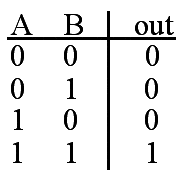
What gate is this table for?
a)
AND
b)
XOR
c)
OR 
d)
NOT
107.
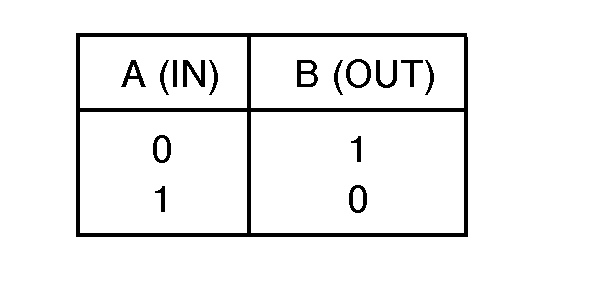
What gate is this table for?
a)
AND
b)
OR
c)
NOT
d)
NOR
108.
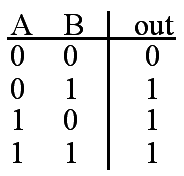
What gate is this truth table for?
a)
AND
b)
OR
c)
NOT
d)
THE 
109.
What is the missing value ? from this truth table for XOR
 
a)
1
b)
0
110.
What value is the output for this?
a)
True
b)
False
c)
Maybe
d)
Elephant
111.
What value is the output for this?
a)
True
b)
False
c)
Maybe
d)
Elephant
112.
What logic gate is this?
a)
AND
b)
OR
c)
NOT
d)
XOR
113.
What logic gate is this?
a)
AND
b)
OR
c)
NOT
d)
XOR
114.
What would a NOT mask do to
010101010
a)
shift it to the left
b)
shift it to the right
c)
flip the bits
d)
make the bits match
115.
What would an AND mask of
110101110
do to
010101010
a)
010101010
b)
11111111
c)
00000111
d)
01111110
116.
What would an OR mask of
11110111
do to
010101010
a)
010101010
b)
11110111
c)
00000111
d)
01111110
117.
What would an XOR mask of
11110111
do to
010101010
a)
010101010
b)
11110111
c)
00000111
d)
10100010
118.
What would an XOR mask of
00000000
do to
010101010
a)
01010101
b)
11110111
c)
00000111
d)
10100010
119.
What would an AND mask of
00000000
do to
010101010
a)
000000000
b)
11110111
c)
00000000
d)
0000000000
120.
What would an OR mask of
00000000
do to
010101010
a)
1000101
b)
01010101
c)
00000000
d)
11110101
121.

How many bits are used in ASCII?

a)

16

b)

1

c)

7

d)

8

122.

How many bytes are used in Unicode?

a)

8

b)

16

c)

1

d)

2

123.

The ASCII code is represented using 16 bits.

a)

TRUE

b)

FALSE

124.

The ASCII code is capable of representing non-European languages.

a)

TRUE

b)

FALSE

125.

Upper and Lower case letters have a different ASCII code.

a)

TRUE

b)

FALSE

126.

What is the maximum number of positive integer values that can be represented in 8-bits?

a)

16

b)

256

c)

65536

d)

128

127.

What is the maximum number of positive integer values that can be represented in 7-bits?

a)

16

b)

256

c)

65536

d)

128

128.

A character set is...

a)

What language can be used in a computer system

b)

The fonts that a computer has installed

c)

The possible characters that can be represented by a computer system

129.

ASCII can represent more characters than Unicode

a)

TRUE

b)

FALSE

130.

Which of the following is the correct Boolean expression for this circuit?

a)

(A AND B) OR (X AND Y) = Z

b)

NOT (A AND B) = Z

c)

(NOT X) OR (NOT Y) = Z

d)

(NOT A) AND (NOT B) = Z

131.

Which of the truth tables shown below, accurately represents this logic circuit?

a)
b)
c)
d)
132.

How many of the following Boolean expressions correctly represent the diagram shown? (Choose as many as are appropriate)

a)

X = (A AND C) OR B

b)

X = (A OR B) AND NOT C

c)

X = (A AND B) OR C

d)

X = (NOT C) AND (A OR B)

133.

Which of the following is the correct truth table for the Boolean expression shown here:

a)
b)
c)
d)
134.

Select all equivalent expressions

a)

Q is A or B

b)

Q = A + B

c)

Q is A and B

d)

Q = A NOT B

135.

Using the Karnaugh Map, find the logical expression.

a)

NOT A NOT B

b)

A NOT B

c)

A NOT B

d)

AB

136.

Using the Karnaugh Map, find the logical expression.

a)

NOT A NOT B

b)

A NOT B

c)

A NOT B

d)

AB

137.

Using the Karnaugh Map, find the logical expression.

a)

A NOT B NOT C OR ABC

b)

A NOT B NOT C OR ABC

c)

NOT A NOT B NOT C OT NOT A B C

d)

ABC OR NOT A NOT B NOT C

138.
Using the Karnaugh Map, find the logical expression.
a)
A'B'C+AB'C
b)
AB'C'+ABC
c)
ABC+ABC'
d)
ABC+A'B'C'
139.

What is the simplified expression?

a)

A NOT B OR AB

b)

A

c)

B

d)

1

140.
What is the simplified expression?
a)
A
b)
B
c)
C
d)
0
141.
What is the simplified expression?
a)
AB
b)
A'B+AB
c)
B
d)
AC+AB
142.
What is the simplified expression?
a)
B'
b)
AB
c)
A'B'+AB'
d)
AC+AB
143.

What is the simplified expression?

a)

B' + D

b)

B'D

c)

B + D'

d)

AB + CD

144.

What is the Logic Expression (equation) for this truth table?

a)

(A'+B)(A+B')(A+B)

b)

A'B + AB' + AB

c)

(A'B)(AB')(AB)

d)

A + B

145.
This  flip-flop transitions on
a)
the falling clock edge.
b)
the rising clock edge.
c)
high clock level.
d)
low clock level.