wayground logo

Free Printable Worksheets

Font size

S
M
L
XL
Worksheets

Electricity and Magnetism

Total questions: 65

Worksheet time: 16hrs 15mins

Name
Class
Date
1.
When two magnets repel each other which poles are facing each other?
a)
North and South
b)
South and North
c)
North and North
d)
Positive and Negative
2.
When is an object negatively charged?
a)
When it gains electrons
b)
When it gains protons
c)
When it loses electrons
d)
When it has more neutrons
3.
What happens to the magnetic force as an object gets further away from the magnetic field?
a)
The force increases
b)
The force decreases
c)
The force stays the same
d)
There was no force to begin with
4.
What is electric discharge?
a)
The sudden and brief flow of protons
b)
The sudden and brief flow of neutrons
c)
Atoms crashing
d)
The sudden and brief flow of electrons
5.
What is a conductor?
a)
A material that stops electric current from flowing
b)
A material that allows electric current to flow easily
6.
Which is an example of a conductor?
a)
Glass
b)
Plastic
c)
Copper
d)
Wood
7.
What is an insulator?
a)
A material that DOES NOT allow electric current to flow
b)
A material that DOES allow electric current to flow
8.
What is static electricity?
a)
The buildup of neutrons
b)
Electricity flowing through a current
c)
Particles staying still
d)
The buildup of electric charges on an object
9.
What is current electricity?
a)
Current electricity involves a continuous flow of neutrons
b)
Current electricity involves a continuous flow of protons
c)
Current electricity is a single transfer of electrons
d)
Current electricity is a steady flow of electrons
10.
What is magnetism?
a)
An invisible force produced by certain metals
b)
A visible force produced by certain metals
c)
An invisible force produced by all metals
d)
A visible force produced by mixtures of metals
11.
What particles of an atom are attracted to each other? 
a)
Protons and Electrons
b)
Electrons and Electrons
c)
Protons and Protons
d)
Electrons and Neutrons
12.
How are the domains of a magnet organized?
a)
The domains are very weak
b)
The domains are all mixed up
c)
The domains all point in the same direction
d)
There are no domains
13.
How is electricity a force?
a)
It is not a force
b)
Electrons are pushed through a circuit
c)
Protons are pushed through a circuit
d)
Neutrons are pushed through a circuit
14.
How are the domains of an ordinary piece of metal organized?
a)
The domains are very strong
b)
The domains are all mixed up
c)
The domains all point in the same direction
d)
There is no such thing as domains
15.
How do you increase the strength of an electromagnet?
a)
Decrease the number of batteries and increase the number of coils
b)
Increase the electric current and decrease the batteries
c)
You cannot strengthen an electromagnet
d)
Increase the electric current and increase the number of coils
16.
How are electromagnets different from regular magnets?
a)
Their strength can be changed
b)
They can be turned on and off
c)
Their polarity can be reversed
d)
All choices are correct
17.
What will happen to the other bulbs in the circuit if one bulb goes out?
a)
The other bulbs will go out
b)
The other bulbs will get brighter
c)
The other bulbs will get dimmer
d)
They will flash on and off
18.
What will happen when a light bulb is removed from the circuit below?
a)
The remaining bulbs will go out
b)
The remaining bulbs will brighten
c)
The remaining bulbs will dim
d)
The brightness of the remaining bulbs will not change
19.
What size resistor would produce a 3 Amp current flow with a 12 Volt battery
a)
1 Ohm
b)
3 Ohms
c)
4 Ohms
d)
12 Ohms
20.
What is current measured in?
a)
Ω (Ohms)
b)
V (Volts)
c)
A (Amps)
d)
W (Watts)
21.
What is resistance measured in?
a)
Ω (Ohms)
b)
V (Volts)
c)
A (Amps)
d)
W (Watts)
22.
What is the Voltage of a circuit that has a resistance of 5 Ω and a current of 2 A?
a)
25 V
b)
10 V
c)
2.5 V
d)
0.4 V
23.

Joan rubs two balloons with a woolen sock and suspends them from a fixed point with string. The balloons push away from each other. Which of the following is most likely true?

a)

One balloon has a positive charge, and one balloon has a negative charge.

b)

One balloon has a neutral charge, and one balloon has a negative charge.

c)

Both balloons have a negative charge.

d)

Both balloons have a neutral charge.

24.

Electric Field strength depends on what

a)

charge

b)

distance

c)

charge and distance

d)

electric force

25.
Where is Earth's magnetic field strongest?
a)
Along the outside lines
b)
Along the inside lines on either side
c)
Where the lines are close together at the poles
d)
In the space outside of the lines
26.
The strongest part of a magnet is...
a)
the bars.
b)
the force field.
c)
the poles. 
d)
the middle.
27.
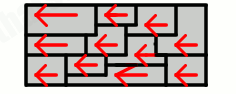
You know this substance is magnetized because
a)
all the domains have right angles
b)
the arrows are drawn in red
c)
the domains are aligned
d)
the domains are random
28.
This large crane magnet functions only when the electrical current is ON.  The crane magnet is an example of what type of magnet?
a)
NIB Magnet
b)
Ceramic Magnet
c)
Electromagnet
d)
funnel magnet
29.
What size resistor would produce a 3 Amp current flow with a 12 Volt battery
a)
1 Ohm
b)
3 Ohms
c)
4 Ohms
d)
12 Ohms
30.
What is Resistance?
a)
The flow of electrons
b)
Electric potential difference
c)
A battery
d)
The ability to reduce the flow of electrons
31.
Electricity that flows in a closed path is called a
a)
path
b)
current
c)
circuit
d)
light
32.
What is the Voltage of a circuit that has a resistance of 5 Ω and a current of 2 A?
a)
25 V
b)
10 V
c)
2.5 V
d)
0.4 V
33.
The mathematical relationship among Voltage, Current, and Resistance
a)
Faraday's Law
b)
Tesla's Law
c)
Edison's Law
d)
Ohm's Law
34.

Voltage divided by Resistance

(V / R)

a)

Current

b)

Power

c)

Ohms

d)

Watts

35.
If the Voltage is increased and the resistance stays the same, Current will
a)
Increase
b)
Decrease
c)
Stay the same
d)
X
36.

If you bring the north pole of a magnet near the south pole of another magnet will:

a)

repel one another

b)

do nothing

c)

attract one another

37.

If you cut a magnet exactly in half

a)

You end up with a north pole on one magnet and the south pole on another

b)

You end up with two magnets that each have a north and south pole

c)

It depends on which way the magnet is facing with respect to the Earth's magnetic field

d)

Neither of the new pieces will be magnetized

38.

Does the current flow in the image go from a

a)

positive to negative direction

b)

negative to positive direction

39.

What happens to electric current in a circuit when resistance increases?

a)

The current increases.

b)

The current decreases.

c)

The current remains the same.

40.

What is Ohm's law in equation form?

a)

current= resistance/voltage

b)

current =voltage x resistance

c)

current =voltage/resistance

41.

A circuit that has more than one path for the electric current to flow

a)

series circuit

b)

parallel circuit

c)

circuit breaker

42.

A circuit that has ONLY one path for the electric current to flow

a)

series circuit

b)

parallel circuit

c)

circuit breaker

43.

What happens when the path is broken in a parallel circuit?

a)

The current won't flow and none of the devices on that circuit will work.

b)

The electrons flow through another path.

c)

nothing

44.

What prevents a wire in a building from overheating?

a)

using a series circuit

b)

using a parallel circuit

c)

circuit breakers or fuses

45.

Fluids in your body are good

a)

insulators

b)

conductors

46.

A closed circuit is a complete circuit.

a)

True

b)

False

47.

What is a Circuit

a)

The pathway taken by an electric current

b)

The pathway taken by a positive current

48.

What is an Electric Current?

a)

The continuous flow of Negative charges

b)

The continuous flow of Positive charges

49.

An open circuit is...

a)

Incomplete

b)

Complete

50.
Like charges
a)
attract
b)
repel
51.
A built up electric charge is called
a)
current electricity
b)
static electricity
52.
In a _________  __________ the parts are connected so that electric current passes through each part, one after another, along a single pathway.
a)
parallel circuit
b)
series circuit
53.
A _________________ is an object that attracts iron and certain other metals.
a)
magnet
b)
nail
54.
A bar magnet is a ____________ magnet.
a)
permanent
b)
temporary
55.
An electromagnet is a ______________ magnet.
a)
permanent
b)
temporary
56.
What device makes a fan plugged into the wall spin?
a)
generator
b)
battery
c)
electromagnet
d)
electric motor
57.
What energy transformation takes place in a battery powered fan that is spinning?
a)
kinetic to chemical to electrical
b)
chemical to kinetic
c)
chemical to electrical to kinetic
d)
electrical to kinetic to chemical
58.

What device changes mechanical kinetic energy into electrical energy?

a)

electric motor

b)

insulator

c)

electromagnet

d)

generator

59.
What device changes electrical energy to mechanical energy?
a)
electromagnet
b)
electric motor
c)
conductor
d)
generator 
60.
What is the region of force around a magnet known as?
a)
magnetic field
b)
magnetic pole
c)
magnetic domain 
d)
lodestone
61.

The resistance of an insulator is

a)

absent

b)

moderate

c)

very low.

d)

high

62.

Whether or not charges will move in a material depends partly on how tightly _____ are held in the atoms of the material.

a)

electrons

b)

protons

c)

neutrons

d)

resistors

63.

A circuit breaker acts as a switch creating a(n) _____ circuit when current is too high.

a)

closed

b)

open

c)

series

d)

parallel

64.

Based on the electrostatic laws, _____ poles of a magnet repel, while _____ poles attract one another.

a)

Like, opposite

b)

North, south

c)

Opposite, like

d)

South, north

65.

The magnetic field of a magnet is strongest _____ the magnet.

a)

at the center of

b)

near the poles of

c)

far away from

d)

perpendicular to