Wayground logo

Free Printable Worksheets

Font size

S
M
L
XL
Worksheets

RC1 -- Bundle in a Day

Total questions: 53

Worksheet time: 40mins

Name
Class
Date
1.

Which two subatomic particles make up the nucleus of an atom? This also happens to be the atomic mass of an atom!

a)

Protons and Electrons

b)

Neutrons and Electrons

c)

Electrons and Protons

d)

Protons and Neutrons

2.

Where are the Electrons found in the structure of an atom?

a)

In the nucleus

b)

in the cloud surrounding the nucleus

3.
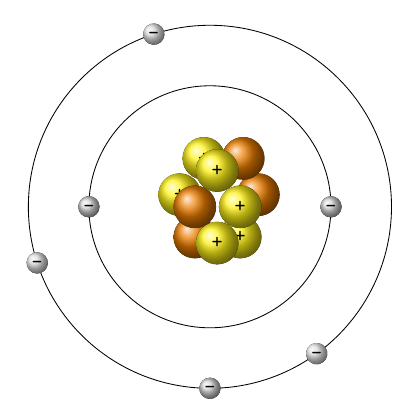
How many protons does this atom have?
a)
3
b)
6
c)
4
d)
2
4.
What are the 3 subatomic particles that make-up the atom?
a)
protons, neutrons, and isotopes
b)
neutrons, isotopes, and electrons
c)
positives, negatives, and electrons
d)
protons, neutrons, and electrons
5.

The atomic number (for our 8th grade purpose) of an atom is the number of

a)

protons in its electron cloud

b)

protons in its nucleus and electrons in the cloud

c)

neutrons in its nucleus

d)

electrons and neutrons in the nucleus

6.

An atom with atomic number 12 would have how many protons?

a)

6

b)

12

c)

24

d)

cannot be determined

7.

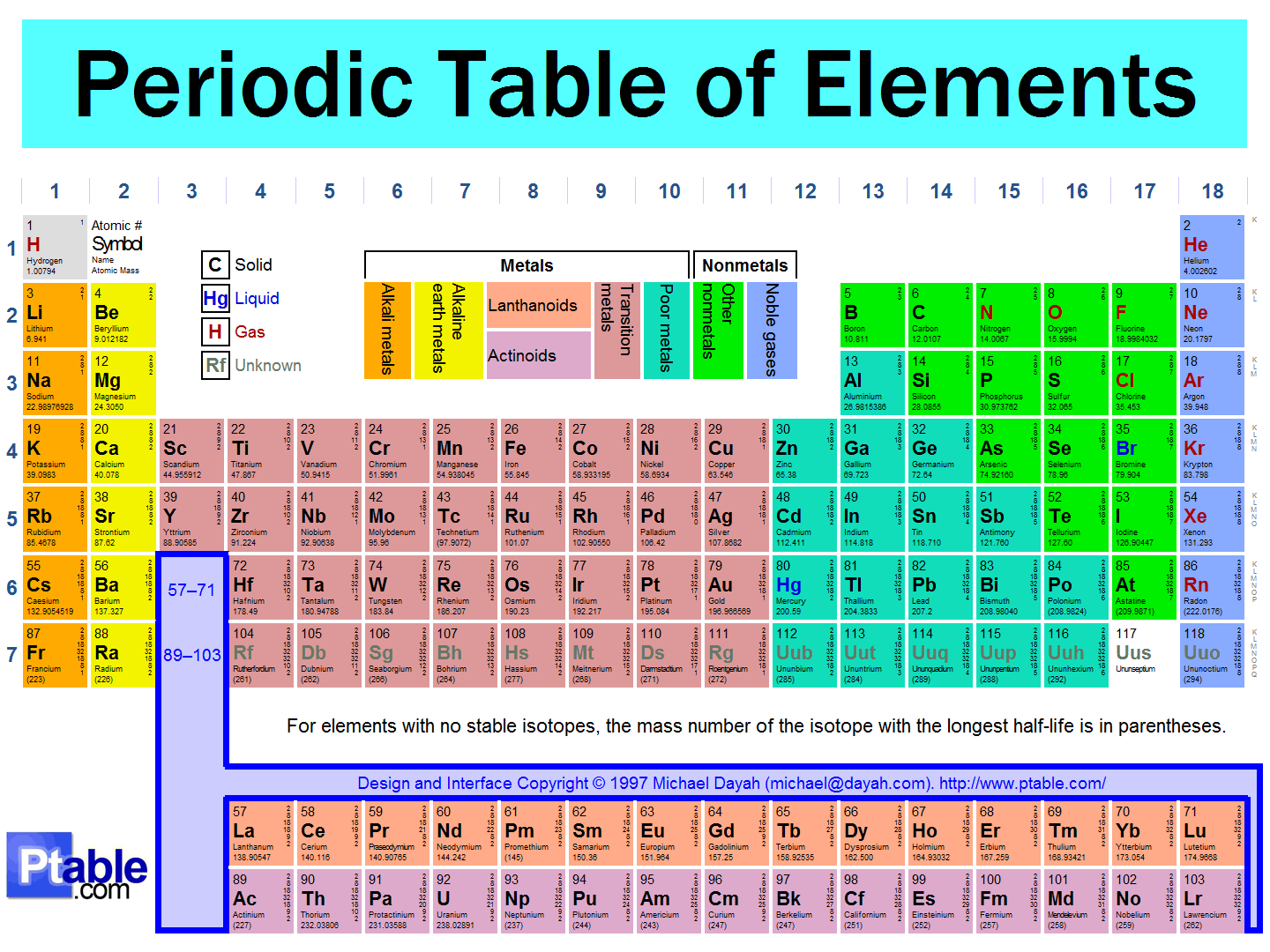
The periodic table is in order by the

a)

Mass number

b)

Neutron number

c)

Atomic number

d)

APE MAN Number

8.

Name the element

a)

Aluminum

b)

Silicon

c)

Phosphorus

d)

Sulfur

9.

What is the atomic mass of barium?

a)

56

b)

82

c)

137

d)

138

10.

How many protons does indium have?

a)

49

b)

66

c)

114

d)

115

11.

How many neutrons does platinum have?

a)

78

b)

117

c)

195

d)

196

12.

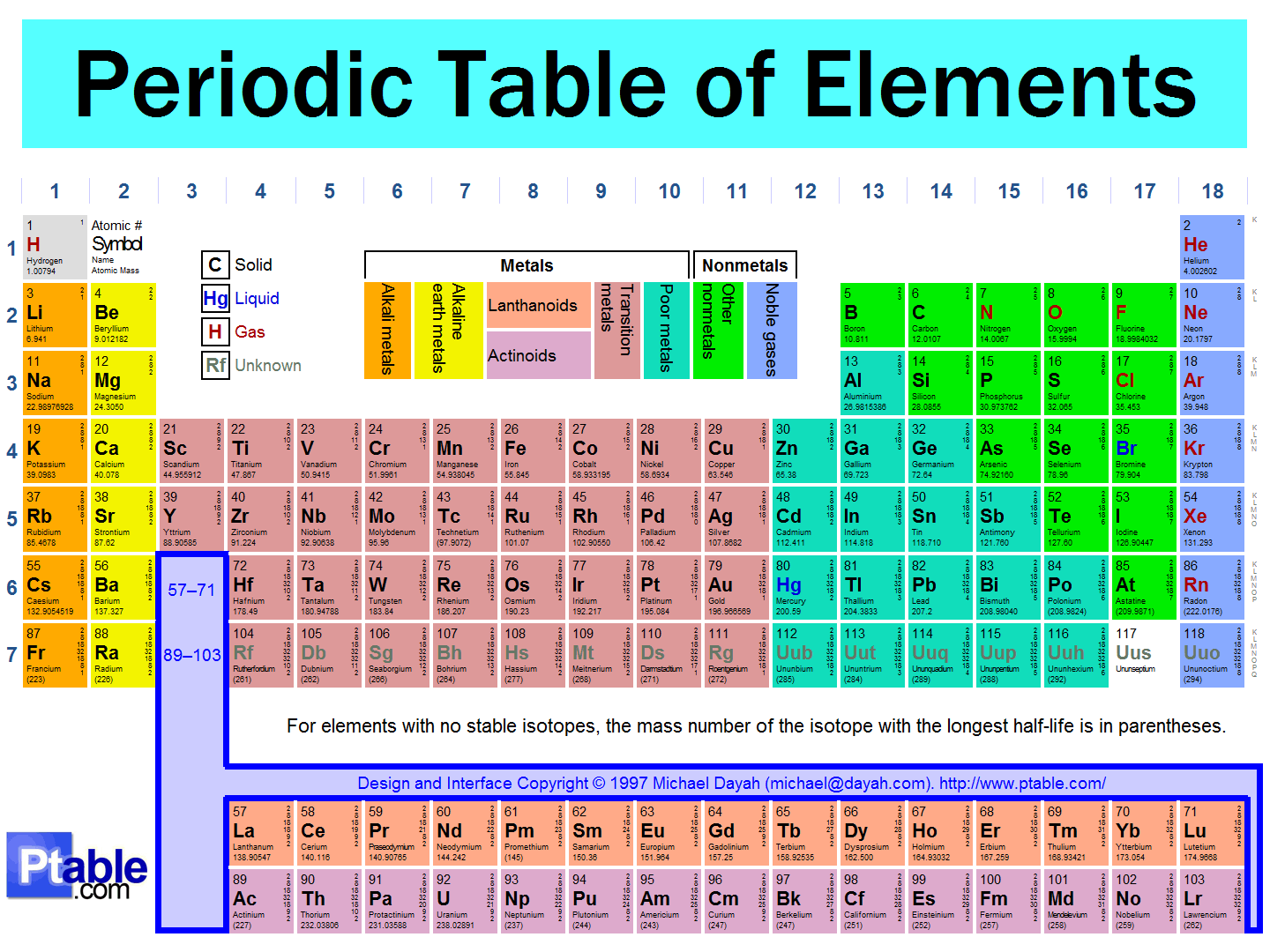
The horizontal row on the periodic table is called a __________________________, and it tells you the number of ___________________________ an element has.

a)

group/valence electrons

b)

family/electrons

c)

period/energy levels

d)

atomic number/protons

13.

A vertical column is called a __________________, and it determines the number of _______________________ an element has.

a)

group/valence electrons

b)

tower/protons

c)

period/energy levels

d)

group/energy levels

14.

Most of the elements on the periodic table are conductors, lustrous and malleable. They are classified as _____.

a)

Metals

b)

Nonmetals

c)

Metalloids

d)

Periods

15.

This class of elements are sometimes called "semiconductors" and can have many different properties.

a)

Metals

b)

Nonmetals

c)

Metalloids

d)

Groups

16.
Which group of the periodic table is composed of inert (not reactive)  gases?
a)
alkali metals
b)
alkaline earth metals
c)
halogens
d)
noble gases
17.

What's a valence electron?

a)

electrons

b)

electrons in the outermost energy level that determine reactivity

c)

the atomic number

d)

electrons in the first level

18.
What does the 1.00794 stand for?
a)
Hydrogen
b)
atomic number
c)
atomic mass
d)
atomic explosion
19.

What does the atomic mass tell you?

a)

The number of electrons plus protons

b)

The number of neutrons

c)

The number of protons plus neutrons

d)

The number of protons.

20.
The substances listed on the right side of a chemical equation are the
a)
Yields
b)
Reactants
c)
Products
d)
Precipitates
21.
The substances listed on the left side of a chemical equation are the
a)
Products
b)
Coefficients
c)
Precipitates
d)
Reactants
22.
How many Oxygen (O) atoms are in 2C2HO8Cl2
a)
2
b)
16
c)
8
d)
5
23.
How many Hydrogen (H) atoms are in NH3O5
a)
3
b)
4
c)
5
d)
1
24.

Identify the Reactants in this equation.

a)

A

b)

B

25.

How many atoms of nitrogen are in the compound shown above?

a)

1

b)

2

c)

3

d)

4

26.
How many atoms of aluminum are on each side of the following equation:
4Al + 3O2 → 2Al2 O3
a)
2
b)
6
c)
1
d)
4
27.
What is the total number of atoms present in  5Na3PO4?
a)
5
b)
40
c)
55
d)
60
28.
Is this equation balanced?:                 CS2 + 2 O2 → CO2 +2 SO2
a)
Yes
b)
No
29.

When a scientist mixed two chemicals, a reaction takes place. Which of the following would be proof that a reaction took place?

a)

an intentional change of color

b)

an intentional change of state

c)

an unintentional temperature change

30.
Which of the following is a chemical change?
a)
water freezes to form ice
b)
sugar dissolves in water
c)
gasoline burns in a car engine
d)
a piece of metal expands when it is heated
31.
A change in the shape of an object is an example of _________________.
a)
a chemical change
b)
energy
c)
an endothermic change
d)
a physical change
32.
Vanessa had a beaker with a small amount of baking soda. She added a few drops of vinegar to the baking soda and observed fizzing and bubbling. Based on her observation, which of these can Vanessa determine about the new substance formed by mixing the baking soda and vinegar?
a)
It was hot.
b)
It was a gas.
c)
It was magnetic.
d)
It was a conductor.
33.
A granular substance is added to a liquid. Which of the following would provide evidence to suggest a chemical change has taken place?
a)
The liquid gives off heat.
b)
The granules dissolve completely.
c)
The volume of the liquid increases.
d)
The granules seem to get smaller.
34.
A student mixes two clear liquids together. After a few minutes, a white powdery solid can be seen settling on the bottom of the test tube. Which of the following is a conclusion that the student can draw based on these observations? The two clear liquids –
a)
were pure substances before they were mixed.
b)
are toxic and should be handled with extreme caution.
c)
have gone through a chemical change in which a new substance called a precipitate was produced.
d)
have been stored too long and are no longer good.
35.

Which of the following describe chemical changes that occur in the digestive system?

a)

Teeth tear food into small pieces

b)

Esophagus carries food to the stomach

c)

Gastric juices mix with food in the stomach to create a new substance, chyme.

d)

Excess water is absorbed in the large intestine

36.

Both chemical and physical changes occur in digestion. A physical change occurs when ___

a)

a change in color occurs

b)

a new substance is created

c)

shape or size is altered

d)

All of the above

37.

Which step in the digestive process represents a chemical change in food?

a)

Storing of swallowed food in the stomach

b)

Churning of food liquids and digestive juices in the stomach.

c)

Movement of food down the esophagus to the stomach.

d)

Substances in the mouth and stomach breaking down fats and proteins.

38.
A piece of copper has a mass of 89g and a volume of 10 cm3.  What would be the density of the copper?
a)
0.89 g/cm3
b)
89 g/cm3
c)
8.9 g/cm3
d)
890 g/cm3
39.
Jack has a rock. The rock has a mass of 14g and a volume of 2cm3. What is the density of the rock?
a)
7 mL
b)
7 g/cm3
c)
28 g/cm3
d)
1/7 g/cm3
40.
What is the volume of Object X?
a)
10.0 cm3
b)
15.0 cm3
c)
20.0 cm3
d)
25.0 cm3
41.
What is the volume of 150 grams of lead if it has a density of 11.3 g/cm3?
a)
13.3 g
b)
13.3 cm3
c)
.075 g
d)
1695 cm3
42.
Which of the following is a compound?
a)
Co
b)
He
c)
CO
d)
H
43.
Which best describes a compound? 
a)
found on the periodic table 
b)
made from two or more elements
c)
a pure substance 
d)
only 100 in the world 
44.
Elements are represented by a...
a)
More than one capital letter
b)
Chemical symbol 
c)
Chemical formula 
d)
Oxygen 
45.
Compounds are represented by a...
a)
Capital Letter
b)
Chemical symbol 
c)
Chemical formula 
d)
Chlorine 
46.
A new compound has been discovered. Here is the chemical formula:
CHOFeNaNPb 

How many elements are in this compound?
a)
5
b)
6
c)
7
d)
10
47.

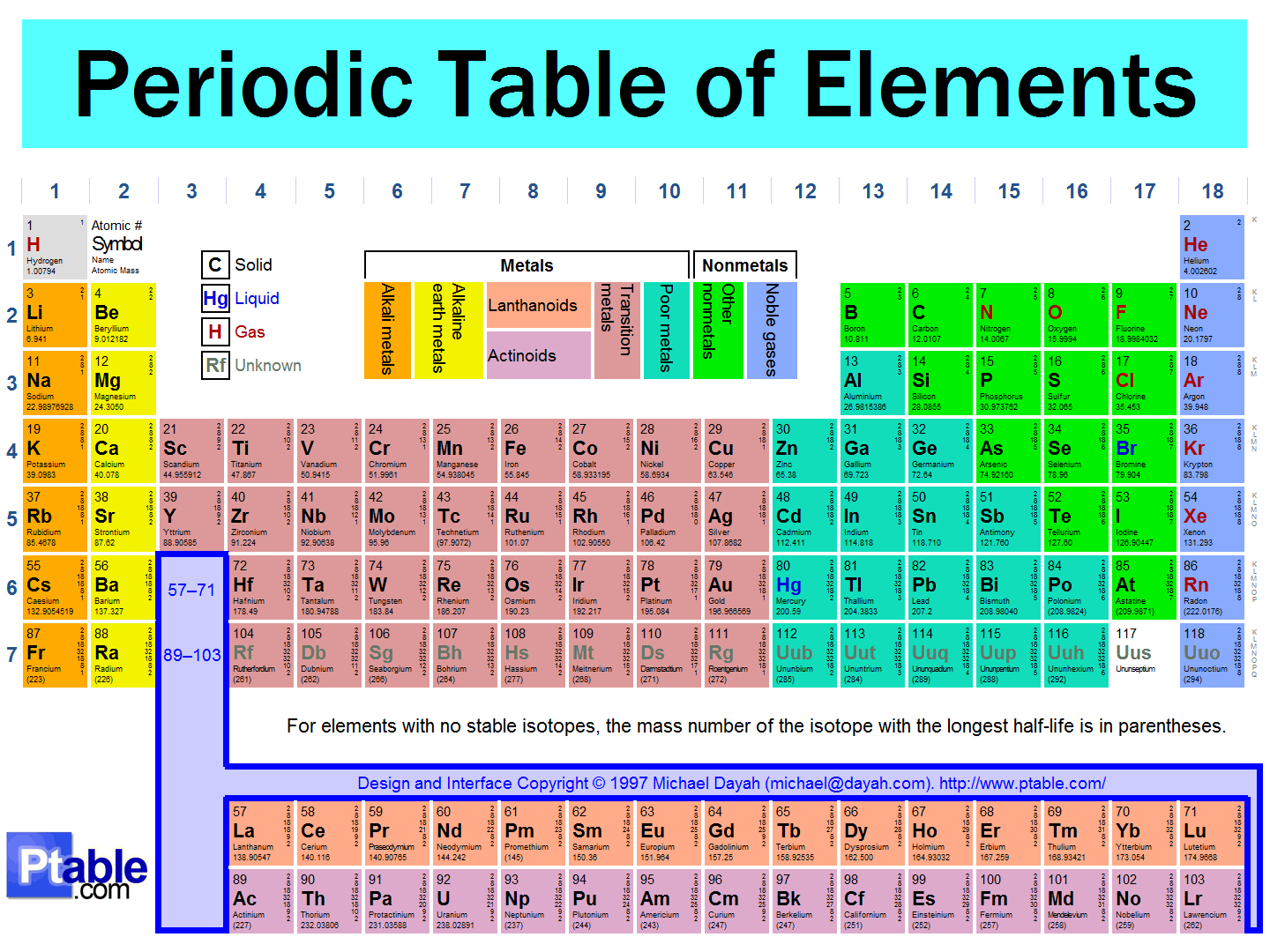
Which two elements would have the same number of energy levels (shells)?

a)

Nickel and Palladium

b)

Magnesium and Lithium

c)

None of these elements

d)

Copper and Zinc

48.

Determine which atom is being described here: Shiny, has the properties of both metals and nonmetals, and has three valence electrons.

a)

Tin (Sn)

b)

Boron (B)

c)

Germanium (Ge)

d)

Antimony (Sb)

49.

On the periodic table, reactivity increases as you move ______________.

a)

from right to left

b)

from left to right

50.

Francium is the most reactive element on the periodic table.

a)

True

b)

False

51.

Using the periodic table, determine the name of the element that has 2 valence electrons and 6 energy levels.

a)

Francium

b)

Barium

c)

Molybdenum

d)

hydrogen

52.
How many valence electrons are elements trying to reach in their outer shells?
a)
1
b)
2
c)
5
d)
8
53.

Elements in the same group have similar _______.

a)

Atomic Mass

b)

Symbol

c)

Chemical Properties

d)

Atomic Number