wayground logo

Free Printable Worksheets

NEW

Font size

S
M
L
XL
Worksheets

AP Biology Unit 8 Review: Ecology

Total questions: 60

Worksheet time: 59mins
Name
Class
Date
1.
A herd of zebras would be considered a
a)
community
b)
species
c)
ecosystem
d)
population
2.
Two organisms of different species exist in a relationship in which each individual benefits from the activity of the other:
a)
commensalism
b)
parasitism
c)
herbivory
d)
mutualism
3.
All of the following are density-dependent factors that limit animal populations EXCEPT.
a)
weather
b)
predation
c)
food competition
d)
birthrate
4.
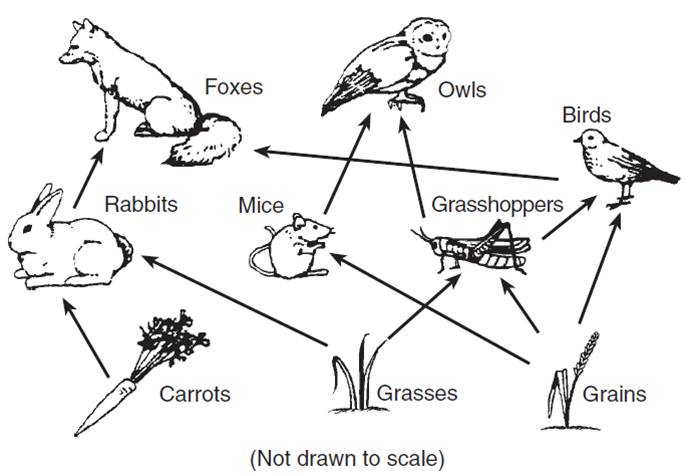
Which of the following is a primary consumer in this food web?
a)
Foxes
b)
Carrots
c)
Mice
d)
Owls
5.
Which organism contains the most energy?
a)
Rabbit
b)
Grains
c)
Birds
d)
Mice
6.
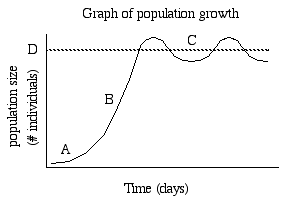
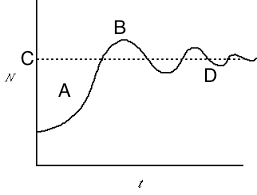
Which point on the graph represents carrying capacity?
a)
A
b)
B
c)
C
d)
D
7.
Why is only 10% of the energy passed along to the next trophic level?
a)
90% is lost through heat, reproduction, and movement
b)
90% is gained
c)
90% is lost in light energy
d)
because only 10% is lost
8.
All of the following statements concerning characteristics of predator-prey relationship are correct EXCEPT:
a)
Camouflage is an adaptation that protects prey.
b)
A rise in the population of predators is followed by a decreased in the population of prey.
c)
A rise in the population of prey is often followed by a rise in the population of predators.
d)
The population of predators most often eliminates the population of prey
9.
Which of the following best explains why there are seldom more than five trophic levels in a food chain?
a)
Most carnivores function at more than one trophic level
b)
Trophic levels about this numbers contain too many individuals
c)
Energy is lost from each trophic level
d)
The ecosystem contains too much biomass
10.
Which of the following represents the combination of all relevant environmental variables in which a species or population lives?
a)
clade
b)
hybrid zone
c)
phylogeny
d)
ecological niche
11.
Which of the following encompases all the others?
a)
ecosystem
b)
community
c)
population
d)
individual
12.
Refer to the diagram of the survivorship curve.
Which curve best describes an organism that invests a lot of energy in parenting?
a)
A
b)
B
c)
C
d)
this is not a survivorship curve
13.
A species described as r-strategist would definitely NOT have which of the following characteristics?
a)
clumped population pattern
b)
much parenting
c)
many offspring
d)
random population pattern
14.
Which letter shows the the exponential growth of a population?
a)
A
b)
B
c)
C
d)
D
15.
The two species, Paramecium aurelia and Paramecium caudatum, which do not prey upon each other, fighting to grow in the same test tube is an example of which of the following?
a)
Competition
b)
Predation
c)
Commensalism
d)
Exclusion
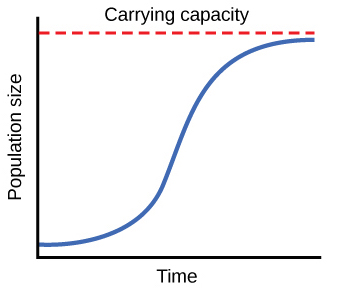
16.
The maximum population size for a species based on the environmental factors is called
a)
ecological footprint
b)
carrying capacity 
c)
population growth
d)
environmental capacity
17.
There are 200 bears in an area.  10 emigrate, 15 immigrate, 10 are born and 20 die.  How many are left?
a)
195
b)
205
c)
200
d)
260
18.
A group of interbreeding individuals occupying the same area is best called
a)
community
b)
population
c)
ecosystem
d)
symbiotic relationship
19.
Refer to a population of 500 that experiences 55 births and 5 deaths during a one year period.
If the population maintains the current growth pattern, a plot of its growth would resemble which of the following?
a)
exponential growth
b)
fluctuating growth
c)
K-selected growth
d)
logistic growth
20.
When two species of cattails are grown together, they grow at different water depths and coexist.  When grown alone, they grow at similar water depths.  Which of the following is best demonstrated by the data?
a)
natural selection
b)
character displacement
c)
resource partitioning
d)
ecological succession
21.
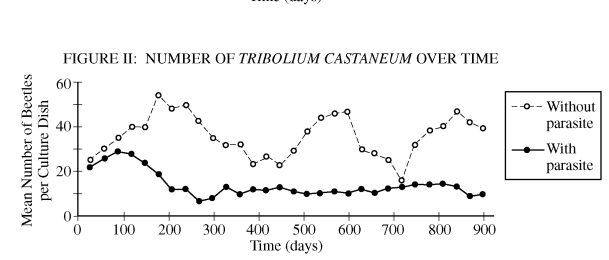
Which of the following correctly describes the interactions between T. castaneum and the parasite.
a)
The parasite decreases the population density of beetles in each culture dish.
b)
The parasite increases the population density of beetles in each culture dish.
c)
The parasite has no effect on the population density of the beetles.
22.

What is the rate of change for the population grown without a parasite from day 200 to day 400?

a)

200 days

b)

a loss of approximately 15 beetles/200 days

c)

a loss of approximately 30 beetles/200 days

d)

30 beetles

23.
How do matter and energy flow differently?
a)
Energy flows in one direction, matter is recycled
b)
Matter flows in one direction, Energy is recycled
c)
Energy and Matter are both recycled
d)
Energy and Matter both flow in one direction
24.
Which of the following is an example of a density-independent limiting factor?
a)
A parasite
b)
A natural disaster
c)
A decrease in prey
d)
A food shortage
25.
Primary consumer's energy is 54,000 joules. How much energy was provided to secondary consumers?
a)
53,460 J
b)
540 J
c)
5,400 J
d)
54 J
26.
A team of ecologists observed feeding patterns of several populations in the desert. The energy pyramid shown below depicts the feeding patterns the ecologists observed. Which of the following best explains the difference in the amount of available energy in the trophic levels of the desert ecosystem?
a)
There is less energy available in the producers because their tissues are less dense than those at higher trophic levels. 
b)
There is more energy available in the second trophic level because less energy is needed for hunting compared to the higher trophic levels. 
c)
There is less available energy in the fourth trophic level because of the loss of energy through metabolism in each of the lower trophic levels. 
d)
There is more available energy in the birds of prey because they have greater muscle mass for storing energy than organisms in lower trophic levels have. 
27.
__________ growth shows growth of a population under environmental constraints (carrying capacity-K) that sets a maximum population size 
a)
logistic
b)
exponential
c)
niche
d)
uniform
28.
These types of organisms which multiply rapidly in numbers 
a)
R-strategists
b)
K-strategists
c)
predators
d)
mutualists
29.

Species richness is measure of the number of different species living in an ecosystem. Which of the following would be indicated by species richness?

a)

dispersal patterns

b)

amount of biodiversity

c)

density of a population

d)

level of productivity exhibited within the ecosystem

30.
A species that exerts a large, positive impaction on its ecosystem is known as a:
a)
Keystone species
b)
Invasive species
c)
Indicator species
d)
Poached species
31.

In most ecosystems, net primary productivity is important because it represents the

a)

Energy used in respiration by herbivores

b)

Total solar energy converted to chemical energy by producers

c)

Biomass for all producers

d)

Energy available for trophic levels above producers

32.
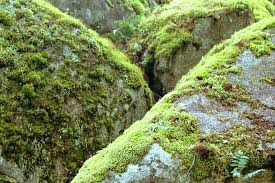
What are examples of pioneer species in a primary succession?
a)
Bushes and Shrubs
b)
Oak trees
c)
Mossess and Lichens 
d)
A rose Bush
33.

What is the most important function of pioneer species?

a)

To function as decomposers

b)

To create soil and add nutrients

c)

Facilitation of the water cycle

d)

Food for animals

34.
After a forest fire, an ecosystem would start regrowth through -
a)
primary succession
b)
secondary succession
c)
climax community
d)
limiting factors
35.
If a blue catfish is introduced and eats the large fish who eat the smaller fish, what will happen to the population of the smaller fish?
a)
Increase
b)
Decrease
c)
Stay the same
d)
No affect on smaller fish
36.
What effect will an invasive species have on the carrying capacity of an ecosystem?
a)
The carrying capacity will increase
b)
The carrying capacity for everyone will decrease
c)
The carrying capacity will only decrease for those in competition for same resource
d)
The carrying capacity for all animals will stay the same
37.
Kudzu has overgrown many parts of southern Missouri and native ground plants have disappeared from the area. This is an example of:
a)
Parasitism between kudzu and the native plants
b)
A predator prey relationship between ground plants and kudzu
c)
Competition occurring between the native and invasive species
d)
Commesalism occurring between the kudzo and native plants
38.

At low densities and in the absence of any other beetle species, the population of a strain of the flour beetle Tribolium castaneum grows at a per capita rate of 0.3 per week. In controlled lab conditions, the per capita growth rate is reduced by 0.015 for every 100 individuals. The addition of a related beetle, Tribolium freemani, further reduces the per

capita growth rate of T. castaneum by 0.02 for every 100 T. freemani individuals. If there are 800 T. castaneum and 500 T. freemani individuals, what is the per capita growth rate of the T. castaneum population?

a)

-0.22

b)

-0.1

c)

0.08

d)

0.18

e)

0.52

39.

Based on the figure you can conclude that interspecific competition

a)

allows for both rock barnacles and stellate barnacles to inhabit the same area.

b)

causes the stellate barnacles to grow more slowly than they would normally grow.

c)

restricts stellate barnacles to a smaller portion of the intertidal zone.

d)

causes the rock barnacles to grow more slowly than they would normally grow.

e)

causes the stellate barnacles to grow more quickly than they would normally grow.

40.

A plant species produces a chemical that is toxic to herbivores. Over time, herbivores that can detoxify the chemical increase in frequency. A mutation in the plant produces a new, different toxic chemical that the herbivores cannot detoxify. This is an example of

a)

a mutualism

b)

resource partitioning

c)

coevolution

d)

commensalism

41.
Which of the following would be most likely to occur if a disease killed off all of the grasshoppers in an area?
a)
An increase in mice.
b)
A decrease in the number of snakes.
c)
An increase in fox.
d)
A decrease in grass.
42.

What is the carrying capacity of the following population?

a)

1000

b)

8000

c)

800

d)

600

43.
A herd of zebras would be considered a
a)
community
b)
species
c)
ecosystem
d)
population
44.
Which of the following statements best describes the concept of NPP (Net Primary Production)
a)
energy captured minus energy lost
b)
total amount of energy lost
c)
total amount of energy produced from photosynthesis
d)
total amount of energy available within an ecosystem
45.
A measure of the number of different species living in an ecosystem is referred to as the
a)
ecological census
b)
species richness
c)
population density
d)
biomass
46.
Which kind of dispersion is #1?
a)
clumped
b)
random
c)
uniform
47.
The process used by some producers of capturing energy from nonliving sources such as gasses emitted in deep sea vents.
a)
Chemosynthesis
b)
Photosynthesis
c)
Percolation
d)
Respiration
48.
Most of the organisms in the ocean exists in the shallow water over the continental shelves.  Why is this true?
a)
Producers, the beginning of all food chains, can only exist where there is sunlight.
b)
Sea predators can easily catch their prey where the water is shallow.
c)
Water over the continental shelves has more minerals than deep ocean water.
d)
Ocean storms destroy organisms living in deep water.
49.
Invasive species are:
a)
non-native
b)
harmful to an ecosystem
c)
organisms that can lack predators in the new environment
d)
all of the answers are correct
50.
Many poisonous animals are brightly colored (red or orange) as a warning to predators.  The special coloration is called
a)
Mullerian mimicry
b)
Batesian mimicry
c)
aposematic coloration 
d)
mutualistic coloration
51.
Two animals live together in close association.  One benefits, while the other is unaware of the first animal. The relationship is best described as
a)
Parasitism
b)
Mutualism
c)
Commensalism
d)
Predation
52.
Which of the following is NOT an abiotic factor?
a)
air 
b)
water 
c)
decomposers 
d)
temperature
53.
Which of the following represents several species of brightly colored, harmless snakes looking like poisonous coral snakes?
a)
commensalism
b)
mutualism
c)
batesian mimicry
d)
mullerian mimicry
54.
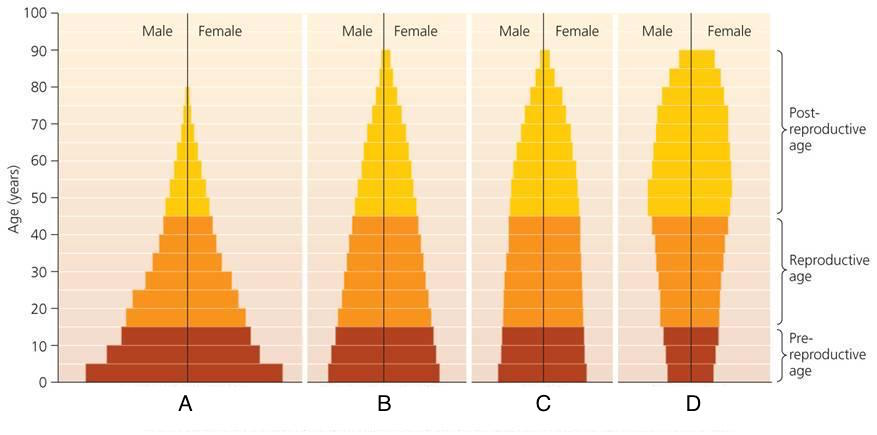
Which of these populations is experiencing the fastest growth?
a)
A
b)
B
c)
C
d)
D
55.
All of the following increases the concentration of CO2 in the atmosphere EXCEPT
a)
photosynthesis
b)
slash and burn clearing of tropical rainforests
c)
burning of fossil fuels
d)
burning of wood for cooking and heating
56.
To measure primary productivity, you can measure carbon dioxide consumption, total carbohydrates produced or ________________.
a)
dissolved oxygen
b)
total proteins produced
c)
light energy entering system
57.
Refer to a population of 500 that experiences 55 births and 5 deaths during a one year period.
If the population maintains the current growth pattern, a plot of its growth would resemble which of the following?
a)
exponential growth
b)
fluctuating growth
c)
K-selected growth
d)
logistic growth
58.
Which of the following represents oxpeckers that are birds that ride rhinoceroses and other ungulates and eat various skin parasites, such as ticks?  
a)
commensalism
b)
mutualism
c)
batesian mimicry
d)
mullerian mimicry
59.
Nitrogen becomes available to plants by all of the following processes EXCEPT
a)
ammonification 
b)
denitrification by denitrifiying bacteria
c)
nitrification by nitrifying bacteria
d)
nitrogen fixation in plant nodules
60.
As it moves through the various food web, energy
a)
is lost
b)
is gained
c)
stays the same
d)
none of these