

wayground logo

Free Printable Worksheets

Font size

S
M
L
XL
Worksheets

EOC Practice (SPS6/SPS7/SPS8)

Total questions: 119

Worksheet time: 1hrs 14mins

Name
Class
Date
1.
A _____ is a special type of mixture.  It has a uniform composition throughout and is made up of two parts: a solute and a solvent.
a)
Solution
b)
Conductivity
c)
electrolyte
2.
Substance being dissolved
a)
solute
b)
solvent
3.
Doing the dissolving
a)
Solute
b)
Solvent
c)
Conductivity
4.
No more solute can dissolve
a)
Saturated Solution
b)
Unstaurated solution
5.
More solute can dissolve
a)
Saturated Solution
b)
Unsaturated Solution
6.
The ability to conduct electricity
a)
Solute
b)
Solvent
c)
Conductivity
7.
Cations and ___________ readily carry electrical charges through the solution.
a)
anions
b)
electrolytes
c)
compounds
8.
Strong acids and bases have a negative high conductivity.  All of these solutions are considered ________ electrolytes.
a)
weak
b)
neutral
c)
strong
9.
Weak acids or bases ionize only partially so they form solutions witThese compounds are called ____ electrolytes.
a)
weak
b)
strong
c)
neutral
10.
Solutions made from covalent compounds have zero conductivity since they dissolve as molecules, not ions.  They cannot carry electrical charges.  These are known as ___________.
a)
conductors
b)
nonconductors
c)
non-electrolytes
11.
Amount of solute dissolve in the solvent
a)
solute
b)
solvent
c)
conductivity
d)
concentration
12.
There are factors that affect the rate at which a solution dissolves.  Name the factor.
____________-
Define: Movement of particles
Affect: Increase solubility
a)
Agitation
b)
Size of Particles
c)
Temperature
d)
Number of Particles
13.
There are factors that affect the rate at which a solution dissolves.  Name the factor.
____________-
Define: Smaller particles dissolve faster due to increased surface area
Affect: Increase solubility
a)
Agitation
b)
Size of Particles
c)
Temperature
d)
Number of Particles
14.
There are factors that affect the rate at which a solution dissolves.  Name the factor.
____________-
Define: Molecules increase the rate of contact
Affect: Increase solubility
a)
Agitation
b)
Size of Particles
c)
Temperature
d)
Number of Particles
15.
There are factors that affect the rate at which a solution dissolves.  Name the factor.
____________-
Define: Fewer number of particles increases surface area
Affect: Increase solubility
a)
Agitation
b)
Size of Particles
c)
Temperature
d)
Number of Particles
16.
The relationship between solubility and temperature plotted on a graph
a)
solubility curve
b)
Charles Law
c)
Acid Bell
d)
Acid Trip
17.
What is the solubility of Potassium Chloride at 45∘C?
a)
40g/100g of water
b)
60g/100g of water
c)
IDK
18.
Components and Properties of ___________
Definition: Solutions with hydronium (h+)
Taste: Sour
Touch: Burn
Reacts with Metals: Corrosive
Electrical ConductivityL Good
Litmus Paper Test: Red
Ph Scale: 0-6.9
a)
Acid
b)
Base
c)
Neutral
19.
Components and Properties of ___________
Definition: with hydroxide (h-)
Taste: Bitter
Touch: Slimey
Reacts with Metals: form of H+ gas
Electrical Conductivity: Good
Litmus Paper Test: Blue
Ph Scale: 7.1-14
a)
Acid
b)
Base
c)
Neutral
20.
5 Common _________:
orange juice
lemon juice
vinegar
tomato juice
battery acide
a)
acids
b)
bases
21.
5 Common _________:
baking soda
drain cleaner
antacids
bleach
maloxx
a)
acids
b)
bases
22.
What is an example of a neutral substance?
a)
bleach
b)
water
c)
orange juice
23.
What is the ph of a neutral substance?
a)
14
b)
7
c)
0
24.
What are the products of a neutralization reaction?
a)
acid + base = salt water
b)
acid + base= lemonade
c)
acid + base= 3 day belly ache
25.
The esophagus is the tube that connects the mouth to the stomach. Heartburn occurs when some of the stomach juices flow backwards up the esophagus. To help relieve heartburn, a person should take medicine that is
a)
neutral
b)
basic
c)

acidic or basic.
d)
acidic
26.
If an acid is combined with a base of equal strength, the result will most likely be
a)
a neutral solution.
b)
a stronger acid.
c)
impossible to tell without testing the pH.
d)
a stronger base
27.
Holly has an unknown substance in a beaker. She wants to determine the relative pH of the unknown substance. She places a piece of blue litmus paper into the substance, and the litmus paper stays blue.
The substance in the beaker
a)
is a base.
b)
has a neutral pH.
c)
is an acid.
d)
does not have a pH.
28.
Litmus paper can be used to determine the _______ of a substance.
a)
relative volume
b)
temperature
c)
relative pH
d)
chemical formula
29.
 Which of the following is an acid?
a)
shampoo
b)
baking soda
c)
orange juice
d)
water
30.
The pH of a solution is tested, and it is found to be a basic solution. Of the following choices, what could the pH have been?
a)
3
b)
9
c)
7
d)
5
31.
Human blood has a pH between 7.35 and 7.45. Which of the following best describes human blood?
a)
strongly acidic
b)
slightly acidic
c)
strongly basic
d)
slightly basic
32.
Which type of ion does a base produce when it is dissolved in water?
a)
oxide
b)
oxygen
c)
hydrogen
d)
hydroxide
33.
When dissolved in water, acids produce:
a)
bases
b)
salts
c)
hydrogen ions
d)
hydroxide ions
34.
The maximum amount of solute dissolved in a solvent at a given temperature measures the ____.
a)
concentration
b)
strenght
c)
solubility
35.
chemical reaction that occurs between an acid and base to produce water and a salt
a)
indicator
b)
neutralization
c)
concentration
d)
solubility
36.
What do a toaster, a hair dryer, and an
iron have in common?
a)
They convert electrical energy to heat
energy.
b)
They convert electrical energy to
mechanical energy.
c)
They convert mechanical energy to
electrical energy
d)
They convert heat energy to electrical
energy.
37.
A pendulum bob swings back and forth
in an arc. Which describes the energy
conversion process in one swing of the
pendulum from left to right?
a)
kinetic energy to chemical energy to
potential energy
b)
kinetic energy to mechanical energy back
to kinetic energy
c)
potential energy to kinetic energy back
to potential energy
d)
potential energy to kinetic energy to
electromagnetic energy
38.
Heterotrophs consume food to obtain
energy for biological processes. During
exercise, the chemical energy in food is
transformed into what other forms of
energy?
a)
potential and electrical energy
b)
electromagnetic and heat energy
c)
mechanical, kinetic, and heat energy
d)
potential, electromagnetic, and heat
energy
39.
The temperature is higher inside a
greenhouse than outside because of the conversion of ______________.
a)
light energy into heat energy
b)
heat energy into light energy
c)
nuclear energy into heat energy
d)
electrical energy into heat energy
40.
Convection is the transfer of energy by
the motion of the heated particles in a
fluid. According to this information, which
statement best describes an example of
convection?
a)
a shirt heated by an iron
b)
a puddle of rainwater heated by
sunlight
c)
a dark-color car heated by sunlight
d)
warm air rising in the atmosphere
41.
Ms. Markas takes a thermos bottle filled with hot coffee to work each day. The thermos bottle keeps the coffee hot by ____________________.
a)
using a battery-powered heating
element
b)
collecting solar heat energy
c)
recirculating hot air inside
d)
slowing heat transfer
42.
According to the chart, what material
requires the most heat to raise its
temperature 10°C?
a)
glass
b)
iron
c)
water
d)
wood
43.

Q = m(Tf − Ti)C

Where Q is the change in thermal

temperature, m is the mass of the object, Tf is the final temperature of the object, and Ti is the initial temperature of the object.

Suppose four pieces of metal, with masses of 10 g, 100 g, 500 g, and 1000 g, are heated. According to the equation above, which piece of metal requires the most heat to go from from 10°C to 20°C?

a)

10-g piece

b)

100-g piece

c)

500-g piece

d)

1000-g piece

44.
In a calorimeter, the sample to be tested generally cools off. What material heats up?
a)
air
b)
water
c)
alcohol
d)
mercury
45.
While a block of ice is melting, the temperature of the ice ___________.
a)
goes up
b)
goes down
c)
remains constant
d)
varies depending on conditions
46.
Examine the heating curve for water. What is happening along the diagonal line in this graph?
a)
Solid water is melting.
b)
Liquid water is boiling.
c)
Liquid water is freezing.
d)
Liquid water is changing  temperature.
47.
The law of conservation of ___________ states that energy, like matter, cannot be created nor destroyed; it can only be changed from one form of energy to another.  Energy takes takes many forms in the world around us.  Each form of energy can be converted to and from other forms of energy.
a)
energy
b)
solubility
c)
conduction
d)
radiation
48.
__________ energy is used in our homes to produce stereo sound through speakers.
a)
potential
b)
kinectic
c)
thermal
d)
sound
49.
______ energy, which is stored in the nucleus of atoms, is harnessed to produce electrical energy in moden power plants.
a)
thermal
b)
nuclear
c)
kinetic
d)
potential
50.
____ energy is stored in the bonds that hold atoms together in molecules.  When fuels or foods are broken down, this energy is converted to heat or kinectic energy.
a)
Nuclear
b)
chemical
c)
kinetic
51.
_____ energy is the energy contained by moving objects due to their motion.
a)
Kinectic
b)
potential
c)
sound
d)
light
52.
______ energy, also known as stored energy, is the energy of position. When a boulder sits on top of a cliff, it has gravitational _____energy as a result of its height above the ground.  When the boulder tumbles off the cliff, its gravitational ______ energy is converted to kinectic energy.  
a)
Kinetic
b)
Potential
c)
Mechanical
d)
Nuclear
53.
________________
Define: The transfer of heat energy between materials that are in direct contact with each other
a)
convection
b)
conduction
c)
radiation
54.
Circulation of air or water
a)
conduction
b)
convection
c)
radiation
55.
transfer of energy through space or air
a)
conduction
b)
convection
c)
radiation
56.
A______ diagram shows how a pure substance changes from one phase to another based on the temperature, T, and the pressure, P.
a)
trend diagram
b)
temperature diagram
c)
phase diagram
57.
What is the change called from a solid to a liquid?
a)
melting
b)
sublimation
c)
freezing
d)
evaporation
58.
What is the change called from a solid to a gas?
a)
melting
b)
sublimation
c)
freezing
d)
evaporation
59.
What is the change called from a liquid to a solid?
a)
melting
b)
sublimation
c)
freezing
d)
evaporation
60.
What is the change called from a liquid to a gas?
a)
melting
b)
sublimation
c)
freezing
d)
evaporation
61.
What is the change called from a gas to solid
a)
deposition
b)
sublimation
c)
freezing
d)
evaporation
62.
What is the change called from a gas to liquid
a)
deposition
b)
sublimation
c)
freezing
d)
condensation
63.
These reactions are __________ (or give off heat)
-- freezing
--depostion
-condensation
-getting colder
a)
exothermic
b)
endothermic
64.
These reactions are __________ (or take in heat)
-- melting
-sublimation
-evaporation-
-getting hotter
a)
exothermic
b)
endothermic
65.
The distance an object moves per unit of time is known as _____.
a)
speed
b)
velocity
c)
acceleration
66.
The ______ is the speed of the object plus its direction.  The average speed can be found by dividing the change in the displacement of an object by the change in time.
a)
speed
b)
velocity
c)
acceleration
67.
The average _______ of an object is found by dividing the change in the velocity of the object by the change time.
Ex: Calculate the average velocity of the new power jet cat.
a)
acceleration
b)
velocity
c)
speed
68.
Newton's _________ Law
An object at rest must stay at rest unless acted upon
Example: Boulder
a)
First
b)
Second
c)
Third
69.
Newton's _________ Law
Greater the force, greater the acceleration
Example: Baseball (pitching)
a)
First
b)
Second
c)
Third
70.
Newton's _________ Law
Every action has an equal and opposite reation
Example: Recoil of a gun/car wash
a)
First
b)
Second
c)
Third
71.
____ force is a force between any two objects. The strength of the force is related to the mass of the objects and the distance between them  The more mass an object has, the greater the _______ force it exerts.  The Moon has less than the earth.  The result the lower ___ forcemade the astronauts appear nearly "weightless" as they moved across the lunar surface. 
a)
Gravitational
b)
Electromagnetic
c)
Nuclear
d)
Frictional
72.
____ forces include both electric forces and magnetic forces
a)
Gravitational
b)
Electromagnetic
c)
Nuclear
d)
Frictional
73.
____ forces hold the protons and neutrons together
a)
Gravitational
b)
Electromagnetic
c)
Nuclear
d)
Frictional
74.
Mass and weight are not the same quantity.
a)
True
b)
False
75.
An object has ____ regardless of wheter gravity or any other force is acting upon it.
a)
mass
b)
weight
76.
______ changes depending on the influence of gravity.
a)
mass
b)
weight
77.
Work can be made easier or done faster by using machings.  Machines that work with one movement are called____
a)
simple tools
b)
work
c)
simple machines
78.
___ is the transfer of energy when applied force moves an object over a distance.  For ____ to be done the force must be applied in the same direction as the movement of the object and the object must move a certain distance.  A person may push a wall, and get tired muscles as a result, but unless the wall moves, the person has done zero ___.  
a)
effort
b)
resistence
c)
work
79.
Force is measured in _____
a)
newtons (N)
b)
meters (m)
80.
A unit of work is the newton -meter (n-m) or the ______
a)
joule (J)
b)
effort force (Fe)
c)
effort distance (de)
81.
Stair, wheelchair ramp
a)
inclined plane
b)
lever
c)
pulley
d)
screw
82.
see-saw, gears, wheel barrow
a)
inclined plane
b)
lever
c)
pulley
d)
screw
83.
old fashioned well, elevator
a)
inclined plane
b)
lever
c)
pulley
d)
screw
84.
knife, nail
a)
wedge
b)
lever
c)
pulley
d)
screw
85.
The force exerted by the machine is called the _________.  
a)
effort force (Fe)
b)
resistance force (Fr)
c)
mechanical advantage
86.
Simple machines cannot increase the amount of work done, but they can change the size and direction of the force applied.  The force applied to a simple machine is called _________. For a machine to work ____ must be applied.
a)
effort force (Fe)
b)
resistance force (Fr)
c)
mechanical advantage
87.
An effort force is applied over a distance known as _______.
a)
effort distance (de)
b)
resistance distance (dr)
c)
mechanical advantage
d)
distance force
88.
The number of time a machine multiplies the effort force is called the ______.
a)
effort distance (de)
b)
resistance distance (dr)
c)
mechanical advantage
d)
distance force
89.
65 miles per hour North is an example of an objects what?
a)
Speed
b)
Velocity
c)
Average Speed
d)
Constant Speed
90.
10 miles per hour is an example of an objects what?
a)
Velocity
b)
Speed
c)
Acceleration
d)
Inertia
91.
Velocity is 
a)
speed
b)
direction
c)
speed with a direction
92.
LT4: The graph shows Ashley riding her bike to Maria's house. 
What was occurring from point B to point C?
a)
She was increasing her speed.
b)
She stopped for 4 minutes
c)
She was decreasing in speed
93.
Nellie runs the length of a 100 -yard football field in a time of 20 seconds. Her average running speed is
a)
5 yards/s.
b)
50 yards/s.
c)
1/2 yard/s.
d)
not enough information
94.
What is a PUSH or PULL of an object?
a)
Motion
b)
Force
c)
Friction
d)
Gravity
95.
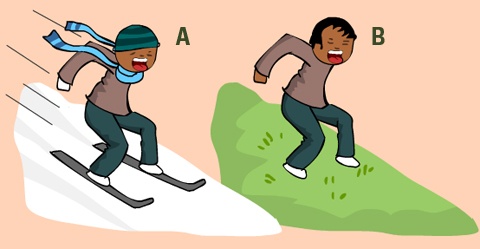
Why is it harder for the boy in Image B to get down the hill?
a)
Motion
b)
Friction
c)
Work
d)
Displacement
96.
Which force produces a change in motion?
a)
unbalanced force
b)
balanced force
c)
gravitational force
d)
frictional force
97.
What is the formula for force?
a)
F=M/A
b)
F=A/M
c)
F=M*A
d)
F=M*F
98.
If a 10 kilogram object accelerates suddenly at 15 m/s2, how much force was applied to the object?
a)
150 Newtons
b)
15 Newtons
c)
150 kilograms
d)
100 kilograms
99.
During which interval is the object speeding up?
a)
A to B
b)
B to C
c)
D to E
d)
E to F
100.
What is this graph showing?
a)
Constant Speed
b)
Acceleration (speeding up)
c)
Deceleration (slowing down)
d)
No motion
101.
8 N to the left , and 4 N to the right. Find the net force. Is this balanced 
a)
12 N Right  No
b)
4 N Left  No
c)
12 N Right  Yes
d)
4 N Left  Yes
102.

In order for a force to be "balanced" it must have forces equal in size but

a)

similar in shape

b)

similar in magnitude

c)

opposite in color

d)

opposite in direction

103.

A force will produce motion only if it is ______.

a)

Balanced

b)

Unbalanced

104.

Graph A shows an object that is

a)

accelerating at a constant speed

b)

accelerating at an increasing speed

c)

decelerating at constant speed

d)

not moving

105.

During which segment of the graph is the person sitting down and eating a snack without moving.

a)

A

b)

B

c)

C

d)

D

106.

During which segment of the graph is the person moving the fastest?

a)

A

b)

B

c)

C

d)

D

107.

Which box shows a box with a net force of 5N down

a)

1

b)

2

c)

3

d)

4

108.

A person walks 25 meters east and 10 meters west. What is the total distance walked?

a)

25

b)

10

c)

35

d)

15

109.

A person walks 25 meters east and 10 meters west. What is the total displacement of the person?

a)

25

b)

10

c)

35

d)

15

110.

____ changes depending on gravitational pull, _____ does not.

a)

mass; weight

b)

weight; mass

c)

gravity; energy

d)

energy; gravity

111.

Newton's 2nd Law of Motion can be summarized by which of the following sayings?

a)

Action and reaction pairs

b)

An object in motion stays in motion

c)

F = ma

112.

Newton's 1st Law of Motion can be summarized by which of the following sayings?

a)

Action and reaction pairs

b)

An object in motion stays in motion

c)

F = ma

113.

An index card is placed on top of a cup and a penny is placed on the index card. When the index card is suddenly knocked away with your finger, the penny falls into the cup. The motion of the penny can be explained by _______.

a)

Newton's 1st Law - inertia

b)

Newton's 2nd Law - f=ma

c)

Newton's 3rd Law - equal/oppsoite

114.

When you decrease the distance between two objects, what happens to the gravitational force?

a)

Decreases

b)

Stays the same

c)

Increases

115.

When the Mechanical Advantage of a machine equals one...

a)

The machine increases the force

b)

The machine changes the direction of the force

c)

The machine decreases the force

116.

The efficiency of a machine is a measure of how much of the work put into the machine is converted into useful output work. Why can efficiency never reach 100%?

a)

acceleration

b)

elasticity

c)

friction

d)

math

117.

Who has the more inertia?

a)
b)
118.

A roller coaster goes from 127 km/hr to 17 km/hr in 10 seconds as it climbs a steep hill. What is its acceleration?

What equation do you use to solve this problem?

a)

F = ma; solving for a

b)

F = ma; solving for f

c)

A = Vf - Vi / t ; solving for A

d)

A = Vf - Vi / t ; solving for Vi

119.

What equation do you use to solve this problem?


Suppose a car travels at a constant speed of 45 m/s. How far would it move in 15 seconds?

a)

F = ma; solving for F

b)

A = Vf - Vi / t ; solving for t

c)

V = d / t ; solving for d

d)

W = f x d ; solving for d
