wayground logo

Free Printable Worksheets

Font size

S
M
L
XL
Worksheets

Molecules to Organism Day 1

Total questions: 99

Worksheet time: 2hrs 35mins

Name
Class
Date
1.

What are the four nitrogen bases?

a)

adenine, thymine, guanine, cytosine

b)

adenine, lysine, prolene, guanine

c)

arganine, cytosine, lysine, purine

d)

lysine, cytosine, lucine, guanine

2.
What are the building blocks for DNA?
a)
carbohydrates
b)
nucleotides
c)
lipids
d)
proteins
3.

A gene is a section of a chromosome?

a)
b)
4.

There are ........ chromosomes in every human body cell

a)

36

b)

42

c)

46

d)

33

5.
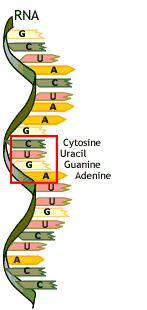
In RNA, Uracil pairs with ______. 
a)
cytosine
b)
adenine
c)
guanine
d)
thymine
6.
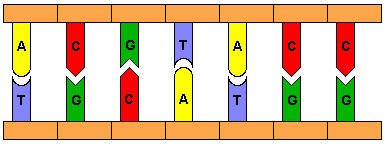
In DNA, Adenine pairs with ___________. 
a)
Guanine
b)
Cytosine
c)
Thymine
d)
Uracil
7.
A change in DNA or chromosomes
a)
Mitosis
b)
Meiosis
c)
mutation
d)
Osmosis
8.
What base pairs with Cytosine (C)? 
a)
Thymine (T) 
b)
Guanine (G) 
c)
Adenine (A) 
d)
Uracil (U) 
9.
Each codon codes for a particular __.
a)
amino acid
b)
anti-codon
c)
nucleotide
d)
protein
10.
What is the complimentary mRNA sequence to the DNA sequence A-T-T-G-C-A.
a)
T-A-A-C-G-T
b)
U-A-A-C-G-T
c)
U-A-A-C-G-U
d)
T-A-A-G-C-U
11.
What mutation has occurred here? 
T-G-A-C-C-A
T-G-A-G-C-A
a)
Substitution
b)
Deletion
c)
Insertion
d)
Frameshift 
12.
In RNA, the nitrogen base____ replaces ____ that was present in DNA. 
a)
A, U (adenine, uracil)
b)
C, G (cytosine, guanine)
c)
U, T (uracil, thymine)
d)
U, A (uracil, adenine)
13.
The "central dogma" states that genetic information flows from 
a)
Protein-->mRNA-->DNA
b)
Protein-->DNA-->mRNA
c)
mRNA-->DNA-->Protein
d)
DNA-->mRNA-->Protein
14.

The DNA sequence UAGCGAUUACGU is part of a gene. How many amino acids are coded for by this sequence?

a)

20

b)

4

c)

8

d)

12

15.
What type of gene mutation has occurred here? Normal-
AGA-TTC-ATA-GCG
Mutant-
AGA-TTC-AAT-AGC-G
a)
deletion frameshift
b)
insertion frameshift
c)
substitution
d)
nonsense
16.
Where do mutations occur?
a)
DNA and RNA
b)
DNA 
c)
RNA
d)
mRNA and tRNA
17.
DNA molecule segment is : TTACGCAAG
The mutated DNA segment is TTCGCAAG. This is an example of ___ mutation.
a)
Substitution
b)
Deletion
c)
Insertion
d)
Inversion
18.
This cell is simple. Only genetic material, cytoplasm and ribosomes inside.
a)
Eukaryotic
b)
Prokaryotic
c)
Plant
d)
Animal
19.
Complex cell. Can be plant or animal. Contains membrane bound organelles. 
a)
Eukaryotic Cell
b)
Prokaryotic Cell
c)
Bacteria
d)
Blood cell
20.
 Look at the diagram of a cross-section of a cell membrane below. The cell membrane controls movement of materials into and out of the cell. The following particles are moving from high concentration to low concentration and are using a carrier protein. How would you describe this type of movement across the membrane? 
a)
simple osmosis
b)
active transport
c)
simple diffusion
d)
facilitated diffusion
21.
Look at the cross section of a cell membrane of a eukaryotic cell. H+ ions are being pumped from a low concentration to a high concentration. How do you describe this type of transport across the cell membrane?
a)
active transport
b)
passive transport
c)
facilitated diffusion
d)
co-transport
22.
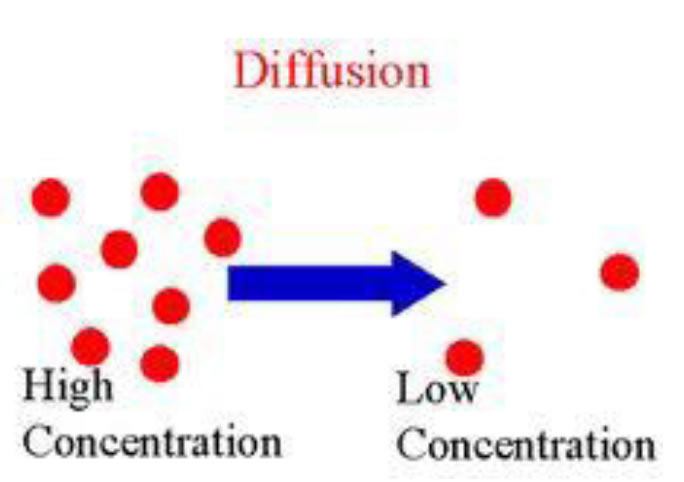
Movement of particles from high to low concentration. 
a)
Passive Transport
b)
Active Transport
23.
a)
Passive Transport
b)
Active Transport
24.
This picture represents what type of cell transport?
a)
endocytosis
b)
exocytosis
c)
osmosis
d)
passive transport
25.
Which is true about active transport?
a)
It requires energy
b)
it does not require energy
c)
It moves substances down the concentration gradient
d)
it moves material from high to low concentration
26.

What is the

force exerted on the cell wall of a plant cell and is dictated by the volume of water in the cell

a)

Turgor Pressure

b)

Temporal Pressure

c)

Cellular Pressure

27.
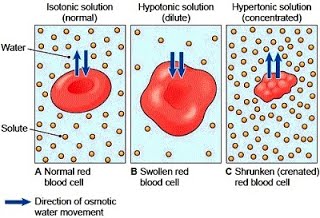
The image indicates what type of solution the cell is in?
a)
Isotonic
b)
Hypertonic
c)
Hypotonic
28.
The image indicates what type of solution the cell is in?
a)
Isotonic
b)
Hypertonic
c)
Hypotonic
29.
The image indicates what type of solution the cell is in?
a)
Isotonic
b)
Hypertonic
c)
Hypotonic
30.
Which beaker has a cell in a hypertonic environment?
a)
A
b)
B
c)
C
31.
Which beaker has a cell in a hypotonic environment?
a)
A
b)
B
c)
C
32.
This reaction shows a(n) ____________ reaction
a)
Catabolic
b)
Anabolic
c)
Dehydration Synthesis
d)
Halogenation
33.
Enzymes are considered to be 
a)
Lipids
b)
Carbohydrate
c)
Protein
d)
Nucleic Acid
34.
What is the purpose  of an enzyme?
a)
give permission for the reaction
b)
raise activation energy
c)
speed up reactions
d)
control how many reactions occur
35.
What is the name for the mechanism of enzyme activity?
a)
Lock and key
b)
jigsaw puzzle
c)
hammer and nail
d)
two hands pattern
36.
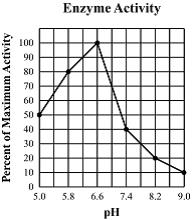
Which of the following conclusions can be drawn from this graph?
a)
The optimum pH of the enzyme is 6.6.
b)
The optimum pH of the enzyme is 5.8
c)
The enzyme’s activity increases as pH increases 5.0 to 9.0
d)
The enzyme’s activity is greater around pH of 8.0 .
37.
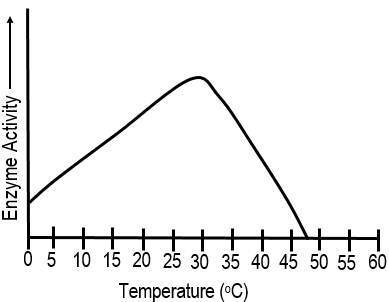
Based on the graph, what temperature does this enzyme work best? 
a)
15 C
b)
40 C
c)
30 C
d)
47 C
38.
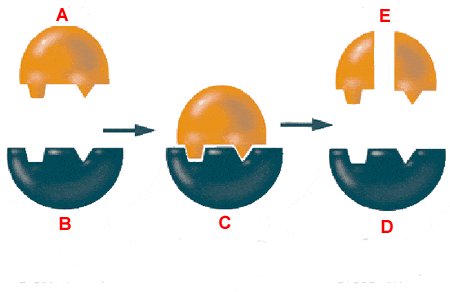
Letter D...
a)
active site
b)
enzyme
c)
substrate
d)
products
39.
Letter C...
a)
active site
b)
enzymes
c)
substrate
d)
products
40.
Letter E...
a)
active site
b)
enzyme
c)
substrate
d)
products
41.
Rapid growth during puberty causes your body to release more and more growth hormones. As you grow, more and more growth hormones are released until puberty is reached, and then the hormones stop.
a)
Positive Feedback Response
b)
Negative Feedback Loop 
42.
If the calcium in your blood decreases below homeostasis levels, a gland in the brain will sense the decrease and send a chemical message to your bones. Your bones will release calcium into the blood, bringing blood calcium levels back up.
a)
Positive Feedback Response
b)
Negative Feedback Loop 
43.
When glucose levels in the blood rise, your brain sends a signal to your pancreas. The pancreas releases insulin, which opens channels in cell membranes to allow glucose to enter the cell, lowering blood sugar levels. 
a)
Positive Feedback Response
b)
Negative Feedback Loop 
44.
Homeostasis
a)
allows for a wildly fluctuating internal environment
b)
is impossible in vertebrates
c)
is the maintenance of a relatively stable internal environment and often incorporates a form of feedback regulation
d)
is the maintenance of a relatively stable external environment and often incorporates a form of feedback regulation
45.
When you get cut, your skin cells release hormones that signal platelets to come and stop the bleeding. Platelets then release more hormones that signal even more platelets to help stop bleeding. The hormone signals continue until the cut is closed.
a)
Positive Feedback Response
b)
Negative Feedback Loop 
46.

Which body system controls the body to maintain homeostasis?

a)

excretory

b)

nervous

c)

circulatory

d)

skeletal

47.

What is the key function of the respiratory system?

a)

digestion of food

b)

allows movement

c)

exchanges gases

d)

processes energy

48.

How are viruses, fungi, bacteria, and parasites similar?

a)

they all carry out sexual reproduction

b)

they are all living

c)

they are all made up of cells

d)

they all contain genetic material

49.

Check the two correct boxes:

a)

Plant Cell - cell plate; Animal Cell - cleavage furrow

b)

Plant Cell - cleavage furrow; Animal Cell - cell plate

50.
A process where one cell forms two identical daughter cells is called...
a)
cell cycle
b)
cell division (mitosis)
c)
interphase
d)
cytokinesis
51.
The cell cycle is ______________.
a)
the process of cells circling throughout the body
b)
the process of splitting the organelles
c)
a process where one cell gets energy
d)
the sequence of stages of growth and division that a cell undergoes
52.
The stages of mitosis in order
a)
Metaphase, Anaphase, Prophase, Telophase
b)
Prophase, Anaphase, Metaphase, Telophase
c)
Prophase, Metaphase, Anaphase, Telophase
d)
Anaphase, Prophase, Telophase, Metaphase
53.

What is Cell differentiation

a)

A process in which an unspecialised cell develops into a specialized type of cell.

b)

A process in which an specialised cell develops into a unspecialised type of cell.

c)

A process in which an egg cell in fertilised

d)

A process where a fertilized egg cell sinks into the wall of the uterus.

54.
All our cells, except sex cells like eggs or sperm, have ___________ DNA
a)
different
b)
similar
c)
exactly the same
d)
half the amount of 
55.
How do stem cells know what type of cells to differentiate into?
a)
The nucleus has instructions to turn some genes on and some genes off
b)
Signals from chemicals in the organism or from the environment determine which genes will be turned on and off
c)
Genes turn on and off randomly
d)
The cell has unique DNA that determines what the cell will become.
56.
In what way is the DNA of a nerve cell different from the DNA of a muscle cell?
a)
The DNA is the same but each cell contains different genes
b)
The DNA is the same but different genes are turned on in each cell
c)
Each cell has its own unique DNA
d)
The DNA is different, but each cell contains the same genes
57.
The diagram shows the process of cell specialization from a single stem cell. Which of the following statements is true about the process of specialization.
a)
Specilized cells (blood, skin, nervous etc) cannot be produced from a single stem cell
b)
Specilized cells are produced immediately following fertilization
c)
Even though all the cells in an organism come from one single cell, they can specialize into different cell types
d)
Sincce all the cells in an organism come from one single cell, they must all have the same structure and function
58.
Which organelle performs PHOTOSYNTHESIS?
a)
Chloroplast
b)
Mitochondria
59.
Which of the following is the correct equation for PHOTOSYNTHESIS?
a)
CO+ light + H2O --> O+ Sugar
b)
CO+ sugar + H2O --> O+ light
c)
O2 + light + H2O --> CO+ Sugar
d)
CO+ O2 + H2O --> Light+ Sugar
60.
What is the ultimate ORIGINAL source of energy for living things
a)
Sugar
b)
Sun
c)
Moon
d)
Carbon Dioxide
61.
Which gas is removed from the atmosphere during photosynthesis?
a)
hydrogen
b)
oxygen
c)
nitrogen
d)
carbon dioxide
62.
What are the products of photosynthesis?
a)
water and carbon dioxide
b)
oxygen and glucose
c)
oxygen and carbon dioxide
d)
oxygen and water
63.
Why do we eat food?
a)
to provide energy/fuel
b)
to eliminate waste products
c)
to prevent diseases
d)
to kill pathogens
64.
What gets used during the light dependent reaction?
a)
water and oxygen
b)
NADPH, ATP & carbon dioxide
c)
carbon dioxide and oxygen
d)
water and sunlight
65.
What gets made during the light dependent reaction?
a)
water and oxygen
b)
NADPH, ATP & oxygen
c)
carbon dioxide and oxygen
d)
water and sunlight
66.
What gets made during the light independent reaction?
a)
water and oxygen
b)
NADPH, ATP & oxygen
c)
glucose
d)
water and sunlight
67.
What gets used during the light independent reaction?
a)
water and oxygen
b)
NADPH, ATP & carbon dioxide
c)
glucose
d)
water and sunlight
68.
What is labeled A?
a)
Light Independent Reaction
b)
Dark Reaction
c)
Light Dependent Reaction
d)
Calvin Cycle
69.
Organic compounds are always based on what element?
a)
hydrogen
b)
water
c)
carbon
d)
arsenic
70.
The 4 macromolecules are
a)
vitamins, lipids, water, micronutrients
b)
micronutrients, macronutrients, water, vitamins
c)
Lipids, Waxes, Vitamin A, Water
d)
Carbohydrates, Lipids, Proteins, Nucleic Acids
71.
Which biomolecule contain your genetics?
a)
Carbohydrate
b)
Lipid
c)
Nucleic Acid
d)
Protein
72.
Which biomolecule contains fats and oils?
a)
Proteins
b)
Nucleic Acid
c)
Lipids
d)
Carbohydrate
73.
Which biomolecule is your main source of quick energy?
a)
Nucleic Acid
b)
Protein
c)
Lipid
d)
Carbohydrate
74.
Which biomolecule is made of amino acids?
a)
Nucleic Acid
b)
Carbohydrate
c)
Protein
d)
Lipid
75.
Which biomolecule is responsible for insulation and energy storage?
a)
Protein
b)
Nucleic Acid
c)
Lipid
d)
Carbohydrate
76.

Which biomolecule helps form muscles?

a)

Nucleic Acid

b)

Carbohydrate

c)

Protein

d)

Lipids

77.
Which biomolecule is made of nucleotides and contain you DNA?
a)
Carbohydrate
b)
Lipids
c)
Protein
d)
Nucleic Acid
78.
Which biomolecule are in starches and fibers?
a)
Lipid
b)
Protein
c)
Nucleic Acid
d)
Carbohydrate
79.
Which biomolecule is also known as enzymes?
a)
Carbohydrate
b)
Lipid
c)
Nucleic Acid
d)
Protein
80.
Where does cellular respiration occur?
a)
Nucleus
b)
Mitochondria
c)
Vacuole
d)
Chloroplast
81.
This is referred to as the energy currency of the cell
a)
ADP
b)
ATP
c)
Mitochondria
d)
Nucleus
82.
What is the net gain of ATP during glycolysis?
a)
1
b)
2
c)
3
d)
4
83.
Glycolysis takes place in the 
a)
mitochondria
b)
cell membrane
c)
cytoplasm
d)
nucleus
84.
This means that oxygen is needed
a)
anaerobic 
b)
aerobic
85.
What is the correct equation for cellular respiration?
a)
6O2 + C6H12O6 -> 6CO2 + 6H2O + Energy
b)
6O2 + C6H12O6 + Energy -> 6CO2 + 6H2O
c)
6CO2 + 6H2O -> 6O2 + C6H12O6 + Energy
d)
6CO2 + 6H2O + Energy -> 6O2 + C6H12O6
86.
Anaerobic respiration.....
a)
doesn't require CO2
b)
requires CO2
c)
doesn't require oxygen
d)
requires oxygen
87.
______________ produces the most ATP.
a)
photosnthesis
b)
aerobic respiration
c)
anaerobic respiration
d)
glycolysis
88.
What are the products of aerobic respiration?
a)
Glucose and oxygen
b)
Carbon dioxide and water
c)
Lactic acid
d)
Carbon monoxide
89.
What is cellular respiration?
a)
the breakdown of glucose  to release ATP
b)
the breakdown of glucose to release NADH
c)
the breakdown of glucose to release FADH
d)
the breakdown of glucose to release carbon
90.
What do viruses need to reproduce?
a)
they need genetic material
b)
They need a host cell
c)
They need  bacteria
d)
They need insulin
91.
Viruses are...
a)
prokaryotic
b)
eukaryotic
c)
non-living
d)
endospores
92.
What do viruses have in common with living cells? They both...
a)
store genetic information
b)
have chloroplasts
c)
use glucose for cellular respiration
d)
have endoplasmic reticulum
93.
Which of the following is something bacteria and viruses have in common?
a)
they are both living
b)
they are both cells
c)
they can both cause disease
d)
they are both non-living
94.

How do viruses reproduce?

a)

Lytic Cycle

b)

Mitosis

c)

Meiosis

d)

Lysogenic Cycle

95.
If you are feeling ill and the doctor prescribes you some antibiotics to help you feel better, you are infected with a _______
a)
Virus
b)
Bacteria
96.
Gonorrhea is sexually transmitted from person to person. The best treatment for this infection is an antibiotic. Is Gonorrhea a bacterial or viral infection
a)
Bacterial
b)
Viral
97.
In the United States, the 1952 polio epidemic became the worst outbreak in the nation’s history. It spreads through contact with the stool of an infected person and droplets from a sneeze or cough. Vaccinations can help prevent polio infections. Is polio a virus or a bacteria?
a)
Bacteria
b)
Virus
98.
You are travelling the Oregon Trail with your family and just drank from a dirty puddle of water. Sadly, a week later, you died of dysentery. Is dysentery more likely to be caused by a virus or a bacteria?
a)
Bacteria
b)
Virus
99.
Superbugs are deadly. But what are they?
a)
Bugs that take after superman
b)
Bacteria that have developed resistance to antibiotics by mutation
c)
A certain illness that causes severe headaches and possibly death to its victims
d)
A virus that has developed resistance to antibiotics by mutation