Wayground logo

Free Printable Worksheets

Font size

S
M
L
XL
Worksheets

BIO EOC

Total questions: 125

Worksheet time: 2hrs 52mins

Name
Class
Date
1.
Which macromolecule is made of simple and complex sugars?
a)
lipids
b)
proteins
c)
carbohydrates
d)
nucleic acids
2.
This is one job proteins do NOT have in the body
a)
storing genetic information
b)
structure
c)
speed up chemical reactions
d)
transport things through cell membrane
3.
All polymers are made up of...
a)
monosaccharides
b)
monomers
c)
proteins
d)
None of these
4.
What is the monomer of proteins?
a)
amino acids
b)
polypeptides
c)
nucleotides
d)
monosaccharides
5.
What are the four macromolecules?
a)
proteins, nucleic acids, carbohydrates, and lipids
b)
monosaccharides, lipids, polysaccaharides, and proteins
c)
RNA, DNA, proteins, and carbohydrates
d)
proteins, DNA, RNA, and steroids
6.
Which macromolecule is this?
a)
carbohydrate
b)
lipid
c)
protein
d)
nucleic acid
7.
Which macromolecule is this?
a)
carbohydrate
b)
lipid
c)
protein
d)
nucleic acid
8.
Which macromolecule is this?
a)
carbohydrate
b)
lipid
c)
protein
d)
nucleic acid
9.
Which of the following organic compounds is the main source of energy for living things?
a)
proteins
b)
nucleic acids
c)
carbohydrates
10.
Phospholipids are used in what biological structure?
a)
RNA
b)
DNA
c)
Cell membrane
d)
Cell wall
11.
Which term includes all the others in the list?
a)
starch
b)
monosaccharide
c)
polysaccharide
d)
carbohydrate
12.
These molecules are examples of _________.
a)
amino acids
b)
triglycerides
c)
monosaccharides
d)
lipids
13.
All organic compounds contain the element
a)
carbon
b)
nitrogen
c)
phosphorus
d)
sulfur
14.
This molecule would be classified as a _______.
a)
lipid
b)
protein
c)
carbohydrate
d)
nucleic acid
15.
Carbohydrates are made of... 
a)
C H O
b)
C H O N
c)
C H O N P
d)
C H O N S
16.
The picture indicates which macromolecule? 
a)
Carbohydrates
b)
Lipids
c)
Proteins
d)
Nucleic Acids 
17.
The picture indicates which macromolecule? 
a)
Carbohydrates
b)
Lipids
c)
Proteins
d)
Nucleic Acid
18.
Basic building blocks of a cell such as a nucleus and mitochondria.
a)
Cell
b)
Macromolecule
c)
Organelle
d)
Atoms
19.
Plays a specific role in an organism, such as the heart, brain, or kidneys.
a)
Organism
b)
Cells
c)
Tissues
d)
Organ
20.
Plants, animals, fungi, and bacteria that can respond to stimuli in an environment, reproduce, grow, and maintain their internal environment.
a)
Organisms
b)
Organ System
c)
Molecule
d)
Cell
21.
Composed of cells from the same origin. Connective, muscle, epithelial, and nerve.
a)
Cell
b)
Tissue
c)
Organ System
d)
Molecules
22.
Is this the correct order? Atoms, Molecules, Cells, Tissues, Organ, Organ System, Organism
a)
Yes
b)
No
23.

What is a STEM cell?

a)

A cell found in the stem of a plant

b)

An unspecialised cell

c)

A differentiated cell

d)

An embryonic cell

24.
When cells become specialised for a particular role, it is known as ...?
a)
cell differentiation
b)
cell replication
c)
cell reproduction
d)
cell mitosis
25.
What process best explains how a nerve cell and a muscle cell can both develop from the same fertilized egg?
a)
differentiation
b)
natural selection
c)
selective breeding
d)
genetic engineering
26.
Which of the following is not an abiotic factor?
a)
Sunlight
b)
bacteria
c)
pH
d)
water
27.
Which of the following are biotic?
I.  Decomposers
II.  Energy flow
III.  Producers
a)
I only
b)
II only
c)
III only
d)
I and III
28.
Choose the correct sequence for energy flow within an ecosystem
a)
herbivores --> producers --> carnivores --> scavengers
b)
producers --> herbivores  --> carnivores --> scavengers
c)
producers --> carnivores --> herbivores --> scavengers
d)
carnivores --> scavengers --> herbivores --> producers
29.
Of the following, which are products of photosynthesis?
I.  Glucose
II.  Carbon dioxide
III.  Water
a)
I only
b)
II only
c)
III only
d)
I, II, and III
30.
Which group of organisms performs photosynthesis?
a)
Autotrophs
b)
Scavengers
c)
Heterotrophs
d)
consumers
31.
Which of the following organisms performs cellular respiration? I.  Autotrophs II.  Heterotrophs III.  Decomposers
a)
I only
b)
II only
c)
III only
d)
I, II and III
32.
How is the majority of energy within an ecosystem lost?
a)
heat loss
b)
energy used to grow biomass
c)
cellular respiration
d)
cellular metabolism
33.
Use Figure 3-1. Which of the organisms illustrated above would be the top predator?
a)
zebra
b)
hyena
c)
lion
d)
cheetah
34.
Use Figure 3-2. How would you describe the relationship between temperature of a continental ecosystem and net primary productivity based on the data provided?
a)
there is no clear relationship between temperature and productivity
b)
the warmer the ecosystem, the higher the productivity 
c)
the colder the ecosystem the higher the productivity
d)
the warmer the ecosystem, the lower the productivity
35.
Use Figure 3-3. Looking at the ecological pyramid above, what would be the most likely number of joules to fill in X, Y and Z?
a)
X=100; Y=1000; Z=10,000
b)
X=1; Y=500; Z=10,000
c)
X=10,000; Y=500; Z=1
d)
X=50; Y=50,000; Z=500,000
36.
Humans have a considerable effect on the hydrologic cycle. Which of the following has a direct effect on this cycle?
I.  Deforestation
II.  Urbanization
III.  Mining of fossil fuels
a)
I only
b)
II only
c)
I and II
d)
I, II and III
37.
Which of the following is considered to be the most important element in living organisms?
a)
carbon
b)
hydrogen
c)
oxygen
d)
phosphorus
38.
What impact does deforestation have on the carbon cycle?
a)
Increase in amount of CO2 in the atmosphere
b)
decrease in amount of CO2 in the atmosphere
c)
Increase in amount of photosynthesis
d)
Increase in the amount of cellular respiration performed by autotrophs
39.
What group of organisms is primarily responsible for the processes that occur in the nitrogen cycle?
a)
Autotrophs
b)
heterotrophs
c)
bacteria
d)
detritovores
40.
What is the major source of phosphorus on land?
a)
Deposition from atmospheric phosporus
b)
compounds that are formed by autotrophs during photosynthesis
c)
compounds released from the weathering of rocks
d)
compounds formed from bacterial conversion
41.
What happens during nitrogen fixation?
a)
Bacteria in the soil convert nitrate into nitrogen gas and nitrous oxide.
b)
Nitrogen wastes are into ammonium.Organisms convert nitrogen into carbon dioxide and energy,
c)
Organisms convert nitrogen into carbon dioxide and energy,
d)
Atmospheric nitrogen diffuses into the soil and is converted into ammonia.
42.

An organism at the second trophic level would be considered a...

a)

Top carnivore

b)

Producer

c)

Herbivore

d)

Carnivore

43.

A collection of organisms that make up a community as well as all of the nonliving aspects of the environment.

a)

Population

b)

Community

c)

Habitat

d)

Ecosystem

44.

Water temperature would be an example of ...

a)

A biotic factor

b)

An abiotic factor

45.

The living portions of the ecosystem

a)

Biotic factors

b)

Abiotic factors

46.

The amount of energy that usually transfers from one trophic level to the next...

a)

10%

b)

20%

c)

80%

d)

50%

47.

Organisms that look similar and can produce fertile offspring

a)

Species

b)

Fish

c)

Community

d)

Trees

48.

Carbon is recycled mostly through

a)

transpiration

b)

photosynthesis and respiration

c)

condensation

d)

mountain formation

49.
The movement of organisms into a given area from another area is called
a)
immigration
b)
emigration
c)
population shift
d)
carrying capacity
50.
When organisms move out of the population, this is known as
a)
emigration
b)
abandonment
c)
immigration
d)
succession
51.
When individuals in a population reproduce at a constant rate, it is called
a)
logistic growth
b)
growth density
c)
exponential growth
d)
multiple growth
52.
As resources in a population become less available, population growth
a)
declines rapidly
b)
increases slowly
c)
reaches carrying capacity
d)
enters a phase of exponential growth
53.
A biotic or an abiotic resource in the environment that causes population size to decrease is a 
a)
carrying capacity
b)
limiting nutrient
c)
limiting factor
d)
growth factor
54.

Which of the following is a density-independent limiting factor?

a)

earthquake

b)

disease

c)

emigration

d)

parasitism

55.
A relationship in which one organism is helped and another organism is neither helped nor hurt is called
a)
mutualism
b)
parasitism
c)
competition
d)
commensalism
56.
A form of symbiosis in which both organisms benefit is called
a)
mutualism
b)
parasitism
c)
competition
d)
commensalism
57.
A type of symbiosis in which one organism benefits and the other is harmed is called
a)
mutualism
b)
parasitism
c)
commensalism
d)
predation
58.
Natural disturbances, such as fires or hurricanes, can result in
a)
commensalism
b)
competition
c)
parasitism
d)
ecological succession
59.
The disappearance of a population in a given niche as a result of direct competition with another species for a resource is called
a)
competitive exclusion
b)
predation
c)
parasitism
d)
mutualism
60.
After a natural disaster occurs in a healthy ecosystem, secondary succession will cause the ecosystem to return to its original ________________________.
a)
climax community.
b)
valley community.
c)
habitat.
d)
pioneering species.
61.
Primary succession is
a)
a series of predictable changes that occur in a community over time.
b)
succession that occurs on surfaces where no soil exists. 
c)
a disturbance that changes a community without removing the soil.
d)
a process by which one monarch succeeds another. 
62.
Secondary succession follows
a)
a series of predictable changes that occur in a community over time.
b)
succession that occurs on surfaces where no soil exists. 
c)
a disturbance that changes a community without removing the soil.
d)
a process by which one monarch succeeds another. 
63.
A relationship between two organisms in which one organism benefits and the other is unharmed
a)
Mutualism 
b)
Competition
c)
Parasitsm 
d)
Commensalism 
64.
_______________ is the clearing of forests on a massive scale.
a)
Delimbing
b)
Reforestation
c)
Deforestation
d)
Detreeing
65.
what is the leading cause of deforestation?
a)
Diseases 
b)
Housing market
c)
Agriculture and Farming
d)
Paper mill
66.
What is global warming?
a)
the steady rise of earth's daily temperature
b)
the rapid rise of Earth's average temperature
c)
the steady rise of the United States' daily temperature
d)
the rapid rise of the United States' average temperature
67.
How does global warming affect polar bears?
a)
It could drive polar bears to warmer climates
b)
It could cause wildfires in polar bears' habitats
c)
It could cause severe weather patterns in the Arctic
d)
It could melt the sea ice which would impact their food supply
68.
What absorbs ultraviolet rays in the atmosphere?
a)
troposphere
b)
stratosphere
c)
ozone layer
d)
greenhouse gases
69.
What does this diagram illustrate?
a)
Ozone Layer
b)
The Greenhouse Effect
c)
Ultraviolet Radiation
d)
Layers of the atmosphere
70.

Which is a way to limit deforestation?

a)

use more wood products

b)

plant and harvest trees on tree farms

c)

increase carbon dioxide levels

d)

fertilize the soil

71.

The sulfur and nitrogen compounds in smog combine with water to form

a)

ozone.

b)

ammonia.

c)

acid rain.

d)

chloroflurocarbons.

72.

The number of different organisms in the biosphere is called

a)

biodiversity

b)

ecosystem diversity

c)

genetic diversity

d)

species diversity

73.

Biodiversity is valuable in the biosphere because it

a)

gives us interesting things to look at.

b)

tells us about many other species.

c)

is the biological life-support system of our planet.

d)

provides humans with resistance to disease.

74.

As DDT moves up the trophic levels in food chains, its concentration

a)

stays the same.

b)

decreases.

c)

increases.

d)

is eliminated.

75.

The goals of conservation biology include all of the following EXCEPT

a)

wise management of natural resources.

b)

protection and management of individual species.

c)

preservation of habitats and wildlife.

d)

introducing foreign species into new environments.

76.
Imported plants and animals in Hawaii have
a)
caused native species to die out.
b)
increased the native bird species.
c)
improved soil fertility.
d)
increased crop yields.
77.

Using resources in an environmentally conscious way

a)

Biodiversity

b)

Sustainable Development

c)

Ecological Hot Spot

78.

Increasing concentration of a harmful substance in organisms at higher trophic levels in a food chain or food web.

a)

Biodiversity

b)

Biological Magnification

c)

Generic Diversity

79.

The total area of functioning land and water ecosystems needed both to provide resources an individual or population uses and to absorb and make harmless waste that individuals or populations generate.

a)

Pollutant

b)

Acid Rain

c)

Ecological Footprint

80.
Translation is the process where
a)
mRNA is created in the Nucleus
b)
mRNA is decoded to form a protein 
c)
glucose molecules are made
d)
is where lipids are synthesised
81.
What is the location in the cell for transcription?
a)
nucleus
b)
cytoplasm
c)
ribosome
d)
mitochondria
82.
What is the location in the cell for translation?
a)
nucleus
b)
mitochondria
c)
ribosome
d)
chloroplast
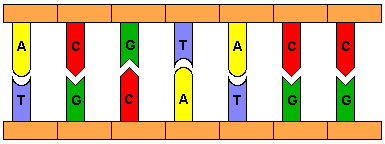
83.
In DNA, Adenine pairs with ___________. 
a)
Guanine
b)
Cytosine
c)
Thymine
d)
Uracil
84.
The process to go from DNA to mRNA is _______
a)
translation
b)
transcription
c)
replication
85.
The process to go from mRNA to a protein is called ____
a)
transcription
b)
rRNA
c)
replication
d)
translation
86.
Which of the following is a phenotype?
a)
Aa
b)
red hair
c)
heterozygous
d)
DNA
87.
Dominant alleles are represented by a:
a)
Male gene
b)
lowercase letter
c)
recessive trait
d)
capital letter
88.
How many boxes would say BB?
a)
1
b)
2
c)
4
d)
0
89.
The dominant trait is
a)
yellow pea seeds
b)
green pea seeds
c)
there is no dominant seed
d)
Jolly green giant
90.
bb is a _________________ genotype
a)
Dominant
b)
Homozygous
c)
Genotype
d)
Phenotype
91.
Which of the following genotypes is heterozygous?
a)
Bb
b)
BB
c)
bb
d)
B
92.
Which of the following is homozygous recessive?
a)
rr
b)
AA
c)
TT
d)
Ff
93.
The cells produced via meiosis are called:
a)
sex cells
b)
somatic cells
c)
body cells
d)
skin cells
94.
Unlike mitosis, meiosis in male mammals results in the formation of
a)
one haploid gamete
b)
three diploid gametes
c)
four diploid gametes
d)
four haploid gametes
95.
If the Diploid number of Carrots is 18, the haploid number is
a)
18
b)
9
c)
27
d)
36
96.
If a body cell in a butterfly contains 24 chromosomes, a butterfly egg would contain
a)
3
b)
6
c)
12
d)
24
97.
How many daughter cells are produced from meiosis ?
a)
10
b)
6
c)
4
d)
2
98.
Name the growth phase of the cell cycle for both Mitosis and Meiosis.
a)
metaphase
b)
telophase
c)
interphase
d)
anaophase
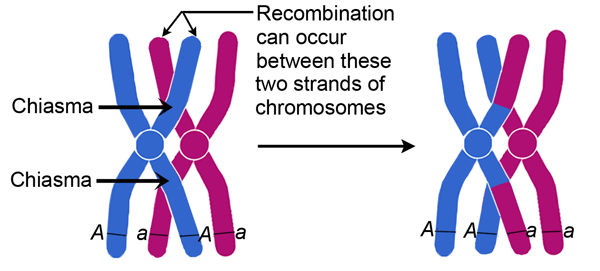
99.
This image shows chromosomes during Prophase 1. Which of the following correctly describes the process shown?
a)
segregation of sister chromatids
b)
condensation and segregation of alleles
c)
mutationin which the DNA content of the gene is altered
d)
crossing - over in which alleles are exchanged
100.
Why do we need meiosis?
a)
To double the number of chromosomes going into sex cells
b)
To halve the number of chromosomes going into sex cells
c)
To triple the number of chromosomes going into sex cells
d)
To not change the number of chromosomes going into sex cells
101.
products of meiosis are genetically
a)
different
b)
identical
102.
This picture shows which process? 
a)
mitosis
b)
meiosis
c)
the cell cycle
103.
Human eggs and sperm are _____, and each has ____ chromosomes.
a)
diploid, 23
b)
diploid, 46
c)
haploid, 23
d)
haploid, 46
104.

different versions of the same gene

a)

Dominate Allele

b)

Genotype

c)

Phenotype

d)

Recessive Allele

e)

Allele

105.

A plant that has purple flowers is crossed with one that has white flowers. The offspring were half white and half purple. What were the genotypes of the parents?

a)

Pp x pp

b)

Pp x Pp

c)

PP x pp

d)

PP x WW

106.
Purple is dominant to white. A heterozygous purple flower is crossed with a white flower. What are the genotypes and phenotypes of the offspring?
a)
100% Pp (purple)
b)
50% Pp (purple); 50% pp (white)
c)
75% Pp (purple); 25% pp (white)
d)
25% PP, 50% Pp, 25% pp
75% purple, 25% white
107.
Fruit fly body cells have 8 chromosomes. After mitosis, you would expect a resulting fruit fly daughter cell to have -
a)
16 chromosomes.
b)
46 chromosomes.
c)
8 chromosomes.
d)
4 chromosomes.
108.
Ostrich wings are examples of
a)
homologous structures
b)
vestigial structures
c)
adaptations
d)
traits
109.
Dolphins have the same arm structure as wolfs, what type of evidence for evolution does this represent?
a)
DNA
b)
vestigial structures
c)
homologous structures
d)
embryology
110.
What would indicate that a series of fossils represent evolution?
a)
the fossils were identical
b)
the fossils were found in the same layers of rock
c)
the fossils show similarities
d)
the fossils were completely different
111.
Why do embryologist study embryos?
a)
to see if they are related
b)
to understand adaptations
c)
to determine the age
d)
to learn what parents are vestigial
112.
What is embryology?
a)
the age of organisms
b)
the oldest stage of development
c)
the life span of an organism
d)
the earliest growth stage of development
113.
Change over time is
a)
evolution
b)
generation
c)
growth
d)
biogenesis
114.
Natural selection is
a)
survival of the fittest
b)
humans change
c)
two species are the same
d)
more animals survive
115.
This makes an organism more suited to its enviornment
a)
species
b)
lifespan
c)
adaptation
d)
mutation
116.
The tree of life is a metaphor for what idea?
a)
we came from a common ancestor
b)
we need water and sunlight to survive
c)
we have multiple species
d)
we are old
117.
In natural selection, the selective agent is the
a)
humans
b)
mutations
c)
breeders
d)
environment
118.
Mutations are important because they bring about
a)
death of the organism in which they develop
b)
genetic variation needed for a population to evolve
c)
benefits for the individual, not for the population
d)
Hardey-Weinberg equilibrium within a population
119.

What is the term for a feature that allows an organism to survive better in its environemtn?

a)

variation

b)

adaptation

c)

homologous structure

d)

vestigial structure

120.
What is the process in which humans breed organisms for certain traits?
a)
natural selection
b)
inheritance
c)
artificial selection
d)
descent withOUT modification
121.
The opossum and kangaroo both incubate their young in a pouch. This provides evidence that they---
a)
are descended from a common ancestor
b)
Have very similar skeletal structures
c)
belong to the same species
d)
must range great distances to eat
122.
The similarities among early stages of the embryos provide evidence that -
a)
these organisms evolved from a common ancestor
b)
the organisms all retained their gills and tails
c)
the organisms belong to the same species
123.
Scientists compare the limbs of organisms to look for evidence of common ancestry. These limbs provide evidence of common ancestry because they -
a)
perform the same function
b)
are the same size
c)
have the same basic structure
d)
are parts of the same animal
124.
If two organisms have similar traits of DNA they are probably
a)
share a common ancestor
b)
share a common environment
c)
share a common population
d)
speciation
125.
Common ancestry relates to evolution because
a)
evolution only happens when there are common ancestors.
b)
Common ancestors make evolution happen more quickly.
c)
evolution can never take place with common ancestors.
d)
the more two organisms have in common, the more recent is their common ancestor during their evolution.