wayground logo

Free Printable Worksheets

Font size

S
M
L
XL
Worksheets

5-1-2019 IPC-QUIZIZZ take untiil you make a 100%

Total questions: 65

Worksheet time: 3hrs 2mins
Name
Class
Date
1.

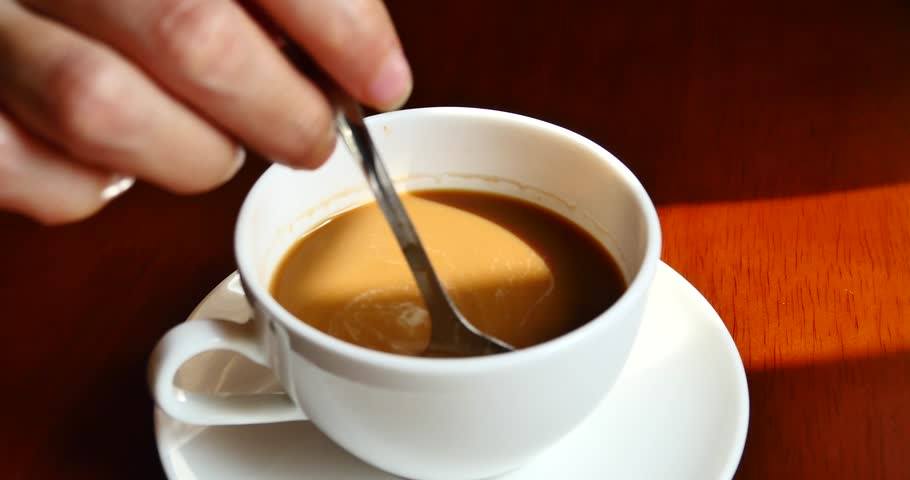
Hot coffee is stirred with a spoon, the spoon gets hot due to

a)

Convection

b)

Conduction

c)

Radiation

2.

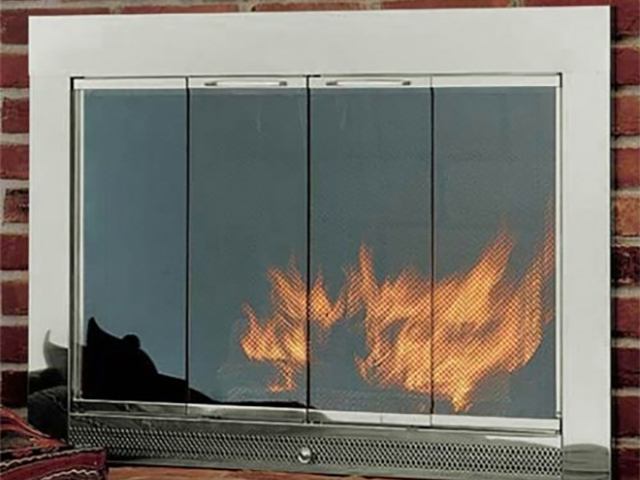
A chair is placed several feet from a fire in a fireplace. The fireplace has a glass screen. The side of the chair facing the fireplace gets warm because of

a)

Convection

b)

Conduction

c)

Radiation

3.

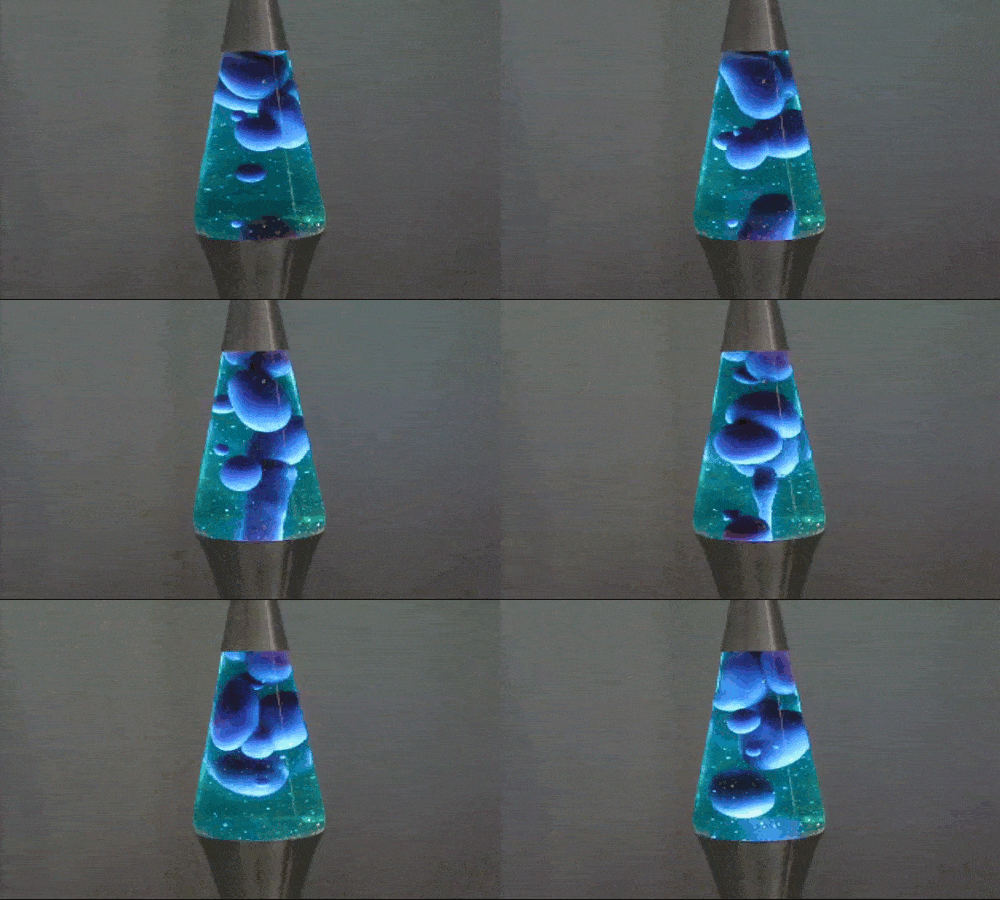
A certain type of decorative lamp contains colored liquids. These liquids form globs that break off and rise to the top of the liquid. The globs rise due to

a)

Convection

b)

Conduction

c)

Radiation

4.

Near the ceiling of a room the air is warmer. The warm air rises because of

a)

Convection

b)

Conduction

c)

Radiation

5.

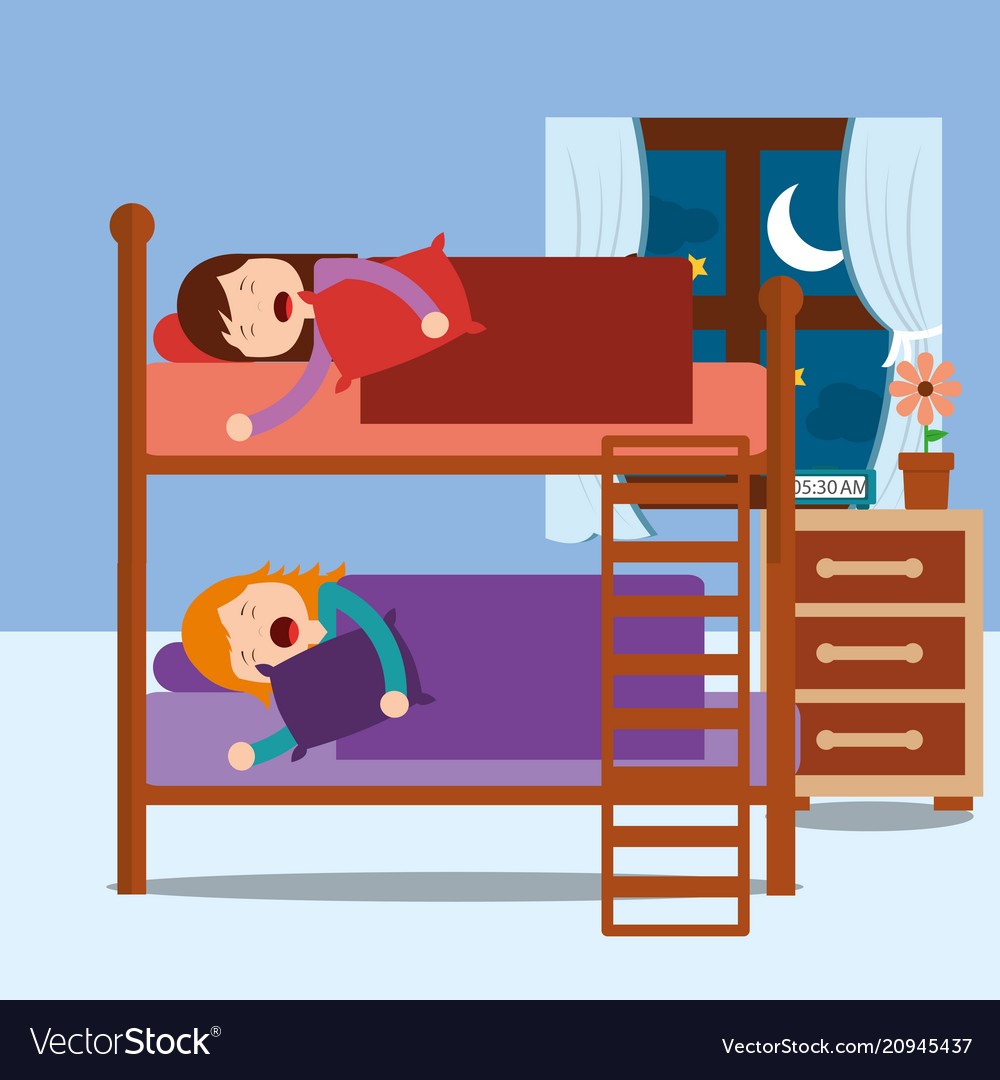
You are in the top bunk of a bunk bed and you want to turn the air conditioner on while your friend on the bottom bunk is fine is caused by

a)

Convection

b)

Conduction

c)

Radiation

6.

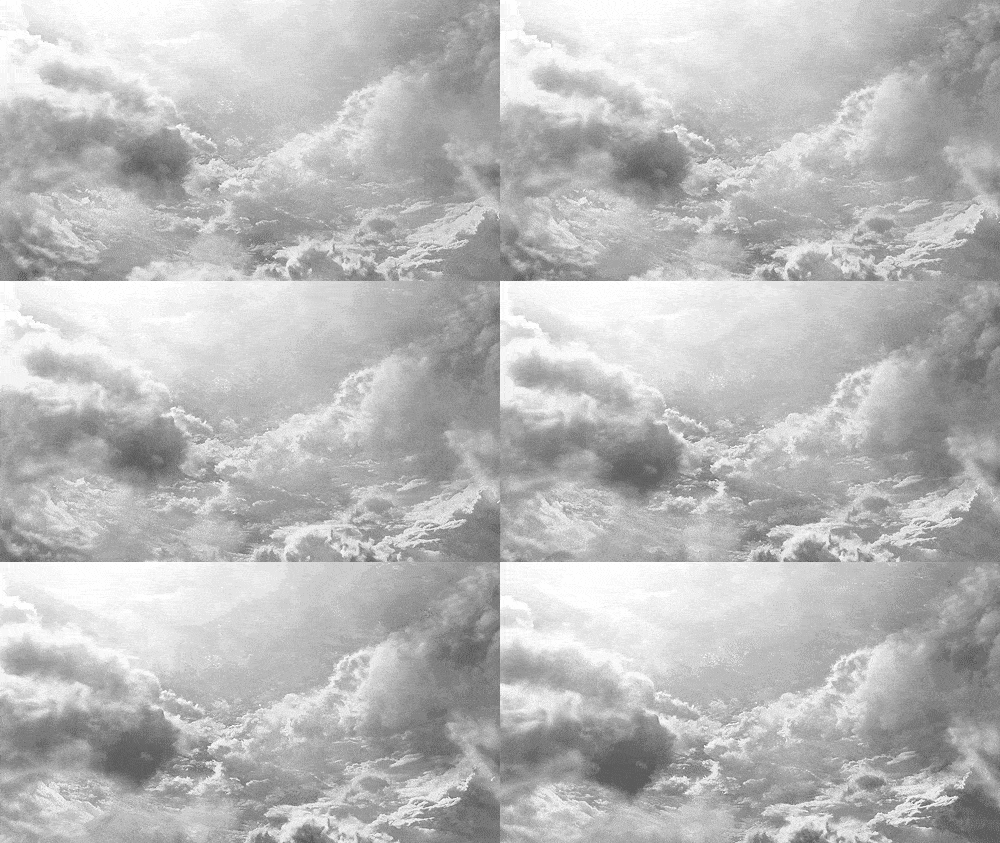
The cause of weather systems on earth is

a)

Convection

b)

Conduction

c)

Radiation

7.

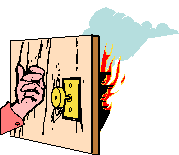
A fireman feels a door and it is hot. Why does his hand feel hot?

a)

Convection

b)

Conduction

c)

Radiation

8.

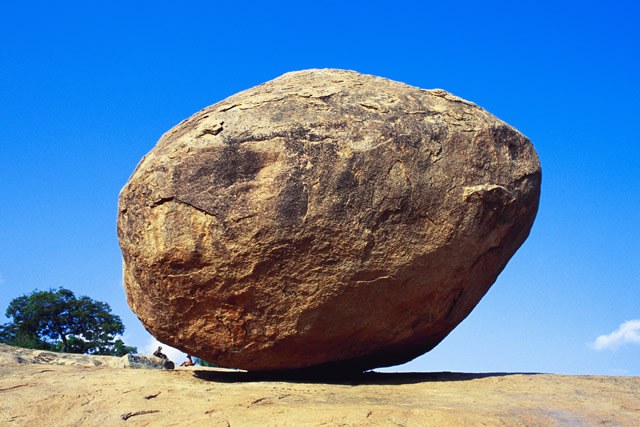
A huge boulder at the state park gets so hot during the day.

a)

Convection

b)

Conduction

c)

Radiation

9.

Warm air over the beach rises while cooler dense air from the ocean rushes in due to

a)

Convection

b)

Conduction

c)

Radiation

10.

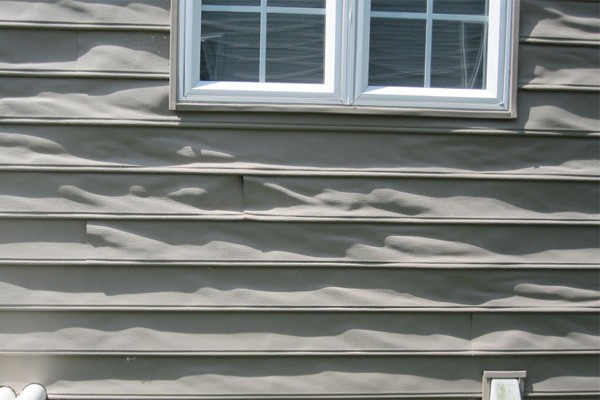
A house burns down. On the house across the street, all of the vinyl siding is twisted and warped by the heat. The heat was transferred across the street by

a)

Convection

b)

Conduction

c)

Radiation

11.

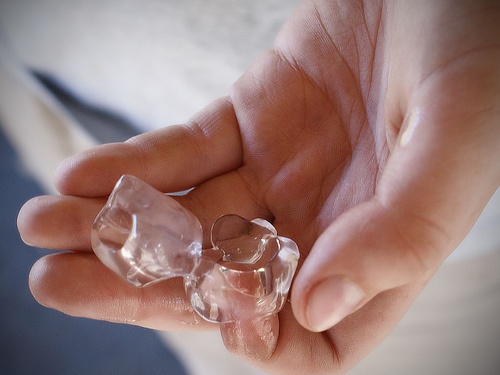
As you hold pieces of ice, they begi to melt from the warmth of you hand on them. This is because of

a)

Convection

b)

Conduction

c)

Radiation

12.

A group of friends gather around a fire to stay warm.

a)

conduction

b)

convection

c)

radiation

13.
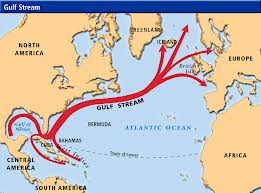
The Gulf Stream is a current that brings warm ocean water from the south to the north.
a)
conduction
b)
convection
c)
radiation
14.
In heat transfer, heat always flows from the _______________ substance to the _______________ substance.
a)
Hotter to colder
b)
Colder to hotter
c)
Hotter to hotter
d)
Colder to colder
15.
The type of heat transfer that happens through direct contact of molecules or particles with each other is ___________________.
a)
Convection
b)
Conduction
c)
Radiation
d)
insulation.
16.
The kind of heat transfer that travels through space in electromagnetic waves is ______________________.
a)
insulation.
b)
Radiation
c)
Conduction
d)
Convection
17.
___________________ is the type of heat transfer that occurs in fluids, such as warm air rising and cold air sinking; creating wind.
a)
Convection
b)
Conduction
c)
Radiation
d)
insulation.
18.

Which statement is true?

a)

The quicker a molecule moves, the colder it is.

b)

The slower a molecule moves, the warmer it is.

c)

The quicker a molecule moves, the warmer it is.
19.

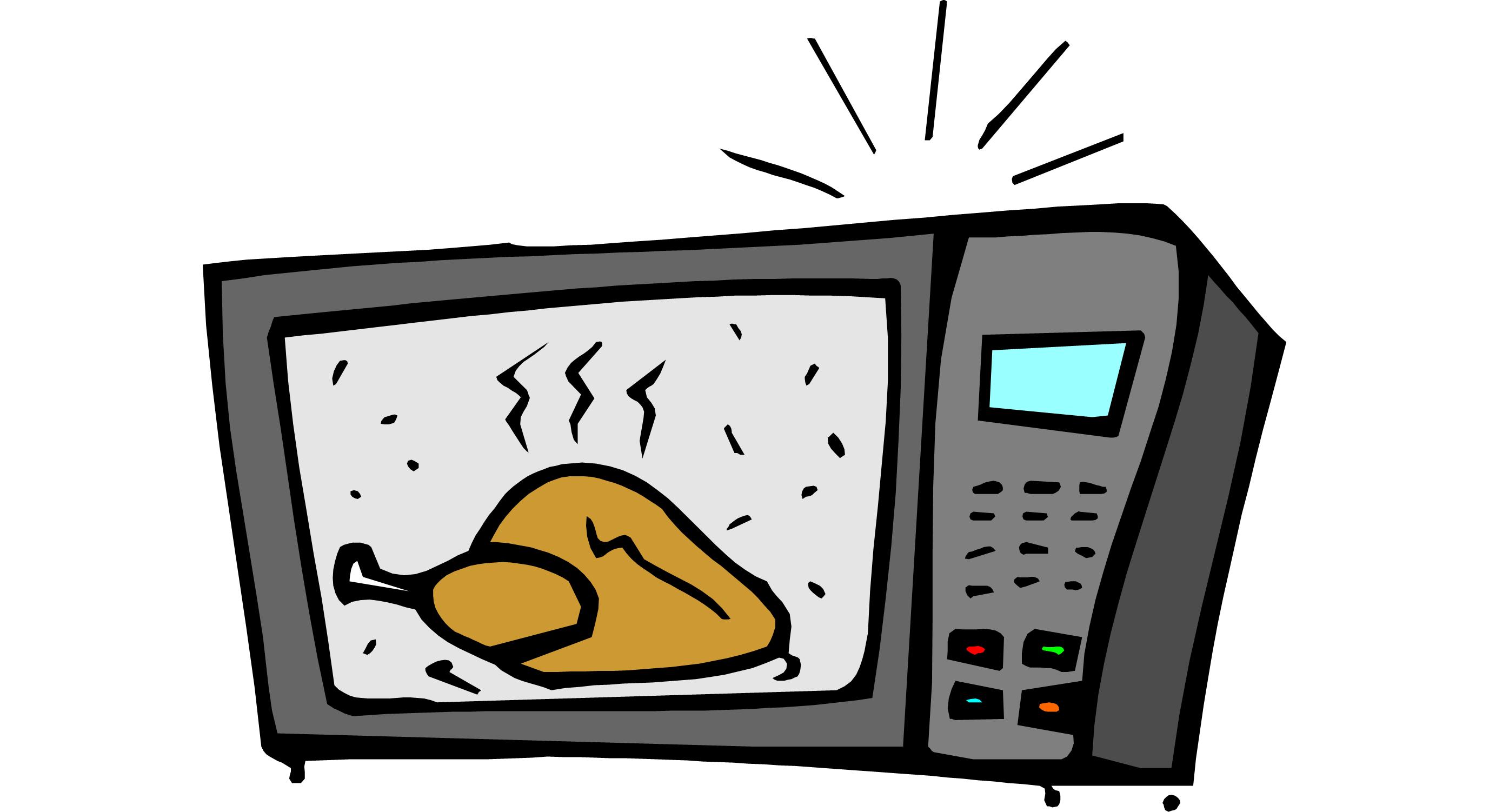
When you use a microwave, what is the main way that heat is transferred?

a)

Convection

b)

Conduction

c)

Radiation

20.

Dan heats up a sandwich in the microwave. What type of heat transfer is it from the microwave to the sandwich?

a)

convection

b)

conduction

c)

radiation

d)

microwave

21.

Jayden puts his hand in a fire. What heat transfer is it from the fire to Jayden's hand?

a)

Energy

b)

Convection

c)

Radiation

d)

None of the above

22.

Liam is cooking pasta. He starts with just a pot of hot water then he adds the cold pasta how does the pasta get cooked?

a)

conduction

b)

radiation

c)

convection

d)

conduction and convection

23.

How does heat move?

a)

In many directions

b)

from warm places to cooler places

c)

from cold places to warm places

d)

Both B and C

24.

How does heat move?

a)

In many directions

b)

from warm places to cooler places

c)

from cold places to warm places

d)

Both B and C

25.

All of the following are good conductors of heat EXCEPT

a)

Copper

b)

Iron

c)

Plastic

d)

Aluminum

26.

What is the term that refers to a material being a poor conductor of heat?

a)

Insulator

b)

conductor

c)

Convector

d)

Radiator

27.

Energy from the Sun travels to Earth as

a)

Conduction

b)

Convection

c)

Insulation

d)

Radiation

28.

A material that reduces the flow of heat is a(n)

a)

conductor

b)

insulator

c)

metal

d)

radiator

29.

What causes hot and cold water to become the same temperature once they are combined?

a)

The heat moves from cooler temperature to warmer temperature.

b)

The energy of the hot water runs out.

c)

Heat (thermal) energy from the hot water is transferred to the cold water.

d)

Heat (thermal) energy causes the water to boil.
30.

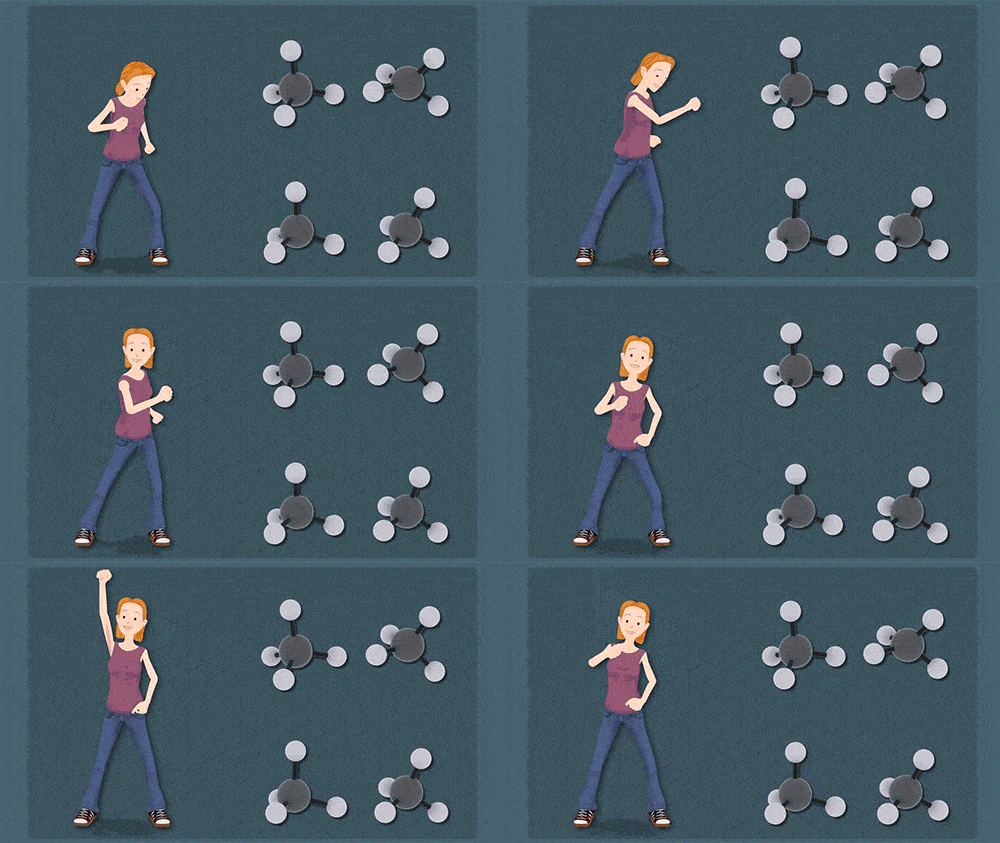
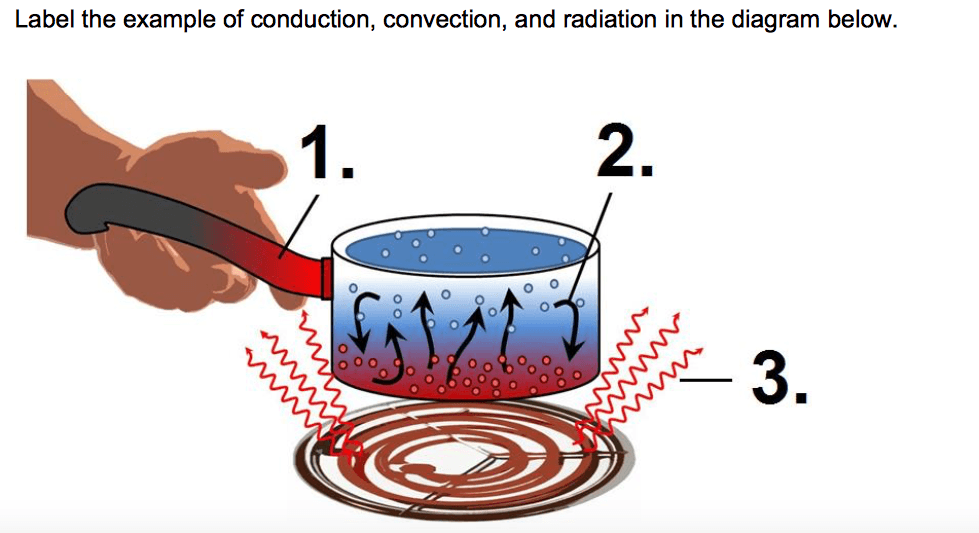
What type of thermal energy transfer is number 1 pointing to?

a)

Convection

b)

Conduction

c)

Radiation

d)

Insulation

31.

What type of thermal energy transfer is number 2 pointing to?

a)

Convection

b)

Conduction

c)

Radiation

d)

Insulation

32.

What type of thermal energy transfer is number 3 pointing to?

a)

Convection

b)

Conduction

c)

Radiation

d)

Insulation

33.
This is a measure of the average kinetic energy of the particles in an object.
a)
temperature
b)
thermal expansion
c)
electricity
d)
sound
34.

Heat is transferred by

a)

conduction, convection and radiation.

b)

radiation only.

c)

conduction and radiation only.

35.

Thermal energy is

a)

the average of the kinetic energy in an object

b)

the total energy of all the particles in an object

c)

is the temperature of an object.

37.

Thermal energy depends on

a)

the arrangement of the particles in an object.

b)

only on the number of particles in an object.

c)

an objects temperature, number of particles in it and how those particles are arranged.

37.

Thermal energy depends on

a)

the arrangement of the particles in an object.

b)

only on the number of particles in an object.

c)

an objects temperature, number of particles in it and how those particles are arranged.

38.
The amount of energy required to raise the temperature 1ºC for every kilogram is called____?
a)
Thermal Energy
b)
Specific Heat
c)
Temperature
d)
Kinetic Energy
39.
What unit do you use to measure Thermal Energy?
a)
J/Kg ºC
b)
Kg
c)
ºC
d)
J
40.
What is the symbol for Specific Heat
a)
Q
b)
t
c)
m
d)
C
41.
What is the symbol for Specific Heat
a)
Q
b)
t
c)
m
d)
C
42.
Water has a specific heat of 4184 J/KgºC.  Wood has a specific heat of 1760 J/KgºC.  What material needs more energy to raise the temperature 1ºC
a)
Wood
b)
Water
c)
Both are the same
43.
Copper, Stainless Steel, Carbon Steel, and Zinc were all heated using the same thermal energy.  What material would be the coolest after being heated?
a)
Copper
b)
Carbon Steel
c)
Zinc
d)
Stainless Steel
44.
A material was cooled from 100ºC to 40ºC.  What is the temperature change?
a)
60ºC
b)
40ºC
c)
-60ºC
d)
-40ºC
45.
What does temperature measure?
a)
Heat
b)
ºC
c)
Kinetic Energy
d)
Thermal Energy
46.
What is the SI unit for temperature?
a)
Kelvin
b)
Celcius
c)
Fahrenheit
d)
All of these
47.
What does temperature measure?
a)
Heat of Molecules
b)
ºC
c)
Average Kinetic Energy of Molecules
d)
Thermal Energy
48.
Specific heat is....
a)
The measure of kinetic energy of an objects particles
b)
A measure of the energy needed to increase the average kinetic energy of the particles
c)
The heating caused by the motion of flluid due to temperature difference
d)
The transfer of energy by electromagnetic radiation
49.
The amount of energy required to raise the temperature 1ºC for every kilogram is called____?
a)
Thermal Energy
b)
Specific Heat
c)
Temperature
d)
Kinetic Energy
50.
What is the equation to measure change in Thermal Energy?
a)
Q=mc∆t
b)
Q=mc
c)
Q= ∆mct
d)
m=QC
51.
There are four cups of hot cocoa. The cup sizes are shown. The temperature of the cocoa in each cup is 25 degrees celsius. Which cup has the MOST thermal energy?
a)
Large cup (Trenta)
b)
Small cup (Tall)
c)
Medium cup (Venti)
d)
All three are the same temperature so they have the same thermal energy
52.
What unit do you use to measure Thermal Energy?
a)
J/Kg ºC
b)
Kg
c)
ºC
d)
J
53.
Copper, Stainless Steel, Carbon Steel, and Zinc were all heated using 10,000 JOULES of thermal energy.  What material would be have the LARGEST change in temperature?
a)
Copper
b)
Carbon Steel
c)
Zinc
d)
Stainless Steel
54.
A high specific heat means...
a)
It requires less energy to change temperature
b)
It requires more energy to change temperature
c)
It heats up very quickly
55.
When a  piece of aluminum foil is taken out of the oven and cools from 100° C to 50°C, What is the change in temperature?
a)
50°
b)
c)
100°
d)
150°
56.
Copper, Stainless Steel, Carbon Steel, and Zinc were all heated using 10,000 JOULES of thermal energy.  Based on the chart, which material would be have the SMALLEST change in temperature?
a)
Copper
b)
Carbon Steel
c)
Zinc
d)
Stainless Steel
57.
The specific heat of aluminum is 0.21 cal/g°C.  How much heat(Q) is released when a 10 g piece of aluminum foil is taken out of the oven and cools from 100° to 50°?
a)
105 J
b)
10.5 J
c)
1.05 J
d)
50 J
58.
If 200 grams of water is to be heated from 24.0° C to  100.0° C to make a cup of tea, what is the mass and what is the change in temperature?
a)
m=100g,  ∆t= 224 C
b)
m=200g,  ∆t=124 C
c)
m=100g,  ∆t=24 C
d)
m=200g,  ∆t=76 C
59.
There are 2 pans of water, one has 100 mL in it and one has 1000mL. You add 4000 joules of energy,  which one has the bigger change in temperature?
a)
100 mL
b)
1000 mL
c)
They the same material so they both heat to the same temperature
d)
They both will cool down.
60.
20 g of water. specific heat of water is 4.18 J/g°C.  temperature changes from 25° C to 20° Chow much heat energy (Q) moves from the water to the surroundings?
a)
418 Joules
b)
209 J
c)
83 J
d)
4.18 J
61.
The specific heat(c) of copper is 0.39 J/g °C. What is the temperature change(∆t) when 100 Joules of heat(Q) is added to 20 grams of copper?
a)
12.82 °C
b)
24.12°C
c)
351 °C
62.
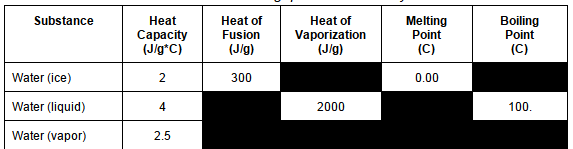
How many Joules of energy are required to change 10 gram of ice at -2 C to water at 20 C?
a)
440 J
b)
880 J
c)
10,140 J
d)
66,000 J
63.
What is the change in temperature when 50,000 Joules of energy is added to 200 grams of water at 25 C?
a)
0.016 C
b)
1,500 C
c)
63 C
d)
0.4 C
64.
How many Joules of energy are required to change 10 gram of water from 20 C to 90 C?
a)
1400 J
b)
2800 J
c)
210,000 J
d)
1,400,000 J
65.
How many Joules of energy are required to make 100 grams of ice at 0 C completely melt?
a)
200 J
b)
400 J
c)
30,000 J
d)
2,000,000 J