wayground logo

Free Printable Worksheets

NEW

Font size

S
M
L
XL
Worksheets

2021 Honors CFE Review Oceans and Weather

Total questions: 78

Worksheet time: 59mins

Name
Class
Date
1.
Deep Ocean currents are a result of
a)
Global Wind Patterns
b)
Earth's Rotation
c)
Density
d)
All of the above
2.
Due to the Coriolis Effect, water in the northern hemisphere moves
a)
clockwise
b)
counter clockwise
c)
both
d)
neither
3.
Warm ocean currents generally come from
a)
The North Pole
b)
The South Pole
c)
The Equator
d)
Both A and B
4.
The California Current (west coast) carries _________ water from canada
a)
Cold 
b)
Warm
c)
Freezing
d)
Fresh
5.
Two types of water currents are
a)
local and global
b)
sea and land
c)
surface and deep
d)
warm and cold
6.

A horizontal movement of ocean water that is caused mainly by wind and that occurs at or near the ocean's surface.

a)

Gulf Stream

b)

Global Conveyor Belt

c)

Surface Current

d)

Gyre

7.
Surface currents are a result of
a)
Global Wind Patterns
b)
Earth's Rotation
c)
Density
d)
All of the above
8.
What might happen if the global conveyor stopped?
a)
Marine life would get too much oxygen
b)
Marine life would get too little oxygen
c)
There would be no effect
d)
There would be a new ice age
9.
____________ are large streams of moving water that flow through the oceans.
a)
La Niña
b)
El Niño
c)
Currents
d)
Climate
10.
       ______ is the pattern of temperature and precipitation typical of an area over a long period of time.
a)
Climate
b)
Weather
c)
A season
d)
The Coriolis Effect
11.
Which of the following is caused by differences in ocean water density?
a)
surface currents
b)
 deep currents
c)
waves
d)
Coriolis effect
12.
How do warm-water currents affect the coastal areas along which they flow?
a)
Cool the coast
b)
Warm the coast
c)
Cause snow to fall
d)
Cause higher tides
13.
What name is given to large, destructive waves caused by underwater earthquakes and volcanoes?
a)
Spring tide
b)
Longshore current
c)
Tsunami
d)
Swell
14.
Upwelling is associated with
a)
a decrease in access to nutrients for phytoplankton
b)
cooler, nutrient-rich waters being pushed up from deeper ocean waters
c)
temperature gradients moving water from the equator to the poles
d)
an increase in human fatalities
15.
Where is ocean water the densest.
a)
The surface
b)
The middle
c)
The bottom
d)
Lake Michigan
16.
Currents are deflected to the _________ in the Northern Hemisphere.
a)
north
b)
right
c)
south
d)
left
17.
If the Earth did not rotate on its axis, there would be no
a)
Greenhouse effect
b)
Coriolis effect
c)
Global warming
d)
Convection
18.
The Coriolis Effect is caused by
a)
Earth rotating around the sun
b)
Earth rotating on its axis
c)
The tides
d)
Gravity
19.
Surface currents influence the climate on Earth because of which of the following?
a)
Cooler water sinks as hot water rises, which moderates the temperature.
b)
Surface currents do not influence the climate, deep water currents do.
c)
Warm equatorial water is moved to the poles, as cool polar water moves toward the equator.  This causes a moderation in temperature.
d)
The Gulf Stream flows all around the world, warming the continents it touches
20.
The large, slow moving circular surface-current pattern found in each ocean.
a)
global conveyor belt
b)
deep water current
c)
Gulf Stream
d)
gyre
21.
How are temperatures inland different than those places that are closer to the shore and experience cool ocean currents?
a)
Temperatures vary more than the shore
b)
Cooler than the shore
c)
Warmer than the shore
d)
No difference
22.

What part of the ocean would these chart be from?

a)

Polar areas

b)

Temperate areas

c)

Equator

23.

Which of these comes from the pole?

a)

the first one on the left

b)

the second one from the left

c)

the third one from the left

d)

the last one on the right

24.

What basic motion does water follow during the passage of a wave?

a)

forward with the energy

b)

backward as energy is released

c)

up and down as energy passes

d)

in a circular motion as energy passes

25.

Waves in the deep ocean move ...

a)

matter

b)

energy

c)

water molecules

d)

all of the above

26.
What causes vertical ocean currents?
a)
The phase of the moon.
b)
The gravitational attraction of the sun
c)
Commercial boating activities.
d)
The temperature and salinity of ocean water
27.
Two types of ocean currents are
a)
local and global
b)
sea and land
c)
surface and deep
d)
warm and cold
28.
Temperature and salinity differences in ocean water cause:
a)
Mid-ocean ridges
b)
Deep Currents
c)
Surface Currents
d)
High tide and low tide
29.
Due to the Coriolis Effect, water in the northern hemisphere moves
a)
clockwise
b)
counter clockwise
c)
both
d)
neither
30.
What is the primary source of energy that generates most ocean waves?
a)
earthquakes
b)
wind
c)
asteriods falling in the ocean
d)
volcanic eruptions
31.
Stronger winds create __________ waves.
a)
larger
b)
smaller
32.
Zoe is a meteorologist.  She is using a barometer.  What feature of weather is Zoe studying with a barometer?
a)
Humidity
b)
Wind Speed
c)
Temperature
d)
Air Pressure
33.
Imagine you hear the following weather report:   "Florida is sweltering in summer-like heat and humidity.  Ahead is a cold front that promises to bring down polar air from Canada and cool down the state next week."  What is a front?
a)
a region where there are severe thunderstorms
b)
an area where a tropical storm is likely to form
c)
a boundary between two air masses with the same temperature
d)
a boundary between two air masses with different densities and usually different temperatures
34.
Lightning can be very dangerous.  It can even cause death if it strikes a person or animal.  What is lightning?
a)
a type of tornado
b)
an expansion of air
c)
a mixture of warm air and cold air
d)
a sudden discharge of static electricity
35.
Thunderstorms in Florida are commonly accompanied by lightning, hail, high winds, and heavy rains. Which of the following is most likely to be caused by lightning?
a)
Flash floods
b)
Sinkholes
c)
Wildfires
d)
Crop damage
36.
Which of these substances is a liquid from of precipitation?
a)
Hail
b)
Rain
c)
Sleet
d)
Snow
37.
The process by which water droplets form on grass is called?
a)
Condensation
b)
Deposition
c)
Evaporation
d)
Sublimation
38.
What is the major cause of global winds (convection cells) on Earth?
a)
the spinning of the Earth
b)
the uneven heating of the Earth by the sun
c)
cool water causing movement of hot air
d)
the jet stream
39.
Wind is moving air.  This can be caused by high and low pressure in both local winds and global winds.  What is the process called that moves air on Earth creating winds by uneven heating?
a)
Coriolis Factor
b)
Infiltration
c)
Solar Radiation
d)
Convection Cell
40.
Earth’s atmosphere pushes on Earth’s surface. Which of the following is a measure of the force with which air molecules push on a surface?
a)
Air pressure
b)
Temperature
c)
Precipitation
d)
Relative humidity
41.
You can predict the weather at a high or low pressure system.  Which of the following is true about high and low air pressure?
a)
High air pressure brings precipitation or cloudiness and warmer air, while low pressure brings clear skies and cooler air.
b)
High pressure brings precipitation or cloudiness and cooler air, while low pressure brings clear skies and warmer air.
c)
High air pressure brings clear skies and cooler air, while low pressure brings precipitation or cloudines and warmer air.
d)
High air pressure brings clear skies and warmer air, while low pressure brings precipitation or cloudiness and cooler air.
42.
Land and sea breezes are common in Florida because it is a peninsula.  How do they form?
a)
Land breezes form during the day because the hotter land heats up the air above it, causing it to rise, pulling air from above the cooler ocean water.
b)
Sea breezes form during the day because the hotter land heats up the air above it, causing it to rise, pulling air from above the cooler ocean water.
c)
Land breezes form during the night because the hotter land heats up the air above it, causing  it to rise, pulling air from above the cooler ocean water.
d)
Sea breezes form during the night because the hotter land heats up the air above it, causing it to rise, pulling air from above the cooler ocean water.
43.
Hot air rises because it  ....
a)
is denser than cooler air.
b)
is less dense than cooler air.
c)
has less gravitational pull than other cooler gases.
d)
becomes helium when heated.
44.
The global movement of air occurs in convection cells.  In general, how does air move?
a)
From areas of higher temperature to areas of lower temperature.
b)
From areas of lower temperature to areas of higher temperature.
c)
From areas of higher pressure to areas of lower pressure
d)
From areas of lower pressure to areas of higher pressure.
45.
The area in which you live has a particular climate. It also has weather. What is weather?
a)
Weather is the condition of Earth’s atmosphere at a particular time and place.
b)
Weather is the characteristic climate in an area over a long period of time.
c)
Weather is determined by temperature and precipitation.
d)
Weather is determined only by humidity, air pressure, and wind conditions.
46.
The area in which you live has a particular climate. It also has weather. What is climate?
a)
The area in which you live has a particular climate. It also has weather. What is climate?
b)
Climate is determined by temperature and precipitation.
c)
Climate is the condition of Earth’s atmosphere at a particular time and place.
d)
Climate is the characteristic weather in an area over a long period of time.
47.
Winds can be characterized by their location and speed. Which winds are narrow bands of high-speed winds that blow in the upper troposphere?
a)
The doldrums
b)
Easterlies
c)
Westerlies
d)
Jet streams
48.
Using the symbol in the diagram, what are the weather conditions that this weather station represents?
a)
Clear sky, wind from the northwest at 19-28 MPH, rain, and temperature at 57 degrees
b)
Cloudy sky, wind from the northeast at 19-28 MPH, snow, and temperature at 57 degrees
c)
Partly cloudy, wind from the southwest at 0-15 MPH, rain, and temperature at 57 degrees
d)
Clear sky, wind from the southeast at 40-50 MPH, rain, and temperature at 57 degrees
49.
The boundary  between two air masses is known as:
a)
front
b)
storm
c)
climate
d)
flood
50.
What does this image show? 
a)
Hotness
b)
High altitude
c)
High pressure
d)
Hi five bro!
51.

What does this symbol show?

a)

High pressure

b)

Low pressure

c)

Low humidity

d)

Longing for someone (strong feelings)

52.
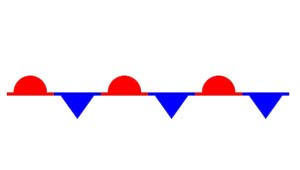
What does this image show? 
a)
A flag banner
b)
Blue alligator teeth
c)
Warm Front
d)
Cold Front
53.
What does this image represent?
a)
Cold front
b)
Red bulbous things
c)
Warm front
d)
Sarah Ju
54.
Which front leads to steady rain for several days?
a)
warm front
b)
cold front
c)
stationary front
d)
occluded front
55.
Located at the leading edge of a warm air mass. Brings gentle rain or light snow, followed by warmer, milder weather.  
a)
Warm Front
b)
Cold Front 
c)
Occluded Front 
d)
Stationary Front 
56.
What direction is the cold front moving?
a)
Northwest
b)
Southeast
c)
Northeast
d)
Southwest
57.
What direction is the warm front moving?
a)
Northeast
b)
Northwest
c)
Southeast
d)
Southwest
58.

Using the graphic provided, which of the following best describes the weather in El Paso?

a)

Partly cloudy skies, winds coming from the Southeast, and the temperature is 27 degrees Celsius.

b)

Cloudy skies, winds coming from the Southeast, and temperature is -3 degrees Celsius

c)

Clear skies, winds heading North, and the temperature is 50 degrees Celsisu

d)

Partly cloudy skies

59.

On a summer day, a barometer reading shows an increase in air pressure. What type of weather should be expected?

a)

Clear and sunny

b)

Cloudy and rainy

c)

Rainy and windy

d)

Cloudy and cold

60.

What kind of weather is a low-pressure system most likely to bring?

a)

Clear weather

b)

Hot, sunny weather

c)

Precipitation (rain or snow)

d)

Light breezes

61.

What kind of weather is a high-pressure system most likely to bring?

a)

Clear, sunny weather

b)

Hot, sunny weather

c)

Precipitation (rain and snow)

d)

Light breezes

62.

A weather forecaster announces that precipitation is on the way and that daytime temperatures will be between 10° C and 20° C. Which kind of weather should people in the area expect?

a)

rain

b)

snow

63.
The local meteorologist said that a Continental Tropical (cT) air mass was moving over Tennessee in the next few days. What kind of weather will it possible bring?
a)
Warm, dry weather
b)
Cold, dry weather
c)
Warm, wet weather
d)
Cold, wet weather
64.

A warm air mass is moving towards a cold air mass. What type of front is this describing?

a)

Cold front

b)

Occluded front

c)

Warm front

d)

Stationary front

65.

Maritime tropical (mT) air masses forms above ____ and near _____

a)

water; the poles

b)

land; the poles

c)

water; the equator

d)

land; the equator

66.

A weather forecaster announces that precipitation is on the way and that daytime temperatures will be between -5° C and -2° C. Which kind of weather should people in the area expect?

a)

rain

b)

snow

67.

On a summer day, a hydrometer shows the humidity is 70%. Based on this data, what type of weather should be expected ?

a)

Clear weather

b)

Cloudy and rainy

68.
 What conditions can lead to the formation of a hurricane?
a)
 low-pressure over warm tropical ocean 
b)
low-pressure system over artic tundra
c)
 high-pressure over warm tropical ocean
d)
high-pressure system over hot, dry land
69.
 When an air mass moves into a new location it brings
a)
changes in temperature and altitude.
b)
changes in temperature and humidity
c)
A  changes in altitude and air pressure.
d)
A  changes in humidity and energy.  
70.
Which weather system is characterized by counter-clockwise movement of air and generally poor weather? 
a)
cold front
b)
low pressure
c)
high pressure
d)
warm front 
71.
Which system results in rainy or stormy weather?
a)
high pressure
b)
low pressure
c)
hurricane
d)
weather system
72.
LABEL THE FOLLOWING FRONTS AND/OR WEATHER MAP SYMBOLS.
a)
 warm front
b)
cold front
c)
stationary front
d)
occluded front  
73.
 Which BEST describes a front?
a)
a large mass of moving air
b)
a boundary between 2 air masses
c)
a high pressure system
d)
a low pressure system  
74.
What characteristics are used to classify air masses?
a)
temperature and humidity
b)
pressure and temperature
c)
latitude and longitude
d)
wind speed and location 
75.
What type of weather would a continental tropical air mass bring?
a)
dry and cold weather
b)
wet and cold weather
c)
dry and warm weather
d)
wet and warm weather
76.

Short term weather predictions are usually accurate for expected temperature and precipitation.

a)

true

b)

false

77.

All long term forecasts are less reliable than short term forecasts.

a)

true

b)

false

78.

Weather forecasting is not as accurate for long term weather because

a)

weather maps aren't made for long term forecasting

b)

computers are not advanced enough

c)

there are too many variables that can influence the weather

d)

radar cannot "see" that far away