wayground logo

Free Printable Worksheets

Font size

S
M
L
XL
Worksheets

SFP Physics Exam

Total questions: 105

Worksheet time: 2hrs 4mins

Name
Class
Date
1.
What happens to frequency when the energy increases?
a)
it increases
b)
it decreases
c)
it stays the same
2.
Distance from 'y' to 'y' is a _______
a)
Wavelength
b)
Amplitude
c)
Compression
d)
Rarefaction
3.
What is represented by the  letter 'y'?
a)
Compression
b)
Rarefaction
c)
Wavelength
d)
Amplitude
4.
What is represented by the letter 'x'?
a)
Crest
b)
Compression
c)
Rarefaction
d)
Wavelength
5.
What is represented by the blue lines?
a)
Trough
b)
Crest
c)
Wavelength
d)
Amplitude
6.
What part is represented by the blue lines?
a)
Crest
b)
Resting Point
c)
Wavelength
d)
Amplitude
7.
What part is represented by the blue lines?
a)
Crest
b)
Resting Point
c)
Wavelength
d)
Amplitude
8.
Which answer best explains what causes a wave?
a)
Shaking
b)
Potential energy
c)
Light
d)
Vibrations
9.
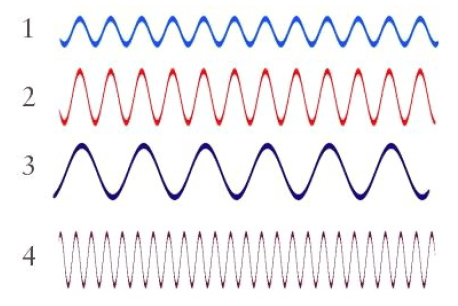
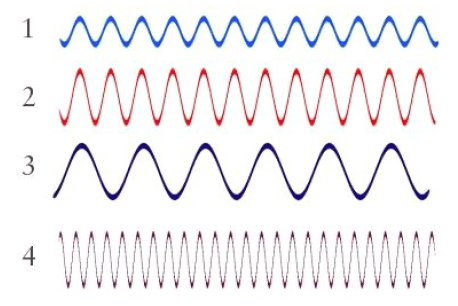
Which wave in the diagram has the greatest frequency?
a)
1
b)
2
c)
3
d)
4
10.
Which wave in the diagram has the greatest wavelength?
a)
1
b)
2
c)
3
d)
4
11.
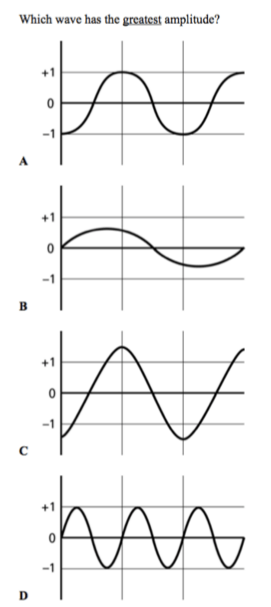
Which wave has the greatest amplitude?
a)
A
b)
B
c)
C
d)
D
12.
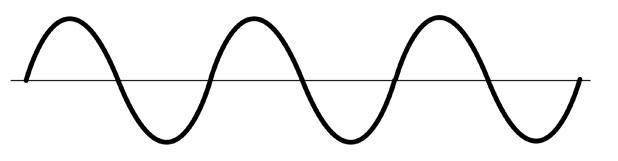
What kind of wave is pictured?
a)
Transverse
b)
Longitudinal
c)
surface
d)
none of the above
13.

What is the amplitude of this wave?

a)

4

b)

8

c)

2

d)

6.3

14.

What is the wavelength of this wave?

a)

4

b)

8

c)

3.3

d)

6.3

15.
Sound is an example of which type of wave?
a)
Transverse
b)
Longitudinal
c)
Both
d)
Neither
16.
Light is an example of which type of wave?
a)
Transverse
b)
Longitudinal
c)
Both
d)
Neither
17.
The shortest wavelength in visible light is______.
a)
violet
b)
red
c)
blue
d)
yellow
18.
This color in the visible part of the spectrum has the lowest energy. 
a)
Blue
b)
Green
c)
Red
d)
Violet
19.

Definition: a wave of a single frequency. Which one is it?

a)

Amplitude

b)

Monochromatic

c)

Monofrequency

d)

Oscillation

20.

Which is the correct definition of frequency?

a)

Number of complete waves passing a point per second

b)

Number of peaks passing a point per minute

c)

How long each oscillation takes

d)

Number of complete waves passing a point per minute

21.
 A wave has frequency of 50 Hz and a wavelength of 10 m. What is the speed of the wave?
a)
500 m/s
b)
50 m/s
c)
5 m/s
d)
0.5 m/s
22.
A wave has wavelength of 10 m and a speed of 340 m/s. What is the frequency of the wave?
a)
34 m/s
b)
3400 Hz
c)
3400 m/s
d)
34 Hz
23.
 A wave has frequency of 5 Hz and a speed of 25 m/s. What is the wavelength of the wave?
a)
25 m
b)
125 m
c)
5 m
d)
25 m/s
24.
What is the speed of a 20 Hz with a 4m wavelength?
a)
0.2 m/s
b)
5 m/s
c)
80 m/s
d)
320 m/s
25.
Which wave has the most energy?
a)
top wave
b)
bottom wave
26.

When the top of one wave meets the bottom of another wave, they...

a)

call each other out.

b)

cancel each other out.

c)

cancel each other off.

d)

don't cancel each other out.

27.

An Interference Pattern appears when...

a)

two particles interact with each other.

b)

waves interact with particles.

c)

two waves interact with each other.

d)

particles interact with particles.

28.

What is inside the nucleus of the atom?

a)

electrons and protons

b)

protons and quarks

c)

protons and neutrons

d)

neutrons and electrons

29.

Why do we never touch anything?

a)

Because electrons are negatively charged.

b)

Because protons are positively charged.

c)

Because neutrons are neutral in charge.

d)

Because we are not allowed to.

30.
It is difficult to get clear young's double slit fringes with white light because
a)
The frequency of white light is too high
b)
The wavelength of white light is too low
c)
the different colour fringes overlap
d)
white light is not bright enough
31.
When two waves combine to form a new wave with a larger amplitude, it is called 
a)
Diffraction
b)
Destructive Interference
c)
Resonance
d)
Constructive Interference
32.
When two waves combine to form a new wave with a smaller amplitude, it is called 
a)
Refraction
b)
Constructive Interference
c)
Resonance
d)
Destructive Interference
33.
When two waves arrive at the same point in phase resulting in a new larger wave this is called...
a)
Constructive interference
b)
Destructive interference
c)
Stationary wave
d)
Monochromatic light
34.
The number of waves that pass the same point in a certain amount of time is known as the ...
a)
frequency
b)
wavelength
c)
amplitude
d)
hertz
35.

Youngs double slit relies on the _______ of light.

a)

dampening

b)

interference

c)

refraction

d)

reflection

36.
The wave-particle duality of light describes light as...
a)
a wave only
b)
a particle only
c)
both a wave and a particle
d)
neither a wave nor a particle
37.

Calculate the energy of a gamma ray photon whose frequency is 5.02 x 10²⁰ Hz?

a)

4.73 x 1072 eV

b)

2.07 x 10 6 eV

c)

3.33 x 10⁻¹³ eV

d)

1.21 x 10 35 eV

38.

What is the energy of light whose wavelength is 4.06 x 10⁻¹¹ m?

a)

2.69 x 10-44 eV

b)

4.89 x 10⁻¹⁵ eV

c)

3.06 x 10 4 eV

d)

5.04 x 10⁻¹⁷ eV

39.

A ____ is a discrete, quantized bundle of energy

a)

Photoelectric effect

b)

Photon

c)

Quantized

d)

Proton

40.
Only the wave theory of light offers an explanation for the ability of light to exhibit...
a)
diffraction.
b)
reflection.
c)
photoluminescence.
d)
illumination.
41.
Sound travels FASTEST through which of these materials?
a)
Air
b)
Empty space
c)
Metal
d)
Water
42.
A longer string makes a _______ pitch than a short string.
a)
louder
b)
softer
c)
higher
d)
lower
43.
To make a sound from a stringed instrument louder you must
a)
hit it
b)
pluck it harder
c)
hold it higher
d)
pluck it softer
44.
Measure of how high or low a sound is
a)
amplitude
b)
compression
c)
speed of sound
d)
pitch
45.
An object that does not vibrate cannot produce
a)
sound
b)
light
c)
heat
d)
electricity
46.
What is frequency?
a)
the number of vibrations per second
b)
how high or low a sound is
c)
the loudness or softness of a sound
d)
the back and forth movement of matter
47.
Area of a longitudinal wave where particles are CLOSE together.
a)
Compression
b)
Rarefaction
48.
Area of a longitudinal wave where particles are APART. 
a)
Compression
b)
Rarefaction
49.
If you want to change the pitch of a sound, you have to change the ___
a)
frequency
b)
amplitude
c)
speed
d)
volume
50.
This is the unit used to measure the volume of a sound. 
a)
Decibel
b)
Medium
c)
Vibration
d)
Oscilloscope
51.
The Doppler effect can cause an apparent change in...
a)
loudness
b)
intensity
c)
pitch
d)
reasonance
52.
As a sound source approaches and then moves past a stationary observer, the observer will hear
a)
a steady rise in pitch
b)
a sudden drop in pitch
c)
a drop in pitch, then a rise in pitch
d)
a rise in pitch, then a drop in pitch
53.
_____ is a method of locating things underwater using echolocation.
a)
trees
b)
solar
c)
sonar
d)
turpentine
54.
A note is played on a guitar.  Next, a lower note is played on the guitar.  Which of these statements describes the lower note?
a)
Both notes vibrated at the same speed.
b)
The second note vibrated slower.
c)
The second note vibrates at a higher frequency.
d)
The second note vibrated faster.
55.
Which is a tool that is used in medicine to view internal organs and pregnancy.
a)
radar
b)
doppler
c)
ultrasound
d)
sonar
56.
If the distance represented by the letter A were increased, how would it change the way the sound was heard?
a)
The sound would be higher. 
b)
The sound would be lower. 
c)
The sound would be softer. 
d)
The sound would be louder. 
57.

Light is made up of...

a)

electricity and waves

b)

magnetism and waves

c)

electricity and magnetism

d)

electricity and energy

58.

If you see a green leaf on a tree, that means...

a)

Green is the color being reflected off the leaf.

b)

Green is the color being absorbed by the leaf.

c)

All the colors are being reflected off the leaf.

d)

All the colors are being absorbed by the leaf.

59.
The dwill be a _________________ value.
a)
positive
b)
negative
60.
The dfor a real image will be a _________________ value
a)
positive
b)
negative
61.
A converging lens produces an image twice the size of the original. If the object is placed 0.40 m from the lens, and the image produced is 0.80 m from the lens. What is the focal length of the lens? 
a)
0.351 m
b)
0.267 m
c)
0.416 m
d)
0.112 m
62.

A tree 20 m high is located 40 m from the converging lens of focal length 0.08 m.Calculate the distance from the lens to the image.

a)

0.08 m

b)

0.01 m

c)

0.10 m

d)

0.20 m

63.

The above lens is a type of ___.

a)

diverging lens

b)

converging lens

c)

divergent lens

d)

convergent lens

64.

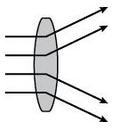
Which lens represents the path light takes through a diverging lens?

a)
b)
c)
d)
65.

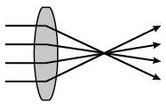
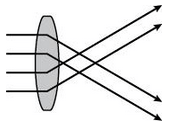
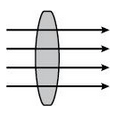
Which figure represents the path light takes through a converging lens?
a)
b)
c)
d)
66.
What type of image is formed when rays of light actually intersect?
a)
real
b)
virtual
c)
projected
d)
curved
67.
An image that you can see , but does not really exist is called which of the following?
a)
Real Image
b)
Fake Image
c)
Virtual Image
d)
Digital Image
68.

When an object is placed on the focal point in front of a convex lens, the image produced is ___.

a)

real, reduced, and inverted

b)

real, magnified, and inverted

c)

real, true, and inverted

d)

There is no image

69.

When an object is placed between the focal point and the convex lens, the image produced is ___.

a)

real, reduced, and inverted

b)

real, magnified, and inverted

c)

virtual, magnified, and upright

d)

virtual, reduced, and upright

70.

Convex lenses can produce...

a)

Real, upright images

b)

Virtual, inverted images

c)

Real, inverted images

d)

no images form

71.
A convex lens has a focal length f.  If an object is placed at 2f at what distance will the image appear?
a)
2f
b)
f
c)
between f and 2f
d)
infinity
72.
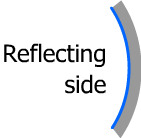
The following is a picture of what type of mirror? 
a)
Convex (diverging) Mirror
b)
Concave (converging) Mirror
c)
Plane Mirror
d)
Flat Mirror
73.

For a spherical concave mirror, light that is parallel to the optical axis will be reflected _____.

a)

parallel to the optical axis

b)

through the center of curvature

c)

through the focal point

74.

Which type of mirror is used on the passenger side of a standard car?

a)

plane mirror

b)

concave mirror

c)

convex mirror

75.

What type of mirror is used in stores for surveillance?

a)

plane mirror

b)

concave mirror

c)

convex mirror

76.

What type of mirror is used as the primary mirror in a reflecting telescope?

a)

plane mirror

b)

concave mirror

c)

convex mirror

77.

An object O placed in front of a concave lens forms an image I as shown. F and F' are the foci of the lens. Which ray diagram is correct?

a)
b)
c)
d)
78.
The splitting of a nucleus into smaller nuclei is
a)
fusion
b)
fission
c)
half-life
d)
gamma radiation
79.
How do nuclear power-plants work?
a)
Fusion
b)
Half-life
c)
Fission
d)
Fusion or fission
80.
This is an example of...
a)
Fission  reaction
b)
Fusion reaction
c)
Decomposition reaction
d)
Decay
81.
Where does fusion occur naturally?
a)
Underwater
b)
All around us
c)
In the radioactive waste
d)
On the sun
82.
Which atoms combine together during fusion reaction on the sun?
a)
Helium and Hydrogen atoms
b)
Hydrogen atoms
c)
Hydrogen and Lithium atoms
d)
Hydrogen and Carbon atoms
83.
_________ happens naturally due to an unstable nucleus.
a)
fission
b)
fusion
c)
radioactive decay
d)
K-capture
84.
Which of these statements correctly describes how the chain reaction occurs in nuclear fission.
a)
Uranium releases electrons to create   electricity
b)
When a nuclear fission reaction occurs, the electrons emitted can strike other nuclei in the sample, and cause them to split
c)
When a nuclear fission reaction occurs, the neutrons emitted can strike other nuclei in the sample, and cause them to split
d)
 Protons and neutrons change to electrons because the nuclei are so big
85.
What is a benefit of nuclear fission?
a)
The ability to absorb energy
b)
The ability to release tremendous amounts of energy
c)
The ability to produce more energy than nuclear fusion
d)
There are no beneficial aspects of nuclear fission
86.
Very high temperature and pressure is required for:
a)
Fission
b)
 Fusion
c)
Radioactive Decay
87.
One disadvantage of nuclear energy is ___.
a)
it is a fossil fuel
b)
it leaves behind radioactive waste
c)
it emits large amounts of pollution into the atmosphere
d)
there are no disadvantages
88.
Which of the following is true about nuclear fusion?
a)
It is easy to implement.
b)
It produces less energy than nuclear fission.
c)
It produces more energy than nuclear fission.
d)
It has the ability to occur easily in everyday life.
89.
Nuclear fusion releases energy when:
a)
heavy ions fuse together
b)
very light nuclei fuse together
c)
uranium splits into two fragments
d)
uranium emits a neutron
90.
Nuclear energy uses _____ to turn turbines to power a generator.
a)
wind
b)
water
c)
steam
d)
solar
91.
Isotopes of the same element have different ____________. 
a)
 numbers of protons  
b)
numbers of electrons
c)
 symbols 
d)
numbers of neutrons
92.
When does radioactive decay occur?
a)
When the nucleus of an isotope is unstable
b)
When the nucleus of an isotope is stable
c)
When the electrons of an isotope are spinning
d)
When the electrons of an isotope are shared with another isotope
93.

What would be the advantage(s) of using nuclear fusion to produce energy?

a)

no radioactive waste and more energy produced

b)

safer

c)

requires less regulation

d)

more controlled energy produced, less radioactive waste produced

94.
This is an example of ---
a)
Radioactive Decay
b)
Nuclear Fission
c)
Nuclear Fusion
d)
Fossil fuel reaction
95.
What is the change in atomic mass when an atom emits a neutron?
a)
0
b)
+1
c)
-1
d)
-2
96.
If you start out with 100 grams of a radioisotope, how much remains after 2 half-lives?
a)
100 grams
b)
75 grams
c)
50 grams
d)
25 grams
97.
What fuel does the US typically use in fission reactors?
a)
Hydrogen
b)
Carbon
c)
Uranium
d)
Plutonium
98.
The least penetrating form of radiation is...
a)
alpha
b)
beta
c)
gamma
d)
neutron
99.
What is another name for an alpha particle?
a)
electron
b)
x-ray
c)
hydrogen nucleus
d)
helium nucleus
100.
What product of fission is necessary in order to establish a chain reaction?
a)
alpha particle
b)
two or more neutrons
c)
two or more protons
d)
gamma rays
101.
How long do spent fuel rods remain dangerously radioactive?
a)
tens of thousands of years
b)
several years
c)
they aren't radioactive
d)
impossible to determine
102.
Why do we need neutron absorption in a nuclear reactor?
a)
it recycles the fuel
b)
it increases heat absorption
c)
it speeds up a reaction
d)
it slows down a reaction
103.
What is a beta particle?
a)
an emitted helium nucleus
b)
a high energy wave
c)
an energetic electron from a decomposed neutron
d)
none of the above
104.
The time needed for half of a radioactive sample to decay is called its __________.
a)
decay period
b)
period
c)
transmutation time
d)
half-life
105.
Barium-122 has a half-life of 2 minutes. A fresh sample weighing 80 g was obtained. If it takes 10 minutes to set up an experiment using barium-122, how much barium-122 will be left when the experiment begins?
a)
0.25g
b)
2.5g
c)
25g
d)
80g