wayground logo

Free Printable Worksheets

Font size

S
M
L
XL
Worksheets

Space Final Review

Total questions: 135

Worksheet time: 2hrs 46mins

Name
Class
Date
1.
What color of star is the hottest?
a)
Blue
b)
Red
c)
Yellow
d)
Orange
2.
What color of star is the coolest?
a)
Red
b)
Yellow
c)
Blue
d)
White
3.
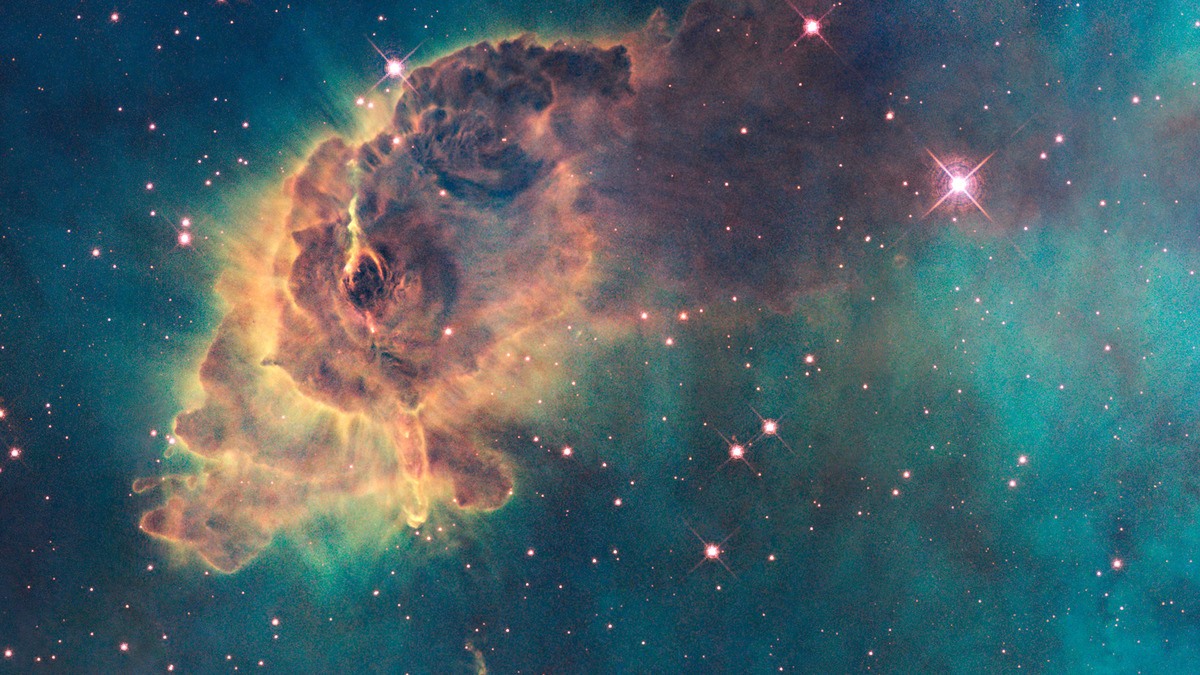
What is the name of the gas/dust clouds that form stars?
a)
Nebulas
b)
Protostars 
c)
Supernova
d)
Neutron Star
4.
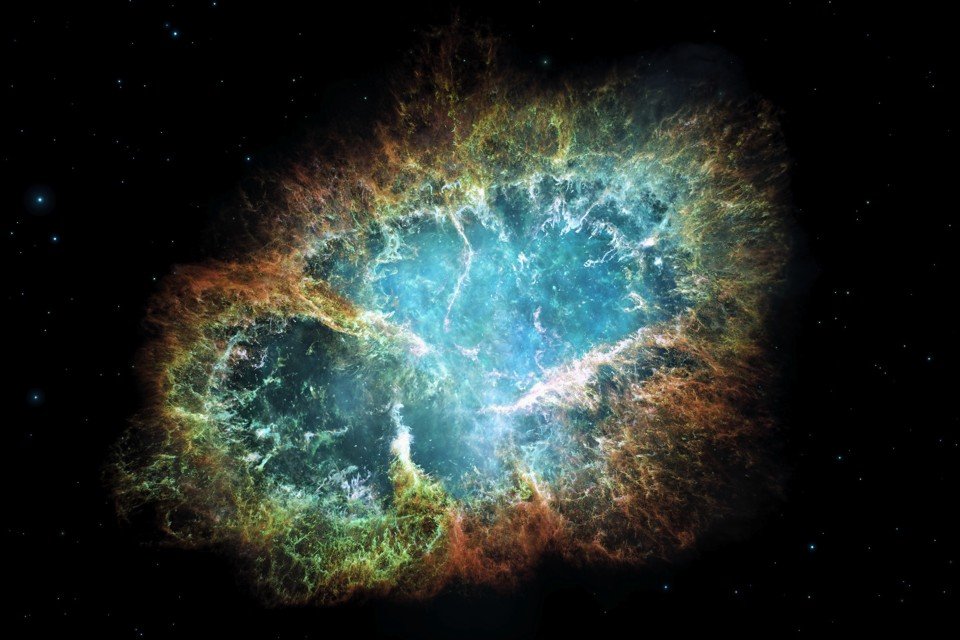
What is the name of the explosion at the death of a massive star?
a)
Supergiant
b)
Supernova
c)
Black Hole
d)
Nebula
5.
All stars begin their life in a
a)
Main Sequence
b)
Nebula
c)
Protostar
d)
Black Dwarf
6.
______ is a force that causes dust particles to stick together in a nebula.
a)
nuclear fusion
b)
gravity
c)
hydrogen
d)
friction
7.
Most stars are made of which elements?
a)
Hydrogen only
b)
Hydrogen and Lithium
c)
Hydrogen and Sodium
d)
Hydrogen and Helium
8.
A ________ is an object so dense with so much gravity that even light cannot escape.
a)
neutron star
b)
white dwarf
c)
blackhole
d)
black dwarf
9.
A supergiant might explode and become a_____.
a)
main sequence stars
b)
white dwarf
c)
supernova
d)
nebula
10.

What will be the next stage in our star the sun's life cycle?

a)

supernova

b)

white dwarf

c)

blackhole

d)

red giant

11.
True or False
The Sun is the biggest star in the sky.
a)
True
b)
False
12.

All stars begin their life as a

a)

Main Sequence

b)

Nebula

c)

Protostar

d)

Black Dwarf

13.
The life cycles of stars are determined by their:
a)
mass (size)
b)
color
c)
distance from Earth
d)
luminosity
14.
Our sun is currently in what star stage?
a)
Protostar
b)
Nebula
c)
Main Sequence
d)
Red Giant
15.
The core of a Red Giant collapses and becomes a ___________________.
a)
White Dwarf
b)
Blue Supergiant
c)
Red Supergiant
d)
Black Hole
16.

The stage after the main sequence star:

a)

red giant

b)

nebula

c)

white dwarf

d)

black dwarf

17.

The super red giant ends its life as a massive explosion called

a)

supernova

b)

planetary nebula

c)

constellation

d)

Andromeds

18.

Black hole ends life of the biggest stars in the universe

a)

true

b)

false

19.

Neutron stars are very small and extremely dense

a)

true

b)

false

20.
This is a young star that glows as gravity brings it together
a)
Nebula
b)
Protostar
c)
Main-sequence star
d)
Red giant
21.
In this stage, a star spends most of its life. Hydrogen is fused into helium at a temperature of millions of degrees.
a)
nebula
b)
protostar
c)
main-sequence
d)
supergiant
22.
Low mass stars expand into what after using up the hydrogen in their core
a)
red giants
b)
supergiants
c)
white dwarfs
d)
protostars
23.
What is the biggest difference between a protostar and a main sequence star?
a)
Protostars are more massive than main sequence stars
b)
Protostars do not engage in nuclear fusion
c)
Stars spend far longer in the protostar phase than their main sequence
d)
Protostars are hotter than main sequence stars
24.

What is the sun made up of?

a)

Hydrogen

b)

Helium

c)

Hydrogen and Helium

d)

None of the Above

25.
What stage fills in the blank. Nebula --> Main sequence --> red giant --> ______________ --> white dwarf --> black dwaft
a)
supergiant
b)
planetary nebula
c)
black hole
d)
supernova
26.
Which of the following is NOT a final stage of a star. 
a)
black hole
b)
black dwarf
c)
neutron star
d)
red giant
27.
If you happen to get cross the event horizon into a black hole, your body gets stretched out in a process called________________.
a)
stretch armstrong
b)
singularification
c)
string theory
d)
spaghettification
28.
A white dwarf is the final stage for _________ mass stars like our Sun.
a)
small/medium
b)
large
c)
super massive
29.
Which type of stars are fusing Helium and heavier elements?
a)
Main Sequence
b)
White Dwarfs
c)
Blue Giants
d)
Red Giants
30.
We consider these stars 'dead' because they no longer are carrying out fusion in their cores.
a)
White Dwarfs
b)
Red Dwarfs
c)
Red Giants
d)
Brown Dwarfs
31.
If a Protostar fails to gain enough mass to ignite fusion in its core it becomes a...
a)
Black Hole
b)
Brown Dwarf
c)
White Dwarf
d)
Red Giant
32.
A main sequence star is composed mostly of what gas?
a)
Hydrogen
b)
Helium
c)
Carbon
d)
Iron
33.
Main sequence stars will become red giants (or supergiants) when they run out of which fuel?
a)
Hydrogen
b)
Helium
c)
Neon
d)
Carbon
34.
If you were a star, your life cycle stage would be ______ ________ because you are 'living'.
a)
Red Giant
b)
Main Sequence
c)
White Dwarf
d)
Black Hole
35.
Low to Medium mass stars like our Sun will not explode in a Supernova because they do not have enough mass. They will 'puff off' their outer layers of gas leaving a __________ nebula behind.
a)
planetary
b)
supernova remnant
c)
shockwave
d)
black hole
36.
Changes in the moon's appearance are
a)
phases
b)
eclipses
c)
stages
d)
cycle
37.
The Moon orbits Earth in a ________________ direction
a)
clockwise
b)
counterclockwise
c)
upwards
d)
downwards
38.
Define Waxing
a)
Moon is increasing and light part appears to be growing
b)
Completely illuminated
c)
dark side is facing earth
d)
Moon is decreasing and light part appears to be shrinking
39.
Define Waxing
a)
Moon is increasing and light part appears to be growing
b)
Completely illuminated
c)
dark side is facing earth
d)
Moon is decreasing and light part appears to be shrinking
40.
Define Gibbous
a)
Less than half of moon visible
b)
More than half of moon visible
c)
All of moon visible
d)
None of moon visible
41.
Define Full Moon
a)
None of moon is visible
b)
Half moon phase is visible
c)
Complete moon face is visible
d)
Less Than half of moon is visible
42.
Define New Moon
a)
None of moon is visible from Earth
b)
All of moon visible from Earth
c)
Moon is 1/2 visible from Earth
d)
Moon is more than Half Visible from Earth
43.
Define Quarter Moon
a)
None of moon visible
b)
Less than Half the moon is visible
c)
More than half of moon is visible
d)
Half of the moon is visible
44.
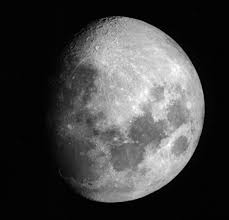
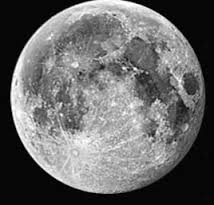
Name this moon phase
a)
Waxing Gibbous
b)
Waxing Crescent
c)
Waning Crescent
d)
Waning Gibbous
45.
Name this moon phase
a)
Waning Crescent
b)
Waxing Crescent
c)
Waning Gibbous
d)
Waxing Gibbous
46.
The phase of the moon that occurs between the sun and Earth
a)
Full moon
b)
Waxing crescent
c)
Waning Crescent
d)
New Moon
47.
In which moon phase, can the moon not be seen at all?
a)
Waning crescent
b)
Full moon
c)
Waxing gibbous
d)
New moon
48.
The 1st Quarter moon is lit on the:
a)
Left Side
b)
Right Side
49.
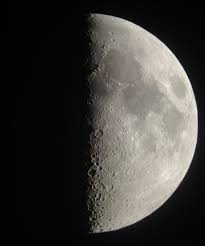
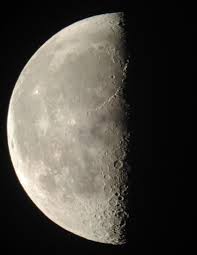
Name this moon phase
a)
waning crescent
b)
waxing crescent
c)
waning gibbous
d)
waxing gibbous
50.
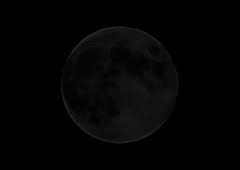
Name this moon phase
a)
First Quarter
b)
Last Quarter
c)
New Moon
d)
Full Moon
51.
Name this moon phase
a)
First Quarter
b)
Last Quarter
c)
New Moon
d)
Full Moon
52.
Name this moon phase
a)
First Quarter
b)
Last Quarter
c)
New Moon
d)
Full Moon
53.
Name this moon phase
a)
First Quarter
b)
Last Quarter
c)
New Moon
d)
Full Moon
54.
What are the reasons for the season?
a)
Earth's tilt & rotation
b)
Earth's tilt & revolution
c)
Earth's rotation & revolution
d)
Earth's tilt & resolution
55.
What moon phase is this picture?
a)
This is the full moon phase.
b)
This is the waxing gibbous moon phase.
c)
This is the waning gibbous moon phase.
d)
This is the first quarter moon phase.
56.
What moon phase is this picture?
a)
This is the waning crescent phase.
b)
This is the waxing gibbous phase.
c)
This is the waning gibbous phase.
d)
This is the new moon phase.
57.
What is this moon phase?
a)
This is the waxing crescent phase.
b)
This is the full moon phase.
c)
This is the waxing gibbous phase.
d)
This is the last quarter moon.
58.
What moon phase is this picture?
a)
This is the full moon phase.  
b)
This is the waxing crescent moon phase.
c)
This is the waning gibbous moon phase.
d)
This is the waning crescent moon phase.
59.
What phase of the moon is this image?
a)
This is the last quarter moon phase.
b)
This is the full moon phase.
c)
This is the first quarter moon phase.
d)
This is the waxing gibbous moon phase.
60.
What is the difference between a gibbous moon and a crescent moon?
a)
The gibbous shows more than half of the bright side of the moon.
b)
The crescent shows more than half of the bright side of the moon.
c)
The gibbous shows less than half of the bright side of the moon. 
61.
How many phases does the moon go through?
a)
4
b)
8
c)
10
d)
16
62.
What part of the moon do we see from Earth?
a)
all of it
b)
the same side
c)
none of it
d)
only one quarter
63.
As the moon's shape appears to get smaller, we say that the moon is _.
a)
swelling
b)
waxing
c)
waning
d)
disappearing
64.
Phases of the moon in which the moon appears to be getting larger are referred to as _.
a)
waxing
b)
waning
c)
new
d)
eclipse
65.
The cycle of the moon lasts about a _.
a)
day
b)
year
c)
week
d)
month
66.
Which moon phase is when you can't see the moon at all?
a)
Waning crescent
b)
Full moon
c)
Waxing gibbous
d)
New moon
67.

Which moon phase is shown in this diagram?

a)

new moon

b)

1st quarter

c)

full moon

d)

3rd quarter

68.

Which moon phase is shown in this diagram?

a)

new moon

b)

first quarter

c)

full moon

d)

3rd quarter

69.

Name the phase of the moon for letter a

a)

First Quarter

b)

Third Quarter

c)

Waxing Gibbous

d)

Waning Gibbous

70.
Name the phase of the moon for letter f
a)
Waning Gibbous
b)
Waxing Gibbous
c)
Waning Crescent
d)
Waxing Crescent
71.
What is illuminating the Moon?
a)
Nuclear Fusion
b)
Sunlight
c)
Mirrors
d)
Flood Lights
72.
Which body has the greater effect on Earth's tides?
a)
Sun
b)
Saturn
c)
Moon 
d)
Venus
73.

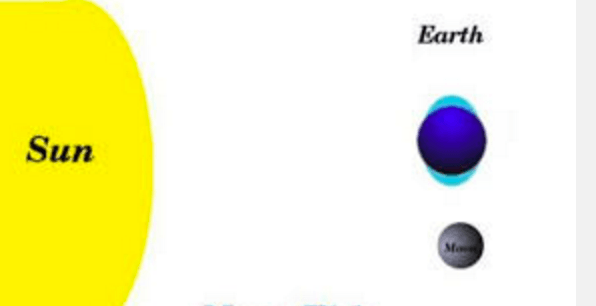
What type of tide would this arrangement of earth-moon-sun create?

a)

full moon tide

b)

new moon tide

c)

neap tide

d)

spring tide

74.
What type of tides would this arrangement of earth-moon-sun create?
a)
neap tide
b)
spring tide
c)
new moon tide
d)
full moon tide
75.
Tides are caused by
a)
strong winds that blow over ocean waters.
b)
the interaction of Earth, the moon and the sun.
c)
the shifting of the plates on the ocean floor.
d)
variations in the salinity of ocean water
76.
What causes tides?
a)
gravity
b)
wind
c)
spring
d)
neap
77.
A neap tide is a tide with the greatest difference between low and high tides
a)
true
b)
false
78.
What is a difference between spring and neap tides?
a)
Spring tides occur when the earth and sun are IN LINE with the new or full moon. 
b)
Spring tides occur when moon in 3rd or 1st quarter phases
c)
Spring tides are LOWER than neap tides
d)
Spring tides occur in Spring and neap tides can occur in any season
79.
This is a diagram of the moon phases Which moon phase would a lunar eclipse occur in?
a)
New Moon
b)
1st quarter
c)
Full moon
d)
3rd quarter
80.
What is the correct order of the Earth, Moon, and Sun in order for a lunar eclipse to occur?
a)
Earth, Moon, Sun
b)
Moon, Sun Earth
Moon, Sun, Earth
c)
Sun, Earth, Moon
81.
This is a diagram of the moon phases. In which phase would a solar eclipse occur?
a)
New Moon
b)
1st quarter
c)
Full Moon
d)
3rd Quarter
82.
The darkest part of the shadow during an eclipse is called the ___________________.
a)
penumbra
b)
corona
c)
umbra
d)
phase
83.
What type of eclipse is occuring inthe diagram?
a)
solar
b)
lunar
84.
What is the correct order of the Earth, Moon, and Sun in order for a solar eclipse to occur?
a)
Earth, Moon, Sun
b)
Moon, Sun Earth
Moon, Sun, Earth
c)
Sun, Earth, Moon
85.
Object spinning on its axis. 
a)
revolution
b)
rotation
86.
Object orbiting another object. 
a)
revolution 
b)
rotation
87.
Longest day of the year
a)
Autumnal Equinox
b)
Summer Solstice 
c)
Winter Solstice
d)
Vernal Equinox
88.
Shortest day of the year
a)
Autumnal Equinox
b)
Summer Solstice 
c)
Winter Solstice
d)
Vernal Equinox
89.
23.5 degrees
a)
axis
b)
day
c)
tilt
d)
rotation
90.
If its ____ in the Northern hemisphere, then its fall in the Southern hemisphere. 
a)
spring
b)
summer
c)
fall
d)
winter
91.
If its ____ in the Northern hemisphere, then its summer in the Southern hemisphere. 
a)
spring
b)
summer
c)
fall
d)
winter
92.
In winter, the axis of the earth is pointed away or toward the sun?
a)
towards
b)
up
c)
down
d)
away
93.
In summer, the axis of the earth is pointed away or toward the sun?
a)
towards
b)
up
c)
down
d)
away
94.
Why is the Equator warmest?
a)
Because it is closest to the sun.
b)
Because it receives the most direct sunlight
c)
Because no clouds form here.
d)
Because it is far from the sun
95.
Which season is taking place in the Northern Hemisphere in Position 1?
a)
Winter
b)
Spring
c)
Summer
d)
Fall
96.
Which season is taking place in the Northern Hemisphere in Position 3?
a)
Winter
b)
Spring
c)
Summer
d)
Fall
97.
If its ____ in the Northern hemisphere, then its summer in the Southern hemisphere. 
a)
spring
b)
summer
c)
fall
d)
winter
98.
What are the reasons for the season?
a)
Earth's tilt & rotation
b)
Earth's tilt & revolution
c)
Earth's rotation & size
d)
Earth's tilt & resolution
99.
The term equinox means....
a)
equal amount of day light and equal amount of night
b)
Equal amount of winter and summer
c)
Equal amounts of hot dogs for everyone
d)
The longest day of the year
100.
What happens when the area in which you live tilts away from the sun?
a)
It is summer.
b)
It is spring.
c)
It is winter.
d)
It is fall.
101.
Why does the area around the equator stay the same temperature all year?
a)
The equator rotates slower than the poles.
b)
The equator remains the same distance from the sun.
c)
The equator always receives direct sunlight.
d)
The equator has 18 hour days.
102.
One rotation of Earth is equal to
a)
a day.
b)
a year.
103.
Day & night are caused by the ______________ of earth on its axis
a)
revolution
b)
orbit
c)
rotation
d)
tilt of the axis
104.
How long does it take earth to make one revolution around the sun?
a)
12 hours
b)
24 hours 
c)
365 days
d)
30 days
105.
Which season, or seasons, have the shortest daylight hours?
a)
Summer
b)
Fall
c)
Winter
d)
Spring
106.
Planets that are farther from the sun
a)
take more time to orbit
b)
take less time to orbit
107.
Planets that are closer to the sun
a)
take more time to orbit
b)
take less time to orbit
108.
How many regular sized planets are in our solar system?
a)
10
b)
4
c)
8
d)
99
109.

Inner Planets- select all that apply

a)

dense core

b)

rocky

c)

few moons

d)

thin atmosphere

e)

smaller than outer planets

110.

Outer Planets- select all that apply

a)

small inner cores

b)

larger

c)

gaseous

d)

many moons

e)

temperatures are colder than inner planets

111.

Planets' orbit the Sun in what shape?

a)

A perfect circle.

b)

An ellipse.

c)

An eclipse.

d)

A parallelogram.

112.

True or false: Earth's distance from the Sun is responsible for the seasons.

a)

True

b)

False

113.

An astronomical unit is approximately how many kilometers?

a)

125 million

b)

175 million

c)

200 million

d)

150 million

114.

When planets are furthest from the Sun, they move...

a)

Faster.

b)

Slower.

115.
How are stars DIFFERENT from planets?
a)
Stars are solid and rocky.
b)
Stars are made of frozen gases.
c)
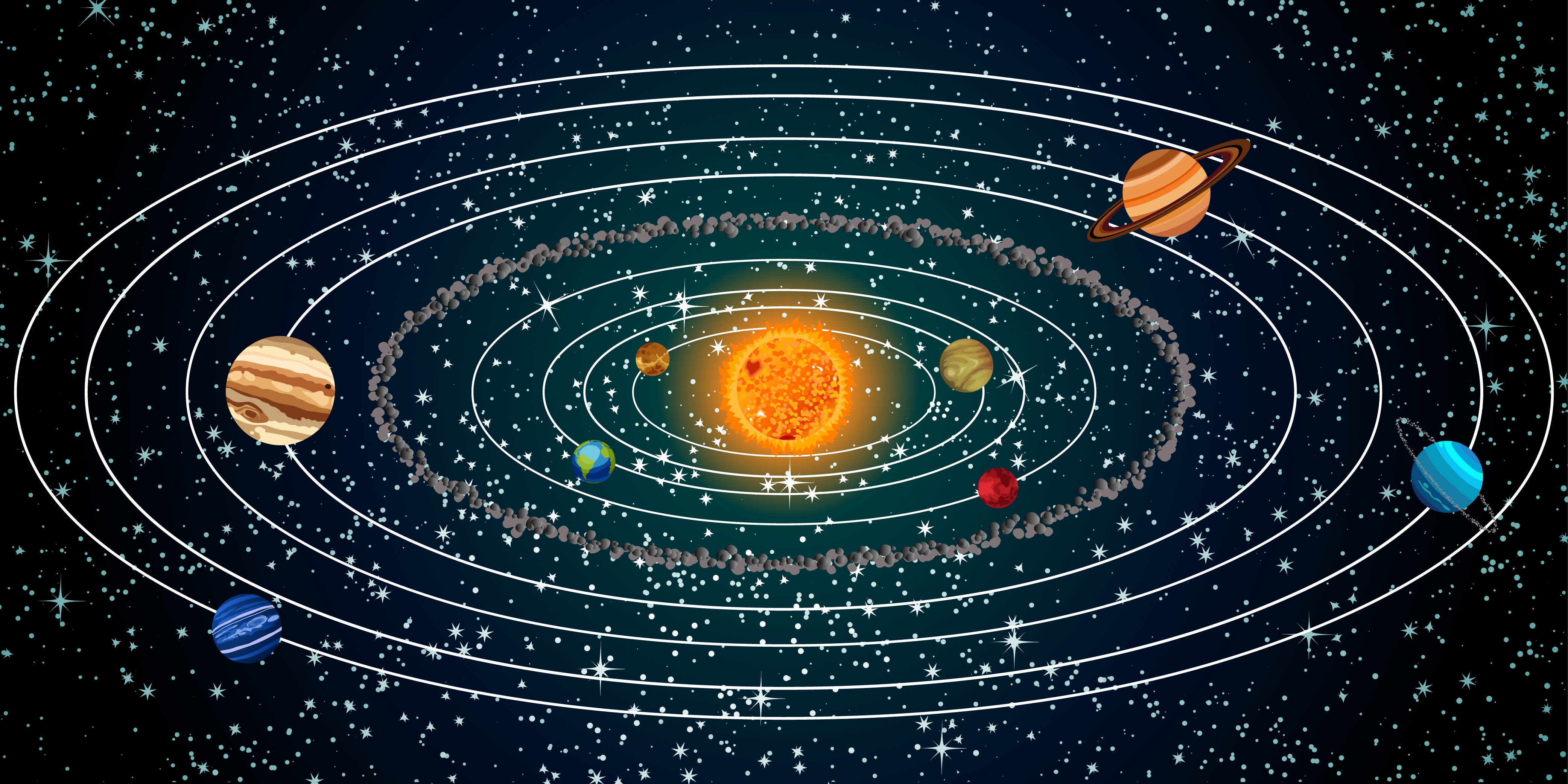
Stars do not move.
d)
Stars revolve around the Sun.
116.
A large body made of gas or rock that orbits around a star.
a)
planet
b)
moon
c)
star
d)
super nova
117.
Why do planets orbit the sun (and not float around in space)?
a)
the moons are keeping them in place
b)
They were hit by an asteroid
c)
they were hit by a comet
d)
the sun's gravity keeps them in place
118.

Which of these planets have rocky surfaces?

a)

Mercury

b)

Venus

c)

Earth

d)

Mars

e)

Jupiter

119.

Which of these planets are mostly made up of gases, known as the gas giants?

a)

Mars

b)

Jupiter

c)

Saturn

d)

Uranus

e)

Neptune

120.

Which of the following are dwarf planets?

a)

Pluto

b)

Neptune

c)

Uranus

d)

Eris

e)

Ceres

121.

Gravity

a)

A spacecraft carrying instruments intended for use in exploration of the physical properties of outer space or celestial bodies other than Earth.

b)

The natural force of attraction exerted by a celestial body, such as Earth, upon objects or near its surface, tending to draw them toward the center off the body.

c)

An arrangement of lenses or mirrors or both that gathers visible light, permitting direct observation or photographic recording of distant objects.

d)

A celestial body that orbits a planet. The moon is an example.

e)

The tendency of a body to resist acceleration; the tendency of a body at rest to remain at rest or of a body in motion to stay in motion.

122.
Which scientist found that planetary orbits were elliptical?
a)
Galileo
b)
Ptolemy
c)
Copernicus
d)
Kepler
123.
The outer planets are called the terrestrial planets.
a)
True
b)
False
124.

Earth, Mars, Mercury, and Venus are the

a)

gas giants.

b)

inner planets

125.
The outer planets have atmospheres composed mostly of
a)
nitrogen and oxygen.
b)
hydrogen and helium.
c)
water vapor and carbon dioxide.
126.
The planets in the solar system are so far apart that scientists measure the distances between them in
a)
miles.
b)
astronomical meters.
c)
kilometers.
d)
astronomical units.
127.
Two factors effecting the magnitude of force of gravity between 2 objects are...
a)
weight and mass 
b)
distance and weight 
c)
mass and matter 
d)
mass and distance 
128.
The law of universal gravitation is credited to whom? 
a)
Einstein 
b)
Galileo
c)
Darwin
d)
Newton 
129.
Gravity attracts all objects towards one another. 
a)
True
b)
False 
130.
An object with mass has gravity.
a)
True
b)
False 
131.
As distance between objects increases the pull of gravity...
a)
increases 
b)
decreases 
c)
Stays the same 
132.
The amount of matter in an object.
a)
force 
b)
mass
c)
weight 
d)
pressure 
133.
Which of the following never changes no matter where you are in the universe? 
a)
Pounds 
b)
weight 
c)
Force
d)
Mass
134.
A person would weigh more on Jupiter than on the Earth because---
a)
Jupiter has less mass, and therefore less gravity
b)
Jupiter has more mass, and therefore less gravity.
c)
Jupiter has less mass, and therefore more gravity.
d)
Jupiter has more mass, and therefore more gravity
135.

Is weight AFFECTED by gravity?

a)

YES, depending on the force of gravity is how much you weigh.

b)

NO, it is not related.