wayground logo

Free Printable Worksheets

Font size

S
M
L
XL
Worksheets

Biology 2nd Semester Final Review

Total questions: 142

Worksheet time: 2hrs 27mins

Name
Class
Date
1.
A word that means the same thing as consumer?
a)
Producer
b)
Autotroph
c)
Heterotroph
d)
Carbohydrate 
2.

Ideally, sustainable development should

a)

put the protection of the environment ahead of human needs.

b)

provide for human needs at the expense of the environment

c)

use more natural resources to make goods to meet human needs

d)

preserve ecosystems while providing for human needs

3.
Matter can recycle through the biosphere because
a)
matter does not change into new compounds.
b)
matter is assembled into chemical compounds.
c)
biological systems do not use up matter, they transform it.
d)
biological systems use only carbon, oxygen, hydrogen, and nitrogen.
4.
What type of RNA carries the DNA message out of the nucleus to the ribosomes?
a)
mRNA
b)
tRNA
c)
RNA
d)
DNA
5.
What do we call the process of turning DNA into mRNA?
a)
Translation
b)
Transcription 
c)
Replication
6.
When DNA is transcribed to RNA.... 
a)
A pairs with U
b)
C pairs with U
c)
A pairs with T
d)
C pairs with T
7.
When the RNA gets to the ribosomes, which molecule transfers to the mRNA to amino acids?
a)
DNA
b)
mRNA
c)
tRNA
d)
Replicated RNA
8.
Amino acids are the building blocks of... 
a)
DNA
b)
RNA
c)
Atoms
d)
Proteins
9.
What is a Codon?
a)
4 base pairs that transfer to amino acids
b)
3 base pairs that transfer to amino acids
c)
3 base pairs that transfer to DNA
d)
3 base pairs that transfer to mRNA
10.
When transferring tRNA to amino acids, the process cannot begin until it reaches a...
a)
Beginning codon
b)
Start codon 
c)
Initiator codon
d)
Anticodon
11.
The process of transferring the codons to the amino acids ends with what codon?
a)
Stop
b)
Terminal
c)
End
d)
Cancel 
12.
What process is occurring in this photo?
a)
Transcription
b)
DNA unwinding
c)
Translation
d)
Transfer RNA is creating bases
13.
What process is occurring in this photo?
a)
Transcription
b)
Translation
c)
mRNA is matching with amino acids
d)
tRNA is transcribing the DNA
14.
In translation, C pairs with 
a)
U
b)
G
c)
A
d)
T
15.
The job of tRNA is to...
a)
carry amino acids to the ribosomes 
b)
carry ribosomes to the ER
c)
carry mRNA out of the nucleus
d)
carry glucose to mitochondria
16.
What is the correct amino acid sequence for the mRNA code AUGCCAGUAUGA?
a)
 Met-Pro-Val-Stop
b)
Met-Pro-Arg-Stop
c)
 Tyr-Gly-His
d)
Tyr-Gly-Arg-His
17.
Which of the following best describes a DNA molecule? 
a)
contains ribose 
b)
made of amino acids
c)
contains Uracil
d)
double helix
18.
In a molecule of double-stranded DNA, the amount of Adenine present is always equal to the amount of:
a)
Uracil
b)
Thymine
c)
Cytosine
d)
Guanine
19.
Which RNA bases would pair with TACGAA in transcription? 
a)
AUGCUU 
b)
ATGCTT
c)
GCATCC
d)
GCAUCC
20.
Where does Translation occur?
a)
Proteins
b)
Mitochondria
c)
Ribosomes
d)
Cytoplasm
21.
What process does the energy come from to fuel protein synthesis?
a)
Cellular respiration
b)
ADP
c)
Carbohydrates
d)
Mitochondria
22.
How long can an amino acid chain get?
a)
up to 50 amino acids
b)
up to 10 amino acids
c)
up to 3 amino acids
d)
up to 10000 amino acids
23.
When RNA is transferred into amino acids, it is destroyed. 
a)
True
b)
False
24.
One characteristic feature of the tundra is that only the surface thaws in the summer and refreezes in the winter, leaving a permanently frozen subsoil. This characteristic is known as 
a)
Hoarfrost
b)
Glaciation
c)
Permafrost
d)
Crystallization 
25.
Which major biome is home to cacti, mesquite, white torn, pack rats, small reptiles, and coyotes?
a)
Desert
b)
Taiga
c)
Tundra
d)
Grassland
26.
An animal that has thick fur, webbed flippers and blubber would probably live in 
a)
The Arctic Ocean
b)
The Amazon Rainforest
c)
A large freshwater lake
d)
The Mojave Desert
27.
Which of these types of information do scientists use to organize the Earth into biomes?
a)
Forest and endangered species
b)
Biomass, energy, and human populations
c)
Precipitation, temperature, and vegetation
d)
Renewable and non-renewable resources
28.
Which biome is most common in GA?
a)
Taiga
b)
Grassland
c)
Temperate Forest
d)
Desert
29.
Which biome is characterized by low temperatures and low amounts of rainfall?
a)
Tundra
b)
Desert
c)
Temperate Deciduous Forest
d)
Tropical Rainforest
30.
Which biome, because of its climate, has the largest number of species of plants and animals?
a)
Tundra
b)
Rainforest
c)
Desert
d)
Pineforest
31.
Which biome, because of its climate, has the largest number of species of plants and animals?
a)
Tundra
b)
Rainforest
c)
Desert
d)
Pineforest
32.
The northern United States and Southern Cnanada are characterized by forest of deciduous trees that lose their leaves in winter and coniferous trees that are evergreens. This area is a transition between which 2 major biomes?
a)
Cold woodland and arctic tundra
b)
Temperate forest and taiga
c)
Northern prairie and deciduous forest
d)
Desert and temperate forest
33.
The kangaroo rat is able to get all of the water it needs through it's food and therefore, never needs to drink liquid. This animal has adapted to survive in which biome?
a)
Forest
b)
Tundra
c)
Desert
d)
Grassland
34.
Which biome covers most of the land mass near Earth's equator?
a)
Desert
b)
Grassland
c)
Tropical rainforest
d)
Temperate forest
35.
Grasslands and savannas are biomes that are very valuable as areas for farming and grazing livestock. In the United States these biomes are most commonly found in the
a)
Southwest
b)
Midwest
c)
Northwest
d)
Southwest
36.
Which characteristics are common in the taiga biome?
a)
Spruces. elk, snowshoe hares, sever winters
b)
Lichens, reindeer, and permafrost
c)
Grasses, bison, prairie dogs
37.
What describes the physical appearance of a trait?
a)
allele
b)
genotype
c)
phenotype
d)
karyotype
38.
If alleles look like Aa in a genotype it is said to be
a)
homozygous
b)
heterozygous
c)
incomplete dominant
d)
codominant 
39.
If alleles look like AA in a genotype it is said to be
a)
homozygous
b)
heterozygous
c)
incomplete dominant
d)
codominant
40.
Trait will always show up in an organism if the allele is present
a)
recessive
b)
dominant
c)
incomplete dominant
d)
codominant
41.
This all is covered up when a dominant allele is present
a)
recessive
b)
dominant
c)
incomplete dominance
d)
co-dominant
42.
What shows the possible combinations of alleles that can result from a genetic cross?
a)
bar graph
b)
pie chart
c)
punnett square
d)
co-dominant graph
43.
If two heterozygous tall plants are crossed, and tall is dominant. What would be your expected phenotypes?
a)
100% tall
b)
75% tall, 25%short
c)
50% tall, 50%short
d)
25% tall, 75% short
44.
Unattached earlobes (E) is dominant. Attached earlobes (e) is recessive. A woman with the genotype (Ee) and a man with the genotype (ee) have a child. What is the probability that the child is heterozygous?
a)
0%
b)
25%
c)
50%
d)
75%
45.
If the allele for gray fur (G) is dominant to the allele for white fur (g) in mice, What will be the ratio if you cross a heterozygous gray mouse with a white mouse?
a)
3GG : 0Gg : 1gg
b)
2GG : 1Gg : 1gg
c)
1GG : 2Gg : 1gg
d)
0GG : 2Gg : 2gg
46.
If a purebred, normal feathered bird (FF) is crossed with a frizzy-feathered bird (ff) how many different phenotypes would you have? 
a)
1
b)
2
c)
3
d)
4
47.
Tomato plants usually have hairy stems. Hairless stems are present in tomato plants that are homozygous recessive for this trait. If the stem characteristics are determined by a single gene, what is the expected outcome of crossing two tomato plants that are heterozygous for hairy stems?
a)
100% hairless stems
b)
100% hairy stems
c)
50% hairy stems : 50% hairless stems
d)
75% hairy stems : 25% hairless stems
48.
In cocker spaniels the allele for a black coat color (B) is dominant over the allele for a brown coat color (b). If a brown cocker spaniel is crossed with a heterozygous black cocker spaniel, which of the following genotypic ratios can be expected?
a)
0BB : 2Bb : 2bb
b)
1BB : 2Bb : 1bb
c)
2BB : 0Bb : 2bb
d)
2BB : 1Bb : 0bb
49.
What is going to be the genotype that is missing?
a)
AABb
b)
AABB
c)
AAbb
d)
aaBB
50.
The genetic makeup of an organism or what represents the letters in a Dihybrid Cross
a)
allele
b)
genotype
c)
phenotype
d)
karyotype
51.
In rabbits, there are four different versions of the gene for coat color. What pattern of inheritance is this?
a)
incomplete dominance
b)
co-dominance
c)
polygenic inheritance
d)
multiple alleles
52.
What trait, dominant or recessive, will be expressed if an organism has one dominant allele and one recessive allele?
a)
Dominant
b)
Recessive
c)
Both dominant and recessive will be expressed.
d)
The organism will lack the trait completely.
53.
The physical characteristics of an organism are called its ____________, whereas the genetic characteristics of an organism are called its ____________.
a)
alleles; phenotype
b)
genotype; phenotype
c)
heredity; genotype
d)
phenotype; genotype
54.
There are genetic crosses in which neither of two alleles is dominant over the other. In these crosses, the phenotype is a blend of the two alleles. These crosses are described as   
a)
Codominant
b)
Incomplete dominance
c)
Polygenic inheritance
d)
Multiple alleles
55.
An experiment crosses an F1 generation of red-flowered (RR) plants and white-flowered (WW) plants. What is the color of the F2 generation if the allele for color is characteristic of incomplete dominance?
a)
Blue
b)
White and Blue stripes
c)
Red and White spots
d)
Pink
56.
What is this chart and what is it showing?
a)
The chart is a karyotype showing trisomy 21.
b)
The chart is a pedigree showing trisomy 21.
c)
The chart is a chromosome map showing trisomy 21.
d)
The chart is a cladogram showing trisomy 21.
57.
What is the phenotype ratio of the cross shown in this punnet square?
a)
9:3:3:1
b)
16:0
c)
3:1
d)
4:4:4:4
58.
A man has blood type A (heterozygous) and a woman has blood type B (heterozygous). What are the possible blood types of their kids?
a)
A or B only
b)
AB only
c)
A, B, AB only
d)
A, B, AB, or O
59.
If a woman is a carrier for a sex linked recessive trait of hemophilia and her husband has hemophilia, which of the following is true? Make a punnett square!
a)
All sons will have hemophilia
b)
all daughters will have hemophilia
c)
50% of daughters and 50% of sons have hemophilia
d)
100% of sons have hemophilia and 100% of daughters are carriers
60.
This pedigree chart is showing what type of inheritance?
a)
Sex linked
b)
Incomplete dominance
c)
Multiple Alleles
d)
Recessive traits inheritance
61.
In the Punnett square shown, which of the following is true about the offspring resulting from the cross?
a)
About half are expected to be short.
b)
All are expected to be short.
c)
About three fourths are expected to be tall.
d)
All are expected to be tall.
62.
A breed of chicken shows codominance for feather color. One allele codes for black feathers, another codes for white feathers. The feathers of heterozygous chickens of this breed will be
a)
Black
b)
White
c)
Gray
d)
Speckled
63.
In pea plants, gray seed color  (G ) is dominant over white seed color (g) and smooth pod shape (S) is dominant over constricted pod shape (s). A plant that has the genotype GGss is crossed with a plant that has the genotype GgSs. What is the probability of having offspring with the genotype Ggss?
a)
0%
b)
10%
c)
25%
d)
50%
64.
A woman has type B blood and her husband has type O blood.  What must be the woman's genotype, if they have a child with type O blood?
a)
BO
b)
BB
c)
OO
d)
type B
65.
In fruit flies, eye color is a sex linked trait. Red is dominant to white. What would be the percentages of offspring of a cross of a white eyed female with a red-eyed male?
a)
1 female white eyes, 1 female red-eyes, 1 male white eyes, 1 male red-eyes
b)
2 female red eyes, 2 males white eyes
c)
2 female white eyes, 2 males red eyes
d)
2 female red eyes, 1 male red eyes, 1 male white eyes
66.
Stem cells are
a)
cells that grow uncontrollably
b)
undifferentiated and can be any type of cell
c)
never go through cell division
d)
only found in embryos
67.
What does "pluripotent" mean?
a)
able to divide and make many different types of cells
b)
not able to divide
c)
can only divide and make one cell type 
d)
if it divides, it will make a cancerous tumor
68.
What process best explains how muscle cells and nerve cells can develop from the same fertilized egg?
a)
genetic engineering
b)
survival of the fittest
c)
differentiation
d)
selective breeding
69.
Which type of cell is unspecialized?
a)
skin cell
b)
stem cell
c)
liver cell
d)
muscle cell
70.
Which of the following is a fossil?
a)
a plant that has recently died
b)
a group of organisms that can reproduce
c)
a structure or organ that no longer functions
d)
a trace of an organisms that existed in the past
71.
In natural selection, the selective agent is the
a)
humans
b)
mutations
c)
breeders
d)
environment
72.
what did Charles Darwin observe in finch populations of the Galapagos Islands off the coast of South America?
a)
different species on different islands
b)
all species on one of the islands
c)
identical species on all the islands
d)
the same species as North America
73.
Mutations are important because they bring about
a)
death of the organism in which they develop
b)
genetic variation needed for a population to evolve
c)
benefits for the individual, not for the population
d)
Hardey-Weinberg equilibrium within a population
74.

What is the term for a feature that allows an organism to survive better in its environemtn?

a)

variation

b)

adaptation

c)

homologous structure

d)

vestigial structure

75.
What is the process in which humans breed organisms for certain traits?
a)
natural selection
b)
inheritance
c)
artificial selection
d)
descent withOUT modification
76.
Natural selection results in change over time by acting on traits that are
a)
heritable
b)
new
c)
mutated 
d)
better than the best
77.
The Physical remains of a plant or animal preserved in rock or Earth's crust. 
a)
Adapt
b)
Fossil
78.
Charles Darwin came up with this theory 
a)
Natural Selection
b)
Mutation
79.
To adjust to a changing environment
a)
Mutation
b)
Adapt
80.
Most of the species found in fossil form are _______________. 
a)
Alive
b)
Extinct
81.
Darwin wrote that organisms with traits that are best suited to the environment will ________________
a)
increase in number
b)
become extinct
82.
Some organisms that share a common ancestor have features that have different functions, but similar structures.  These are known as
a)
vestigial structures
b)
analogous structures
c)
homologous structures
d)
fossil structures
83.
What increases genetic variation when animals move from one population to another
a)
genetic drift
b)
sexual selection
c)
bottleneck effect
d)
gene flow
84.
This mechanism of evolution occurs when populations migrate.
a)
Extinction
b)
Gene flow
c)
Genetic drift
d)
Natural Selection
85.
The gradual change in species over time is...
a)
Evolution
b)
Nucleotide 
c)
Adaptation
d)
Natural Selection
86.
Who is the father of evolution?
a)
Darwin
b)
Mendel
c)
Newton
d)
Einstein
87.
What is the study of organisms at the early stages of development?
a)
DNA studies
b)
embryology 
c)
extinction
d)
fossil record
88.

When organisms are better adapted to their environment they will survive and reproduce more successfully than organisms less adapted. This process is called what?

a)

Selective breeding

b)

Natural Selection

c)

Cloning

d)

Evolution of all species

89.

Which scientist visited the Galapagos Islands and came up with the theory of natural selection?

a)

Theodor Schwann

b)

Gregor Mendel

c)

Charles Darwin

d)

Rudolf Virchow

90.

Scientists have collected millions of fossils of different organisms, and have developed a timeline of life on Earth. What do we call this?

a)

Mutation

b)

Natural Selection

c)

The theory of evolution

d)

Fossil Record

91.

Sometimes bones in the front limbs of animals are very similar in structure. What do we call similar bone structures that indicate a link to a common ancestor?

a)

Adaptations

b)

Gradualism

c)

Homologous Structures

d)

Extinction

92.

A physical or behavioral trait that helps an organism survive and reproduce in its environment is called a what?

a)

An adaptation

b)

A response to a stimulus

c)

A mutation

d)

Evolution

93.

What most likely caused the finches on the Galapagos Islands to have beaks that were different from the finches on the mainland?

a)

There were different types of predators on the island.

b)

There were different types of food available on the island.

c)

The finches had no water to drink.

d)

The finches on the mainland could not fly high enough.

94.

When looking at two birds of the same species, you notice that one has darker feathers than the other one. You also notice that one has a beak that is just a little longer. These slight differences within members of the same species are called.....

a)

Fossils

b)

Extinction

c)

Meiosis

d)

Variations

95.

What do we call a change in a species over time?

a)

Adaptation

b)

Evolution

c)

Extinction

d)

Environmental influences

96.

How does an area's weather differ from the area's climate?

a)

Weather involves temperature and precipitation and climate involves only temperature.

b)

An area's weather depends on where it is located on Earth and the area's climate does not.

c)

An area's weather does not change very much and an area's climate changes many times.

d)

Weather is the area's day-to-day conditions and climate is the area's average conditions.

97.

Which of the following is a biological aspect of an organism's niche?

a)

the water in the area

b)

the way it gets food

c)

amount of sunlight

d)

composition of soil

98.

Polar bears live in the arctic. The arctic is their

a)

niche.

b)

habitat.

c)

tolerance.

d)

microclimate.

99.

No two species can occupy the same niche in the same habitat at the same time

a)

because of the interactions that shape the ecosystem.

b)

unless the species require different abiotic factors.

c)

because the competitive exclusion principle.

d)

unless the species require different biotic factors.

100.

An interaction in which an animal feeds on plants is called

a)

carnivory.

b)

herbivory.

c)

predation.

d)

symbiosis.

101.

An example of a human-caused disturbance is

a)

a hurricane.

b)

forest-clearing.

c)

wildfires.

d)

lichens.

102.

What is at the base of all ecological pyramids?

a)

consumers

b)

decomposers

c)

producers

d)

scavengers

103.

Primary succession would most likely occur after

a)

a forest fire.

b)

a lava flow.

c)

farm land is abandoned.

d)

a severe storm.

104.

What is one difference between primary and secondary succession?

a)

Primary succession is rapid and secondary succession is slow.

b)

Secondary succession begins on soil and primary succession begins on newly exposed surfaces.

c)

Primary succession modifies the environment and secondary succession does not.

d)

Secondary succession begins with lichens and primary successions begins with trees.

105.

Each of the following is an abiotic factor in the environment EXCEPT

a)

plant life.

b)

soil type.

c)

rainfall.

d)

temperature.

106.

What organisms are found in a climax community for an ecosystem?

a)

lichens and moss

b)

mature trees and shrubs

c)

weeds and grasses

d)

volcanoes and soil

107.

Which of the following organisms does NOT require sunlight to live?

a)

chemosynthetic bacteria

b)

algae

c)

trees

d)

photosynthetic bacteria

108.

A model of the complex feeding interactions among organisms in a community from producers to decomposers is called a

a)

food web

b)

ecosystem

c)

food chain

d)

population

109.

The repeated movement of water between Earth's surface and the atmosphere is called

a)

the water cycle.

b)

the condensation cycle.

c)

precipitation.

d)

evaporation.

110.

Carbon cycles through the biosphere in all of the following processes EXCEPT

a)

photosynthesis.

b)

transpiration.

c)

burning of fossil fuels.

d)

decomposition of plants and animals.

111.

Animals get most of the nitrogen they need

a)

by consuming plants or other animals.

b)

by breathing in atmospheric nitrogen.

c)

directly from bacteria in the soil.

d)

from the process of denitrification.

112.

Organisms need nutrients in order to

a)

utilize hydrogen and oxygen.

b)

carry out essential life functions.

c)

recycle chemical compounds.

d)

carry out nitrogen fixation.

113.

A symbiotic relationship in which both species benefit is

a)

commensalism.

b)

mutualism

c)

predation.

d)

parasitism.

114.

How is parasitism different from commensalism?

a)

Both organisms benefit in parasitism and only one organism benefits in commensalism.

b)

One organism benefits in parasitism and no organisms benefit in commensalism.

c)

One organism is harmed in parasitism and both organisms are harmed in commensalism.

d)

One organism is harmed in parasitism and no organisms are harmed in commensalism.

115.

The photic zone

a)

extends to the bottom of the open ocean

b)

extends to a depth of about 200 meters

c)

is deep, cold, and permanently dark.

d)

is where chemosynthetic bacteria are the producers.

116.

Which is one way a freshwater wetland differs from a lake or pond?

a)

Water flows in a lake or pond but never flows in a wetland.

b)

Wetlands are nesting areas for birds, but not lakes or ponds.

c)

Water does not always cover a wetland as it does a lake or pond.

d)

Wetlands are salty, but lakes or ponds are fresh.

117.
Which sequence of DNA bases would pair with this partial strand
ATG TGA CAG
a)
ATG TGA CAG
b)
TAC ACT GTC
c)
GTA AGT GAC
d)
CAT TCA CTG
118.
Which of the following best describes a DNA molecule?
a)
double helix
b)
contains ribose
c)
made of amino acids
d)
contains Uracil
119.
Which of the following units are repeatedly joined together to form a strand of DNA?
a)
amino acids
b)
nucleotides
c)
fatty acids
d)
polysaccharides
120.
Are all mutations bad?
a)
Yes
b)
No
121.
ATTTGAGCC- Original
ATTGAGCC - Mutated
The example above is an example of a 
a)
Insertion- Frameshift
b)
Deletion- Substitution
c)
Deletion -Frameshift
d)
All of the above
122.
Would a mutation in the DNA of a skin cell be passed on to an organism's offspring?
a)
Yes, because any change to the DNA is passed on to the offspring
b)
Maybe. Sex cells only use half of the body's genetic code. It might get the copy of a gene that wasn't mutated.
c)
No. Only mutations that occur in the gametes (sex cells) are passed on to the offspring
d)
Without knowing the animal, it would be hard to tell whether or not the mutation would be passed on.
123.
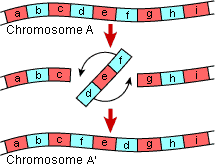
What type of chromosomal mutation is this?
a)
Translocation
b)
Inversion
c)
Deletion
d)
Duplication
124.
What type of chromosomal mutation is this?
a)
Translocation
b)
Inversion
c)
Deletion
d)
Duplication
125.
RNA is read in sections called:
a)
Triplets
b)
Genes
c)
Codons
d)
Genes
126.
Transcription is a process that in eukaryotic cells takes place in the:
a)
Nucleus
b)
Cytoplasm
c)
Golgi Apparatus
d)
Rough E.R.
127.

Human populations are fast growing

a)

True

b)

False-slow

128.

The human population has had a pattern of logistic growth

a)

True

b)

False-exponential

129.

The development of agriculture let humans settle down in villages and cities.

a)

True

b)

False

130.

The invention of agriculture

a)

led to an increased birth rate and death rate.

b)

provided a more dependable food supply.

c)

allowed people to settle down in villages.

d)

all of the above

131.

The carrying capacity for the human population may be about

a)

8 billion people.

b)

9 billion people.

c)

10 billion people.

d)

Humans do not have a carrying capacity.

132.
What kind of factor: disease?
a)
density-independent
b)
density-dependent
133.
What kind of factor: resource scarcity?
a)
density-independent
b)
density-dependent
134.
What kind of factor: flood?
a)
density-independent
b)
density-dependent
135.
What kind of factor: predation?
a)
density-independent
b)
density-dependent
136.
What kind of factor: temperature?
a)
density-independent
b)
density-dependent
137.
What kind of factor resists a population to cause a carrying capacity?
a)
density-independent
b)
density-dependent
138.
Birth rate is also called:
a)
mortality
b)
emigration
c)
natality
d)
immigration
139.
This factor causes a population to decrease due to members moving out.
a)
mortality
b)
emigration
c)
natality
d)
immigration
140.
Logistic population growth leads to this kind of graph
a)
S curve
b)
J curve
c)
M curve
d)
W curve
141.
What is the carrying capacity of this population?
a)
100
b)
200
c)
300
d)
400
142.
This population would be characterized as which kind of species?
a)
r-selected
b)
S-selected
c)
K-selected
d)
C-selected