wayground logo

Free Printable Worksheets

Font size

S
M
L
XL
Worksheets

Bio Final Study Guide

Total questions: 111

Worksheet time: 4hrs 33mins

Name
Class
Date
1.
An ionic bond forms when atoms ___________ electrons.
a)
gain
b)
share
c)
increase
d)
transfer
2.
Which type of bond has a transfer of an electron from on atom to another?
a)
Polar Covalent 
b)
Non Polar Covalent
c)
Ionic
d)
Metallic
3.
All chemical bonds involve two atoms sharing electrons.
a)
True
b)
False
4.
Chemical bonds form when atoms
a)
combined nuclei
b)
give up neutrons
c)
gain protons
d)
share or transfer electrons
5.
The chemical bond formed when two atoms share electrons  is called a(an) IONIC bond. 
a)
True
b)
False
6.
Atoms joined together by SHARING electrons are?
a)
Ionic bonds
b)
Covalent bonds
c)
Metallic Bonds
d)
James Bonds
7.
Covalent bonds are between...
a)
Metal and Non-metal
b)
Non-metal and Non-metal
c)
Metal and Metal
8.
Ionic bonds are between...
a)
Metal and Non-metal
b)
Non-metal and Non-metal
c)
Metal and Metal
9.
Atoms are most stable when their outer shell is complete.
a)
true
b)
false
10.

What is the term for the programmed death of cells?

a)

kinase

b)

cyclin

c)

carcinogen

d)

apoptosis

11.

Two internal factors that are important in advancing the cell cycle are

a)

kinases and cyclins.

b)

hormones and enzymes.

c)

phosphates and enzymes.

d)

proteins and platelets

12.

Which phrase best describes cancer?

a)

absence of cyclins

b)

multiple gene mutations

c)

uncontrolled cell growth

d)

presence of genetic defects

13.
The phase in mitosis where chromosomes move away and are pulled apart by spindles to opposite sides of the cell.
a)
prophase
b)
anaphase
c)
metaphase
d)
telephase
14.
Which of these phases of mitosis take place first?
a)
anaphase
b)
telophase
c)
prophase
d)
metaphase
15.
DNA is replicated during the ______ phase of the cell cycle.
a)
G1
b)
Synthesis
c)
G2
d)
G0
16.
Chromosomes duplicate, the cell grows and develops
a)
Metaphase
b)
Telophase
c)
Interphase
d)
Anaphase
17.
What is the longest stage of the cell cycle called?
a)
Cytokinesis
b)
M phase
c)
Interphase
d)
G1 Phase
18.
During what stage does the G1, S and G2 phases happen?
a)
Interphase
b)
M phase
c)
Mitosis
d)
Cytokinesis
19.
How many stages are in mitosis?
a)
1
b)
2
c)
3
d)
4
20.
Put the following stages of mitosis in order: anaphase, prophase, metaphase, and telophase. 
a)
prophase, metaphase, telophase, anaphase
b)
prophase, anaphase, metaphase, telophase
c)
prophase, metaphase, anaphase, telophase
d)
prophase, telophase, metaphase, anaphase
21.
Uncontrollable cell growth is known as _____
a)
obesity
b)
cancer
c)
diabetes
d)
hepatitis
22.
What is a checkpoint in the cell cycle?
a)
A check to see if the cell is ready to move on
b)
A stoplight
c)
A green light
d)
Something that makes sure that cells die
23.
What do cyclins need to work in conjunction with to activate proteins in that control the cell cycle?
a)
cyclin-independent kinases
b)
cyclin-dependent hypases
c)
cyclin-dependent kinases
d)
cyclin-kinase dependent sugars
24.
________________________ is a process of recognizing defective cells, letting them die, and replacing with normal cells.
a)
Mitosis
b)
Apoptosis
c)
Interphase
d)
Metaphase
25.
In a ___________change, a substance changes into a different substance.
a)
Physical
b)
Chemical
26.
Which of these is NOT a sign that a chemical change has occurred? 
a)
A loss of transparency 
b)
An unexpected color change
c)
A temperature change
d)
The formation of a precipitate
27.
a copper penny turning greenish after a few years.
a)
Chemical Change
b)
Physical Change
28.
Which of the following IS a physical change?
a)
Getting a haircut
b)
Rusty metal
c)
sour milk
d)
A compound
29.
___________________ are the elements are compounds that leave (are formed in) a chemical
reaction.
a)
Polymers
b)
Bonds
c)
Reactants
d)
Products
30.

A chemical change is different than a physical change because in a chemical change

a)

chemicals are used

b)

molecules do not physically touch

c)

a new substance is formed and in a physical no new substance is formed

d)

the change can be seen but in a physical change it cannot

31.

In a chemical reaction, if the reactants are heated, the reaction usually happens

a)

slower

b)

faster

c)

at the same rate

d)

in a smaller volume

32.

Some chemical reactions require a substance called a catalyst. The purpose of a catalyst is

a)

to warm up the reaction

b)

to speed up the reaction

c)

to create more reactants

d)

to stop the reaction

33.

Which is the correct word equation for photosynthesis?

a)

water + glucose + oxygen ---> energy + carbon dioxide

b)

energy + oxygen + carbon dioxide ---> water + glucose

c)

water + carbon dioxide + energy ---> glucose + oxygen

d)

glucose + oxygen ---> water + carbon dioxide + energy

34.

Which of the following is the word equation for cellular respiration?

a)

water + carbon dioxide + energy ---> glucose + oxygen

b)

water + glucose ---> energy + carbon dioxide + oxygen

c)

oxygen + carbon dioxide ---> water + energy + glucose

d)

glucose + oxygen ---> water + carbon dioxide + energy

35.

Photosynthesis takes place in the

a)

mitochondria

b)

chloroplast

c)

nucleus

d)

cytoplasm

36.

cellular respiration takes place in the

a)

mitochondria

b)

chloroplast

c)

nucleus

d)

cytoplasm

37.

What is the purpose of photosynthesis. Select all that apply.

a)

to form glucose, food for the plant

b)

to form carbon dioxide

c)

to form oxygen

d)

to form energy

e)

to form water

38.

What is the purpose of cellular respiration. Select all that apply.

a)

to form glucose

b)

to form oxygen

c)

to form carbon dioxide

d)

to form energy

e)

to form water

39.

Which of the following is a common sign that a chemical change has occurred?

a)

A chemical has turned a different color, bubbled, and/or changed temperature.

b)

A chemical has changed to a different state of matter, such as a liquid to a solid.

c)

A chemical has changed size.

d)

A chemical has become a different shape.

40.
The number of ATP molecules produced out of Krebs Cycle is:
a)
2
b)
3
c)
4
d)
0
41.
Which of the following is not a requirement for the Krebs Cycle?
a)
NAD+
b)
FAD+
c)
Water
d)
Pyruvate
42.
Krebs Cycle takes place in the:
a)
Cytoplasm
b)
Matrix
c)
Ribsome
d)
InterMembrane Space
43.
Krebs Cycle is part of_______________ respiration.
a)
Aerobic
b)
Anaerobic
44.
Prior to entering the Krebs Cycle, each pyruvate molecule loses electrons, hydrogen ions, and a carbon, forming an energy-rich molecule of
a)
Acetyl-CoA
b)
Citrate
c)
Oxaloacetate
d)
Malate
45.
what travel through the electron transport chain?
a)
cells
b)
electrons
c)
blood
d)
thylokoid
46.
how many ATP can be produce from 1 glucose?
a)
2
b)
40
c)
4
d)
36
47.
Osmosis is the movement of _____ across a membrane.
a)
food
b)
energy
c)
oxygen
d)
water
48.
During osmosis
a)
water moves from high to low concentration
b)
large or oddly shaped molecules move across a cell membrane
c)
water moves when energy is used
d)
proteins are built
49.
HYPO means...
a)
Low
b)
High
c)
Equal
d)
Fat
50.
ISO means...
a)
Low
b)
A lot
c)
Equal
d)
Mammal
51.
Why can't you drink salt water?
a)
It's hypertonic to your cells
b)
It's hypotonic to your cells
c)
It's isotonic to your cells
d)
It's paratonic to your cells
52.

Describe COHESION.

a)

Water molecules attracted to other substances.

b)

Water molecules climbing upwards against the force of gravity.

c)

Water molecules dissolving many substances because of its polarity.

d)

Water molecules attracted to other water molecules.

53.
What word describes when water is attracted to other substances?
a)
cohesion
b)
adhesion
c)
capillary action
d)
surface tension
54.
Attractions between water molecules are called
a)
Covalent bonds
b)
Ionic bonds
c)
Polar bonds
d)
Hydrogen bonds
55.
Which end of the water molecule has a slightly positive charge?
a)
the oxygen end
b)
the hydrogen end
c)
both ends are slightly positive
d)
neither end is positive
56.

Water's ability to stick to glass is

a)

adhesion

b)

cohesion

c)

surface tention

d)

capillary action

57.
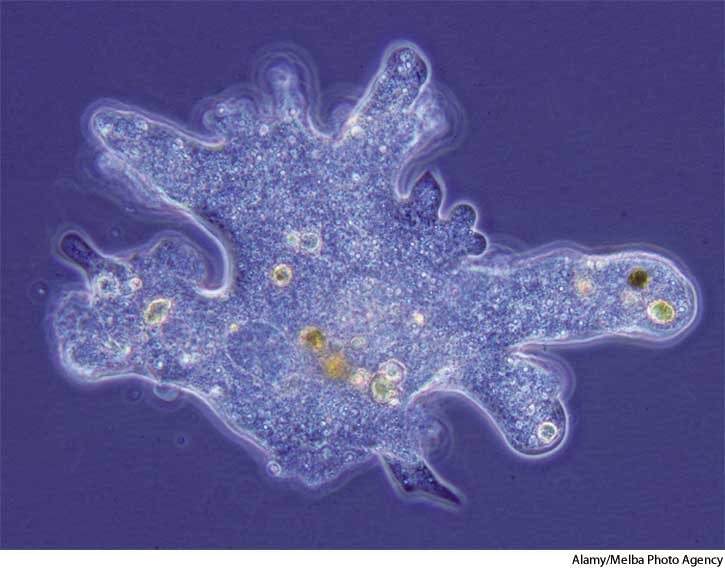
An Amoeba is a unicellular, animal-like protist that lives in ponds and streams. According to cell theory, where did this cell come from?
a)
another pre-existing amoeba cell.
b)
energy from sun that allowed the protist to reproduce.
c)
a multicellular organism.
d)
the nonliving environment.
58.
What tool do you use to view the cells?
a)
metric ruler
b)
centrifuge
c)
microscope
d)
telescope
59.
Which of the following is NOT a cell theory.
a)
All non-living things are made of cells
b)
All cells come from pre-existing cells
c)
Cells are the basic unit of structure and function of all living things
60.
All living things are made up of...
a)
cells
b)
cell tissues
c)
organ
d)
organ systems
61.
An organism made of one cell is called
a)
unicellular organism
b)
multicellular organism
62.
Which of the following statements is not part of the cell theory?
a)
Cells are the basic unit of structure and function in all living things.
b)
All cells are produced from other cells.
c)
Only animal cells are composed of cells.
d)
All living things are composed of cells.
63.
In order to sustain life, all cells must...
a)
digest nutrients and water
b)
excrete waste and fluids
c)
must be able to maintain a homeostasis environment (aka cellular respiration and regulation)
d)
All of the above
64.
Which is NOT part of the Cell Theory
a)
New cells are produced from existing cells
b)
All living things are composed of cells
c)
Only eukaryotic cells have a nucleus
d)
Cells are the basic unit of structure & function in living things
65.
Which invention from the 17th century allowed for the development of modern cell theory?
a)
x-rays
b)
computers
c)
the light microscope
d)
the scanning electron microscope
66.
Cell theory was first proposed in 1838. Evidence obtained through additional scientific investigations resulted in the current cell theory. Which statement describes a component of the original cell theory that was removed because of the new scientific knowledge?
a)
 All living things are made of cells.
b)
All cells come from other preexisting cells.
c)
Cells form through spontaneous generation.
d)
 Cells are the basic structural and functional units of life.
67.
The symbol for specific heat is .......
a)
c
b)
Q
c)
m
d)
t
68.
Specific heat is....
a)
The measure of kinetic energy of an objects particles
b)
A measure of the energy needed to increase the average kinetic energy of the particles
c)
The heating caused by the motion of flluid due to temperature difference
d)
The transfer of energy by electromagnetic radiation
69.
A high specific heat means...
a)
It heats up quickly with energy added
b)
It requires more energy to change temperature
70.
What elements make up carbohydrates?
a)
Carbon, hydrogen, nitrogen, oxygen
b)
sulfur, carbon, hydrogen
c)
glucose and fructose
d)
carbon, hydrogen, oxygen
71.
The 3 categories of carbohydrates are:
a)
Monosaccharide, disaccharide, polysaccharide
b)
glucose, fructose, galatose
c)
starch, cellulose, chitin
d)
There are no categories of carbohydrates
72.
What is the function of a carbohydrate?
a)
Stores energy
b)
Movement
c)
Stores genetic information
d)
Speeds up reactions
73.
What is a protein: 
a)
A polymer composed of many sugars.
b)
A polymer composed of many amino acids. 
c)
A polymer composed of fatty acids. 
d)
A polymer composed of nucleotides. 
74.
What is the monomer of proteins?
a)
amino acids
b)
polypeptides
c)
nucleotides
d)
monosaccharides
75.
What is the monomer of a carbohydrate?
a)
Monosaccharide
b)
Amino Acid
c)
Nucleotide
d)
Glycerol+Fatty Acid
76.
What is the monomer of a lipid?
a)
Monosaccharide
b)
Nucleotide
c)
Glycerol+Fatty Acid
d)
Amino Acid
77.

Proteins contain

a)

Hydrogen

b)

Carbon

c)

Oxygen

d)

Nitrogen

e)

Phosphorous

78.
DNA and RNA are examples of...
a)
proteins
b)
nucleic acids
c)
carbohydrates
d)
lipids
79.
What is the function of nucleic acids?
a)
Stores energy
b)
Stores genetic information
c)
Movement
d)
Physical structure
80.
Which macromolecule is this?
a)
carbohydrate
b)
lipid
c)
protein
d)
nucleic acid
81.
Which macromolecule is shown?
a)
lipid
b)
protein
c)
nucleic acid
d)
carbohydrate
82.
What are two types of passive transport?
a)
endo and exocytosis 
b)
in a minute and later
c)
hydrophobic and hydrophillic 
d)
osmosis and diffusion
83.
Special proteins help move particles, but NO energy is needed. This is..
a)
facilitated diffusion
b)
exocytosis
c)
active transport
d)
equilibrium
84.
When something is 'water loving' it is.....
a)
Hydrophobic
b)
Hydrophilic 
c)
Hydroelectric 
d)
Hydroloric
85.
When something is 'water fearing' it is....
a)
Hydrophobic
b)
Hydrophilic 
c)
Hydroelectric 
d)
Hydrochloric
86.
The cell membrane is selectively permeable, which means...
a)
All materials can enter and leave the cell
b)
Certain things can enter while others cannot
c)
The cell manually sorts through all materials
d)
Only certain cells can interact with the cell.
87.

ATP is a form of energy needed for.....

a)

passive transport

b)

active transport

c)

facilitated transport

d)

country roads take me home to the place i belong wEST VIRGINIA

88.
Which part of this phospholipid is hydrophobic?
a)
fatty lipid tails
b)
head
c)
all of it is hydrophobic
d)
none of it is hydrophobic
89.
Against the concentration gradient, from low to high, uses ATP; this decribes.....
a)
facilitated diffusion
b)
osmosis
c)
active transport
d)
simple diffusion
90.
When looking at the cell membrane, where are the lipid tails located?
a)
Inner part of the bilayer
b)
Outer part of the bilayer
c)
At the end of the bilayer
d)
Goes through each end of the bilayer
91.
When looking at the cell membrane, where are the lipid tails located?
a)
Inner part of the bilayer
b)
Outer part of the bilayer
c)
At the end of the bilayer
d)
Goes through each end of the bilayer
92.
How does a cell maintain homeostasis?
a)
Regulates what enters and leaves the cell
b)
Flexibility
c)
Protective barrier
d)
Structure and support
93.
A ______________ is composed of a phosphate and glycerol head and 2 fatty acid chain tails. 
a)
phospholipid 
b)
Carbohydrate
c)
Cholesterol 
d)
Protein 
94.
___________ allow cells to recognize each other and act like ID tags. 
a)
Carbohydrates 
b)
Proteins
c)
Phospholipids 
d)
Cholesterol
95.
___________ have 2 functions in the cell membrane.
1.) They act like gatekeepers, only let certain things in. 
2.) Enzyme receptors embedded in the membrane.
a)
Carbohydrates 
b)
Proteins 
c)
Phospholipids 
d)
Cholesterol
96.

Which type of solution makes a cell shrink?

a)

Hypotonic

b)

Hypertonic

c)

Isotonic

97.
What type of transport does not require the use of ATP (energy)?
a)
Passive
b)
Active
98.

Which of the following are examples of passive transport? Select multiple answers.

a)

Ion pump

b)

Facilitated diffusion

c)

Endocytosis

d)

Exocytosis

e)

Osmosis

99.
A new organism is produced from one parent organism.
a)
Sexual Reproduction
b)
Asexual Reproduction
100.
Mitosis is a type of ________________ reproduction.
a)
Sexual
b)
Asexual
101.
What is the first phase of Mitosis?
a)
Prophase
b)
Metaphase
c)
Anaphase
d)
Telophase
102.
The building blocks (monomers) or proteins are _______.
a)
Nucleotides
b)
Monosaccharides
c)
Amino Acids
d)
Glycerol and fatty acids
103.
___________ are many monomers bonded together that form a larger molecule.
a)
Polymers
b)
Monomers
c)
Trinominers
d)
DNA
104.
DNA and RNA are examples of 
a)
Carbohydrates
b)
Lipids
c)
Proteins
d)
Nucleic Acids
105.
Nucleotides are the building blocks (monomers) of ______.
a)
Carbohydrates
b)
Lipids
c)
Proteins
d)
Nucleic Acids
106.
Sugars, starches and chitin are examples of
a)
Carbohydrates
b)
Lipids
c)
Proteins
d)
Nucleic Acids
107.
What are the building blocks of carbohydrates?
a)
simple sugars (glucose)
b)
amino acids
c)
glycerol
d)
DNA
108.
A biological substance that speeds up a chemical reaction.
a)
sugar
b)
enzyme
c)
cellulose
d)
lipid
109.
Who discovered and named cells? 
a)
Captain Hook
b)
Robert Hooke
c)
Zacharias Janssen
d)
Rudolf Virchow
110.
What did Hooke first examine? 
a)
Pond water
b)
Plant cells
c)
Cork
d)
Animal fat
111.

Country Roads, Take me home...

a)

to the pLACE, I bElOng!

b)

WEST VIRGINA

c)

MOUNTAIN MAMA TAKE ME HOME

d)

COUNTRY rOaDs

e)

i got the horses in the back