wayground logo

Free Printable Worksheets

Font size

S
M
L
XL
Worksheets

Atmosphere Unit Review

Total questions: 89

Worksheet time: 2hrs 46mins

Name
Class
Date
1.
What are the two main factors that determine the climate of an area?
a)
precipitation and humidity
b)
temperature and air pressure
c)
wind conditions and humidity
d)
temperature and precipitation
2.
Which BEST describes why latitudes closest to the equator have warmer climates?
a)
they are at lower elevations
b)
they receive more solar energy
c)
they are nearer to ocean currents
d)
they get more winds that carry energy in the form of heat
3.
Ocean currents have an affect on which two things
a)
climate and weather
b)
temperature and density
c)
land and sea
d)
equator and poles
4.
What is the weather conditions in an area over a long period of time?
a)
climate
b)
temperature
c)
elevation
d)
precipitation
5.
What is it called when plants give off water vapor as a waste product?
a)
condensation
b)
evaporation
c)
sublimation
d)
transpiration
6.
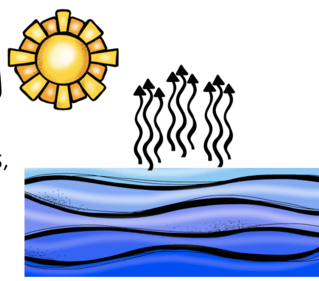
Evaporation happens when the sun ___________ water and turns it into vapor.
a)
cools
b)
heats up
c)
freezes
d)
lights up
7.
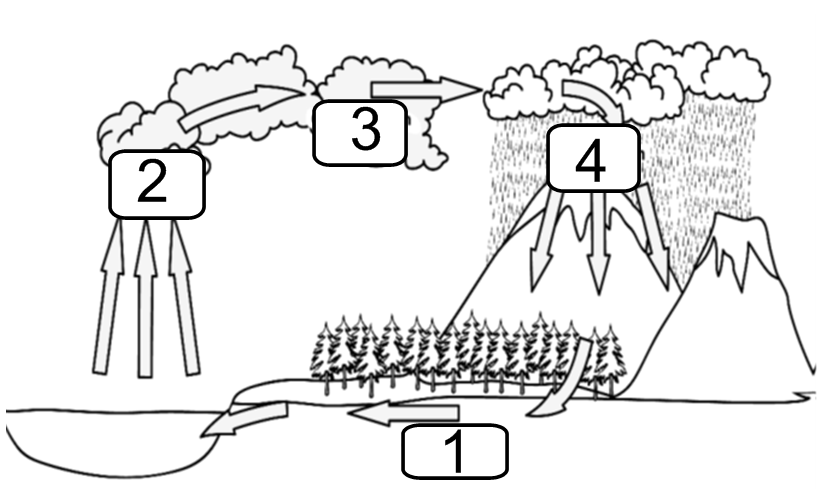
Which stage does the #2 show in the diagram?
a)
condensation
b)
evaporation
c)
precipitation
d)
run off
8.
Which stage does the #3 show in the diagram?
a)
condensation
b)
evaporation
c)
precipitation
d)
run off
9.
what does the #4 show in the diagram?
a)
condensation
b)
evaporation
c)
precipitation
d)
run off
10.
Where you will find the ozone layer.
a)
stratosphere
b)
thermosphere
c)
exosphere
d)
mesosphere
11.
Where weather occurs.
a)
stratosphere
b)
thermosphere
c)
troposphere
d)
mesosphere
12.
Where we live.
a)
stratosphere
b)
thermosphere
c)
troposphere
d)
mesosphere
13.
The hottest layer.
a)
troposphere
b)
thermosphere
c)
exosphere
d)
mesosphere
14.

Which order is correct from the earth to space?

a)

thermosphere

troposphere

exosphere

mesosphere

stratosphere

b)

thermosphere

troposphere

stratosphere

exosphere

mesosphere

c)

exosphere

thermosphere

mesosphere

stratosphere

troposphere

d)

thermosphere

troposphere

stratosphere

exosphere

mesosphere

15.
As you go higher in the troposphere, the temperature _______________.
a)
decreases
b)
increases
c)
stays the same
d)
gets very hot
16.

When gas, oil, and coal are burned, ___ is added to the atmosphere.

a)

Carbon Dioxide

b)

Oxygen

c)

Chlorofluorocarbon

d)

Hydrogen

17.

What is one benefit of warm temperatures brought about by climate change?

a)

extreme weather events

b)

longer growing seasons

c)

mudslides

d)

coastal flooding

18.

Which of the following is a way a 13 year old in America can help control greenhouse gasses?

a)

plant trees

b)

recycle aluminum cans

c)

turn off electronics that are not in use

d)

all of the above

19.

A major influence on climate is___.

a)

large bodies of water

b)

large cities

c)

ocean currents

d)

all of the above

20.

How does the ozone layer help life on Earth?

a)

It produces oxygen for the atmosphere

b)

It protects Earth from meteors

c)

It absorbs damaging ultraviolet radiation from the Sun

d)

It reflects most of the Sun's radiation to keep the planet cool

21.

Which general direction do air masses move over the continental United States?

a)

south to north

b)

north to south

c)

east to west

d)

west to east

22.

Which gas is represented by the 78% area of the graph shown?

a)

Carbon Dioxide

b)

Oxygen

c)

Nitrogen

d)

Hydrogen

23.

What causes the curved paths of the planetary winds known as the Coriolus Effect?

a)

magnetic forces of the poles

b)

revolution of Earth around the Sun

c)

gravitational pull of the Moon

d)

rotation of the Earth

24.
What happens to air pressure as you move upward into the atmosphere?
a)
increases
b)
decreases
c)
stays the same
25.
A device that is used to measure atmospheric pressure is a ___________.
a)
barometer
b)
thermometer
c)
kilometer
d)
micrometer
26.
Density of air is greater ________.
a)
at the top of the mountain
b)
at the bottom of the mountain
c)
at the center of the mountain
27.
What causes wind?
a)
differences in the thermosphere
b)
differences in gravity
c)
differences in oxygen
d)
differences in air pressure
28.
The winds that blow from 30° to 60° latitude in both hemispheres are called
a)
global easterlies.
b)
trade winds.
c)
polar easterlies.
d)
westerlies.
29.
Narrow belts of winds that can reach 400 km/h are called
a)
convection streams.
b)
jet streams.
c)
convection currents.
d)
jet currents.
30.
The winds that blow from 30° latitude in both hemispheres toward the equator are calledd. 
a)
the doldrums.
b)
 polar easterlies.
c)
trade winds.
d)
westerlies.
31.
A severe storm that involves strong winds and forms over warm water is:
a)
tornado
b)
thunderstorm
c)
hurricane
d)
blizzard
32.
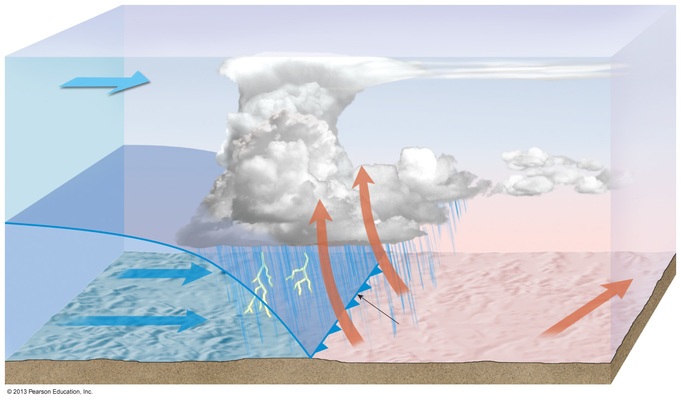
A severe storm which involves a funnel cloud forming from a cumulonimbus cloud:
a)
hurricane
b)
tornado
c)
thunderstorm
d)
blizzard
33.
This severe weather involves lightning, rain, and forms from a cumulonimbus cloud.
a)
thunderstorm
b)
tornado
c)
hurricane
d)
blizzard
34.
This weather tool measures wind speed 
a)
thermometer
b)
barometer
c)
anemometer
d)
psychrometer
35.
Humidity is the...
a)
Amount of Water Vapor in the Air
b)
Amount of Wind in the Air
c)
Amount of Precipitation in the Air
d)
Amount of Pressure in the Air
36.
What kind of weather is usually associated with a low pressure system?
a)
Sunny weather
b)
Precipitation (rain, snow, etc.)
37.
What kind of weather is usually associated with a high pressure system?
a)
Sunny weather
b)
Precipitation (rain, snow, etc.)
38.
In what direction do winds always blow?
a)
From areas of high pressure to areas of low pressure
b)
From areas of low pressure to areas of high pressure
39.
What type of cloud looks like cotton and is in the lower altitudes?
a)
Cumulus
b)
Stratus
c)
Cirrus
40.
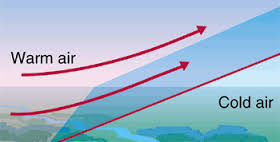
What type of storm front is this? 
a)
warm front
b)
cold front
c)
stationary front
d)
occluded front
41.
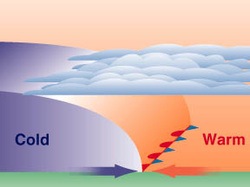
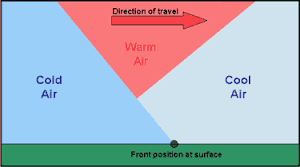
Which type of front is pictured?
a)
Cold front
b)
Warm front
c)
Occluded front
d)
Stationary front
42.
Which type of front is pictured?
a)
Cold front
b)
Warm front
c)
Occluded front
d)
Stationary front
43.
What symbol is this?
a)
warm front
b)
cold front
c)
stationary front
d)
occluded front
44.
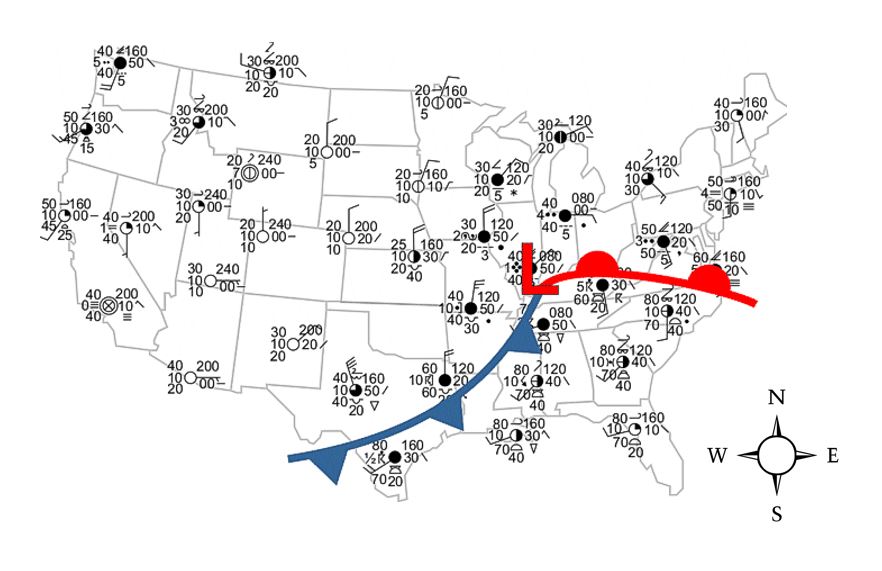
What direction is the warm front moving on the map? 
a)
North
b)
South
c)
East
d)
West
45.
Which type of front is pictured?
a)
Cold front
b)
Warm front
c)
Occluded front
d)
Stationary front
46.

What does this symbol represent?

a)

Cold Front

b)

Warm Front

c)

Stationary Front

d)

Occluded Front

47.

What does this symbol represent?

a)

Cold Front

b)

Warm Front

c)

Stationary Front

d)

Occluded Front

48.

What does this symbol represent?

a)

Cold Front

b)

Warm Front

c)

Stationary Front

d)

Occluded Front

49.

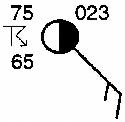
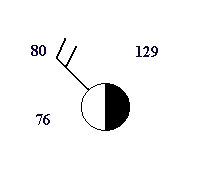
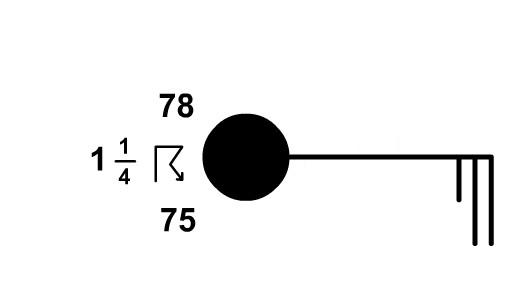
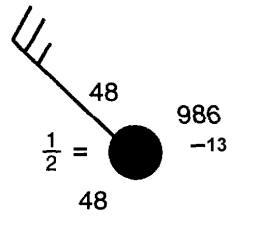
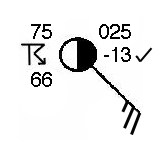
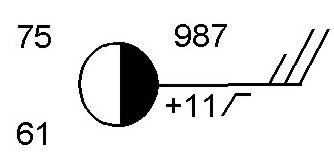
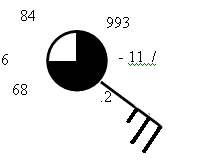
What is the dewpoint for the following station model?

a)

10 ºF

b)

23 ºF

c)

65 ºF

d)

75 ºF

50.

What is the temperature for the following station model?

a)

4 ºF

b)

76 ºF

c)

80 ºF

d)

129 ºF

51.

What is the present weather for the following station model?

a)

rain

b)

thunderstorms

c)

drizzle

d)

fog

52.

What is the wind direction for the following station model?

a)

north

b)

east

c)

northwest

d)

northeast

53.

What is the wind speed for the following station model?

a)

10 knots

b)

15 knots

c)

20 knots

d)

25 knots

54.

What is the barometric pressure for the following station model?

a)

987 mb

b)

998.7 mb

c)

1098.7 mb

d)

1098 mb

55.

What is the amount of cloud cover for the following station model?

a)

25%

b)

50%

c)

75%

d)

100%

56.
What is the climate of the top of a mountain like as compared to the bottom of the mountain?
a)
warmer
b)
cooler
c)
drier
d)
wetter
57.
What is the difference between climate and weather?
a)
 Climate averages the weather conditions in a specific place over a long period of time, while weather describes the state of the atmosphere at a specific moment in time.
b)
 Weather averages the weather conditions in a specific place over a long period of time, while Climate describes the state of the atmosphere at a specific moment in time.
c)
Climate describes the weather conditions at night, while weather describes the conditions during the daytime.
d)
 There is not a difference between climate and weather.
58.
What are the 3 major climate zones in order from equator to the poles?
a)
polar, temperate, tropical
b)
tropical, temperate, polar
c)
temperate, polar, tropical
d)
temperate, tropical, polar
59.
Climates are classified according to which two major factors?
a)
elevation & precipitation
b)
latitude & temperature
c)
elevation & latitude
d)
precipitation & temperature
60.
What is weather?
a)
What's happening in space at a time and place.
b)
What's happening in our atmosphere at a time and place.
c)
The average weather over many years
d)
The average temperature over many years.
61.
The seasons are caused by___________?
a)
The direction the Earth's axis is tilted toward the sun
b)
Tropical Storms
c)
Changes in the moon
d)
The Earth's rotation on its axis
62.
In which position is it summer in the Northern Hemisphere?
a)
1
b)
2
c)
3
d)
4
63.
Which of the following does NOT have an affect on a region's climate?
a)
Large bodies of water
b)
Latitude
c)
Mountains
d)
Longitude
64.
Which of the following is NOT a natural cause of climate change?
a)
pollution
b)
meteorite collisions
c)
solar spots
d)
Volcanic eruptions
65.
Which of the following is a greenhouse gas?
a)
carbon monoxide
b)
oxygen
c)
nitrogen
d)
carbon dioxide
66.
When the sun's rays pass through our atmosphere and then heat is trapped by the atmosphere it is called
a)
Global Warming
b)
Greenland Effect
c)
Greenhouse Effect
d)
Ice Age
67.
All of the following are causes of Global Warming except
a)
Rotation of the Earth
b)
Deforestation
c)
Increases in Greenhouse Gases
d)
Burning Fossil Fuels
68.
Which of the following would help decrease Global Warming?
a)
drive hybrid/fuel efficient cars
b)
burn fossil fuels
c)
deforestation
d)
use aerosol cans
69.

The Clean Air Act- regulates vehicle emissions.

a)

true

b)

false

70.

A type of pollution found both indoors and outdoors, which includes pollen, dander, soot, carbon, and dust.

a)

Water droplets

b)

Allergens

c)

Particulate matter

d)

Combustibles

71.

Which of the following government agencies is responsible for the Clean Air Act?

a)

the USGS

b)

the USDA

c)

the EPA

d)

the USDOJ

72.

What is the major cause for air pollution?

a)

deforestation

b)

oil spills

c)

transportation

d)

cigarretes

73.
Which of these problems can be caused by air pollution?
a)
Respiratory problems
b)
Reduced food sources for humans
c)
Increased disease for humans
d)
Decrease in global temperatures
74.
Greenhouse gases, in moderate amounts, keep the Earth's temperature stable
a)
True
b)
False
75.
Increase in which gas is primarily responsible for increased global warming?
a)
Carbon dioxide
b)
Water vapor
c)
Methane
d)
Nitric oxides
76.
Pollution hanging over urban areas that causes reduced visibility is called
a)
Air pollution
b)
Temperature inversion
c)
Light pollution
d)
Smog
77.
What can humans do to reduce the effects of acid rain?
a)
Develop Alternate Energy Sources (Solar Power, Wind Energy)
b)
Use Less Energy
c)
Stop Burning Fossil Fuels
d)
All of the Answers are Correct
78.

When the Ozone Layer loses Ozone what happens to organisms on the earth's surface?

a)

They are exposed to Smog

b)

Nothing happens

c)

They are exposed to Acid Rain

d)

They are exposed to Ultraviolet B Radiation

79.

Where is the Ozone Layer found in our atmosphere?

a)

Troposphere (lower portion)

b)

Stratosphere (upper portion)

80.

CFC's may cause harm to our

a)

Troposphere

b)

Inversion Layer

c)

Ozone Layer

d)

Carbon Dioxide

81.

Which pair below are the two main sources of air pollution in urban (populated) areas?

a)

vehicles, volcanoes

b)

vehicles, industries

c)

Industries, agriculture

d)

All of the above

82.

Acid precipitation/rain can be traced back to

a)

the burning of fossil fuels.

b)

the use of electrostatic precipitators.

c)

thermal inversions.

d)

the release of particulate matter into the atmosphere.

83.

A group of friends gather around a fire to stay warm. This is an example of ________.

a)

conduction

b)

convection

c)

radiation

84.

In heat transfer, heat always flows from the _______________ substance to the _______________ substance.

a)

hotter to colder

b)

colder to hotter

c)

hotter to hotter

d)

colder to colder

85.

The handle of a metal spoon warms up when it is placed in a hot bowl of soup because of ________.

a)

convection

b)

conduction

c)

radiation

86.

Near the ceiling of a room the air is warmer. The warm air rises because of ________.

a)

conduction

b)

convection

c)

radiation

87.

The heat from a lamp allows a lizard to remain warm. This is an example of which type of heat transfer?

a)

radiation

b)

conduction

c)

convection

88.

A huge rock at the state park gets so hot during the day because of ________.

a)

conduction

b)

convection

c)

radiation

89.

The type of heat transfer that creates currents in water is called ________.

a)

conduction

b)

convection

c)

radiation