Wayground logo

Free Printable Worksheets

Font size

S
M
L
XL
Worksheets

October Benchmark Review

Total questions: 104

Worksheet time: 4hrs 53mins

Name
Class
Date
1.
The amount of space something takes up.
a)
matter
b)
mass
c)
volume
d)
element
2.
Anything that has mass and takes up space.
a)
volume
b)
matter
c)
solid
d)
temperature
3.
The measure of the energy of motion in the particles of matter, which we feel as how hot or cold something is.
a)
matter
b)
gas
c)
temperature
d)
atomic theory
4.
The state of matter in which a substance has a definite volume but no definite shape.
a)
gas
b)
liquid
c)
solid
d)
matter
5.
The state of matter in which a substance has a definite shape and definite volume.
a)
solid
b)
gas
c)
atom
d)
liquid
6.
The state of matter in which a substance does not have a definite shape or volume.
a)
element
b)
compound
c)
gas
d)
liquid
7.
A change in which the form or shape of a substance changes but the chemical makeup of the substance remains the same.
a)
chemical change
b)
reaction
c)
physical change
d)
solution
8.
A change in one or more substances, caused by a reaction, that forms new and different substances.
a)
mixture
b)
physical change
c)
element
d)
chemical change
9.
A combination of two or more different substances in which the substances keep their identities. 
a)
reaction
b)
mixture
c)
solution
d)
atom
10.
The process in which new substances are formed during  a chemical change.
a)
reaction
b)
solution
c)
matter
d)
volume
11.
A mixture that has the same composition throughout because all the parts are mixed evenly.
a)
reaction
b)
solution
c)
mixture
d)
atam
12.
The smallest unit into which an element can be divided and still retain all the properties of that element.
a)
atomic theory
b)
compound
c)
element
d)
atom
13.
Matter that is made of only one kind of atom.
a)
compound
b)
volume
c)
element
d)
atom
14.
What is this tool to get volume?
a)
triple beam balance
b)
ruler
c)
thermometer
d)
graduate cylinder
15.
What is this tool to get mass?
a)
triple beam balance
b)
ruler
c)
thermometer
d)
graduate cylinder
16.
True or False:  The density of a specific type of material never changes.  
a)
True
b)
False
17.
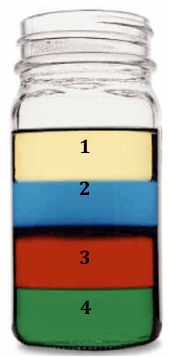
Put the liquids in order from most dense to least dense?
a)
4, 3, 2, 1
b)
1, 2, 3, 4
c)
3, 4, 2, 1, 
d)
4, 3, 1, 2
18.
Why does ice float?
a)
Liquid water is less dense than solid water.
b)
Solid water is less dense than liquid water.
c)
Gaseous water is less dense than solid water.
d)
Liquid water is less dense than gaseous water.
19.
What do we know about the density of lamp oil, rubbing alcohol, and vegetable oil?  
a)
The density is greater than 1.0 g/mL
b)
The density is less than 1.0 g/mL
c)
The density is equal to 1.0 g/mL
d)
The density can not be determined
20.
In general what is the most dense form of matter?
a)
solid
b)
liquid
c)
gas
d)
plasmas
21.
If an object has a density of .6 g/cm^3 and you put it into water, will it sink or float?  
a)
sink
b)
float
22.
If an object has a density of 3.6 g/cm^3 and you put it into water, will it sink or float?  
a)
sink
b)
float
23.
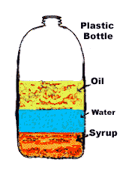
Which liquid is the least dense?
a)
oil
b)
water
c)
syrup 
d)
plastic bottle
24.
Jack has a rock. The rock has a mass of 14 g and a volume of 2 cm3. What is the density of the rock?
a)
7 mL
b)
7 g/cm3
c)
28 g/cm3
d)
1/7 g/cm3
25.
Frank has an eraser. It has a mass of 4 g, and a volume of 2 cm3. What is its density?
a)
8 g/cm3
b)
2 g/cm3
c)
1/2 g/cm3
d)
24 g/cm3
26.
Frank has a liquid. It has a mass of 6 g and a volume of 9 mL. What is its density?
a)
3 g/mL
b)
.66 g/mL
c)
1.33 g/mL
d)
54 g/mL
27.

Subatomic particles with a negative charge

a)

Electrons

b)

Neutrons

c)

Protons

d)

Quarks

28.
subatomic particles found on the outermost shell & responsible for the atom's reactivity
a)
neutrons
b)
valence electrons
c)
isotopes
d)
ions
29.
Subatomic particles with a positive charge
a)
neutrons
b)
atomic mass
c)
protons
d)
isotopes
30.
Measure mainly of the nuclear particles: protons + neutrons
a)
Subatomic Particles
b)
Atomic Number
c)
Atomic Mass
d)
Gluons
31.
Value representing the number of protons in an element
a)
Atomic Mass
b)
Mass Number
c)
Valence Electrons
d)
Atomic Number
32.
Subatomic particles that are neutral in charge
a)
Neutrons
b)
Protons
c)
Nucleus 
d)
Electrons
33.
A charged atom
a)
Ion
b)
Isotope
c)
Electron Cloud
d)
Quark
34.
The smallest particle of an element that shows all the properties of that element.
a)
Subatomic Particles
b)
Atom
c)
Quarks
d)
Gluons
35.
Where electrons are likely to be found as they travel around the nucleus
a)
Nucleus
b)
Electron Cloud
c)
Within a Proton
d)
Within a Neutron
36.
A tiny but very dense, positively charged portion of the atom that holds most of the atomic mass
a)
Electron Shells
b)
Orbitals
c)
Electron Cloud
d)
Nucleus
37.
The only element with no neutrons in its nucleus.
a)
Oxygen
b)
Helium 
c)
Hydrogen
d)
Lithium
38.
What is atomic number?
a)
Number of protons in an atoms 
b)
Number of neutrons in an atom
c)
Mass of an atom
d)
Charge on an atom
39.
Which subatomic particles are found in the nucleus of an atom?
a)
Protons and Electrons
b)
Protons and Neutrons
c)
Neutrons and Electrons
d)
Protons, Neutrons and Electrons
40.
The total number of protons and neutrons in an atom is called the...
a)
Atomic number
b)
Proton number
c)
Mass number
d)
Weight number
41.
How many protons does an aluminium atom have? (Use the image to help you)
a)
27
b)
14
c)
40
d)
13
42.
How many neutrons does a sodium atom have? (Use the image to help you)
a)
23
b)
11
c)
12
d)
34
43.
The mass number of an element that has18 protons, 18 electrons, and 19 neutrons is _____.
a)
12.5
b)
13
c)
25
d)
37
44.
The atomic number of an element that has 9 protons, 9 electrons, and 10 neutrons is _____.
a)
9
b)
10
c)
19
d)
28
45.
What element is represented in this Bohr Model? 
a)
Carbon
b)
Hydrogen
c)
Aluminum
d)
Lithium
46.
Which of these grouping of elements could have the characteristic of luster (shiny)?
a)
Metal
b)
Nonmetal
c)
metalloids
d)
Both metals and metalloids
47.
Which of these is a property of metals?
a)
It's malleable
b)
It can't conduct electricity
c)
They are used in food
d)
It's very brittle
48.
Brittle
a)
Metal
b)
Nonmetal
49.
Good conductor of heat
a)
Metal
b)
Nonmetal
50.
Which element is a metalloid?
a)
Titanium
b)
Selenium
c)
Potassium
d)
Polonium
51.
All of the following would classify an element as a metal except?
a)
Dull
b)
Luster
c)
Malleable
d)
Hard
52.
Iron is a good conductor, malleable and magnetic. What type of element is Iron? 
a)
Metal
b)
Nonmetal
c)
Metalloid
d)
Pretty
53.
A student is given a sample of an unknown substance. He is asked to determine if it is classified as a metal, a metalloid, or a nonmetal. He discovered that the unknown element conducted some heat and electricity, had a shiny luster, and broke easily. This element is most likely a 
a)
metal
b)
nonmetal
c)
metalloid
d)
cannot be determined
54.
Which table below correctly lists the properties of metals and nonmetals? *
a)
A
b)
B
c)
C
d)
D
55.
All of the following are properties used to classify elements as metals, non-metals, and metalloids EXCEPT —
a)
texture
b)
conductivity
c)
luster
d)
malleability
56.
How many valence electrons are found in atoms of group 14?
a)
4
b)
3
c)
14
d)
16
57.
Which group has the greatest number of valence electrons?
a)
1
b)
14
c)
18
d)
16
58.
How many valence electrons are found in atoms of group 15?
a)
4
b)
5
c)
2
d)
3
59.
How many valence electrons are found in atoms of group 1?
a)
7
b)
6
c)
4
d)
1
60.

What are valence electrons?

a)

The total number of electrons in an atom

b)

The number of electrons in the outermost shell

c)

The number of electrons in the second shell

d)

The number of protons in the outermost shell

61.

Which elements have the most similar chemical properties?

a)

boron and carbon

b)

oxygen and sulfur

c)

aluminum and bromine

d)

argon and silicon

62.

All atoms are most stable with (or would "prefer") how many electrons in their valence shell?

a)

1

b)

2

c)

8

d)

18

63.
Valence electrons are: 
a)
Electrons farthest away from the nucleus
b)
Electrons closest to the nucleus
c)
Electrons that just come and go - they don't stay with the atom
d)
Electrons in the second shell
64.

When trying to identify an unknown element, a scientist determines what other elements reacts with chemically. Which property of the unknown element determines the other element it reacts with?

a)

The total number of neutrons in the unknown element

b)

The total number of particles in the nucleus of the unknown element

c)

The number of protons in the nucleus of the unknown element

d)

The number of valence electrons in the unknown element

65.

Why are halogens so reactive?

a)

They want to get rid of their only valance electron

b)

They only need one more electron

c)

They are non reactive, they have a full shell

66.
what is the definition of physical change?
a)
any change that results in the formation of new chemical substances. 
b)
rusting
c)
changes affecting the form of a chemical substance, but not its chemical composition.
d)
any property that is measurable, whose value describes a state of a physical system
67.
what is the definition of chemical change?
a)
any change that results in the formation of new chemical substances. 
b)
changing clothes
c)
matter cannot be created or destroyed, only change form
d)
changes affecting the form of a chemical substance, but not its chemical composition.
68.
Is burning wood a chemical or physical change?
a)
chemical
b)
physical
69.
Is hammering wood together to build a house a chemical or physical change?
a)
chemical
b)
physical
70.
Which of the following is NOT an example of chemical change?
a)
sour milk
b)
burning wood
c)
breaking a pencil
d)
rust
71.
Baking a cake by mixing flour, sugar, chocolate powder, eggs, and milk, and then heating them in the oven.
a)
Chemical Change
b)
Physical Change
72.
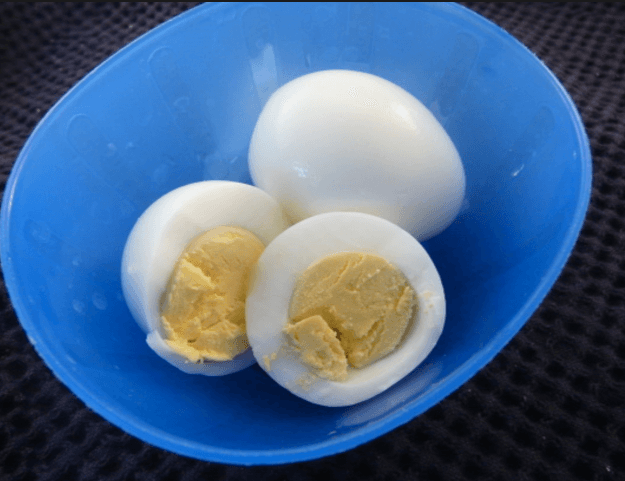
Are hard boiled eggs a physical or chemical change?
a)
Physical
b)
Chemical
73.
When you break a cracker into pieces it is a 
a)
Chemical change
b)
Physical change
c)
Chemical Weathering
d)
Physical Weathering
74.
Is melting iron a physical or chemical change?
a)
Physical
b)
Chemical
75.
When baking soda and vinegar mix it creates a bubbly mess. Is this a chemical or physical change?
a)
Physical
b)
Chemical
76.
Marie had a beaker with a small amount of baking soda. She added a few drops of pickle juice to the baking soda and observed fizzing and bubbling. Based on her observation, which of these can Marie determine about the new substance formed by mixing the baking soda and pickle juice?
a)
A chemical reaction produced a solid.
b)
A chemical reaction produced a gas.
c)
No chemical reaction took place.
d)
Only a physical change happened.
77.
Vanessa had a beaker with a small amount of baking soda. She added a few drops of vinegar to the baking soda and observed fizzing and bubbling. Based on her observation, which of these can Vanessa determine about the new substance formed by mixing the baking soda and vinegar?
a)
It was hot.
b)
It was a gas.
c)
It was magnetic.
d)
It was a conductor.
78.
The Best Friend's Club uses "invisible ink" to write notes to each other. The invisible ink is actually lemon juice that is clear when it dries on paper, but turns brown when a club member holds a burning candle under the paper. Once it is heated, it is never invisible again.
 What type of change is occurring when the paper is heated?
a)
chemical change
b)
elemental change
c)
physical change
d)
temperature change
79.
The Best Friend's Club uses "invisible ink" to write notes to each other. The invisible ink is actually lemon juice that is clear when it dries on paper, but turns brown when a club member holds a burning candle under the paper. Once it is heated, it is never invisible again.
 What type of change is occurring when the paper is heated?
a)
chemical change
b)
elemental change
c)
physical change
d)
temperature change
80.
Bubbles and fizzing can be seen instantly when baking soda is mixed with vinegar. The bubbles are evidence of which of the following?
a)
A gas is formed when baking soda and vinegar are mixed.
b)
Baking soda dissolves in vinegar when they are mixed.
c)
Vinegar turns into alcohol when it is mixed with baking soda.
d)
A precipitate is formed when baking soda and vinegar are mixed.
81.
Which of the following characteristics is shared by all chemical reactions?
a)
Produce a precipitate
b)
Show a color change
c)
Release heat energy
d)
Form new substances
82.
A granular substance is added to a liquid. Which of the following would provide evidence to suggest a chemical change has taken place?
a)
The liquid gives off heat.
b)
The granules dissolve completely.
c)
The volume of the liquid increases.
d)
The granules seem to get smaller.
83.
A student mixes two clear liquids together. After a few minutes, a white powdery solid can be seen settling on the bottom of the test tube. Which of the following is a conclusion that the student can draw based on these observations? The two clear liquids –
a)
were pure substances before they were mixed.
b)
are toxic and should be handled with extreme caution.
c)
have gone through a chemical change in which a new substance called a precipitate was produced.
d)
have been stored too long and are no longer good.
84.
A student added white crystals to a clear liquid. The crystals dissolved in the liquid. After a few seconds, the liquid became quite warm and then turned bright red in color. Indications that a chemical change was taking place could be observed when –
a)
the white crystals were added to the clear liquid.
b)
the crystals dissolved in the liquid leaving only the liquid visible.
c)
There are no indications of chemical change
d)
the temperature of the liquid increased and an unexpected color change occurred.
85.
A student observes some sugar as it is heated and burns. The student concludes that a chemical reaction has occurred. Which of the following observations about the burning sugar provides evidence of a chemical reaction?
a)
Heat is added to the sugar crystals.
b)
The sugar melts and becomes a liquid.
c)
Gas is produced as the sugar turns black.
d)
No evidence of chemical reaction is present.
86.
Which is the correct formula for:
 three hydrogen (H)
one sulfur (S)
four oxygen (O)

a)
H3SO4
b)
HSO4
c)
H4S3O
d)
H2O
87.
Number of C's in 2Na₂CO₃
a)
1
b)
2
c)
3
d)
5
88.
The number of Na's in Na₂CO₃
a)
1
b)
2
c)
3
d)
6
89.
How many Elements are in the compound C2H8O ?
a)
2
b)
1
c)
3
d)
0
90.
How many total atoms are in the compound C2H8O ?
a)
11
b)
2
c)
8
d)
1
91.
How many Aluminum are in Al2O3?
a)
3
b)
2
c)
5
92.
How many Sodium (Na) are in 6NaCl?
a)
1
b)
12
c)
6
93.
How many Chlorine are in MgCl2?
a)
2
b)
1
c)
3
94.
How many Magnesium are in 10MgCl2?
a)
10
b)
5
c)
20
95.
How many Nitrogen are in 2AlN?
a)
4
b)
5
c)
1
d)
2
96.
How many atoms are there TOTAL in:
H2SO4
a)
6
b)
5
c)
7
d)
3
97.
How many elements are in C6H12O6?
a)
1
b)
2
c)
3
d)
4
98.
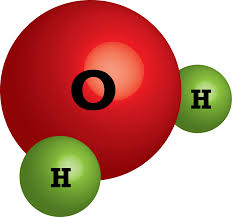
How many atoms of Hydrogen are in this compound
a)
1
b)
2
c)
3
d)
4
99.
How many atoms of Oxygen are in this compound?
a)
1
b)
2
c)
3
d)
4
100.
How many TOTAL atoms are in this compound?
H2C3O4N5
a)
5
b)
14
c)
15
d)
19
101.
In this compound structure of alcohol, how many Hydrogen atoms are there?
a)
2
b)
4
c)
6
d)
8
102.
a capital letter or combination of a capital letter and a small letter that is used to represent an element is called a(n) ________
a)
chemical symbol
b)
element sign
103.
What is the number of protons that the element in this image contain?
a)
14
b)
7
c)
15
d)
18
104.
Which is the correct formula for:
 three hydrogen (H)
one sulfur (S)
four oxygen (O)
a)
H3SO4
b)
HSO4
c)
H4S3O
d)
H2O