wayground logo

Free Printable Worksheets

Font size

S
M
L
XL
Worksheets

Fall Midterm Review

Total questions: 102

Worksheet time: 1hrs 9mins

Name
Class
Date
1.

True or False. Carbohydrates only consist of carbon and hydrogen atoms

a)

True

b)

False

2.

True or False. Carbohydrates are used primarily as a form of energy within our cells

a)

True

b)

False

3.

Glucose is a type of sugar that is

a)

produced by plants through the process of cellular respiration

b)

found inside your cells so that it can be broken down for energy

c)

a monosaccharide that can combine with another glucose to form lactose

d)

more than one of these answers is correct

4.

Glycogen differs from starch in that glycogen

a)

provides a way for glucose to be stored within our bodies

b)

is broken down by the cell walls of the plant

c)

is a polysaccharide, while starch is a monosaccharide

d)

is the monosaccharide for glucose

5.

Based on this image, it can be concluded that

a)

carbohydrates and fats are converted back and forth between each other

b)

glucose is released into the bloodstream as fat is being formed

c)

glycerol is burned in order to form glucose

d)

only the liver (the brown structure near the top left) takes in glucose

6.

True or False. There are some sugars that your body cannot digest properly.

a)

True

b)

False

7.

Monosaccharides and polysaccharides can be found

a)

in your blood as they are being digested or transported

b)

in cell walls of plants for protection and structure

c)

in yo mama as she's as sweet as a plate of yams with extra syrup

d)

in all of these places

8.

1. Carbon chains are principal features of both carbohydrates and lipids. What is the primary difference between these two types of macromolecules?

a)

Lipids always have longer carbon chains than carbohydrates.

b)

Carbohydrates cannot form rings like lipids can.

c)

Lipids provide energy, but carbohydrates cannot.

d)

Carbohydrates form ring structures, lipids form long chains

9.
The characteristic that all lipids have in common is----
a)
made of lots of double bonds
b)
acidic when mixed with water
c)
no high energy content
d)
do not dissolve in water
10.
Which of the following is NOT a function of lipids?
a)
long term energy
b)
provides flavor in food
c)
used to make hormones
d)
building of muscles
11.
These are the monomers (building blocks) of lipids?
a)
nucleotides
b)
amino acids
c)
disaccharides
d)
fatty acids
12.
This picture shows what type of lipid?
a)
unsaturated fat
b)
wax
c)
saturated fat
d)
steroid
13.
A "kinky structure" due to the double bonds between carbon atoms creates a lipid known as what?
a)
saturated fat
b)
wax
c)
steroid
d)
unsaturated fat
14.
Why are lipids efficient for energy storage?
a)
they are short chains of nitrogen and oxygen.
b)
they are medium chains of hydrogen and oxygen.
c)
They are long chains of carbon and hydrogen.
15.
What is Hydrogenation?    & Is it good for us?
a)
Hydrogen atoms converting a solid fat into liquid/NO
b)
Hydrogen atoms converting a solid fat into liquid/YES 
c)
Hydrogen atoms converting an oil into a solid form/ NO
d)
Hydrogen atoms converting an oil into a solid form/ YES
16.
How come having excess cholesterol in our arteries is not desirable?
a)
having excess cholesterol makes us weigh more 
b)
It is desirable to have excess cholesterol in your arteries 
c)
Can block blood flow and lead to heart disease 
17.
What are two main functions of fats within the body?
a)
energy storage and cellular transport
b)
energy storage and insulation
c)
building blocks for DNA and hormones
d)
storing cellular information and in the cell membrane
18.

True or False. Lipids can be formed from carbohydrates that are converted into lipids

a)

True

b)

False

19.

Phospholipids are beneficial in the membrane because

a)

they have the ability to repel substances with their hydrophilic heads

b)

they prevent water and other compounds from coming with with their hydrophobic tails

c)

they are uncharged, meaning they do not interact chemically with anything else

d)

more than one of these is correct

20.

DNA is found inside

a)

the cytoplasm of your cells

b)

the nucleus of your cells

c)

the mitochondria of your cells

d)

A+B

e)

B+C

21.

True or False. All DNA codes for proteins.

a)

True

b)

False

22.

RNA

a)

consists of ribose

b)

can be found exclusively in the nucleus

c)

does not contain nucleotides as DNA does

d)

A+B

e)

A+C

23.

The component of DNA that can distinguish some nucleotides from others is the

a)

nitrogenous base

b)

phosphate groups

c)

sugar

d)

A+B

e)

B+C

24.

True or False. DNA has a different sugar from RNA.

a)

True

b)

False

25.

If a DNA strand has the sequence of ATG, then the mRNA strand that matches up to transcribe it would be

a)

AUG

b)

UAC

c)

AUC

d)

none of these

26.

A major difference between DNA and RNA is

a)

the fact that DNA is single stranded

b)

the shape of the two molecules, as RNA typically remains in a double helix

c)

uracil is found in place of adenine in RNA

d)

that DNA stays in the nucleus

e)

none of these are differences

27.

True or False. DNA is directly involved in translation

a)

True

b)

False

28.

True or False. mRNA assists with both transcription and translation

a)

True

b)

False

29.

The order of the bases in DNA is important so that it can

a)

code for the right amino acids

b)

bind with tRNA

c)

convert its thymines to uracils

d)

none of these

30.
Identify the Cell Cycle Stage.
a)
Prophase
b)
Interphase
c)
Anaphase
d)
Telophase
31.
Identify the Cell Cycle Stage.
a)
Anaphase
b)
Cytokinesis
c)
Telophase
d)
Metaphase
32.
Identify the Cell Cycle Stage.
a)
Cytokinesis
b)
Interphase
c)
Anaphase
d)
Metaphase
33.
Identify the Cell Cycle Stage.
a)
Anaphase
b)
Cytonkinesis
c)
Interphase
d)
Prophase
34.
Identify the Cell Cycle Stage.
a)
Interphase
b)
Anaphase
c)
Telophase
d)
Prophase
35.
The phase in mitosis where chromosomes move away and are pulled apart by spindles to opposite sides of the cell.
a)
prophase
b)
anaphase
c)
metaphase
d)
telephase
36.
In mitosis, the two resulting cells are
a)
different from the starting cell and identical to each other.
b)
different from the starting cell and different from each other.
c)
identical to the starting cell and different from each other.
d)
identical to the starting cell and identical to each other.
37.
The time between cell divisions in the life cycle of the cell is called
a)
anaphase
b)
interphase
c)
prophase
d)
metaphase
38.
Chromatin is found during which phase?
a)
Prophase
b)
Metaphase
c)
Interphase
d)
Telophase
39.
Asexual reproduction will result in
a)
Identical offspring to the parent
b)
Twins
c)
Meiosis
d)
Non-identical offspring to the parent
40.
90% of the cell's life is spent during what stage?
a)
Prophase
b)
Anaphase
c)
Metaphase
d)
Interphase
41.
When during the cell cycle are chromosomes visible?
a)
Interphase
b)
When they are being replicated
c)
During cell division
d)
During the G1 phase
42.
Structure A refers to the _____.
a)
chromatid
b)
chromosome
c)
centromere
43.
Cells of organism must replicate for ?
a)
growth
b)
repair of damaged cells
c)
replacement of dying cells.
d)
All of the above
44.
Before cells can divide, what must be copied?
a)
mitochondria
b)
cytoplasm
c)
DNA
d)
Cell Wall
45.
The division of the nucleus is known as:
a)
Synthesis
b)
Mitosis
c)
G1
d)
G2
46.
In the S stage of interphase_______________
a)
the cell grows
b)
the nucleus divides
c)
the cell membrane divides
d)
the DNA is replicated
47.
In the G2 stage of cell division, ______________ are made.
a)
organelles
b)
structures for cell division
c)
proteins
d)
all of the above
48.
If a cell is cubic shaped with each side having a length of 3 cm, what is the surface area to volume ratio of the cell?
a)
6:1
b)
3:1
c)
2:1
d)
1:1
49.
As a cell increases in size, the surface area to volume ratio _________________.
a)
increases
b)
decreases
c)
stays the same
50.
The larger the surface area to volume ratio, the _______________ efficient the cell is in transporting nutrients and waste in and out of the cell. 
a)
less
b)
more
51.
This egg has shrunk, what type of solution was it placed in?
a)
hypotonic solution
b)
hypertonic solution
c)
isotonic solution
d)
active transport
52.
What type of solution allows water to enter the plant cell?
a)
hypotonic solution
b)
hypertonic solution
c)
isotonic solution
d)
active transport
53.
If a cell is placed in a HYPOTONIC solution, water will move _________ of the cell, causing it to ___________.
a)
into, swell
b)
out of, shrivel
c)
in and out of the cell, stay the same
54.
In a solution, salt is considered the _______.
a)
solvent
b)
solute
c)
solution
55.
The difference in the concentration of a substance from one location to another is called a/an
a)
diffusion
b)
osmosis
c)
concentration gradient
d)
passive transport
56.
A molecule that diffuses down a concentration gradient goes from an area of ______ concentration into an area of ______ concentration.
a)
high, low
b)
low, high
c)
passive, active
d)
active, passive
57.

Passive transport requires no

a)

concentration gradients

b)

osmosis

c)

motion

d)

energy

58.
This example of passive transport is the diffusion of water.
a)
osmosis
b)
concentration gradient
c)
isotonic
d)
facilitated diffusion
59.
In facilitated diffusion, molecules move
a)
Down a concentration gradient
b)
Against a concentration gradient
60.

Facilitated diffusion is beneficial because

a)

some molecules cannot pass through the phospholipid bilayer

b)

often times carbohydrates are sent to the membrane and are used to assist molecules to go through

c)

it allows for you to use energy to move things in and out of a cell

d)

it helps to move things from low to high

e)

all of the above

61.

If a cell has a concentration of 0.3 M of glucose and it is placed in a solution that has 0.4 M of glucose, we can conclude that

a)

the cell has been placed in a hypotonic solution

b)

the cell has been placed in a hypertonic solution

c)

the cell will not lose or gain any water

d)

the cell will lose all of its glucose

e)

more than one of these is correct

62.

Which of the following organelles are NOT involved in helping to create components the cell membrane?

a)

Rough ER

b)

nucleus

c)

lysosome

d)

Golgi apparatus

63.

In an ideal cell, as the surface area of a cell increases,

a)

the volume increases along with it

b)

the volume decreases along with it

c)

then the cell gets swell

d)

none of these

64.

True or False. The energy created by the mitochondria is something that is nice to have, but is not necessary for homeostasis to take place.

a)

True

b)

False

65.

If wastes build up within cells, then one of the reasons is that

a)

the smooth ER could not be detoxifying at a fast enough rate

b)

the vacuole could not be functioning properly

c)

the mitochondria could not be breaking down wastes in the cell

d)

A and B

e)

A,B and C

66.

True or False. Chloroplasts are only found in plants.

a)

True

b)

False.

67.

Ribosomes can

a)

make proteins inside of the nucleus

b)

carry out translation using rRNA to connect mRNA from the nucleus and tRNA from the cytoplasm

c)

carry out transcription using rRNA to connect mRNA from the nucleus and tRNA from the cytoplasm

d)

make every component of the cell membrane

e)

none of these

68.

True or False. The cell membrane is made of all four organic macromolecules.

a)

True

b)

False

69.

Which of the following is the proper order that compounds go through in order to create the cell membrane?

a)

nucleus, Golgi, ER, membrane

b)

Golgi, nucleus, ER, membrane

c)

nucleus, ER, Golgi, membrane

d)

ER, Golgi, nucleus, membrane

70.

Production of sugars is carried out by the

a)

chloroplasts

b)

mitochondria

c)

ribosomes

d)

A and B

e)

A, B + C

71.

One of the differences between eukaryotic cells and prokaryotic cells is that

a)

prokaryotes have a nucleus

b)

eukaryotes have more organelles

c)

only prokaryotes have ribosomes

d)

more than one of these

e)

none of these

72.

Which of the following areas is likely to have the highest concentrations of enzymes?

a)

ribosomes

b)

lysosomes

c)

cell membrane

d)

outside of a cell

73.

Which of the following cell structures has a primary role in carrying out protein synthesis in a eukaryotic cell?

a)

nucleus and vacuoles

b)

ER and ribosomes

c)

Golgi and cell membrane

d)

ER and mitochondria

74.

Unlike eukaryotic cells, prokaryotic cells

a)

lack a nucleus

b)

have a cell wall

c)

divide can carry out metabolism

d)

move around

e)

more than one of these

75.

A healthy patient arrives at a doctor's office and complains of having signs of fatigue. They have had the same diet as usual, however, they have felt sluggish. Which of the following would be the BEST explanation for what could be happening with the patient?

a)

the patient does not have any mitochondria inside their cells

b)

the patient's mitochondria has been damaged within certain areas of their body

c)

the patient's ribosomes are not producing enough mitochondria to meet the required demand

d)

the patient's nucleus has stopped producing more DNA

76.
What is the purpose of cell respiration?
a)
produce glucose
b)
make oxygen
c)
remove carbon dioxide 
d)
produce usable energy - ATP
77.
What are the products of cellular respiration?
a)
Energy (ATP), Water, and Carbon DIoxide.
b)
Water and Oxygen
c)
Oxygen and Carbon Dioxide
d)
Water and Energy (ATP)
78.
Lactic acid fermentation occurs in your muscles after a workout because your cells are struggling to get...
a)
Glucose
b)
Sunlight
c)
Oxygen
d)
Water
79.
How is energy released from ATP?
a)
adding a phosphate
b)
making a new bond
c)
removing the 3rd phosphate
d)
adding a protein
80.
What is the waste energy from respiration given off as?
a)
Heat
b)
Light
c)
Sound
d)
Kinetic
81.
Where does the Krebs Cycle take place?
a)
mitochondria
b)
chloroplast
c)
cytoplasm
d)
nucleus
82.
What gas is needed for respiration?
a)
Carbon dioxide
b)
nitrogen
c)
Oxygen
d)
hydrogen
83.
The first step in the break down of glucose is
a)
light reactions
b)
glycolysis
c)
Kreb's cycle
d)
Calvin Cycle
84.
What are the three stages that make up cellular respiration?
a)
light reactions, calvin cycle and electron transport
b)
glycolysis, kreb's cycle and Calvin cycle
c)
Glycolysis, Kreb's cycle and electron transport
d)
Light Reactions, Calvin Cycle and Glycolysis
85.
Using the figure, which parts of the molecule must the bonds be broken to form an ADP molecule?
a)
A and B
b)
B and C
c)
C and D
d)
all of the above
86.
Which structures shown in the Figure make up the ADP molecule?
a)
A and B
b)
A, B and C
c)
A, B, C, and D
d)
C and D
87.
Which of the following is not a requirement for glycolysis?
a)
Oxygen
b)
ATP
c)
NAD+
d)
Glucose
88.
What enzyme in the ETC is responsible for generating the ATP molecules?
a)
acetyl-CoA
b)
ATP synthase
c)
hexokinase
d)
none of the above
89.
After strenuous exercise, a muscle cell would contain decreased amounts of ______ and increased amounts of ______ ____
a)
glucose, ATP
b)
ATP, glucose
c)
oxygen, lactic acid
d)
lactic acid, ATP
90.
Is ADP or ATP more like a fully charged battery, and why?
a)
ADP, because it has three phosphate groups; breaking and reforming the bonds among them releases energy.
b)
ATP, because it has three phosphate groups; breaking and reforming the bonds among them releases energy.
c)
ADP, because it has two phosphate groups; breaking and reforming the bonds among them releases energy.
d)
ATP, because it has two phosphate groups; breaking and reforming the bonds among them releases energy.
91.
The reactants of photosynthesis are
a)
sugar and water.
b)
sugar and oxygen.
c)
carbon dioxide and water.
d)
carbon dioxide and oxygen.
92.
Which of the following is the correct equation for PHOTOSYNTHESIS?
a)
6CO2 + 6H2O --> 6O+ C6H12O6
b)
6CO+ C6H12O6 + 6H2O --> O
c)
6O2 + 6H2O --> 6CO+ C6H12O6
d)
C6H12O6 + 6O2 ---> 6H2O + 6CO2 
93.
What is the function of NADPH and ATP?
a)
They absorb light
b)
They power the light-dependent reactions
c)
They are light-reflecting pigments
d)
They are short term energy carriers
94.
Which of the following is NOT a product of the light-dependent reactions?
a)
ATP
b)
NADPH
c)
Oxygen
d)
Glucose
95.
Where do the light-dependent reactions occur? 
a)
thylakoid membrane
b)
stroma
c)
mesophyll
d)
mitochondria
96.
What is the primary function of the light-dependent reactions of photosynthesis?
a)
To produce glucose
b)
To produce NADPH and ATP
c)
To use ATP
d)
To produce RuBP
97.
What is produced as a result of photosynthesis?
a)
Glucose and Chlorophyll
b)
Glucose and Oxygen
c)
Water and Light energy
d)
Carbon dioxide and Water
98.
If all four plants were watered daily but placed in a closet, receiving no sunlight, what process would NOT occur?
a)
Ingestion of carbon dioxide
b)
Filtration of water through the soil
c)
Photosynthesis
d)
Water absorbtion
99.
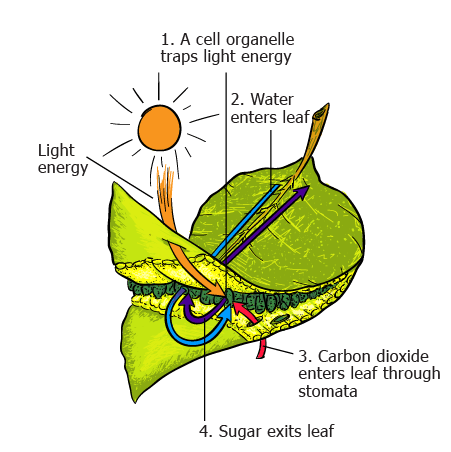
Look at the image
What substances and organelle work together to absorb sunlight to perform photosynthesis in this example?

a)
cell wall and chloroplast
b)
mitochondria and water
c)
vacuole and carbon dioxide
d)
chloroplast and chlorophyll
100.
The tiny holes on the back of a plant’s leaves that allow Oxygen and Carbon Dioxide to flow through are called what?
a)
pigment
b)
stomata
c)
chloroplast
d)
mitochondria
101.
Which of the following are RAW MATERIALS (INGREDIENTS) needed for Photosynthesis to occur? 
a)
water
b)
sugar
c)
oxygen
d)
baking soda
102.
If carbon dioxide is removed from a plant's environment, what would you expect to happen to the plant's production of sugar (glucose)? (HINT: Think of what would happen if you removed an ingredient from a recipe!)
a)
MORE sugars will be produced
b)
The SAME NUMBER of sugars would be produced, but without Carbon Dioxide.
c)
FEWER will be produced
d)
the plant would not be affected in any way