wayground logo

Free Printable Worksheets

Font size

S
M
L
XL
Worksheets

G7 Science

Total questions: 89

Worksheet time: 2hrs 35mins

Name
Class
Date
1.
What is the difference between biotic and abiotic?
a)
Biotic are non-living things
b)
Abiotic are living organisms
c)
Biotic is life,
Abiotic is non-living
d)
Biotic is non-living, Abiotic is living
2.
Which biome is more biodiverse?
a)
Desert
b)
Sand
c)
Tundra
d)
Rainforest
3.
Which option is abiotic?
a)
Plants
b)
Bacteria
c)
Water
d)
Fungi
4.
Which option is abiotic?
a)
Plants
b)
Rocks
c)
Animals
d)
Fungi
5.
 Which biome is more likely to survive a change in the environment?
a)
High (rich) biodiversity
b)
Low (poor) biodiversity
6.
What does biodiversity mean?
a)
Only one species in an area.
b)
The different amount of species in an area
c)
All abiotic life
d)
Nitrogen fixation
7.

Biodiversity is important to keep an area (biome) healthy. In this example "Food Web A" is sustainable. Why is sustainability important for an ecosystem in "Food Web A".

a)

If one organism is removed the food web can still operate (work) with little or no negative effect.

b)

If an organism is removed the food web will collapse and will affect the environment.

8.

Food Web B is an example of...

a)

Low biodiversity and low sustainability. If the producer dies then all the food web will suffer.

b)

High biodiversity and high sustainability. If an organism is removed the food web will continue with no effect.

9.
A small marine area has phytoplankton as its only producer.  Should the marine biologist be concerned about this ecosystem?
a)
No the fish do not need the phytoplanton. Since there are so many fish, there is high biodiversity.
b)
Yes, this ecosystem has low biodiversity.  Without a producer the herbivores will die out leaving no food.
c)
Yes, this system has high biodiversity; however the fish can adapt and get food from another source.
d)
Yes, the fish will overate to get all of the phytoplankton that is left, then they will die.
10.
This picture is a great example of ____________ biodiversity.
a)
high
b)
moderate
c)
low
d)
hhhmmmm there is no way to know without counting.
11.
Different biomes support different varieties of organisms.  Think of a desert biome.  In this environment you will see organisms that have adapted to the heat and low availability of water, such as a cacti, mouse or rattle snake.  In which biome would you find an animal that has padding on its feet, white fur?
a)
Desert
b)
Tundra
c)
Forest 
d)
Savannah
12.

A population is

a)

a group of similar species in different areas

b)

a group of the same species in the same geographic area.

c)

a group of several species in the same geographic area

d)

a group of several species along with their abiotic factors in a small area.

13.
A system made up of organisms interacting with one another
a)
biology
b)
abiotic
c)
biotic
d)
ecosystem
14.
A group of the same type of organisms living in the same place at the same time.
a)
threatened species
b)
populations
c)
community
d)
limiting factor
15.
A species that is in danger of becoming extinct.
a)
Threatened species
b)
out of luck
c)
do do birds
d)
endangered species
16.
Which is a biotic factor?
a)
sunlight
b)
air 
c)
bacteria
d)
all of the above
17.
Deserts, mountains, and rivers are all examples of ________.
a)
vacation spots
b)
tundra
c)
ecosystems
d)
wetlands
18.
Decomposers get their food by __________.
a)
making it themselves
b)
eating live organisms
c)
using dead organisms
d)
eating themselves
19.
In an ecosystem, producers and consumers are both __________.
a)
biotic factors
b)
very nice
c)
cranky
d)
abiotic factors
20.
Which is an abiotic factor that most limits the number of frogs living in a pond? 
a)
the color of the water 
b)
the number of predators 
c)
the temperature of the water 
d)
the populations of producers 
21.
Field mice are the primary food source for horned owls in an area. Due to a drought, many field mice left the area. Which result would this drought most likely have on the horned owls?
a)
The horned owl population will consume more field mice.
b)
Horned owls will follow the field mice to a different area.
c)
The horned owl population will increase in the area.
d)
Horned owls will change to a plant-based diet.
22.
Deer are introduced into a grassland ecosystem and their population increases considerably. If the deer population continues to grow, which is the most likely outcome for the ecosystem?
a)
Biodiversity would decrease, and sustainability would decrease.
b)
Biodiversity would decrease, and sustainability would increase.
c)
Biodiversity would increase, and sustainability would increase.
d)
Biodiversity would increase, and sustainability would decrease.
23.
Below is an example of a simple food chain.

Acorn → Squirrel → Fox → Mountain Lion 

What will most likely happen if squirrels are removed from the food chain?
a)
The fox will eat acorns
b)
The fox population will decrease
c)
The trees will produce fewer acorns.
d)
The mountain lion population will increase
24.
In a forest ecosystem, a food chain might look like this:
green plants → rabbit → fox → panther

If the green plants are destroyed in a forest fire, which short-term effect will this have on the organisms in this food chain?
a)
There would be fewer rabbits for the foxes to eat. 
b)
The panthers would have to begin to eat green plants.
c)
There would be an increase in the fox population
d)
There would be more green plants for the rabbits to eat
25.

Producers are ...

a)

plants

b)

able to do photosynthesis

c)

also called autotrophs

d)

all of these are true

26.

Arrows in a food web represent...

a)

eating

b)

sunlight

c)

energy

d)

matter

27.

Photosynthesis is important because...

a)

it makes carbon dioxide

b)

it makes food for the food webs

c)

it makes water

d)

it's not important

28.

All of these are types of consumers except...

a)

omnivores

b)

carnivores

c)

decomposers

d)

herbivores

29.

In photosynthesis, which are the products?

a)

carbon dioxide, water

b)

oxygen, glucose

c)

sunlight, oxygen

d)

water, soil

30.

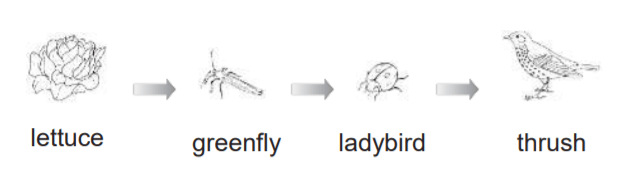
Who is the producer?

a)

lettuce

b)

greenfly

c)

ladybird

d)

thrush

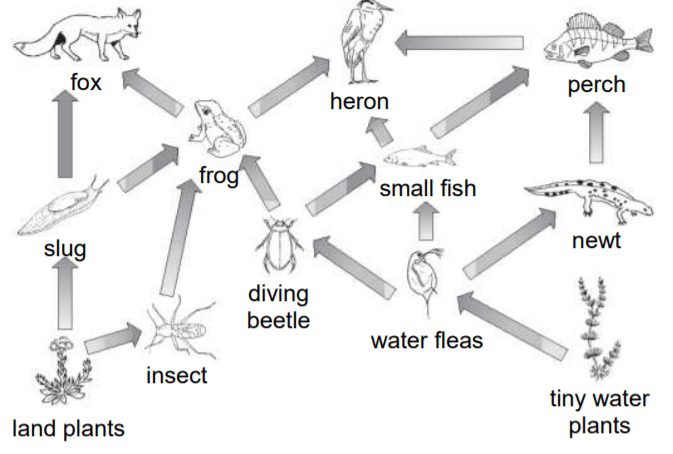
31.
a)

This is a food chain

b)

This is a food web

c)

This is an energy pyramid

32.

The original source of energy for a food web is...

a)

plants

b)

sun

c)

producers

d)

decomposers

33.

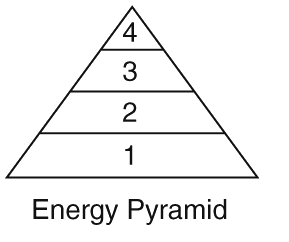
Level 1 on the pyramid

a)

Producers

b)

Primary Consumer

c)

Secondary Consumer

d)

Tertiary Consumer

34.

Level 2 on the pyramid

a)

Producers

b)

Primary Consumer

c)

Secondary Consumer

d)

Tertiary Consumer

35.

Level 3 on the pyramid

a)

Producers

b)

Primary Consumer

c)

Secondary Consumer

d)

Tertiary Consumer

36.

Level 4 on the pyramid

a)

Producers

b)

Primary Consumer

c)

Secondary Consumer

d)

Tertiary Consumer

37.
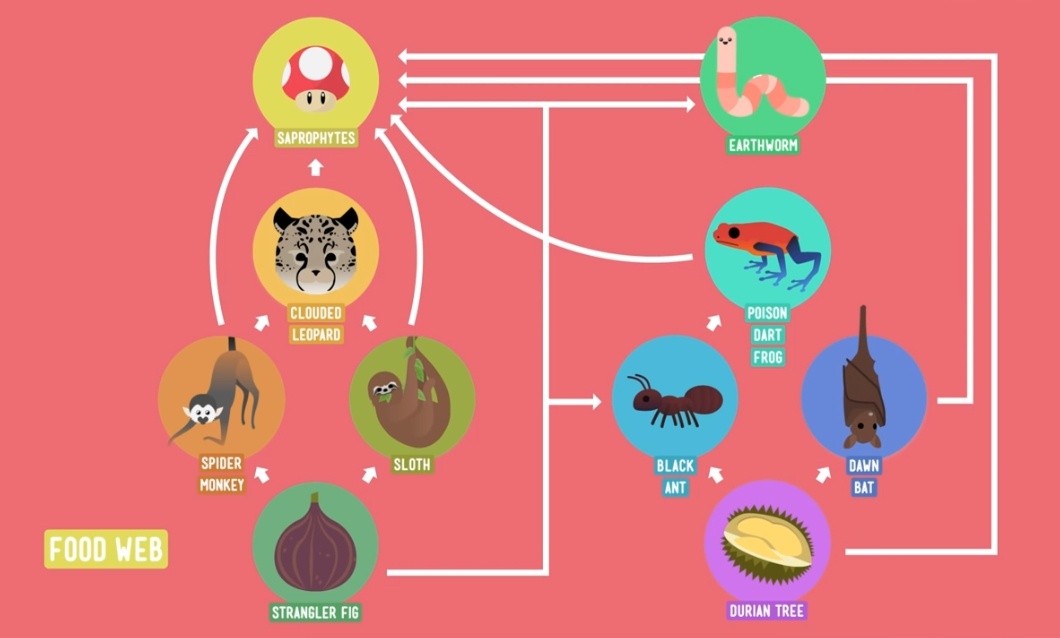
Leopards dine on ___
a)
figs and spider monkeys
b)
sloths and strangler figs
c)
sloths and spider monkeys
d)
ants and bats
38.
A tree is a ....
a)
composer
b)
decomposer
c)
producer
39.
Humans are considered...
a)
consumers
b)
decomposers
c)
producers
40.
What is a producer?
a)
an organism that gets energy from eating other organisms
b)
an organisms that uses sunlight to make its own food
c)
an organism that gets energy from eating dead organisms, non-living material or waste
d)
an organism that uses chemical energy to make its own food
41.
Which of the following is NOT a consumer
a)
grass
b)
dog
c)
shark
d)
fish
42.
Barnacles sometimes live on the outside surface of other larger shelled organisms without causing any harm. What is the ecological relationship?
a)
Mutualism
b)
Parasitism
c)
Commensalism
d)
Predator-Prey
43.
Barnacles create home sites by attaching themselves to whales. This neither harms nor benefits the whales.
a)
commensalism
b)
parasitism
c)
mutualism
44.
Mistletoe extracts water and nutrients from the spruce tree to the tree's detriment.
a)
commensalism
b)
parasitisim
c)
mutualism
45.
Yucca flowers are pollinated by yucca moths. The moths lay their eggs in the flowers where the larvae hatch and eat some of the developing seeds. Both species benefit.
a)
commensalism
b)
parasitism
c)
mutualism
46.
Hermit crabs live in shells made and then abandoned by snails. This neither harms nor benefits the snails.
a)
commensalism
b)
parasitism
c)
mutualism
47.
A flea feeds on a mouse's blood to the mouse's detriment.
a)
commensalism
b)
parasitism
c)
mutualism
48.
Ticks feed on deer blood to the deer's detriment.
a)
commensalism
b)
parasitism
c)
mutualism
49.
Honey guide birds alerts and directs badgers to bee hives. The badgers then expose the hives and feed on the honey first. Then the honey guide bird eats. Both species benefit.
a)
mutualism
b)
commensalism
c)
parasitim
50.
The following picture is an example of...
a)
population
b)
community
c)
microorganism
d)
predator
51.
Which list contains only biotic factors of an ecosystem?
a)
deer, microorganisms, and roses
b)
rocks, water, and sand
c)
rainbow trout, water, and microorganisms
d)
oak trees, dirt, and grass
52.

How are greenhouse gasses harming our environment?

a)

They aren't

b)

Less heat is able to escape causing the Earth to cool down

c)

Less heat is able to escape causing the Earth to warm up

d)

More heat is able to escape

53.

As greenhouse gasses increase, what happens to Earth's temperature?

a)

Increase

b)

Decrease

c)

Stays the Same

d)

No Trend

54.

As greenhouse gasses increase, what happens to heat flow out?

a)

Increase

b)

Decrease

c)

Stays the Same

d)

No Trend

55.

As greenhouse gasses increase, what happens to heat flow in from the sun?

a)

Increase

b)

Decrease

c)

Stays the same

d)

No Trend

56.

If the Earth is like a greenhouse, carbon dioxide in the atmosphere is like

a)

Plants

b)

Glass

c)

Sun

d)

Ground

57.

Which of the following could increase the amount of greenhouse gasses in our atmosphere?

a)

Burning fossil fuels

b)

Planting trees

c)

Walking to school and work

d)

Cutting down trees

58.

Why do we need greenhouse gasses?

a)

We don't! All greenhouse gasses are bad

b)

They help regulate Earth's climate

c)

They decrease Earth's temperature

d)

None of the above

59.

On the picture, the heat out is decreasing. What can we assume if this is happening?

a)

There is no change in the graph

b)

We don't have any greenhouse gasses

c)

Greenhouse gasses are decreasing

d)

Greenhouse gasses are increasing

60.
How does the amount of greenhouse gases in the atmosphere affect the atmosphere's temperature?
a)
If greenhouse gases in the atmosphere increase, they trap more heat and warm the atmosphere.
b)
If greenhouse gases in the atmosphere increase, they trap less heat and the atmosphere cools.
c)
If greenhouse gases in the atmosphere decrease, they trap more heat and warm the atmosphere. 
61.
Greenhouse gases, in moderate amounts, keep the Earth's temperature stable
a)
True
b)
False
62.

What results from livestock and other agricultural practices and by the decay of organic waste in municipal solid waste landfills?

a)

Carbon Dioxide

b)

Methane

c)

Water Vapor

d)

Fluorinated Gases

e)

Nitrous Oxide

63.

Accounts for 81.6% of all U.S. greenhouse gas emissions from human activities.

a)

Water Vapor

b)

Fluorinated Gases

c)

Carbon Dioxide

d)

Methane

e)

Nitrous Oxide

64.

The primary source of CH4 emissions is _______.

a)

Industry

b)

Agriculture

c)

Carbon Sinks

d)

Fossil Fuels

e)

Electricity

65.
Which one of the choices below is NOT a  cause for global warming?
a)
Having too many cows
b)
Burning Fossil Fuels
c)
Planting new trees
66.

Which resources are renewable?

a)

Solar, Wind, Water

b)

Gas, Oil, Coal

c)

Fossil Fuels

67.

What is one disadvantage of using solar power?

a)

It is free

b)

At night, no power can be made

c)

It is renewable

68.

What is one advantage of using wind power?

a)

It is renewable

b)

The wind doesn't always blow

c)

The windmills are far away from people

69.

Petroleum is mainly used in the United States for...

a)

gasoline for cars

b)

running coal burning power plants

c)

making windmills turn

d)

burning for heat

70.

Which are non renewable resources?

(Choose all correct answers)

a)

natural gas

b)

coal

c)

water in a dam

d)

oil

e)

nuclear energy

71.

Which of these is non renewable

a)

natural gas

b)

water in a dam

c)

solar power

d)

wind energy

72.
The fish shown in the pictures below is the Anglerfish. The stalk in front of its eyes is a flashing light that it uses to lure prey to its mouth. This structural adaptation enables the Anglerfish to survive in a very dark and deep aquatic habitat.
Where are anglerfish likely to be found? 
a)
A shallow freshwater lake
b)
An estuary or wetland area on the coast
c)
In the shallow water of a creek or stream
d)
The deep abyssal zone of the ocean
73.
In a population of spiders there are three different sizes: small, medium, and large.
---The large spiders are easily seen by predators.
---Small spiders have a difficult time finding food.
What will most likely happen to this population of spiders after many generations?
a)
Small and large spiders will mutate
b)
Medium spiders will be the most plentiful
c)
Large spiders will learn to hide from predators
d)
Small and medium spiders will be the least plentiful
74.

A stable ecosystem typically has high biodiversity.

a)

True

b)

False

75.
What does it mean when an animal is extinct?
a)
Something once lived but no longer exists.
b)
Animals that is at risk of extinction.
c)
Place that protects animals at risk.
76.
A habitat is home to a tangle of food chains called ___
a)
a nutrient hub
b)
an energy chain
c)
a food web
d)
the carbon cycle
77.
An organism that needs to eat other organisms to obtain energy is known as a:
a)
Autotroph
b)
Producer
c)
Consumer
d)
Mutualist
78.
The spider crabs live on the shallow ocean floor. The algae lives on the crabs. The algae helps the crabs blend in and the algae gets a good place to live.
a)
Commensalism
b)
Mutualism
c)
Parasitism
d)
Mitosis
79.
A tapeworm and a cat have this type of relationship.
a)
mutualism
b)
parasitism
c)
commensalism
d)
competition
80.
 Skunks often live in burrows that have been dug and abandoned by woodchucks. This relationship is an example of _______.
a)
commensalism
b)
mutualism
c)
parasitism
d)
predation
81.
What type of symbiosis is this?
Snails die and leave behind their shells.Hermit crabs find shells left by snails that have died and move in. 
a)
commensalism
b)
mutualism
c)
parasitism
d)
predation
82.
A relationship between two organisms in which both organisms benefit. 
a)
Mutualism 
b)
Competition
c)
Parasitsm 
d)
Commensalism 
83.
Lice attach to the hairs of the body or head, and then suck blood from the host. This relationship is known as ________. 
a)
Commensalism
b)
Parasitism
c)
Mutualism
d)
Optimism
84.
A flea is a parasite that gets its energy from the blood of animals like dogs. How are the flea and dog affected in this relationship?
a)
Both organisms are helped
b)
Both organisms are unaffected
c)
The flea is helped, and the dog is harmed
d)
The dog is helped, and the flea is not affected
85.
Remoras are small fish that swim close to or attach themselves to sharks.  Remoras eat small scraps left as the sharks feed and the sharks are unaffected. 
a)
Competition
b)
Predation
c)
Mutualism
d)
Commensalism
86.
Wrasse fish feed on the parasites found on the black sea bass's body (usually in the mouth). This is like dental floss for the fish and both species benefit.
This is an example of which type of symbiosis?
a)
Commensalism
b)
Mutualism
c)
Parasitism
d)
Predation
87.
Ostriches and gazelles feed next to each other. They both watch for predators. Because the visual abilities of the two species are different, they can each identify threats that the other animal may not see as readily. Both species benefit.
This is an example of which type of symbiosis?
a)
Commensalism
b)
Mutualism
c)
Parasitism
d)
IDK
88.
Clown fish live among anemones, acting as a lure for the sea anemone's prey. The clown fish gets protection and shelter from the anemone.
This is an example of which type of symbiosis?
a)
Commensalism
b)
Mutualism
c)
Parasitism
d)
IDK
89.
Bacteria in the intestines of cows gain nutrients and aid in the cow's'  digestion
a)
commensalism
b)
mutualism
c)
parasitism
d)
competition