wayground logo

Free Printable Worksheets

Font size

S
M
L
XL
Worksheets

Evolution

Total questions: 85

Worksheet time: 2hrs 1mins

Name
Class
Date
1.
According to fossil records, the horses that lived 50 million years ago were much smaller, weaker and slower than modern horses. Which process is most likely responsible for the changes that have led to the increased size, strength, and speed in horses?
a)
commensalism
b)
inbreeding
c)
migration
d)
evolution by natural selection
2.
The diagram illustrates an embryonic stage of two organisms.Which of the following can be determined by observing the embryos shown in the diagram? 
a)
The organisms share a common ancestry.
b)
The organisms belong to the same genus.
c)
The organisms are native to the same geographic areas.
d)
The organisms will grow into anatomically similar adults.
3.
Scientists have found evidence that about 2.4 million years ago a gene regulating jaw muscles mutated and may have led to the more graceful human jaw we see today. The diagram below shows the skulls of 3 hominid species.Which statement below most closely explains the link between jaw size and hominid evolution? 
a)
The jaws of hominids evolved to be smaller and less protruding over time. 
b)
The jaws of hominids evolved to be smaller and less protruding over time. 
c)
There appears to be no change in the jaws of hominids over time.
d)
The jaws of hominids changed over time due to a change in brain size. 
4.
Scientists are studying the evolutionary history of a group of plants in the United States, and they developed an evolutionary tree, as shown below.Which statement can be inferred from the evolutionary tree?
a)
Species 1 is most closely related to Species 8.
b)
Species 2 is most closely related to Species 3.
c)
Species 3 is most closely related to Species 7.
d)
Species 5 is most closely related to Species 6.
5.
Scientists are studying the evolutionary history of a group of plants in the United States, and they developed an evolutionary tree, as shown below.What information about the organisms best helps the scientists to determine the evolutionary relationships among them?
a)
DNA sequences
b)
 Anatomical features
c)
Habitat types
d)
Reproductive Strategies
6.
 The diagram represents the relationship between beak structure and food in several species of finches found on the Galapagos Islands. The different beak structures observed in the diagram are evidence of
a)
 different species of finches adapting to different environments over many generations
b)
 finches changing their beak characteristics so that they could feed efficiently
c)
finch species with different beak structures coming to the Galapagos Islands from the mainland
d)
 finches mating with birds of other species and acquiring some of their traits
7.
Natural selection is best described as
a)
a change in an organism in response to a need of that organism
b)
a process of nearly constant improvement that leads to an organism that is nearly perfect
c)
differences in survival rates as a result of different inherited characteristics
d)
inheritance of characteristics acquired during the life of an organism
8.
Which occurrence represents an example of evolution?
a)
 Exposure to radiation reduces the rate of mutation in leaf cells.
b)
A mutation in a liver cell causes a person to produce an enzyme that is less efficient.
c)
 Cells in a zygote eventually change into bone cells or skin cells
d)
Some antibiotics are almost useless, because pathogens have developed a resistance to these antibiotics.
9.
Scientist find dinosaur fossils in the bottom of a cliff and mammals fossils in the middle layer, what can be inferred?
a)
dinosaurs ate plants
b)
dinosaurs were eaten by the mammals
c)
they lived at the same time
d)
dinosaurs lived before the mammals
10.
Ostrich wings are examples of
a)
homologous structures
b)
vestigial structures
c)
adaptations
d)
traits
11.
Dolphins have the same arm structure as wolfs, what type of evidence for evolution does this represent?
a)
DNA
b)
vestigial structures
c)
homologous structures
d)
embryology
12.
Why do embryologist study embryos?
a)
to see if they are related
b)
to understand adaptations
c)
to determine the age
d)
to learn what parents are vestigial
13.
Surviving and reproducing show that an organism
a)
is adapting
b)
is not adapting
c)
is forming fossils
d)
is not reproducing
14.
Who was Charles Darwin?
a)
A naturalist who came up with the theory of evolution
b)
A scientist who studied plants
c)
A geologist who looked at rocks and fossils
d)
A paleontologist who studied dinosaurs
15.

Which of the following is NOT an example of natural selection?

a)

People selectively breeding hamsters for size.

b)

Insect populations developing resistance to certain pesticides.

c)

Bacteria becoming resistant to antibiotics.

d)

Male birds of certain species inheriting colorful feathers that are more attractive to females.

16.

How does a species change over time?

a)

by adapting to the environment

b)

changes in the gene frequencies in a population

c)

acquiring new traits

d)

they do not change

17.

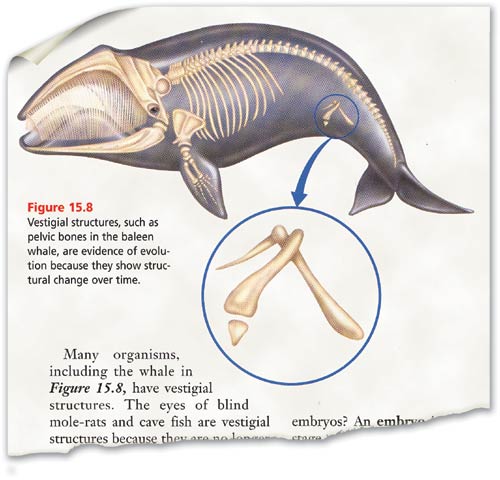
The pelvic bone of whales is not needed for movement within the water. This is an example of a(n) ______________ structure.

a)

vestigial

b)

analogous

c)

homologous

18.
What is the process of which humans breed organisms for certain traits?
a)
artificial selection
b)
descent without modification
c)
inheritance of acquired characteristics
d)
natural selection
19.

Which scientist visited the Galapagos Islands and came up with the theory of natural selection?

a)

Theodor Schwann

b)

Gregor Mendel

c)

Charles Darwin

d)

Rudolf Virchow

20.

Gigantopithecus were very large primates that lived 500,000 years ago. Since none of these mammals are still today, they are said to be....

a)

Extinct

b)

Threatened

c)

Endangered

d)

Declining

21.
A characteristic or behavior that gives an organism an advantage in its environment is known as....
a)
Fitness
b)
Adaptation
c)
Evidence
d)
Gene
22.
Why do the following finches have different beak sizes and shapes?
a)
They live in different places
b)
They are different species
c)
They eat different food
d)
They can change their beaks
23.
Who is considered to be the "father of evolution"?
a)
Charles Darwin
b)
Gregor Mendel
c)
James Watson
d)
Francis Crick
24.

Why are these referred to as "homologous structures"?

a)

they have the same function

b)

they have the same structure

c)

same genotype

d)

same species

25.

What does the word "fit" mean in Biology?

a)

the strongest in the environment

b)

the fastest in the environment

c)

able to survive and reproduce in environment

d)

most attractive in the environment

26.
Which 2 species are most closely related based on this molecular evidence?
a)
Fruit Fly & Screwworm Fly
b)
Screwworm Fly & Hornworm Moth
c)
Hornworm Moth &Silkworm Moth
d)
Fruit Fly & Silkworm Moth
27.

The fact that whales and hippos are both mammals, is evidence that they....

a)

Descend from a common ancestor

b)

Have the same DNA

c)

Live in areas with water

d)

Share the same habitat

28.
Flocks of ostriches lay 10 eggs, but many do not survive to hatch.  The benefit of laying multiple eggs is.....
a)
It increases genetic diversity
b)
Some will survive and reproduce
c)
Some will have mutations
d)
It increases competition for resources
29.

In a population of cockroaches, 15% are resistant (not affected) by insecticide. The other 85% die when exposed.

This is an example of .......

a)

variation in a population

b)

different species

c)

sexual selection

d)

gene flow

30.

Based on this dendrogram, which two species are more closely related?

a)

Birds and Crocodiles

b)

Crocodiles and Lizards

c)

Turtles and Dinosaurs

d)

Mosasaurs and Dinosaurs

31.

Which populations of coyotes would be more closely related?

a)

2 populations that are separated by 50 miles

b)

2 populations separated by a mountain range

c)

2 populations separated by an ocean

d)

2 populations separated by a river

32.

Natural Selection is..............

a)

The ability of an organism to live to an old age in it's environment

b)

The ability of an organism to survive and reproduce in it's environment

c)

The ability of an organism to reproduce in it's environment

33.
Darwin wrote that organisms with traits that are best suited to the environment will ________________
a)
increase in number
b)
become extinct
34.
What characteristic did Darwin observe about the finches on the Galapagos Islands?
a)
Their feathers 
b)
Genotypes 
c)
Their beaks
d)
Their body sizes
35.
The natural differences between individuals of a species is called ___________.
a)
adaptations
b)
natural selection
c)
variation
d)
fitness
36.
The struggle for existence against other members of an organisms species is
a)
Competition
b)
Natural Selection
c)
gene flow
d)
genetic drift
37.
Remains of ancient organisms are called
a)
Extinctions
b)
Fossils
c)
Mutations
d)
Variations
38.
This picture is best known as
a)
homologous structures
b)
analogous structures
c)
vestigial structures
d)
embryology
39.
What do phylogenetic trees do?
a)
Help you visualize how species are related.
b)
Provide windbreaks in your yard.
c)
Provide DNA details.
d)
Show the distribution of organisms
40.
What do the similarities of the structures suggest?
a)
a common ancestor
b)
grow at different rates
c)
evolved slowly
d)
lived a long time
41.
Which two species are most related?
a)
B&C
b)
A&B
c)
A&C
d)
C&B
42.
The magnified part of this picture is best known as
a)
vestigial structures
b)
homologous structures
c)
analogous structure
d)
adapations
43.
Which type of cell came first?
a)
Eukaryotic
b)
Prokaryotic
c)
Protists
d)
Both Eukaryotic and Prokaryotic were about the same
44.
Elimination of species from Earth
a)
Evolution
b)
Species
c)
Fitness
d)
Extinction
45.
group of organisms so similar to one another that they can breed and produce fertile offspring 
a)
Species
b)
Fitness
c)
Biogeography
d)
Fossil
46.
process by which humans modify a species by breeding it for certain traits
a)
Natural Selection
b)
Fitness
c)
Adaptation
d)
Artificial Selection
47.
body part that is similar in structure on different organisms but performs different functions
a)
Analogous Structure
b)
Homologous Structure
c)
Vestigial Structure
d)
Adaptation
48.
collection of alleles found in all of the individuals of a population
a)
Species
b)
Fitness
c)
Vestigial Structures
d)
Gene Pool
49.
mechanism by which individuals that have inherited beneficial adaptions produce more offspring on average than do other individuals 
a)
Fitness
b)
Natural Selection
c)
Evolution
d)
Artificial Selection
50.

An early stage in the development of an organism...

a)

Embryo

b)

Embryology

c)

Epoch

d)

Evolution

51.

An adaptation is

a)

Body parts of different organisms that performs similar functions but do not have similar structures

b)

The process by which species of organisms change over time

c)

a trait that helps an organism survive in a particular setting

d)

When you get bit by a spider and get cool Spider -senses

52.

A vestigial structure is...

a)

A cool new vest you can wear

b)

a body part that does not seem to have a function in an organism.

c)

an arrangement of and relations between the parts or elements of something complex

d)

body parts of different organisms that have a similar structure but not necessarily a similar function

53.

A mutation can be

a)

Harmful to an organism

b)

Helpful and improve an organisms ability to exist

c)

Have no effect on the organism

d)

All of the Above

54.

An Analogous structure is described as body parts that have a similar function but a similar structure.

Which of the following is an example of an analogous structure

a)

Bird Wing and Human arm

b)

Human wing and Whale Flipper

c)

Bird wing and butterfly wing

d)

Human arm and butterfly wing

55.

Based on our knowledge on natural selection which animal would be best suited for a dry desert environment

a)

human

b)

Camel

c)

Fish

d)

Frog

56.

True or False: A variation is a difference that exists naturally among members of a population or species.

a)

True

b)

False

57.

Homologous structures are body parts of different organisms that have similar _________ but not necessarily a similar __________ .

a)

Function; Structure

b)

Purpose; Look

c)

Bones; Structure

d)

Structure; Function

58.

Evolution is

a)

the process by which a species stays the same

b)

the process by which a species dies off

c)

the process by which a species changes over time

d)

the process by which a species contracts a new disease

59.

This image is an example of a(n)

a)

Variation

b)

Mutation

c)

Analogous structure

d)

Natural Selection

60.

What would be considered a vestigial structure in the human body?

a)

Heart

b)

Brain

c)

Lungs

d)

Appendix

61.

This image illustrates what type of structure

a)

Homologous

b)

Analogous

c)

Vestigial

d)

Bone

62.

This image illustrates

a)

Evolution of the giraffes necks

b)

4 different giraffes

c)

Giraffe embryo

d)

A giraffes vestigial structures

63.

This driving force of evolution is NOT random

a)

Mutation

b)

Gene Flow

c)

Genetic Drift

d)

Natural selection

64.

The scientist who discovered natural selection was

a)

Charles Dawin

b)

Charles Rodriguez

c)

Charles Barkley

d)

Charles in Charge

65.

Darwin's book that detailed the processes of Natural Selection was titled

a)

Original Species

b)

On the Origin of Species

c)

How Species Evolve

d)

Evolution of Species

66.

Survival of the fittest always refers to physical things like strength and speed

a)

True

b)

False

67.

Brown bugs living in green trees are more likely to be eaten by predators than green bugs. This is an example of

a)

Mutation

b)

Genetic Drift

c)

Natural selection

d)

Racial selection

68.

A new, better adapted organism moves into a population, causing less well adapted organisms to go extinct. This is an example of

a)

Natural Selection

b)

Selection extinction

c)

Index fossils

d)

Genetic Drift

69.

Studying the fossil record may give us insight into

a)

How animals used to live

b)

What defenses organisms used to protect themselves

c)

How the environment looked long ago

d)

All of these

70.

Tooth marks on the bones or shell of a fossil might tell us

a)

Whether the organism was warm or cold blooded

b)

What climate the organisms lived in

c)

Whether the organism was a predator or prey

d)

Whether the organism was mutating

71.

Many fish live in or near coral reefs that provide food and camouflage. If those reefs went extinct, the fish near them would likely

a)

Migrate to a new environment

b)

Individually adapt and change

c)

Quickly adapt to use new camuflage

d)

Also go extinct.

72.

When all of the organisms of a species have died out, it is called

a)

evolution

b)

extinction

c)

adaptation

d)

natural selection

73.

Which rock layer would have the oldest fossils?

a)

1

b)

2

c)

3

d)

4

74.

Darwin wrote that organisms with traits that are best suited to the environment will survive and __________.

a)

reproduce more often

b)

become extinct

c)

never reproduce

d)

lose all their traits

75.

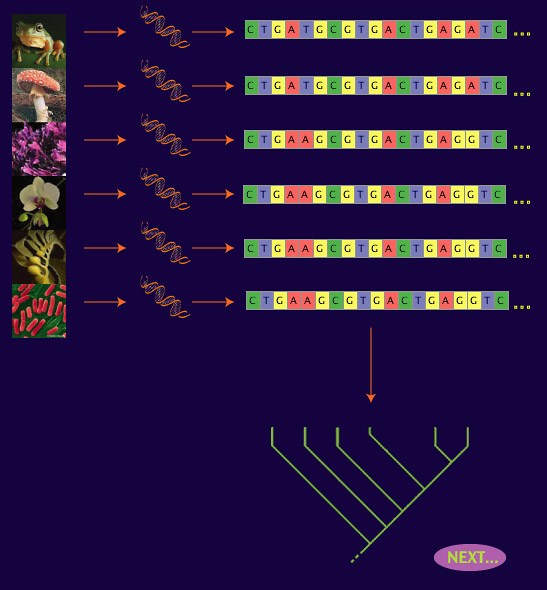
Which species' DNA is most similar to the DNA of the toothed whale? 
a)
Hippopotamus 
b)
Baleen Whale
c)
Grazing Mammals
d)
Camels
76.
Two organisms that are closely related would have
a)
very similar DNA sequence
b)
exactly the same DNA sequences
c)
no proteins in common
d)
completely different DNA sequence
77.

Which of the following is an example of a vestigial structure?

a)

the wings of a red-tailed hawk

b)

the hind limbs of a house cat

c)

the fins of sharks

d)

the tailbone of a human

78.
The opossum and kangaroo both incubate their young in a pouch. This provides evidence that they---
a)
are descended from a common ancestor
b)
Have very similar skeletal structures
c)
belong to the same species
d)
must range great distances to eat
79.

Mutations are important because they produce:

a)

death of the organism in which they develop.

b)

new traits that help natural selection occur.

c)

benefits for the individual, not for the population.

d)

Hardey-Weinberg equilibrium within a population.

80.
What is an example of a vestigial structure of a HUMAN?
a)
Femur
b)
Wisdom Teeth
c)
Brain
d)
Finger
81.
Bat wing, human arm
a)
Homologous
b)
Analogous
c)
Vestigial
82.
What is another name for natural selection?
a)
survival of the smartest
b)
survival of the fastest
c)
survival of the biggest
d)
survival of the fittest
83.

Why are hybrid animals, e.g ligers or mules, not considered a new species?

a)

They are sterile

b)

They can interbreed

84.

What is a species?

a)

A group of organisms that can interbreed to produce fertile offspring.

b)

A group of organisms that can interbreed to produce infertile offspring.

c)

A group of different organisms that can interbreed to produce fertile offspring.

85.

Human and cat DNA similitude is around 90%. This is an example of which of the following...

a)

Geologic Fossil Record

b)

DNA Structural Similarities

c)

Homologous Structure

d)

Embryological Development