
Font size
S
M
L
XL
 Worksheets
Unit 3 Matter Review
Total questions: 85
Worksheet time: 1hrs 20mins
Name
Class
Date
1.
What are the three states of matter?
a)
solid, volume, mass
b)
density, volume, mass
c)
solid, liquid, gas
d)
density, gas, volume
2.
Something that takes up space and has mass.
a)
volume
b)
matter
c)
mass
d)
density
3.
A state of matter that has a definite volume and shape.
a)
solid
b)
liquid
c)
gas
d)
matter
4.
The amount of space something takes up
a)
density
b)
volume
c)
mass
d)
matter
5.
A watermelon has more matter than a grape, so it has more
a)
mass
b)
eat
c)
solid
d)
greater
6.
You can measure ______ with grams.
a)
mass
b)
volume
c)
conductivity
d)
melting point
7.
Solids have a definite _______________.
a)
smell
b)
shape
c)
picture
d)
sound
8.
Liquid matter takes the shape of _______.
a)
a gas
b)
water
c)
a pet
d)
Its container
9.
Water in its solid form is _____________.
a)
a vapor
b)
ice
c)
a liquid
d)
boiling
10.
The measurement system used by scientist around the world.
a)
metric system
b)
customary systerm
c)
calorie system
d)
science system
11.
What is the measure of gravity on an object?
a)
matter
b)
mass
c)
weight
d)
volume
12.
Volume is ______________.
a)
length X width
b)
height X length
c)
length X width X height
d)
width X height
13.
Two or more atoms joined together for a(n)...
a)
Element
b)
Compound
c)
Molecule
d)
Mixture
14.
Salt has a chemical formula of NaCl. Salt is a...
a)
Compound
b)
Element
c)
Mixture
d)
None of the Above
15.
The amount of mass in a specific volume
a)
density
b)
weight
c)
matter
d)
state
16.
The ability of a substance to be pounded or rolled into thin sheets
a)
State
b)
Ductility
c)
Malleability
d)
Thermal Conductivity
17.
Physical or Chemical? Water is nonflammable
a)
Physical
b)
Chemical
c)
Neither
18.
Physical or Chemical Property? If copper comes in contact with water, it will turn green.
a)
Physical
b)
Chemical
c)
Neither
19.
Physical or Chemical Property? The temperature of boiling water is 100 degrees Celsius.
a)
Physical
b)
Chemical
c)
Neither
20.
Physical or Chemical Property? The solid form of water is ice.
a)
Physical
b)
Chemical
c)
Neither
21.
Define a Physical Property
a)
A property of matter not involving in its manifestation a chemical change
b)
A property in which stops a chemical reaction from occuring.
c)
A property or behavior of a substance which undergoes a chemical change or reaction.
d)
A property which makes the object smell or taste different.
22.
Define a Chemical Property
a)
A property which depends on the objects size or matter.
b)
A property of matter not involving in its manifestation a chemical change
c)
A property or behavior of a substance which undergoes a chemical change or reaction.
d)
A property which makes the object smell or taste different.
23.
Boiling point,melting point, and density are some of an element's
a)
pure properties
b)
physical properties
c)
chemical properties
24.
A mixture that appears to be evenly mixed throughout:
a)
an atom
b)
a compound
c)
a homogeneous mixture
d)
a heterogeneous mixture
25.
mixture that does NOT appear to be evenly mixed throughout:
a)
an atom
b)
a compound
c)
a homogeneous mixture
d)
a heterogeneous mixture
26.
Which of these is an example of a chemical property?
a)
density
b)
melting point
c)
ductility
d)
flammability
27.
Can a mixture be separated?
a)
No
b)
Yes
c)
Only sometimes
28.
An example of a physical change would be a change in...
a)
Color
b)
Shape
c)
Size
d)
All of the above
29.
Jack has a rock. The rock has a mass of 14g and a volume of 2cm3. What is the density of the rock?
a)
7 mL
b)
7 g/cm3
c)
28 g/cm3
d)
1/7 g/cm3
30.
Which units of measurement are used for volume?
a)
grams
b)
centimeters
c)
grams/milliliter
d)
milliliter
31.

I have two objects with the same volume but different masses. Which object will be more dense?
a)
The object with less weight.
b)
The object with more weight.
c)
The object with more mass.
d)
The object with less mass.
32.
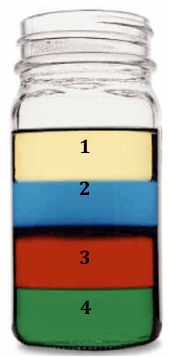
Put the liquids in order from most dense to least dense?
a)
4, 3, 2, 1
b)
1, 2, 3, 4
c)
3, 4, 2, 1,
d)
4, 3, 1, 2
33.
What is the formula for density?
a)
density = mass x volume
b)
density = mass / volume
c)
density = mass + volume
d)
density = mass - volume
34.
What is the volume of 150 grams of lead if it has a density of 11.3 g/cm3?
a)
13.3 g
b)
13.3 cm3
c)
.075 g
d)
1695 cm3
35.
Density is...
a)
the amount of mass in an object
b)
the amount of space an object takes up
c)
the amount of mass in a given space
d)
the weight of an object
36.

This pumice has a mass of 35.4 grams. Water the same size as this pumice has a mass of 41.2 grams. Will it sink or float?
a)
sink
b)
float
c)
same
37.
What is the density of water?
a)
0 g/ml
b)
1 g/ml
c)
10 g/ml
d)
100 g/ml
38.
What are the correct units of measurement for density?
a)
g/cm
b)
cm3
c)
g/mL
d)
g/lb
39.
What is the density of a substance that has a mass of 30g and a volume of 6 liters?
a)
24 g/L
b)
5 g/L
c)
36 g/L
d)
180 g/L
40.

What is the volume of Object X?
a)
10.0 cm3
b)
15.0 cm3
c)
20.0 cm3
d)
25.0 cm3
41.
An object that allows heat or electricity to pass through easily is a
a)
Insulator
b)
Conductor
42.
Which of the following is insoluble in water?
a)
saltwater
b)
lemon juice
c)
black pepper
d)
sugar
43.
Which object would a magnet attract?
a)
a glass bottle
b)
a piece of paper
c)
a metal paper clip
compass
compass
d)
a rubber eraser
magnetic field
magnetic field
44.
What is NOT an example of an insulator in the kitchen?
a)
An oven mitt
b)
Pots and pans
c)
A wooden spoon
d)
A plastic measuring cup
45.
A description of objects that can be measured and observed.
a)
gas
b)
mustangs
c)
physical properties
d)
melting point
46.
Which of the following is a part of the water cycle?
a)
evaporation
b)
condensation
c)
precipitation
d)
all of the above
47.
Which physical property will change if you visit the moon?
a)
mass
b)
volume
c)
density
d)
weight
48.
If you saw a glass of water and later the water was gone what happened to the water? Remember that your in the science lab.
a)
Ms. Klenk was very thirsty and drank the water.
b)
evaporation
c)
precipitation
d)
solubility
49.
What must be in metal for it to stick to a magnet?
a)
soy sauce
b)
copper
c)
iron
d)
aluminum
50.
In which state of matter are the particles moving the fastest?
a)
solid
b)
liquid
c)
gas
d)
onions
51.
If you see bubbles in a liquid what must be present?
a)
a solid
b)
Dr Pepper
c)
ice
d)
a gas
52.
Which of the following will not dissolve in water?
a)
salt
b)
sugar
c)
Kool-Aid
d)
sand
53.

Physical Properties
a)
The look, feel, taste, sound, or smell of an object.
b)
Stay on the surface level in a liquid.
c)
Drop below the surface level in a liquid.
d)
Anything that has mass and takes up space.
54.

Magnetism
a)
Drop below the surface in a liquid.
b)
Group together based on similar traits.
c)
The property of attraction to a magnet.
d)
The look, feel, taste, sound, or smell of an object.
55.
Which item is considered to be a conductor?
a)
Cardboard
b)
Yarn
c)
Copper
d)
Rubber
56.
Which item is considered to be an insulator?
a)
Nail
b)
Metal fence
c)
Copper
d)
Foam
57.
If an item has the physical property of solubility, it will
a)
be attracted to a magnet.
b)
have a greater mass.
c)
dissolve in water.
d)
be allow energy to pass.
58.
When salt is mixed with water, the physical property of salt
a)
remains the same shape.
b)
changes when it dissolves.
c)
changes the way it tastes.
d)
changes in size.
59.
Which of the following is not a chemical property?
a)
rusting
b)
boiling
c)
rotting
d)
burning
60.

What is reactivity?
a)
how a substance combines physically with another substance
b)
how a substance combines chemically with another substance
61.

Ability to rust is this type of property:
a)
Physical property
b)
Chemical property
62.
Which is an example of a physical property?
a)
ability to react with acid
b)
state of matter
c)
flammability
d)
ability to react with oxygen
63.
Which of the following is a chemical change?
a)
human digestion
b)
cutting a tree down
c)
melting a chocolate bar
d)
Has a density of 1 gm/mL
64.
What kind of properties can only be observed when a substance changes into a different substance?
a)
physical properties
b)
chemical properties
c)
liquid properties
d)
real properties
65.
Flammability (burns)
a)
Physical Property
b)
Chemical Property
66.
Solubility (dissolves)
a)
Physical Proeprty
b)
Chemical Property
67.
Reacts with acid
a)
Physical Property
b)
Chemical Property
68.
Sour taste
a)
Physical Property
b)
Chemical Property
69.
Melting point
a)
Physical Property
b)
Chemical Property
70.
Reacts with water
a)
Physical Property
b)
Chemical Property
71.
Hardness
a)
Physical Property
b)
Chemical Property
72.
Your friend decides to toast a piece of bread, but leaves it in the toaster too long. The bread is black and the kitchen if full of smoke.
a)
Physical Change
b)
Chemical Change
73.
You blow dry your wet hair.
a)
Physical Change
b)
Chemical Change
74.
You forgot to dry the bread knife when you washed it and reddish brown spots appeared on it.
a)
Physical Change
b)
Chemical Change
75.
Food color is dropped into water to give it color.
a)
Physical Change
b)
Chemical Change
76.
In a fireworks show, the fireworks explode giving off heat and light.
a)
Physical Change
b)
Chemical Change
77.
Chewing food to break it down into smaller particles represents a _________ change, but the changing of starch into sugars by enzymes in the digestive system represents a ___________change.
a)
Chemical then Physical
b)
Physical then Chemical
c)
Both Physical
d)
Both Chemical
78.
When something is dropped, what type of energy transfer takes place?
a)
Kinetic -> Potential
b)
Gravitational Potential -> Kinetic -> Sound
c)
Electrical -> Chemical
d)
Heat -> Nuclear
79.
Energy cannot be destroyed.
a)
True
b)
False
80.
Imagine dropping a basketball. When would it have the most gravitational potential energy?
a)
When it is closest to the ground
b)
When it is at the highest point
c)
When it is halfway down
d)
It has the same amount of gravitational PE at all points
81.
Food has _______ potential energy that our bodies transform into kinetic energy.
a)
Elastic
b)
Nuclear
c)
Gravitational
d)
Chemical
82.
What is the Law of Conservation of mass?
a)
Mass is created in a chemical reaction
b)
Mass is created in a physical change
c)
New chemicals formed from a chemical reaction have a larger overall mass than the original reactants
d)
Mass is never created or destroyed
83.

The sun shines down on this family as the play on the beach.
a)
conduction
b)
convection
c)
radiation
84.

Walking on the warm sand sand with your bare feet.
a)
conduction
b)
convection
c)
radiation
85.

Blow drying your wet hair.
a)
conduction
b)
convection
c)
radiation
Reset

