wayground logo

Free Printable Worksheets

Font size

S
M
L
XL
Worksheets

Classification, Viruses, Bacteria

Total questions: 113

Worksheet time: 2hrs 54mins

Name
Class
Date
1.
Tigers, Jellyfish, Gorillas and Sponges are all part of kingdom _______.
a)
Animalia
b)
Plantae
c)
Fungi
d)
Bacteria
2.
Which kingdom is autotrophic AND has a cell wall?
a)
Bacteria
b)
Fungi
c)
Plantae
d)
Protista
3.
 You would find mushrooms in which kingdom?
a)
Plantae
b)
Protists
c)
Fungi
d)
Animalia
4.
The scientific name for an organism is made from the:
a)
class and family name
b)
genus and species name
c)
domain and kingdom name
d)
kingdom and phylum name
5.
Term given to describe the 2 name naming system is:
a)
dichotmous key
b)
binomial nomenclature
c)
2 scientific names
d)
binomial key
6.
The 8 levels of classification, most broad to most specific.
a)
Domain, Genus, Family, Order, Class, Phylum, Kingdom, Species
b)
Domain, Species, Kingdom, Genus, Phylum, Family, Class, Order
c)
Domain, Kingdom, Phylum, Class, Order, Family, Genus, Species
d)
Order, Kingdom, Species, Domain, Phylum, Family, Class, Genus
7.
Which of the following organisms are MOST closely related?
a)
organisms that share a domain
b)
organisms that share a family 
c)
organisms that share a genus 
d)
organisms that share an order  
8.
Cladograms are constructed by grouping organisms together based on their____________ characteristics.
a)
shared
b)
different
c)
similar
d)
opposite
9.
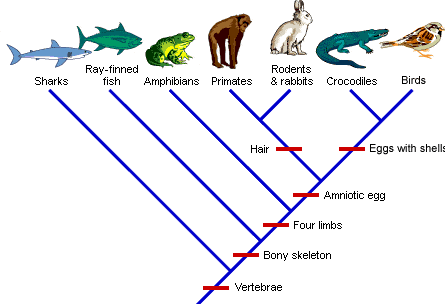
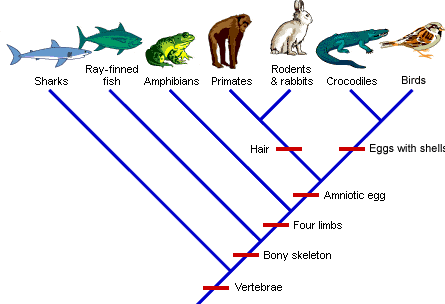
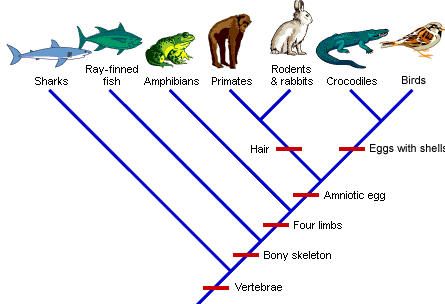
According to this cladogram, sharks are MOST closely related to which organism? 
a)
Amphibians
b)
Ray finned fish
c)
Crocodiles
d)
Birds
10.
Which two orgainsms have hair? 
a)
Sharks & Ray Finned Fish
b)
Primates & Rodents
c)
Birds & Crocodiles
d)
Rabbits & Birds
11.
According to this cladogram, birds are LEAST related to: 
a)
Amphibians
b)
Sharks
c)
Ray Finned Fish
d)
Crocodiles
12.
On the cladogram, which organism is the closest relative of the human?
a)
Frog
b)
Hare
c)
Caiman
d)
Parrot
13.
Which trait do only humans have, according to the cladogram?
a)
jaws
b)
mammary glands & hair
c)
terrestrial during all life stages
d)
bipedal & opposable thumbs
14.
What is the most specific level of classification?
a)
Family
b)
Domain
c)
Species
d)
Carolus Linnaeus
15.

What is defined as " a scheme of classification?"

a)

Taxonomy

b)

Domain

c)

Dichotomous

d)

Mnemonic

16.

Which of these is written correctly?

a)

Homo sapiens

b)

Homo Sapiens

c)

Homo Sapiens

d)

Homo sapiens

17.

What is defined as " A group of similar species?"

a)

Genus

b)

Family

c)

Kingdom

d)

Class

18.

What level of classification is "picta" in "Chrysemys picta?"

a)

Genus

b)

Species

c)

Class

d)

Order

19.

What level of classification is "gallus" in "Gallus domesticus?"

a)

Genus

b)

Species

c)

Kingdom

d)

Class

20.

What can be said about all organisms that make their own food by photosynthesis

a)

They are all plants

b)

They are all vascular

c)

They are autorophs

d)

They are heterotrophs

21.

Which taxonomic level includes the least number of organisms?

a)

species

b)

kingdom

c)

order

d)

genus

22.

According to this cladogram, primates share a common ancestor with

a)

amphibians

b)

rodents and rabbits

c)

crocodiles

d)

birds

23.
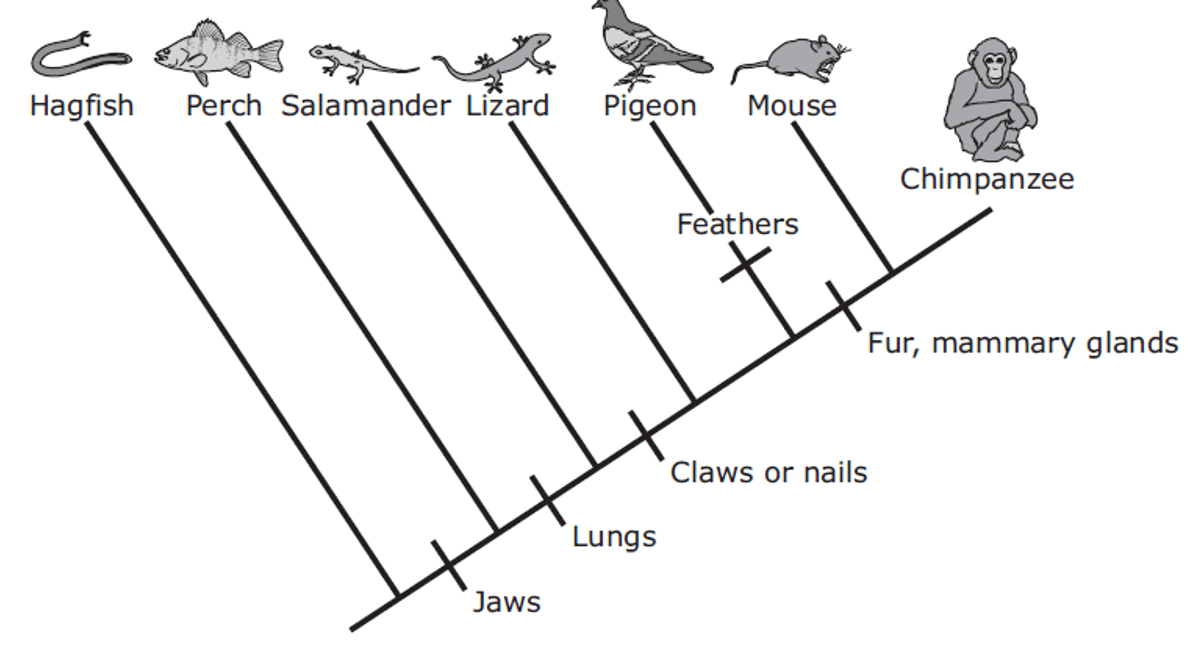
All the animals to the right of the hagfish would have the common characteristic of -
a)
Fur
b)
Claws or nails
c)
Lungs
d)
Jaws
24.

All the animals to the right of the salamander would have the common characteristic of...

a)

Fur

b)

Claws or nails

c)

Lungs

d)

Jaws

25.

On the cladogram, which number represents the most recent common ancestor of organisms B & D?

a)

1

b)

2

c)

3

d)

A

26.

In the blank cladogram, what type of information would go on the lines labeled A?

a)

derived characteristics

b)

common ancestors

c)

DNA analysis

d)

organisms

27.

In the cladogram, what type of information would go in

the area labeled B (hash lines)?

a)

shared characteristics

b)

DNA analysis

c)

common ancestors

d)

organisms

28.

According to this image, which two domains of life are most related?

a)

Bacteria & Archaea

b)

Archaea & Eukarya

c)

Eukarya & Bacteria

29.

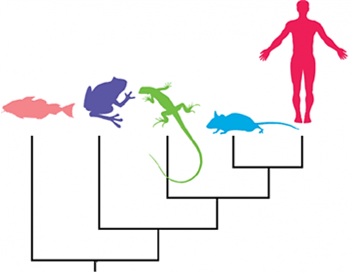
According to this phylogenetic tree, which creature is the least related out of all pictured?

a)

Fish

b)

Frog

c)

Salamander

d)

Human

30.
A branching diagram that represents the proposed phylogeny or evolutionary history of a species or group 
a)
Cladogram 
b)
Cladistics
c)
Phylogeny
d)
Taxonomy
31.
A method that classifies organisms according to the order that they diverged from a common ancestor 
a)
Cladogram 
b)
Dichotomous Key
c)
Molecular Clock
d)
Cladistics
32.
The first part of the scientific name is ALWAYS
a)
italicized
b)
underlined
c)
capitalized
d)
lowercased
33.
Reasons that viruses are considered to be nonliving is because
a)
They are not cellular
b)
They cannot reproduce on their own
c)
They cannot make proteins
d)
all of the above
34.
What do viruses need to reproduce?
a)
they need genetic material
b)
They need a host cell
c)
They need  bacteria
d)
They need insulin
35.
A(n) _____ is a virus that enters a bacterial cell.
a)
endospore
b)
decomposer
c)
plasmid
d)
bacteriophage
36.
When a virus invades a living cell, its _______
takes over the cell's functions.
a)
outer coat
b)
genetic material
c)
core
d)
cytoplasm
37.
Viruses are...
a)
prokaryotic
b)
eukaryotic
c)
non-living
d)
endospores
38.
Why do doctors suggest people get a flu vaccine every year?
a)
Flu viruses replicate more rapidly over time
b)
Flu viruses can mutate from year to year
c)
Vaccines are absorbed by the body after a year
d)
Vaccines get stronger over time
39.
What is a way to become immune to a disease without first having the disease?
a)
antibiotics
b)
Anti-retroviral drugs
c)
Vaccinations
d)
Exposure Therapies
40.
What does a vaccine do?
a)
Gives you immunity
b)
Gives you a disease
c)
Cures you from a disease
41.
Viruses trick host cells into making copies of the virus
a)
True
b)
False
42.
Viruses are larger than bacteria
a)
True
b)
False
43.
Which of the following occurs after a virus attaches to a host cell
a)
The host cell dies
b)
The virus dies
c)
The virus inserts its genetic information into the host cell
d)
the virus eats the cell
44.
Viruses 
a)
have many cells
b)
are misfolded proteins
c)
are a protein coat around genetic material
d)
endospores
45.
Viruses can reproduce on their own
a)
False
b)
True
46.
Viruses are _______.
a)
producers
b)
consumers
c)
parasites
d)
decomposers
47.
Which of the following is one important difference between a virus and a bacterial cell?
a)
a virus is much larger in size than a bacterial cell
b)
a virus always causes more severe disease than a bacterial cell
c)
a virus can never reproduce on its own, but a bacterial cell can
d)
a virus does not contain genetic material, but a bacterial cell does
48.
What is a host?
a)
Organism that lives on the cell and causes it harm 
b)
Something that causes harm to the cell 
c)
Cell that the virus invades and takes over
49.
What is the first step of the virus reproduction cycle?
a)
The viruses genetic material (DNA) starts to take over the functions of the cell
b)
The host cell bursts open, releasing the new viruses
c)
The virus injects its genetic material into the cell
d)
A virus attaches to the surface of a host cell
50.
What is the last step in the viral reproduction cycle?
a)
A virus attaches to the surface of a host cell
b)
The proteins and genetic material start to assemble in the cell
c)
The host cell bursts open, releasing the new viruses
d)
The virus injects its genetic material into the cell
51.
Which is bigger, a bacteria or a virus?
a)
Bacteria
b)
Virus
52.
Where do viruses reproduce?
a)
Outside of a cell
b)
Inside of a cell
c)
They do not reproduce
53.
Which letter on the diagram points to the genetic material of the virus?
a)
b)
B
c)
C
d)
D
54.
Which letter on the diagram points to the capsid?
a)
b)
B
c)
C
d)
D
55.
Which of the following is an example of a retrovirus?
a)
HIV
b)
Influenza
c)
Common cold
d)
Measles
56.
A retrovirus is different from other viruses because retroviruses have __________ at their core.
a)
RNA and Reverse Transcriptase Enzymes
b)
RNA and Transcriptase Enzymes
c)
DNA and Reverse Transcriptase Enzymes
d)
DNA and Transcriptase Enzymes
57.
During which reproductive cycle do viruses turn host cells into virus making machines?
a)
Lytic Cycle
b)
Lysogenic Cycle
c)
Passive Cycle
d)
Active Cycle
58.
Which viral reproductive cycle is displayed in the image?
a)
Lytic Cycle
b)
Lysogenic Cycle
c)
Active Cycle
d)
Passive Cycle
59.
True or False: In the lysogenic cycle, viral DNA is integrated in the host DNA and passed on during mitosis.
a)
True
b)
False
60.
Which viral reproductive cycle is displayed in the image?
a)
Lytic Cycle
b)
Lysogenic Cycle
c)
Active Cycle
d)
Passive Cycle
61.
Put the following in order from LARGEST to SMALLEST: prokaryotic cell, virus, eukaryotic cell.
a)
Virus - Prokaryotic Cell - Eukaryotic Cell
b)
Eukaryotic Cell - Prokaryotic Cell - Virus
c)
Eukaryotic Cell - Virus - Prokaryotic Cell
d)
Prokaryotic Cell - Eukaryotic Cell - Virus
62.
What is the name for the protein shell that encloses a viral genome?
a)
Capsid
b)
Nucleoid
c)
Tail fibers
d)
Prion
63.
What is the purpose of glycoproteins on the virus's membranous envelope?
a)
Cell recognition
b)
Store energy
c)
Produce mRNA
d)
Hereditary information
64.
What is the purpose of reverse transcriptase used by retroviruses?
a)
To copy RNA into DNA
b)
To transcribe mRNA from DNA
c)
To destroy RNA and DNA
d)
To replicate amino acids
65.

HIV is a __________________ meaning that it is composed not of DNA but of RNA.

a)

Ebolavirus

b)

Computer Virus

c)

Retrovirus

66.

Bacterial cells are...

a)

Eukaryotic

b)

Prokaryotic

c)

Viruses

d)

Fungal

67.

Prokaryotic cells are

a)

Multicellular

b)

Unicellular

68.

Bacteria have three shapes. Which of the following is not a common shape of bacteria?

a)

Spirilla

b)

Cocci

c)

Bacilli

d)

Cube

69.

Which of the following is the largest?

a)

Virus

b)

Eukaryotes

c)

Prokaryotes

70.

How do bacteria reproduce?

a)

Sexual Reproduction

b)

Division

c)

Binary Fission

d)

Pollination

71.

Bacteria are treated with

a)

Antibiotics

b)

Vaccines

c)

Asprin

d)

Chemotherapy

72.

Binary fission results in

a)

2 genetically different cells

b)

4 genetically identical cells

c)

2 genetically identical cells

d)

4 genetically different cells

73.

Which of the following is an organelle that prokaryotes have?

a)

Nucleus

b)

Ribosomes

c)

Mitochondria

d)

Lysosome

74.

What are pathogens?

a)

Eukaryotic cells that turned in to bacteria

b)

Disease causing agents

c)

Microorganisms that help clean up oil spills

d)

Beneficial bacterial cells

75.

The organelle described as a long, thin-like projection that helps with movement

a)

Mitochondria

b)

Chlorplast

c)

Flagella

d)

Cell Membrane

76.

Organelle that helps create proteins in the cell

a)

Ribosome

b)

Cell Wall

c)

Mitochondria

d)

Lysosome

77.

Where is the DNA in a prokaryotic cells?

a)

Nucleus

b)

Cell Membrane

c)

Cytoplasm

d)

Chloroplast

78.
The outer covering of a bacteria cell is called the
a)
flagella
b)
cytoplasm
c)
cell wall 
79.
Name this bacteria shape
a)
coccus
b)
spirillum
c)
bacillus
80.
Name this bacteria shape
a)
bacillus
b)
coccus
c)
spirillum
81.
Name this bacteria shape
a)
coccus
b)
bacillus
c)
spirillum
82.
 Bacteria that help break down dead material in the environment are called 
a)
vaccines
b)
decomposers
c)
oats
83.
Live bacteria are found in milk, cheese and yogurt
a)
True
b)
False
84.
All bacteria are
a)
unicellular
b)
multicellular
c)
eukaryotic
85.
Letter J is pointing to the:
a)
Plasmid
b)
Ribosome
c)
Chromosome
d)
Cytoplasm
86.
Bacteria cells share which of the following organelles in common with plant and animal cells?
a)
cell membrane, RER
b)
cell wall, mitochondria
c)
nucleus, ribosomes
d)
ribosomes, cytoplasm
87.

Allows two bacteria to connect and "share" information.

a)

slime layer

b)

cell wall

c)

flagella

d)

plasmid

e)

pilli

88.

Strong outer layer that protects the bacterial cell from infection by viruses and attack from immune cells.

a)

Pilli

b)

Cell wall

c)

Capsule

d)

Flagella

89.

Layer outside the cell membrane that gives the bacterial cell a solid shape.

a)

Cytoplasm

b)

Cell wall

c)

Plasma membrane

d)

Pilli

90.

Jelly like substance that fills the inside of the bacterial cell.

a)

Flagella

b)

Chromosome

c)

Plasmid

d)

Cytoplasm

91.
All bacteria have DNA. 
a)
true
b)
false
92.
Conjugation is
a)
sexual reproduction
b)
the passing of a DNA plasmid from one bacteria to another
c)
the joining of sentences with the words "and" or "or"
d)
the way bacteria make food
93.
Conjugation
a)
increases genetic variation
b)
creates more bacteria
c)
is bacterial sexual reproduction
d)
the joining of 2 bacteria into 1 super-bacteria
94.
Endospores are created by bacteria
a)
when environmental conditions become unfavorable
b)
to woo female bacteria
c)
as a defense mechanism against invading viruses
d)
when they produce eggs
95.
In what kingdom would you find regular, everyday bacteria?
a)
Kingdom Bacteria
b)
Kingdom Archaea
c)
Kingdom Protista
d)
Kingdom Anamalia
96.
In what Kingdom would you find extreme bacteria? 
a)
Kingdom Bacteria
b)
Kingdom Archaea
c)
Kingdom Microbiologica
d)
Kingdom Protista
97.
Which part of a bacteria cell wall "holds" the stain? 
a)
plasma membrane
b)
fimbriae
c)
peptidoglycan
d)
pilus
98.
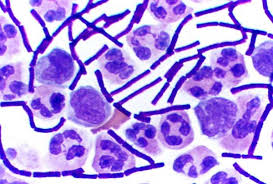
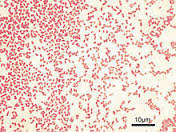
These bacteria are
a)
gram positive
b)
gram negative
c)
nonliving
d)
viral
99.
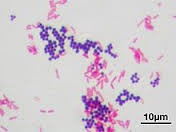
These bacteria are
a)
nonliving
b)
gram positive
c)
gram negative
d)
gram positive and gram negative
100.
These bacteria are
a)
gram positive and negative
b)
gram positive
c)
gram negative
d)
viral
101.
This is
a)
gram positive
b)
gram negative
c)
confusing (don't choose!)
d)
Who knows? (don't choose)
102.
___ must have oxygen to survive. 
a)
obligate aerobes
b)
obligate anaerobes
c)
facultative aerobes
d)
high energy bacteria
103.
Which is not an extremophile?
a)
halophile
b)
methanogen
c)
proteobacteria
d)
thermoacidophiles
104.

What's the difference between archaea and bacteria?

a)

There is no difference.

b)

Archaea is single celled and bacteria is multi-celled.

c)

Archaea is less common and bacteria is found everywhere

105.
The ability of bacteria to survive and become "stronger" even after antibiotic treatment is called
a)
cellular respiration
b)
endospore formation
c)
antibody resistance
d)
antibiotic resistance
106.
Which group of bacteria would likely be found in hot, acidic sulfur springs?
a)
Methanogens
b)
Thermophiles
c)
Archaebacteria
d)
Halophiles
107.
Which of the following is NOT a type of archeabacteria?
a)
Methanogen
b)
Halophile
c)
Heterotroph
108.
Type of bacteria that —live in areas with extremely high salt content
a)
theroacidophiles
b)
halophiles
c)
extremophiles
d)
methanogens
109.
What type of organism is found in extreme environments
a)
Hot Springs
b)
Bacteria
c)
Viruses
d)
Archaea
110.
Which organism can survive either with or without oxygen?
a)
heterotrophs
b)
autotrophs
c)
obligate anaerobe
d)
facultative anaerobe
111.
Which organism cannot survive in the presence of oxygen?
a)
heterotrophs
b)
autotrophs
c)
obligate anaerobe
d)
facultative anaerobe
112.
During an experiment a scientist observed prokaryotes that lived near volcanic vents deep in the ocean.  The scientist must likely observed
a)
photoautotrophs
b)
chemoautotrophs 
c)
heterotrophs
d)
photoheterotrophs
113.
The ecological roles filled by prokaryotes include all of the following except
a)
decomposers
b)
producers
c)
scavengers
d)
nitrogen fixers