wayground logo

Free Printable Worksheets

Font size

S
M
L
XL
Worksheets

7th Science Midterm

Total questions: 131

Worksheet time: 2hrs 27mins

Name
Class
Date
1.
Which organelle is only found in a plant cell? 
a)
nucleus
b)
chloroplast
c)
mitochondria
d)
cell membrane
2.

Directs all cell activities through the DNA located there.

a)

Lysosomes

b)

Nucleus

c)

ribosomes

d)

Mitochondria

3.

I am a protein packaging and shipping machine! Who am I?

a)

vacuole

b)

ribosome

c)

mitochondrion

d)

golgi apparatus

4.

Which part of the cell is often called "the brain of the cell"?

a)

nuclear membrane

b)

endoplasmic reticulum

c)

nucleus

d)

mitochondria

5.

What organelle stores large amounts of water in plant cells?

a)

Nucleus

b)

Mitochondria

c)

Chloroplast

d)

Vacuole

6.

Where are proteins made?

a)

Golgi body

b)

Mitochondria

c)

Chromosomes

d)

Ribosomes

7.
This organelle takes food and turns it into ENERGY for plant and animal cells.
a)
Chloroplast
b)
Mitochondria
c)
Lysosome
d)
Ribosome
8.

The organelle where photosynthesis takes place in plant cells?

a)

ribosome

b)

mitochondria

c)

chloroplast

d)

nucleus

9.

I am the outer most layer of an animal cell. What am I?

a)

cell wall

b)

nucleus

c)

cell membrane

d)

cell skin

10.

What are tiny organelles that convert glucose into ATP?

a)

Ribosomes

b)

Vesicles

c)

Cytoskeleton

d)

Mitochondria

11.

A rigid layer that lies outside the cell's membrane is...

a)

Cytoskeleton

b)

Cilia

c)

Cell Wall

d)

Flagella

12.
What organelle is called the "powerhouse" of a cell?

a)
Endoplasmic Reticulum
b)
Nucleus
c)
Mitochondria
d)
Nucleolus
13.
A group of tissues that work together to perform a similar function is called_____. (Examples include the heart, lungs or stomach)
a)
cells
b)
tissues
c)
organs
d)
organ system
14.

A group of cells working together to perform a function?

a)

cells

b)

tissues

c)

organs

d)

atoms

15.
Organs that work together to perform a related function is called _____________?
a)
cells
b)
tissues 
c)
organ system
d)
organs
16.

When many organ systems work together it can form an...?

a)

organ

b)

cells

c)

organ system

d)

organism

17.
This is a example of ........
a)
cell
b)
organ system
c)
organ
d)
tissue
18.
The brain is a part of which organ system?
a)
nervous
b)
skeletal
c)
muscular
d)
digestive 
19.
The lungs and the kidneys are examples of
a)
cells
b)
organs
c)
tissues
d)
organ systmes
20.

What is the structure inside the nucleus that makes ribosomes?

a)

Golgi Body

b)

Lysosome

c)

Rough E.R.

d)

Nucleolus

21.
This organelle function is to package, modify and transport materials in/out of cell.
a)
Rough E.R.
b)
Smooth E.R.
c)
MItochondria
d)
Golgi Body
22.
This cell sends one way chemical signals throughout the body. 
a)
Nerve Cell
b)
Red Blood Cell
c)
White Blood Cell
d)
Xylem
23.

what is the function of a lysosome?

a)

To create energy for the cell

b)

To command the cell what to do

c)

To remove waste using digestive enzymes from the cell

d)

To protect the cell

24.

What is the purpose of the nucleus?

a)

It is the command center, contains DNA, and cell division

b)

It protects the cell

c)

It stores energy for the cell

d)

It gets rid of waste in the cell

25.

What is the difference between mitochondria and chloroplast?

a)

Mitochondria produces energy and chloroplasts breaks down energy

b)

There is no difference. They are the same.

c)

Mitochondria breaks down energy from food and chloroplasts produce energy from sunlight.

d)

Mitochondria contains DNA and chloroplasts are green

26.

The outermost layer of a plant cell and animal cell is...

a)

Plant cell - cell membrane, animal cell - cell wall

b)

Plant cell - cell wall; animal cell - cell membrane

c)

Plant and animal cell - cell wall

d)

Plant and animal cell - cell membrane

27.

What does a plant cell have that an animal cell doesn't have?

a)

Cell Membrane and Cell Wall

b)

Cell Wall and Mitochondria

c)

Cell Wall and Nucleus

d)

Cell Wall and Chloroplast

28.

What is the jelly-like substance that keeps the organelles floating?

a)

Cell Membrane

b)

Nucleus

c)

ER

d)

Cytoplasm

29.
Label #3
a)
Nucleus
b)
Mitochondria
c)
Vacuole
d)
Golgi Body
30.
Label #5
a)
Nucleus
b)
Nucleolus
c)
Endoplasmic Reticulum
d)
Mitochondria
31.
Label #8
a)
Vacuoles
b)
Lysosomes
c)
Cytoplasm
d)
Endoplasmic Reticulum
32.
Label #10
a)
Endoplasmic Reticulum 
b)
Golgi Bodies
c)
Ribosomes
d)
Nucleolus
33.
Label #11
a)
Cell membrane
b)
Cytoplasm
c)
Mitochondria
d)
Ribosomes
34.
Label A
a)
Cell wall
b)
Cell membrane
c)
Cytoplasm
d)
Chloroplast
35.
Label C
a)
Mitochondria
b)
Vacuole
c)
Nucleus
d)
Cytoplasm
36.
Label D
a)
Cytoplasm
b)
Chloroplast
c)
Vacuole
d)
Mitochondria
37.
This diagram depicts which phase of mitosis? 
a)
prophase
b)
metaphase
c)
anaphase
d)
telophase
38.
a)
Anaphase
b)
Cytokinesis
c)
Telophase
d)
Metaphase
39.
a)
Cytokinesis
b)
Interphase
c)
Anaphase
d)
Metaphase
40.
a)
Anaphase
b)
Cytonkinesis
c)
Interphase
d)
Prophase
41.

In mitosis, the two resulting cells are

a)

different from the starting cell and identical to each other.

b)

different from the starting cell and different from each other.

c)

identical to the starting cell and different from each other.

d)

identical to the starting cell and identical to each other.

42.

Where does a cell contain it's genetic material?

a)

nucleus

b)

nucleolus

c)

ribosome

d)

mitochondria

43.
What is the first phase of Mitosis?
a)
Prophase
b)
Metaphase
c)
Anaphase
d)
Telophase
44.

Identify the correct order of the phases of mitosis.

a)

interphase, metaphase, prophase, anaphase

b)

metaphase, prophase, anaphase, telophase

c)

prophase, metaphase, anaphase, telophase

d)

telophase, interphase, metaphase, anaphase

45.
Passive transport requires no
a)
concentration gradients
b)
osmosis
c)
motion
d)
energy
46.
What is diffusion?
a)
when molecules move 
b)
when molecules move from a high concentration to a low.
c)
no movement 
d)
molecules move everywhere
47.
Osmosis is the movement of _____ across a membrane.
a)
food
b)
energy
c)
oxygen
d)
water
48.
When both inside and outside of a cell have the same amount of water it is said that the cell has reached a state of
a)
Osmosis
b)
Diffusion
c)
Equilibrium
49.
What do plants give off after photosynthesis?
a)
Oxygen
b)
carbon
c)
nitrogen
d)
hydrogen
50.
Plants need ________from the air for photosynthesis
a)
oxygen
b)
soil
c)
carbon dioxide
d)
sugar
51.
The products of photosynthesis are
a)
water and carbon dioxide
b)
oxygen and water
c)
sugar and cabon dioxide
d)
oxygen and sugar (glucose)
52.
Which gas is removed from the atmosphere during photosynthesis?
a)
hydrogen
b)
oxygen
c)
nitrogen
d)
carbon dioxide
53.
The main source of energy for all life comes from ____.
a)
the Earth
b)
the moon
c)
the sun
d)
the food we eat/make
54.
In what part of the cell does photosynthesis occur?
a)
Nucleus
b)
Chloroplast
c)
Epidermis
d)
Vacuole
55.
After photosynthesis, plants store their energy as _________ .
a)
chlorophyll
b)
pigment
c)
glucose (sugar)
d)
Oxygen
56.
Which of the following go through the process of photosynthesis?
a)
bees
b)
algae
c)
humans
d)
mushrooms
57.
What are the reactants (what's needed) for photosynthesis?
a)
glucose and oxygen
b)
light, water, and carbon dioxide
58.
Where does cellular respiration take place in the cell?
a)
Cell Membrane
b)
Nucleus
c)
Mitochondria
d)
Vacuole
59.
What is the purpose of cellular respiration?
a)
to break down food
b)
to create energy in the body
c)
to release energy from food
d)
there is none; it's a waste of time
60.
Which of the following is the correct equation for PHOTOSYNTHESIS?
a)
CO+ light + H2O --> O+ Sugar
b)
CO+ sugar + H2O --> O+ light
c)
O2 + light + H2O --> CO+ Sugar
d)
CO+ O2 + H2O --> Light+ Sugar
61.
The passing of traits from parents to offspring
a)
heredity
b)
genetics
c)
trait
d)
alleles
62.
Characteristics can also be called
a)
heredity
b)
traits
c)
gene 
d)
alleles
63.
The different forms of a gene
a)
heredity
b)
genetics
c)
gene
d)
alleles
64.
The factors that control a trait
a)
genetics
b)
trait
c)
gene
d)
alleles
65.
This trait always shows up in an organism when the allele is present
a)
dominant allele
b)
codominance
c)
probability
d)
recessive allele
66.
This trait is hidden whenever the dominant allele is present
a)
dominant allele
b)
codominance
c)
recessive allele
d)
Punnett Square
67.
A chart that shows all the possible combinations of alleles that can result from a genetic cross
a)
dominant allele
b)
codominance
c)
probability
d)
Punnett Square
68.
The mathematical chance that an event will occur
a)
dominant allele
b)
probability
c)
recessive allele
d)
Punnett Square
69.
When alleles are neither dominant nor recessive (As a result, both alleles are expressed in the offspring.).
a)
codominance
b)
probability
c)
recessive allele
d)
Punnett Square
70.
An organism's physical appearance or visible traits
a)
fertilization
b)
genotype
c)
phenotype
d)
homozygous
71.
An organism's genetic makeup, or allele combination
a)
fertilization
b)
genotype
c)
phenotype
d)
heterozygous
72.
An organism that has two different alleles for a trait (hybrid)
a)
fertilization
b)
genotype
c)
homozygous
d)
heterozygous
73.
An organism that has two identical alleles for a trait (purebred)
a)
genotype
b)
phenotype
c)
homozygous
d)
heterozygous
74.
A new organism begins to form when egg and sperm join in a process called
a)
fertilization
b)
phenotype
c)
homozygous
d)
heterozygous
75.
T - tall and t = short
In the punnett square below, what belongs in the missing square
a)
tt
b)
Tt
c)
Bb
d)
TT
76.
G = green, g = yellow
The genotype for a yellow plant is...
a)
GG
b)
Gg
c)
gg
d)
all of the choices result in yellow
77.
B = brown fur  b = white fur
In the punnett square, what is the probability for white fur? 
a)
0%
b)
25%
c)
50%
d)
75%
78.
Which of the following alleles is homozygous (purebred) recessive?
a)
Tt
b)
tt
c)
TT
d)
t
79.
Two brown eyed parents (Bb) have a baby. What is the chance the baby is blue eyed?
a)
0 %
b)
25%
c)
50%
d)
75%
80.
Dominant alleles are represented by a:
a)
Male gene
b)
lowercase letter
c)
recessive trait
d)
capital letter
81.
Aa, DD, bB, yy are all examples of
a)
genotypes
b)
phenotypes
82.
In a heterozygous genotype, the ___________ allele takes over in the phenotype.
a)
recessive
b)
dominant
c)
lower case letter
d)
both 
83.
AA and Aa always show up as
a)
dominant
b)
recessive
84.
aa always shows up as
a)
dominant
b)
recessive
85.
Aa is
a)
homozygous
b)
heterozygous
86.
Which of the following is a phenotype?
a)
Aa
b)
red hair
c)
heterozygous
d)
DNA
87.
What is a punnett square?
a)
graph used to predict the possible genotypes of offspring in a given cross
b)
a graph used to predict the possible birth rate of offspring.
c)
a graph used to predict the possible behavioral characteristics an offspring could have
d)
None of the above
88.
In a punnet square where are the parent alleles written?
a)
Top and inside the boxes
b)
Only on the left and right side of the boxes. 
c)
outside of the boxes (top and left side)
d)
All on the top side of the boxes
89.
What is the dominant trait?
a)
yellow pea seeds
b)
green pea seeds
c)
there is no dominant seed
d)
Jolly green giant
90.

This is the male part of the flower; it makes pollen.

a)

stigma

b)

ovary

c)

sepal

d)

stamen

91.

These are found at the bottom of the pistil of a flower; they are tiny egg cells that will become seeds.

a)

ovaries

b)

ovules

c)

anthers

d)

sepals

92.

This is the stalk that holds the anther.

a)

stamen

b)

stigma

c)

filament

d)

pistil

93.
The pistil is the _______ part of the flower
a)
Male
b)
Female
94.
The stigma, style and ovary makeup the...
a)
Pistil 
b)
Stamen
95.
What part of the flower produces pollen?
a)
Anther
b)
Filament 
c)
Ovary
d)
Sepal
96.
Colorful leaf like structure that attracts pollinators 
a)
Petals
b)
Sepal
c)
Leave
d)
Stamen
97.
Green leaf like structure that protects the flower bud
a)
Sepal
b)
Pistil
c)
Petal
d)
Stamen
98.
The sticky tip of the pistil 
a)
Stigma
b)
Stamen
c)
Ovary 
d)
Ovule
99.
Which of these is not part of the stamen
a)
filament 
b)
anther
c)
stigma
100.
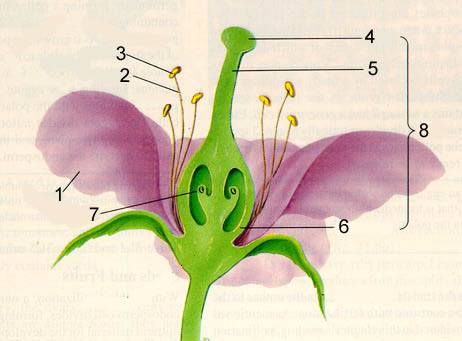
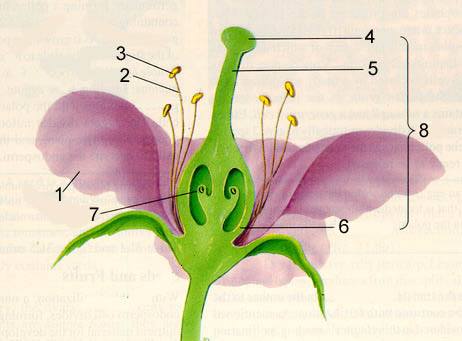
What is #1 pointing to?
a)
ovary
b)
petal
c)
stigma
d)
stamen
101.
What is #8 pointing to?
a)
petal
b)
stamen
c)
pistil
d)
ovary
102.
What is #2 pointing to?
a)
anther
b)
filament
c)
ovary
d)
style
103.
What is #3 pointing to?
a)
stigma
b)
filament
c)
ovary
d)
anther
104.
What is #4 pointing to?
a)
anther
b)
style
c)
stigma
d)
ovary
105.
What is #5 pointing to?
a)
anther
b)
filament
c)
stigma
d)
style
106.
The sepal_________
a)
smells good
b)
protects and supports the flower
c)
attracts other animals
d)
produces pollen grains
107.
Which part attracts insects and mammals to the flower
a)
sepal
b)
petal
c)
ovaries
d)
style
108.
The style____________
a)
connects the stigma to the ovary
b)
holds up the anther
c)
smells great
d)
produces pollen grains
109.
Diffusion is the movement of molecules from an area of _____ concentration to an ______ concentration
a)
High, low
b)
Low, high
c)
Low, low,
d)
High, high
110.
If there is more oxygen in the blood than in an organ, which direction would the oxygen move?
a)
Out of the blood
b)
Into the blood
111.
In the given scenario what will happen?  An egg is placed in pure water for 48 hours.
a)
The egg will gain water and swell.
b)
Water will move in and out of the cell equally, and the cell with neither shrink nor swell.
c)
The egg will lose water and shrink.
112.
Permeable means
a)
things can pass through
b)
the concentration levels are different
c)
it is permanent
d)
things are stuck
113.
Urine is one way that our body gets rid of ___________.
a)
pee
b)
liquids
c)
waste
d)
carbon dioxide
114.

What does the digestive system do?

a)

Breaks down and handles food

b)

Pumps blood throughout the body

c)

Helps you breathe

d)

Helps your arms and legs move

115.

Which of the following is not part of the digestive system?

a)

mouth

b)

esophagus

c)

heart

d)

intestines

116.

Where does digestion begin?

a)

mouth

b)

esophagus

c)

stomach

d)

intestines

117.

Your body couldn’t breathe without this system. Which one is it?

a)

circulatory

b)

skeletal

c)

respiratory

d)

urinary

118.

When you breathe in air, you inhale oxygen into your lungs and exhale ____.

a)

carbon dioxide

b)

oxygen

c)

nitrogen

d)

carbon monoxide

119.

The movement of blood through the heart and body is called ______.

a)

circulation

b)

ventriculation

c)

locomotion

d)

pumping heart

120.

Each bone has a particular job. What is the job of the skull?

a)

pumps blood to the brain

b)

protects the brain

c)

helps the body to make decisions

d)

tells the brain what to do

121.

A ___________ is a place where two or more bones meet.

a)

joint

b)

pivot

c)

organ

d)

muscle

122.

Skeletal muscles work with bones to give your body...

a)

strength

b)

the ability to move

c)

strength and the ability to move

d)

shape and form

123.

The nervous system is made up of these three parts:

a)

Brain, heart, and spinal cord

b)

Brain, spinal cord, and nerves

c)

Nerves, arteries, and veins

d)

Nerves, liver, and heart

124.

Which part of the body is the control center for the nervous system?

a)

spinal cord

b)

stomach

c)

brain

d)

heart

125.
The smallest unit that is a building block for all life.
a)
tissue
b)
organelle
c)
cell
d)
molecule
126.

What body system protects your organs?

a)

Nervous System

b)

Cardiovascular System

c)

Respiratory System

d)

Skeletal System

127.

What system protects the body from disease?

a)

Lymphatic System

b)

Endocrine System

c)

Immune System

d)

Urinary System

128.

This system regulates body functions.

a)

Endocrine System

b)

Muscular System

c)

Cardiovascular System

d)

Nervous System

129.
Which system produces sperm and egg cells?  In females, it also nourishes the fetus.
a)
reproductive
b)
endocrine
c)
nervous
d)
lymphatic
130.
Which of the following body systems work together for support, protection, and movement?
a)
respiratory and cardiovascular
b)
skeletal and muscular
c)
skeletal and integumentary
d)
digestive and respiratory
131.

What body system removes the waste from your body?

a)

Circulatory

b)

Excretory

c)

Digestive

d)

Respiratory