wayground logo

Free Printable Worksheets

Font size

S
M
L
XL
Worksheets

Chemistry Semester Exam Practice

Total questions: 150

Worksheet time: 4hrs 51mins

Name
Class
Date
1.

Matter that flows.

a)

solid

b)

liquid

c)

elements

d)

reactants

2.

Matter with a definite shape and volume.

a)

solid

b)

liquid

c)

elements

d)

reactants

3.

Substances formed in a chemical reaction.

a)

solids

b)

liquids

c)

products

d)

reactants

4.

The simplest form of matter.

a)

solid

b)

liquid

c)

element

d)

reactant

5.

Starting substances in a chemical reaction.

a)

solid

b)

liquid

c)

products

d)

reactants

6.

Anything that takes up space and has mass.

a)

mass

b)

matter

c)

mixture

d)

compound

7.

Amount of matter that an object contains.

a)

mass

b)

matter

c)

element

d)

compound

8.

Homogeneous mixture

a)

mass

b)

matter

c)

compound

d)

solution

9.

A physical blend of two or more substances.

a)

element

b)

compound

c)

mixture

d)

matter

10.

Substances that can be separated into simpler substances only by a chemical reaction.

a)

element

b)

compound

c)

mixture

d)

solution

11.
Round 87.073 m to three significant figures.
a)
87.07 m
b)
87.0 m
c)
87.1 m
12.
How many significant figures does the following number have: 100.3
a)
4
b)
3
c)
5
d)
2
13.
Calculate 12.34 × 1.234 × 0.1234
a)
1.87908
b)
1.879
c)
1.9
d)
1.8790809
14.

How many significant figures should be displayed in the result of the operation, 8.5201 + 1.93?

a)

1

b)

2

c)

3

d)

4

15.
The diameter of a carbon atom is 0.000 000 000 154 m.  What is this number expressed in scientific notation?
a)
1.54 x 10⁻¹⁰
b)
1.54 x 10¹⁰
c)
1.54 x 10⁻¹²
d)
1.54 x 10¹²
16.
How many significant figures are in the measurement 0.003 4 kg?
a)
This cannot be determined
b)
two
c)
four
d)
five
17.
Express the product of 4.0 x 10⁻² m and 8.1 x 10² m using the correct number of significant figures.
a)
3.24 x 101 m2
b)
3 x 101 m2
c)
3.2 x 101 m2
d)
3.0 x 101 m2
18.
What is the measurement 1042 L rounded off to two significant figures?
a)
1.0 x 10³ L
b)
1050 L
c)
1.1 x 10³ L
d)
1040 L
19.
How many sig figs are there?
0.00400
a)
1
b)
3
c)
5
d)
6
20.
How many sig figs are there?
0.0009009090000
a)
3
b)
10
c)
14
21.
What is 0.658 rounded to 1 significant figure?
a)
0
b)
0.66
c)
0.6
d)
0.658
22.
How many significant figures will be in the answer to the following question:
7.62 x 6.98 x 3.2645
a)
1
b)
2
c)
3
d)
4
23.
Expressed in scientific notation, 0.0930 m is
a)
93  X  10-3 m
b)
9.3  X 10-3 m.
c)
9.30 X  10-2 m.
d)
9.30 X 10⁻⁴ m.
24.

Which one of the flowing is a qualitative measurement

a)

height

b)

mass

c)

shape

d)

volume

e)

none of these

25.

Which one of these contains 5 significant figures?

a)

20020 mL

b)

200.00 mL

c)

0123.0 mL

d)

340. mL

26.

the standard unit for length is

a)

inch

b)

gram

c)

liter

d)

meter

27.

What is this number in decimal form: 8.71 x10⁻⁵

a)

.0000871

b)

.00871

c)

87100

d)

871000

e)

871

28.

25.3 degrees C = ? Kelvin

a)

298.3 K

b)

-247.7 K

c)

0 K

d)

57.3 K

29.
How do you calculate density?
a)
mass divided by volume
b)
volume divided by mass
c)
mass times volume
d)
very carefully
30.
Frank has a paper clip. It has a mass of 9g and a volume of 3cm3. What is its density?
a)
3 g/cm3
b)
1/3 g/cm3
c)
27 g/cm3
d)
39 g/cm3
31.
Calculate the density of the cube.
a)
.33 g/cm3
b)
.4 g/cm3
c)
.6 g/cm3
d)
.5 g/cm3
32.
Convert from meters to cm:  9 meters
a)
900 cm
b)
90 cm
c)
0.9 cm
d)
0.09 cm
33.
Jack has a rock. The rock has a mass of 14g and a volume of 2cm3. What is the density of the rock?
a)
7 mL
b)
7 g/cm3
c)
28 g/cm3
d)
1/7 g/cm3
34.
There are ___ millimeters(mm) in 2.7 centimeters (cm)
a)
270 mm
b)
.27 mm
c)
27 mm
d)
.027 mm
35.
What is the left part of a chemical equation called?
H2 + O → H2O
a)
Reactants
b)
Products 
c)
Yields 
d)
Chemical Equation 
36.
Which among the following is an element?
a)
brass
b)
bronze
c)
silver
d)
stainless steel
37.
How is a gas defined?
a)
Indefinite shape, indefinite volume
b)
Definite shape, definite volume
c)
Found in stars
d)
Definite volume, indefinite shape
38.

Methane (CH4) is an example of a(n):

a)

Element

b)

Compound

c)

Homogeneous Mixture

d)

Heterogeneous Mixture

39.

Which of the following is a physical property?

a)

Heat of combustion

b)

Boiling point

c)

Flammability

d)

Reactivity

40.

Which of the following is a physical property?

a)

Combustion

b)

Electronegativity

c)

Color

d)

PH Level

41.
Which of the following are parts of Dalton's theory?
a)
All substances are made of atoms.
b)
Atoms Join with other atoms to make new substances.
c)
Atoms of different elements are different
d)
All of these are part of his theory
42.
What two particles are part of the nucleus of an atom?
a)
Protons and Electrons
b)
Electrons and Neutrons
c)
Protons and Neutrons
d)
Alpha and Beta
43.
What particle resides in the nucleus and has no charge?
a)
Proton
b)
Neutron
c)
Electron
d)
Crouton
44.
How did Rutherford describe the nucleus?
a)
Tiny
b)
Dense
c)
Positively Charged
d)
all of the above
45.
The average mass of all naturally occurring isotope is also known as ...
a)
Atomic Number
b)
Atomic Mass
c)
Mass Number
d)
Radioactivity
46.
When you add the number of protons and neutrons together, you are calculating...
a)
Atomic Number
b)
Atomic Mass
c)
Mass Number
d)
Pythagorean's Theorem
47.
The number of protons in the nucleus of an atom is the ____________ ____________.
a)
Atomic Number
b)
Atomic Mass
c)
Mass Number
d)
12
48.
What particle resides in the nucleus and has a positive charge?
a)
Proton
b)
Neutron
c)
Electron
d)
Isotope
49.
What is an element that has a different number of neutrons called?
a)
ion
b)
isotope
c)
carbon
d)
radioactive
50.
What is a charged atom that has a different amount of protons and electrons called?
a)
ion
b)
isotope
c)
radioactive
d)
Frank
51.
This is a negatively charged particle found outside the nucleus
a)
Electron
b)
Proton
c)
Neutron
d)
Orbital
52.

Conservation of mass means

a)

all the atoms present before a chemical reaction are not present after

b)

atoms present before chemical reactions are present after

c)

new substances and new elements are formed in a chemical reaction

53.

In a chemical reaction, reactants contact each other, bonds between atoms in the reactants

are broken, and

a)

atoms rearrange and form new bonds to make the products.

b)

atoms remain the same and do not form new bonds to make the proudcts

54.
How many elements in ..... 5 NaHCO3.
a)
5
b)
15
c)
4
d)
6
55.
How many total atoms in  ..... H2SO?
a)
7
b)
3
c)
4
d)
10
56.
What is the product ?
N2 + 3 H2 ------>   2 NH3
a)
N2
b)
3 H2
c)
N2 + 3 H2
d)
2 NH3
57.
What are used to balance chemical equations?
a)
Coefficients
b)
Subscripts
c)
Elements
d)
Scale
58.
Columns of the modern periodic table are called ______________. 
a)
metalloids
b)
metals
c)
groups
d)
periods
59.
Elements on the far right of the periodic table all have FULL outer shells.
a)
True
b)
False
60.

An atom is electrically neutral because

a)

neutrons balance the protons and electrons.

b)

nuclear forces stabilize the charges.

c)

the numbers of protons and electrons are equal.

d)

the numbers of protons and neutrons are equal.

61.

All atoms of the same element have the same

a)

atomic mass.

b)

number of neutrons.

c)

mass number.

d)

atomic number.

62.

An aluminum isotope consists of 13 protons, 13 electrons, and 14 neutrons. Its mass number is

a)

13.

b)

14.

c)

27.

d)

40.

63.

Chlorine has atomic number 17 and mass number 35. It has

a)

17 protons, 17 electrons, and 18 neutrons.

b)

35 protons, 35 electrons, and 17 neutrons.

c)

17 protons, 17 electrons, and 52 neutrons.

d)

18 protons, 18 electrons, and 17 neutrons.

64.

What is an amu

a)

atomic mass unit

b)

all matter unit

c)

all must unite

d)

atomic measurement universal

65.

The ability of an atom in a molecule to attract electrons is best quantified by the ______.

a)

electronegativity

b)

paramagnetism

c)

diamagnetism

d)

electron change-to-mass ratio

e)

first ionization energy

66.
What is it called when an atom has more electrons than protons?
a)
isotope
b)
radioactive isotope
c)
ions (cations)
d)
ions (anions)
67.

An observation made with your senses

a)

Qualitative observation

b)

Quantitative observation

c)

temperature

d)

conclusion

68.

The '12' in Carbon-12 represents

a)

the atomic number

b)

the mass number

c)

the protons + the electrons

d)

# protons x 2

69.

How do the following two elements bond together?

Al3+ O2-

a)

AlO

b)

Al2O3

c)

Al3O6

d)

Al3O2

70.

The proper formula for magnesium hydroxide:

a)

MgOH

b)

Mg2OH

c)

Mg(OH)2

d)

Mg2OH2

71.
What is a valence electron?
a)
an electron that is found in the outermost orbital of an atom. 
b)
an electron found in the innermost orbital of an atom.
c)
an electron found in the middle orbital.
72.
In chemical compounds, covalent bonds form when
a)
the electronegativity difference between two atoms is very large.
b)
electrons are completely transferred between two atoms.
c)
pairs of electrons are shared between two atoms.
d)
ions are held together by opposite charges.
73.
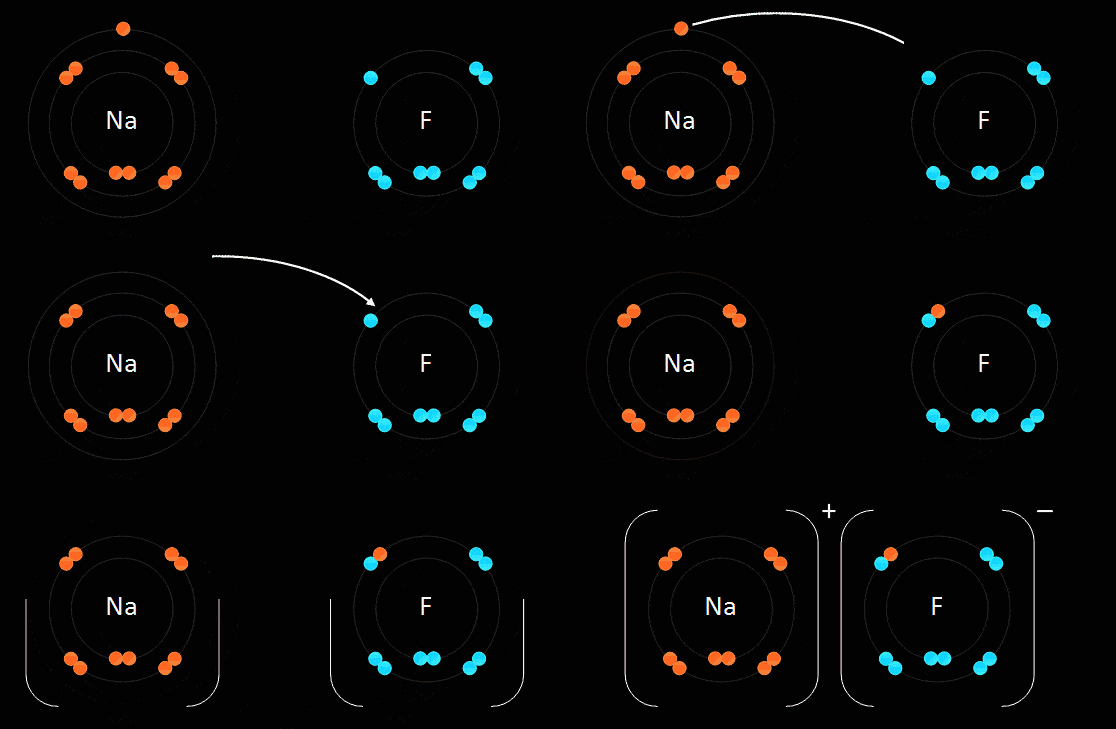
Why type of bond is forming between the atoms in the diagram?
a)
Ionic
b)
Covalent
74.
If X is the symbol for an element, which of the following two symbols represent    isotopes of the same element?     I. 7735X  II. 7733X  III. 8137X  IV. 8135 X
a)
I and II
b)
III and IV
c)
I and IV
d)
I and III
75.
What is the formula for copper(I) sulfate?
a)
Cu(SO3)
b)
Cu(SO4)
c)
Cu2(SO3)
d)
Cu2(SO4)
76.
What is the formula for magnesium phosphide?
a)
Mg3P2
b)
Mg2P3
c)
Mg2(PO3)
d)
Mg3(PO3)2
77.
Which of these combinations is an ionic compound made of?
a)
Metal and Metal
b)
Nonmetal and Nonmetal
c)
Metal and Nonmetal
d)
Cation and Cation
78.
Name the following ionic compound: NaF
a)
nitrogen fluorine
b)
sodium fluoride
c)
nitrogen fluoride
d)
sodium fluorine
79.
Phosphorous trichloride
a)
PCl3
b)
P3Cl
c)
P3Cl3
d)
PCl
80.
P2O5
a)
Phosphorus Oxide
b)
Pentaphosphorus Dioxide
c)
Diphosphorous pentoxide
d)
Phosphoric Oxygen
81.
What is the name of the compound Li(OH)?
a)
lithium hydrogen oxide
b)
lithium hydroxide
c)
lithium hydride
d)
lithium oxide hydride
82.
The chemical formula for an ionic compound of potassium and oxygen is
a)
KO.
b)
K2O.
c)
K2O2.
d)
KO2.
83.
Fe(CO3)2
a)
Iron (IV) Carbonate
b)
Iron (II) Carbonate
c)
Iron Carbonate
d)
Iron (III) Carbonate
84.
What atom matches this electron configuration?
1s22s22p63s23p64s23d10
a)
Zinc
b)
Copper
c)
Nickel
d)
Germanium
85.
What atom matches this electron configuration?
1s22s22p63s2
a)
Neon
b)
Magnesium
c)
Aluminum
d)
Potassium
86.
Which electron configuration belongs to Chlorine (Cl)?
a)
1s2s2p3s3p5
b)
1s2s2p3s3p6
c)
1s2s2p3s3p7
87.
Electrons occupy orbitals of lowest energy first is part of what electron configuration rule?
a)
Hund’s Rule
b)
Aufbau Principle
c)
Pauli Exclusion Principle
88.
Electron arrangement that uses arrows
a)
Electron configuration
b)
Shorthand configuration
c)
Lewis dot structure
d)
Orbital diagram
89.
What is the shorthand electron configuration for Sulfur atom?
a)
[Ar] 3p4
b)
[He] 3s23p4
c)
[Ne] 3s23p4
d)
[Na] 3s23p3
90.
Which of the following is a p block element?
a)
Ca
b)
Ar
c)
Re
d)
Au
91.
An orbital can at most hold how many electrons?
a)
1 electron
b)
2 electrons
c)
3 electrons
d)
4 electrons
92.

Which of the following elements has 5 valence electrons?

a)

phosphorus

b)

oxygen

c)

beryllium

d)

rubidium

93.
Rows on the period table are called _____ while columns are called _____.
a)
groups, families
b)
groups, periods
c)
periods, groups
d)
families, groups
94.

How many electrons are in the outer (valence) shell of Sodium?

a)

1

b)

3

c)

6

d)

7

95.

This could be the dot diagram of what element?

a)

Mg

b)

Cl

c)

C

d)

O

96.

This could be the dot diagram of what element?

a)

Mg

b)

Cl

c)

C

d)

Al

97.
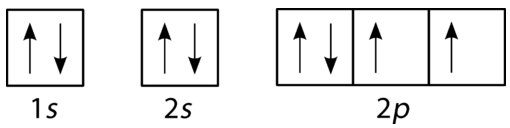
This orbital diagram represents:  
a)
C
b)
B
c)
N
d)
O
98.
This orbital diagram represents:  
a)
C
b)
B
c)
N
d)
O
99.
How many electrons can the d sublevel hold?
a)
14
b)
10
c)
2
d)
6
100.
Which type of bonding is found in sodium chloride?
a)
Ionic
b)
Covalent
c)
Metallic
101.
A metal in Group 2 will form an ion with what charge?
a)
2-
b)
2+
c)
1-
d)
1+
102.

What is the correct Lewis Dot Structure for ammonia NH3

a)
b)
c)
d)
103.

Which is the correct molecular structure for carbon dioxide?

a)
b)
c)
d)
104.

CO2 has how many lone pairs?

a)

0

b)

1

c)

2

d)

3

e)

4

105.

CCl4 has how many double bonds?

a)

0

b)

1

c)

2

d)

3

106.
What is the the shape of this molecule according to VSPER theory?
a)
Linear
b)
Tetrahedral
c)
Trigonal Planar
d)
Trigonal pyramidal
107.

Draw the Lewis Dot structure for ICl2- and determine its predicted molecular geometry.

a)

see-saw

b)

trigonal bipyramidal

c)

linear

d)

bent

108.

The lowest-energy arrangement of electrons in a subshell is obtained by putting electrons into separate orbitals of the subshell before pairing electrons.

a)

Hund's Rule

b)

Aufbau Principal

c)

Electron Placement Rule

d)

Pauli Exclusion Principle

109.

An atomic orbital can hold no more than two electrons.

a)

Hund's Rule

b)

Aufbau Principal

c)

Electron Placement Rule

d)

Pauli Exclusion Principle

110.

What is the molecular geometry of H2O?

a)

Bent

b)

Linear

c)

Trigonal Planar

d)

Trigonal Bipyrimidal

111.

Which of the following correctly pairs a chemical name with its chemical formula?

a)

Lithium sulfate - Li2SO3

b)

Iron bromide, FeBr3

c)

Sodium nitrate, Na3N

d)

Sodium sulfite, Na2SO3

112.
A substance which has a high melting point, conducts electricity when dissolved in water, and has a crystalline structure probably has what type of bond?
a)
Ionic
b)
Metallic
c)
Covalent
d)
Crystalline
113.

What type of chemical bond is being shown in the F2 molecule?

a)

single covalent bond

b)

double covalent bond

c)

triple covalent bond

d)

quadruple covalent bond

114.
If an aluminum atom has 13 protons (+) and 10 electrons (-), what is it's charge?
a)
Al3+
b)
Al13+
c)
Al10+
d)
Al10-
115.
Ionic or covalent?
NaBr
a)
Ionic
b)
Covalent
116.
What molecular shape is the structure shown here? (BCl3)
a)
linear
b)
trigonal planar
c)
tetrahedral
d)
trigonal pyramidal
117.

Choose which of the following compounds contain IONIC Bonds (you may choose more than one answer)

a)

H2O

b)

SO2

c)

AlCl3

d)

H2

e)

MgI2

118.

Choose which of the following compounds contain COVALENT Bonds (you may choose more than one answer).

a)

NH3

b)

NaCl

c)

CaF2

d)

CH4

e)

N2

119.
According to the octet rule most elements need _______ valence electrons.
a)
2
b)
8
c)
6
d)
18
120.
How many d orbitals are there in a given sublevel?
a)
1
b)
3
c)
5
d)
7
121.
What Periodic Table family is represented by the Lewis dot diagram?
a)
Halogens
b)
Alkali Metals
c)
Transition Metals
d)
Noble Gases
122.
What group on the Periodic Table contains the elements of the alkaline earth family?
a)
1
b)
2
c)
17
d)
18
123.
Which of the following is the most reactive group of non-metals? 
a)
Alkali
b)
Alkali Earth
c)
Halogen
d)
Noble Gas
124.
How many valence electrons does an alkaline earth metal have? 
a)
1
b)
2
c)
7
d)
8
125.
How many valence electrons does a halogen have? 
a)
1
b)
2
c)
7
d)
8
126.
Which of the following in not a diatomic element?
a)
hydrogen
b)
carbon
c)
nitrogen
d)
oxygen
127.

The is family has properties of both metals and nonmetals.

a)

Alkali

b)

Halogens

c)

Nonmetals

d)

Metalloids

128.

Of the following elements, which is most likely to form a negative ion with a charge of 1-?

a)

Ba

b)

Ca

c)

Si

d)

P

e)

Cl

129.
Which of the elements listed have the largest ionization energy and highest electronegativity?
a)
F
b)
Cl
c)
Br
d)
I
130.
Which of the following will have a larger radius than Zinc?
a)
Gallium
b)
Aluminum
c)
Magnesium
d)
Strontium
131.
Which of the following will have a higher electronegativity than arsenic (As)?
a)
Carbon (C)
b)
Neon (Ne)
c)
Antimony (Sb)
d)
Germanium (Ge)
132.
As atoms of elements in group 16 are considered in order from top to bottom, the electronegativity of each successive element....
a)
decreases
b)
increases
c)
remains the same
d)
none of the above
133.
What coefficient should be used to make the following equation balanced?
N2+O2--> _NO 
a)
1
b)
2
c)
3
d)
4
134.

Which coefficient must go in the missing spot to balance the chemical equation?


___Cu + O2 --> 2Cu2O

a)

4

b)

1

c)

5

d)

3

135.

What type of reaction is below?

CH4 + O2 --> CO2 + H2O

a)

Combination/Synthesis

b)

Decomposition

c)

Single Replacement

d)

Double Replacement

e)

Combustion

136.

What type of reaction is below?

Cu2O + K --> K2O + Cu

a)

Combination/Synthesis

b)

Decomposition

c)

Double Replacement

d)

Combustion

e)

Single Replacement

137.

What type of reaction is below?

H2O --> H2 + O2

a)

Combination/Synthesis

b)

Decomposition

c)

Single Replacement

d)

Double Replacement

138.

What type of reaction is below?

Mg(NO3)2 + Na2O --> NaNO3 + MgO

a)

Combination/Synthesis

b)

Single Replacement

c)

Double Replacement

d)

Combustion

139.

Balance the following reaction: ___Na + ___O2 --> ___Na2O

a)

4Na, 2O2, 3Na2O

b)

2Na, 2O2, 3Na2O

c)

4Na, O2, 2Na2O

d)

1Na, O2, 2Na2O

140.

What element is required for a combustion reaction?

a)

nitrogen

b)

hydrogen

c)

silicon

d)

oxygen

e)

carbon

141.
What does the (aq) stand for in NaCl (aq)?
a)
solid
b)
aqueous 
c)
liquid
d)
gas
142.
This helps to speed up a reaction but does not take part in the chemical reaction. 
a)
coeffiecents
b)
reactants
c)
catalyst
d)
combustion
143.

If an equation does not have the correct number of coefficients to be balances it is a

a)

Dot equation

b)

Skeleton equation

c)

Miss matched equation

d)

Structural equation

144.

The symbol (s) in a chemical equation means what?

a)

solid

b)

liquid

c)

gas

d)

catalyst

145.
Pb + FeSO4 ----> PbSO4 + Fe
a)
Synthesis (or combination)
b)
Decomposition
c)
Single displacement
d)
Double displacement
146.
MgCl2 + Li2CO3 ----> MgCO3 + 2 LiCl
a)
Synthesis (or combination)
b)
Decomposition
c)
Single displacement
d)
Double displacement
147.

What are always the product(s) for the complete combustion of a hydrocarbon?

a)

O2

b)

Acids and Bases

c)

H2O and CO2

d)

H2 and C

148.

According to the activity series, which of the following single replacement reactions can occur?

a)

Ca + Al2(SO4)3

b)

Fe + NaOH

c)

Ni + MgSO4

d)

Al + KOH

149.
What is the name for the solid formed during a reaction?
a)
Precipitate
b)
Rocks
c)
Bubbles
d)
Aqueous 
150.

Which of the following is NOT considered to be a driving force (product) behind double replacement reactions?

a)

precipitate

b)

gas

c)

water

d)

liquid