wayground logo

Free Printable Worksheets

Font size

S
M
L
XL
Worksheets

Semester One Vocabulary

Total questions: 100

Worksheet time: 1hrs 16mins

Name
Class
Date
1.
Which is NOT a step in the scientific method?
a)
Make observation
b)
Form a theory
c)
Collect data
d)
Form a hypothesis
2.
A testable explanation to a problem that has not yet been tested. 
a)
data
b)
theory
c)
hypothesis
d)
fact
3.
The summary at the end of an experiment that explains the results. 
a)
conclusion
b)
procedures
c)
materials
d)
responding variable
4.
An experiment is performed on plants to see how different liquids affect plant growth. Each plant in the experiment is given a different liquid; water, apple juice, or milk. Each plant has the same amount of soil, sunlight, and listens to the same music. In this investigation, the independent variable is ...
a)
The type of plant
b)
The amount of sunlight
c)
The type of music
d)
The type of liquid
5.
If you increase the amount of spinach you eat, then you will increase the iron in your blood. 
What's the dependent variable?
a)
increase the amount of iron in your blood
b)
spinach you eat
6.
If I ride my bike to school instead of walking, then I will get to school faster. What is the dependent variable?
a)
True
b)
How fast you get to school
c)
Riding a bike or walking
d)
False
7.
This part of the experiment serves as a basis of comparison; the one variable being tested has been omitted. 
a)
experimental group
b)
control group
c)
data
d)
variables
8.
An experiment is performed on plants to see how different liquids affect plant growth. Each plant in the experiment is given a different liquid; water, apple juice, or milk. Each plant has the same amount of soil, sunlight, and listens to the same music. In this investigation, the independent variable is ...
a)
The type of plant
b)
The amount of sunlight
c)
The type of music
d)
The type of liquid
9.
On what axis should the independent variable always be?
a)
X
b)
Y
10.
Which of these contains steps in the right order?
a)
Ask a question, state your hypothesis, research, experiment, analyze, make a conclusion
b)
State your hypothesis, ask a question, research, experiment, analyze, make a conclusion
c)
Ask a question, research, state your hypothesis, experiment, analyze, make a conclusion
d)
State your hypothesis, ask a question, research, make a conclusion, experiment, analyze
11.

mean

a)

subtract the highest number from the lowest

b)

add up all the numbers and divide by the number of numbers

c)

Ms.Syroid

d)

the cafeteria lady

12.

Procedure

a)

an educated guess

b)

add all numbers and divide by the number of numbers

c)

a series of steps that can be replicated

d)

using 5 senses to interpret an object

13.

analyze

a)

look at in detail

b)

a series of steps

c)

subtract the lowest number from the highest

d)

experiment where knowledge is learned

14.

range

a)

add all the numbers and divide by the number of numbers

b)

a large prairie

c)

a stove

d)

subtract the lowest data point from the highest data point

15.
Which major macromolecule is being represented in this image? 
a)
carbohydrate
b)
lipid
c)
protein
d)
nucleic acid
16.
Which of the following contains the genetic code for protein synthesis?
a)
carbohydrate
b)
lipid
c)
protein
d)
nucleic acid
17.
What type of macromolecule is being represented in this image? 
a)
carbohydrate
b)
lipid
c)
protein
d)
nucleic acid
18.
Which of the following decreases the activation energy necessary to initiate the chemical change within the body?
a)
nucleotides
b)
enzymes
c)
amino acids
d)
fatty acids
19.
What are the building blocks of proteins?
a)
amino acid
b)
fatty acid
c)
nucleotide
d)
lipid
20.
What are the single sugars that are the building blocks of carbohydrates?
a)
monosaccharides
b)
disaccharides
c)
polysaccharides
d)
amino acid
21.
DNA and RNA are examples of 
a)
Carbohydrates
b)
Lipids
c)
Proteins
d)
Nucleic Acids
22.
Nucleotides are monomers of
a)
Carbohydrates
b)
Lipids
c)
Proteins
d)
Nucleic Acids
23.
Waxes, oils and fats are examples of
a)
Carbohydrates
b)
Lipids
c)
Proteins
d)
Nucleic Acids
24.
What is the function of nucleic acids?
a)
store genetic information
b)
store energy (long-term)
c)
store energy (short-term)
d)
build skin, hair, nails, muscles
25.
Which of the following organic compounds is the main source of energy for living things?
a)
carbohydrates
b)
lipids
c)
nucleic acids
d)
proteins
26.
All polymers are made up of...
a)
monosaccharides
b)
monomers
c)
proteins
d)
None of these
27.
All organic compounds contain the element
a)
carbon
b)
nitrogen
c)
phosphorus
d)
sulfur
28.

Enzymes belong to which class of macromolecules?

a)

lipids

b)

carbohydrates

c)

proteins

d)

nucleic acids

29.
Glycerol and fatty acids combine to form...?
a)
Carbohydrates
b)
Lipids
c)
Proteins
d)
Nucleic Acids
30.
Carbon, Hydrogen, Oxygen and Nitrogen are elements in what biomolecule?
a)
Carbohydrate
b)
Lipid
c)
Protein
d)
Nucleic acid
31.
I am responsible for long term energy storage in mammals.
a)
Protein
b)
Lipid
c)
Carbohydrate
d)
Nucleic Acid
32.
Which is NOT a monomer?
a)
sucrose
b)
glucose
c)
amino acid
d)
fatty acid
33.
This is the area on an enzyme that the substrate attaches.
a)
active site
b)
product
c)
catalytic region
d)
reactant site
34.
Which factor denatures a enzyme?
a)
Excessive heat
b)
Nothing can
c)
Exposure to light
d)
Exposure to bacteria
35.
Which line represents an enzyme-catalyzed reaction? 
a)
Line 1
b)
Line 2
36.
In a chemical reaction, a reactant binds to an enzyme at a region known as the
a)
catalyst.
b)
product.
c)
substrate.
d)
active site. 
37.
Which of the following are NOT found in animal cells
a)
chloroplasts and cytoplasm
b)
chloroplasts and cell wall
c)
cell wall and cell membrane
d)
mitochondria and nucleus
38.

Which of the following converts food into energy for the cell?

a)

vacuole

b)

mitochondria

c)

cytoplasm

d)

cell membrane

39.
What do vacuoles do? 
a)
They actually do not have an important role
b)
They protect the cell
c)
They are the brain of the cell
d)
storage area for cells; water storage in plants 
40.
Which piece of equipment is the best to use to observe the structure of a cell?
a)
magnifying glass
b)
binoculars
c)
telescope
d)
microscope
41.
A rigid layer that lies outside the cell's  membrane is...
a)
Cytoplasm
b)
Cell membrane
c)
Cell Wall
d)
Flagella
42.
What is the jelly-like substance inside of cells called?

a)
chloroplast
b)
photosynthesis
c)
cell membrane
d)
cytoplasm
43.
Which structures are found in every living cell?
a)
cell membrane and cytoplasm
b)
chloroplasts and mitochondria
c)
a cell wall and nucleus
d)
chloroplasts and cell wall
44.
In what part of the plant cell does the process of photosynthesis take place?
a)
nucleus
b)
mitochondria
c)
chloroplasts
d)
vacuoles
45.
Cells with a nucleus and membrane-bound organelles are called ____________________.
a)
prokaryotes
b)
eukaryotes
c)
bacteria
d)
protists
46.
_ are organelles responsible for digesting certain materials within the cell.
a)
vacuoles
b)
chloroplasts
c)
lysosomes
d)
cell membrane
47.
Which of the following is not part of the cell theory?
a)
cells must contain DNA 
b)
all living things are made from cells
c)
cells can only come from other cells
d)
cells are the basic unit of life
48.
He discovered that all plants are made of cells:
a)
Anton van Leeuwenhoek
b)
Theordor Schwann
c)
Robert Hooke
d)
Mattias Schleiden
49.
Who was the first  person to see cells under the microscope and give them their name?
a)
Mattias Schleiden
b)
Robert Hooke
c)
Theordor Schwann
d)
Anton van Leeuwenhoek
50.
How does carbon dioxide get into the leaves of a plant?
a)
It's absorbed by the roots
b)
It's made in a chemical reaction in the stem
c)
It enters through the stomata
d)
It goes through the flowers
51.
What are the products of photosynthesis (what is made)?
a)
Glucose and Chlorophyll
b)
Glucose and Oxygen
c)
Water and Light
d)
Carbon dioxide and Water
52.
Which of these conditions would decrease the rate of photosynthesis in a plant?
a)
Above average precipitation
b)
Changing the daylight hours from 14 hrs to 10 hrs
c)
Changing the CO2 concentration from 380 ppm to 410 ppm
d)
All of these choices
53.

Select all that are raw materials for Photosynthesis.

a)

Water

b)

Carbon Dioxide

c)

Oxygen

d)

Sunlight (Light Energy)

e)

Glucose (Sugar/food)

54.

What is the green pigment that "traps" sunlight?

a)

Chlorophyll

b)

Chloroplasts

c)

Photosynthesis

d)

ATP

55.

Is Glucose (C6H12O6) a Raw Material (Ingredient) or Product of Photosynthesis?

a)

Product

b)

Raw Material

c)

Niether

d)

What's Photosynthesis?

56.

Is Oxygen a Raw Material (Ingredient) or Product of Photosynthesis?

a)

Product

b)

Raw Material

c)

Niether

d)

What's Photosynthesis?

57.

What are the reactants for Cell Respiration?

a)

CO2 + H20

b)

C6H12O6 + CO2

c)

C6H12O6 + O2

d)

CO2 + H20 + 38 ATP

58.

What are the products for Cell Respiration?

a)

CO2 + H20

b)

C6H12O6 + CO2

c)

C6H12O6 + O2

d)

CO2 + H20 + 38 ATP

59.
What is the first step of Cell Respiration?
a)
Glycolysis
b)
Krebs Cycle
c)
Calvin Cycle
d)
Electron Transport Chain
60.
What is the second step of Cell Respiration?
a)
Glycolysis
b)
Krebs Cycle
c)
Calvin Cycle
d)
Electron Transport Chain
61.
What is the third step of Cell Respiration?
a)
Glycolysis
b)
Krebs Cycle
c)
Calvin Cycle
d)
Electron Transport Chain
62.
In what organelle does cell respiration take place?
a)
Mitochondria
b)
Chloroplast
c)
Golgi Apparatus
d)
Nucleus
63.
______________ produces the most ATP.
a)
photosnthesis
b)
aerobic respiration
c)
anaerobic respiration
d)
glycolysis
64.
How many ATP are produced in Alcoholic respiration?
a)
2
b)
33
c)
4
d)
36
65.

How many ATP are produced in aerobic respiration?

a)

2

b)

33

c)

4

d)

38

66.
What is the function of ATP in living things?
a)
provides energy for cells
b)
stores genetic information
c)
provides structure in the nucleus
67.
Where does glycolysis occur?
a)
mitochondrial matrix
b)
cytoplasm
c)
inner membrane of mitochondria
d)
outer membrane of mitochondria
68.
Which of the following is the correct equation for PHOTOSYNTHESIS?
a)
CO+ light + H2O --> O+ Sugar
b)
CO+ sugar + H2O --> O+ light
c)
O2 + light + H2O --> CO+ Sugar
d)
CO+ O2 + H2O --> Light+ Sugar
69.
Which organelle performs PHOTOSYNTHESIS?
a)
Chloroplast
b)
Mitochondria
70.
Fruit fly body cells have 8 chromosomes. After mitosis, you would expect a resulting fruit fly daughter cell to have ...
a)
16 chromosomes.
b)
46 chromosomes.
c)
8 chromosomes.
d)
4 chromosomes.
71.
Structure B is pointing to the _____. 
a)
chromosome
b)
centromere
c)
DNA
d)
chromatid
72.
Structure C is pointing to one ____. 
a)
sister chromatid
b)
chromosome
c)
centromere
d)
gene
73.
What is the name of the structure labeled X?
a)
Centriole
b)
Centrosome
c)
Chromatid
d)
Chromosome 
74.
Identify the phase of mitosis.
a)
prophase
b)
metaphase
c)
anaphase
d)
telophase
75.
a)
Prophase
b)
Interphase
c)
Anaphase
d)
Telophase
76.
a)
Anaphase
b)
Cytonkinesis
c)
Interphase
d)
Prophase
77.
a)
Cytokinesis
b)
Anaphase
c)
Telophase
d)
Prophase
78.
DNA is replicated during the ______ phase of the cell cycle.
a)
G1
b)
Synthesis
c)
G2
d)
G0
79.
A process where one cell forms two identical daughter cells is called...
a)
cell cycle
b)
cell division (mitosis)
c)
interphase
d)
cytokinesis
80.

What happens to an enzyme when it denatures?

a)

The activation energy of the reaction is doubled.

b)

The activation energy of the reaction is lowered.

c)

It's optimal conditions for temperature of the enzyme are doubled.

d)

The shape of the enzyme molecule is changed.

81.

Enzymes in your body probably work best at which of the following temperatures>

a)

25oC

b)

98oC

c)

37oC

d)

210oC

82.
What is the purpose  of an enzyme?
a)
give permission for the reaction
b)
raise activation energy
c)
speed up reactions
d)
control how many reactions occur
83.
With what 3 letters do enzymes typically end?
a)
-ose
b)
-ase
c)
-ese
d)
-tic
84.
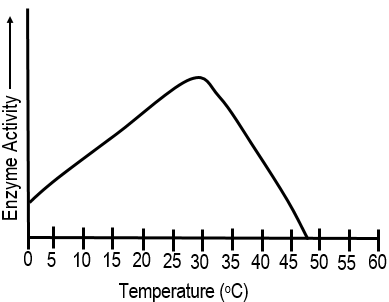
Based on the graph, what is the optimal temperature for this enzyme? 
a)
15oC
b)
40oC
c)
30oC
d)
35oC
85.
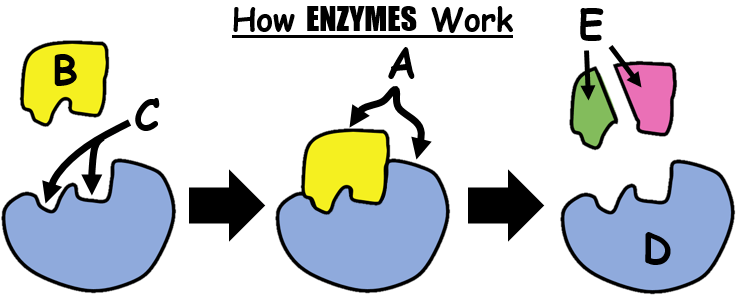
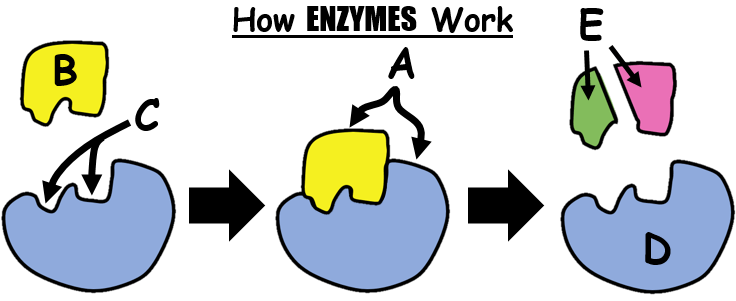
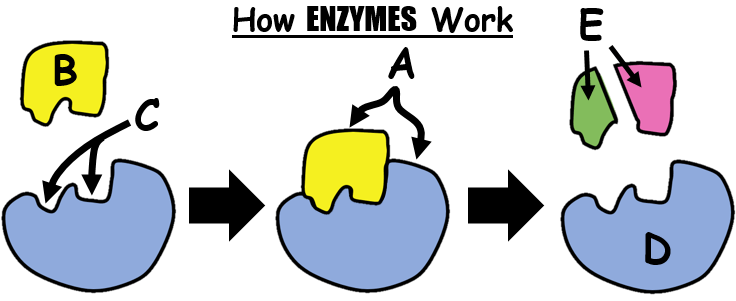
Letter D...
a)
active site
b)
enzyme
c)
substrate
d)
products
86.
Letter B...
a)
active site
b)
enzyme
c)
substrate
d)
products
87.
Letter C...
a)
active site
b)
enzymes
c)
substrate
d)
products
88.
When a piece of liver is dropped into hydrogen peroxide, the peroxide bubbles vigorously as the hydrogen peroxide (H2O2) decomposes into water (H2O) and oxygen (O2). This rapid change in reaction rate suggests 
a)
that liver contains lots of germs
b)
 the liver contains an enzyme that breaks down hydrogen peroxide
c)
 that liver is a substrate for hydrogen peroxide
d)
that hydrogen peroxide is a powerful enzyme
89.

Which 2 factors can affect the rate of enzyme activity?

a)

Light intensity

b)

Temperature

c)

pH

d)

Oxygen concentration

90.
The graph shows how enzymes affect reactions in cells. Which statement best summarizes the information shown in the graph?
a)
Enzymes increase the energy of the reactants.
b)
Enzymes decrease the energy level of the products.
c)
Enzyme decrease the activation energy of the reaction.
d)
Enzymes reverse the direction of the reaction.
91.
What is another term for "selectively permeable"?
a)
porous
b)
completely permeable
c)
permanent
d)
semipermeable
92.
What forms the channels and pumps in the phospholipid bilayer?
a)
carbohydrates
b)
proteins
c)
hydrophilic heads 
d)
lipids
93.
What does "bilayer" mean?
a)
one layer
b)
two layers
c)
laminated
d)
bilateral
94.
The _____ in the plasma membrane prevents the fatty acids tails from sticking together. 
a)
carbohydrate chains
b)
cholesterol
c)
proteins
d)
lipids
95.
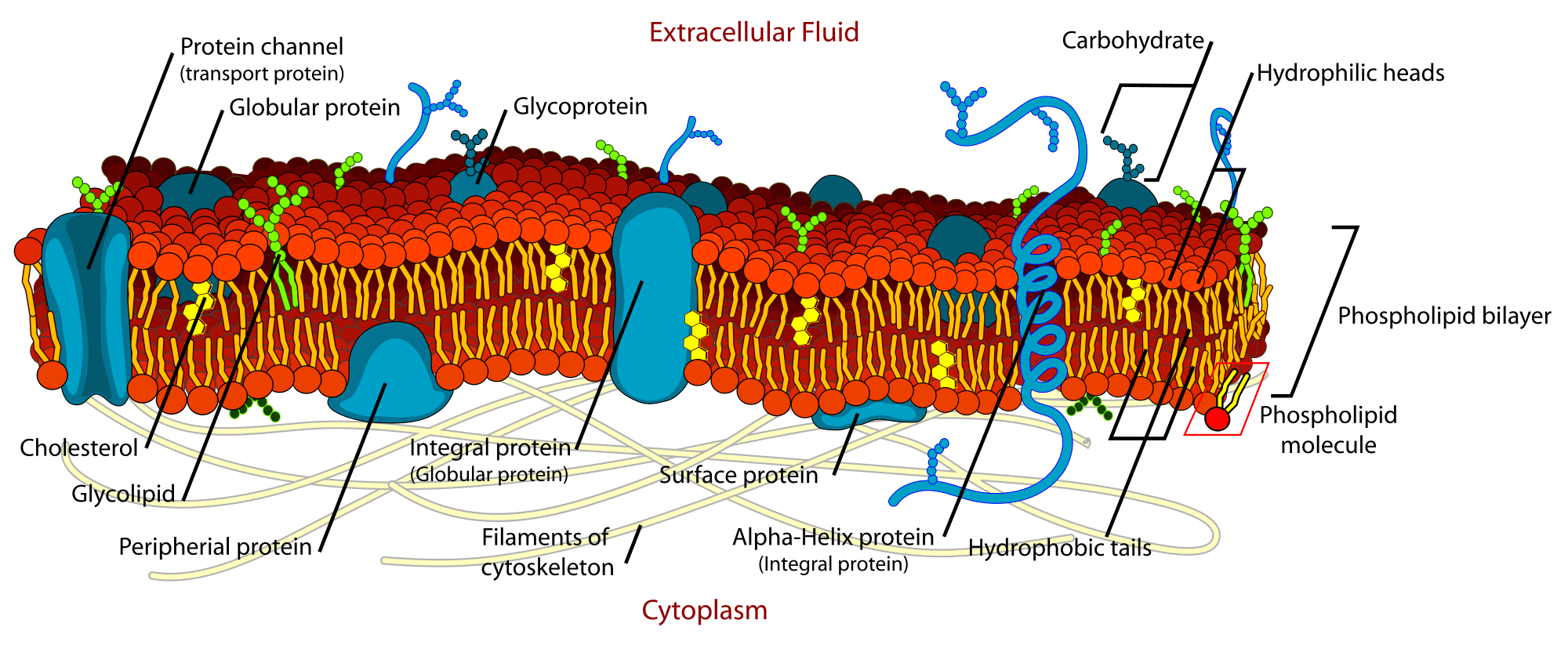
What is this image?
a)
cell membrane
b)
proteins
c)
carbohydrates
d)
lipids
96.
The function of the plasma membrane is....
a)
to regulate what enters and leaves the cell.
b)
fight bacteria and viruses that enter the cell.
c)
provide rigid support and protection to the cell.
d)
make sure each cell can move
97.

Diffusion & Facilitated Diffusion are both __________ transport.

a)

Passive

b)

Active

c)

Easy

d)

Free

98.
Osmosis is the movement of _____ across a membrane.
a)
food
b)
energy
c)
oxygen
d)
water
99.

What is DIFFUSION?

a)
b)
c)
d)
100.

When the concentration of two solutions is the same

a)

Hypertonic

b)

Isotonic

c)

Hypertonic

d)

Osmotic pressure