
Font size
 Worksheets
Reach for the Stars SciOly 2024
Total questions: 115
Worksheet time: 2hrs 21mins

Identify.
Lyra
Orion
Crux
Cygnus
What is the brightest star in Cygnus?
Algol
Deneb
Arcturus
Capella
Stars (Mainly) consist of _________ & ______________.
Hydrogen
Copper
Helium
Nickel
Rock
The electromagnetic waves with the longest wavelengths and lowest frequencies are called
Microwaves
Infrared
Radio Waves
Visible Light
The electromagnetic waves with the higher frequencies than radio waves but lower than infrared are called
Microwaves
Infrared
Radio Waves
Visible Light
Electromagnetic waves of frequencies lower than gamma rays, but higher than ultraviolet
Ultraviolet
X-Ray
Radio Waves
Visible Light
Electromagnetic waves with the shortest wavelengths and highest frequencies
Ultraviolet
X-Ray
Gamma Rays
Visible Light
What is the entire range of electromagnetic waves called?
Emission Spectrum
Absorption Spectrum
Continuous Spectrum
Electromagnetic Spectrum
Which is the correct order for spectral classes?
O, B, A, F, G, K, M
M, K, G, F, A, B, O
A, B, F, O, M, K, G
B, F, O, G, K, A, M
The temperature of the star is measured in what?
Fahrenheit
Celcius
Kelvin
Kilometers
Newtons
What is the correct formula to calculate the luminosity of a star?
L=4πR2 σT
L=4πR2 σT4
L=4πR σT4
L=4πR2 σT6
"The rule states that the power intensity per unit area from a point source, if the rays strike the surface at a right angle, varies inversely according to the square of the distance from the source". This statement is the definition for which law?
Wein's Law
Stefan-Boltzmann Law
Inverse Square Law
None of the above
The formula that relates the temperature of a blackbody to the wavelength at which it emits the greatest intensity of radiation is called?
Wein's Law
Stefan-Boltzmann Law
Inverse Square Law
None of the above
A discrete unit (or “packet”) of electromagnetic energy is called a?
Proton
Electron
Photon
Magnetron
Which best describes the Sun?
small, blue star
large, red star
medium, yellow star
large, yellow star
Brightness of a star as seen from Earth.
paraliax
apparent magnitude
absolute magnitude
spectrum

Most stars are identified as ___________ on an H-R Diagram?
Supergiants
Giants
Main Sequence
White Dwarf

What determines if a star becomes a giant or a supergiant?
star mass
star temperature
star color
star luminosity


Which spectral class does our Sun belong to?
M
K
G
F
Which is an example of a Red Supergiant star?
Betelgeuse
Castor
Sirius B
Polaris

main sequence>
red giant >
white dwarf>black dwarfs
main sequence>
white dwarf>
red giant
protostar>
white dwarf>
red giant
red giant >
main sequence>
white dwarf

Which star is considered a giant star?
Mira
Zeta Arindani
Barnard's Star
Betelgeuse

Which star is considered a supergiant?
Sirius B
Sun
Betelgeuse
Van Maanan's Star

Which star is considered a dwarf star?
Altair
Procyon B
Deneb
Sirius

Identify
(a)
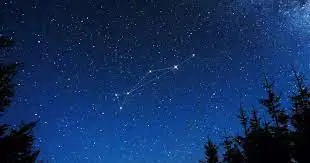
Identify
(a)
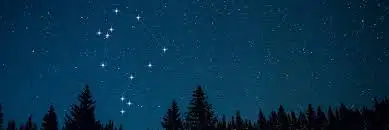
Identify
(a)
Stars are 96% - 99% ____ and ___.
gas, dust
helium, hydrogen
hydrogen, helium
hydrogen, carbon
When the sun becomes a ____ it will start fusing helium into carbon.
white dwarf
red dwarf
supergiant
red giant
Sun-like stars shed their outer layers as they age, forming:
planetary nebulae
pulsars
red dwarfs
red giants
The core left after a sun-like star sheds its outer layers is no longer fusing anything. It is a _____.
pulsar
red giant
white dwarf
supernova
When does a supernova occur?
In the initial flash when a star starts burning Hydrogen
When the pressure of the core overcomes the gravitational pressures generated by the density of the star and the heat of the core creates a black hole.
At the end of main sequence prior to becoming a red giant.
When the pressure of the core overcomes the gravitational pressures generated by the density of the star and the heat of the core pushes the stars energy out into space in a fantastic explosion.
The life of a star starts
as a white dwarf.
with a Big Bang.
in a stellar nebula.
from ionized carbon.
What is a Red Giant?
A massive star that is much cooler in temperature than main sequence stars
A massive star that is much hotter in temperature than main sequence stars
A newly formed star consisting of heavier elements.
A star that has just entered the main sequence of it's life.
What is hydro-static equilibrium?
It is the pressure that causes a protostar to form.
It is the pressure that the stars magnetic fields exert upon it.
It is the balance that is created between gravity and the core pressure than enables the star to blast into a supernova
It is the balance that is created between gravity and the core pressure than enables the star to stay formed.
What are the two most important properties that we measure in a star?
Color and galactic placement
Location to other stars and Brightness
Color and Brightness
Brightness and density
Our sun is
a protostar.
a yellow dwarf.
a main sequence star.
a white dwarf.
The color of a star reveals to us it's
temperature
size
A star that emits light in the blue spectrum indicates the star is
relatively hot in comparison to other stars.
relatively cool in comparison to other stars.
not relevant in measuring the temperature of a star.
All of the above
Red light emitted from a star signifies that the star is
relatively hot in comparison to other stars.
relatively cool in comparison to other stars.
very dense.
all of the above.
How old is our own sun?
100,000,000 yrs.
5 billion yrs.
100 billion yrs.
10 billion yrs.
What is a variable star?
A star whose luminosity remains constant.
A star whose color remains constant.
A star whose luminosity changes over time.
A star whose luminosity stays fairly dim through the stages of it's life.
What is a Cepheid star?
A star that pulsates at an unpredictable rate at which we can measure.
A star that pulsates at a predictable rate at which we can not measure.
A star that pulsates at a predictable rate allowing us to measure it's mass.
A star that pulsates at a predictable rate at which we can measure.
How do we estimate the mass of stars?
By measuring its diameter
By measuring the temperature and luminosity.
By predicting conditions in the core of the star
By determining the stage of life the star is in.
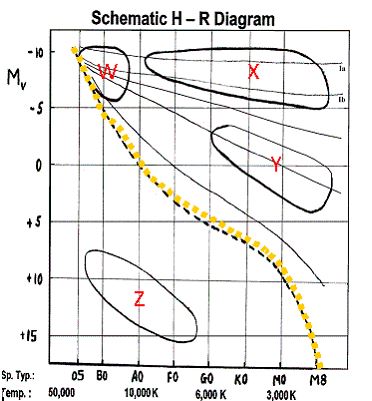


The H-R diagram shows which two things on its axis? Choose two.
Luminosity
Size
Temperature
Mass
Hydrostatic equilibrium is established when the inward gravitational force is balanced by the outward ___________ from nuclear fusion.
pressure
temperature
electrostatics
kinetic energy
density
A star that has 10 times the mass of the Sun will most closely live
more than 10 times longer than the Sun
about 10 times longer than the Sun
about the same amount of time as the Sun
1/10th as long as the Sun
Less than 1/10th as long as the Sun
"The total energy radiated from a blackbody is proportional to the fourth power of its temperature" Which law is stated by this statement?
Wein's law
Stefan-Boltzmann Law
All of the above
None of the above

Identify
(a)

Identify
(a)

Identify
(a)

Identify
(a)
Identify
(a)
Identify
(a)
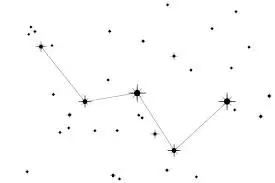
Identify
(a)
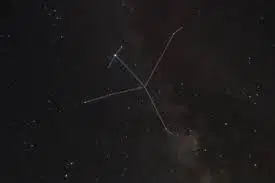
Identify
(a)
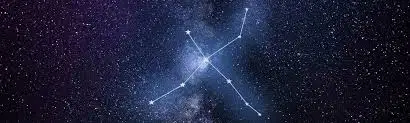
Identify
(a)
Identify
(a)

Identify.
Aquila
Cygnus
Crux
Dorado
What is the brightest star in Aquila?
Spica
Vega
Altair
Sirius
What is the brightest star in Canis Major?
Sirius
Mizar
Polaris
Algol
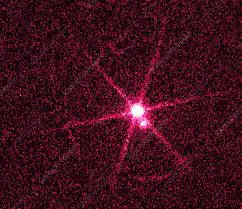
Identify
(a)
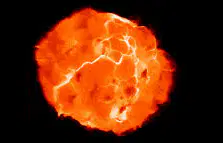
Identify
(a)

Identify
(a)
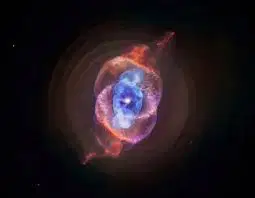
Identify
(a)
Identify
(a)

Identify
(a)
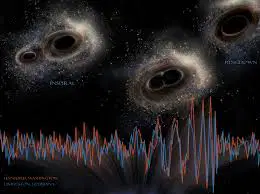
Identify
(a)
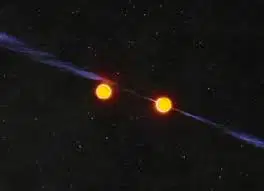
Identify
(a)
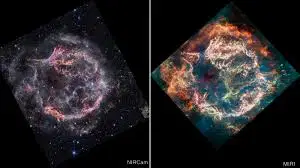
Identify
(a)
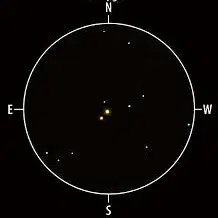
Identify
(a)
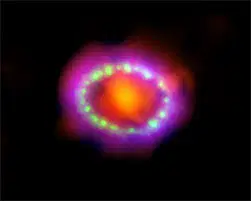
Identify
(a)
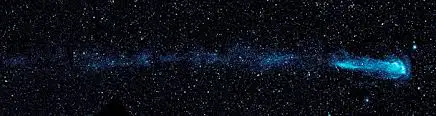
Identify
(a)

Term for "new star" that occurs in mass-transfer binary and/or white dwarf companion stars.
supernova
stella nova
pulsar
neutron star

As material is added to the accretion disk, _____ may reach a temporary fusion point.
pressures
electron degeneracy
temperatures
matter

A supernova occurs when a _____ star runs out of fuel (or overloads) and explodes.
sun-like
single
massive
double

A ____ star with a mass of 1.4 suns may go supernova (I) if too much material accretes.
white dwarf
red dwarf
red giant
neutron

Type II supernovae occur when a star with at least ____ times the mass of our sun explodes.
1.4
1.5
3
8

Type II supernovae explosions may leave behind a
neutron star
black hole
pulsar
white dwarf

Neutron stars are formed when gravity squeezes electrons & _____ into neutrons in a supernova.
protons
isotopes
quarks
matter

Neutron stars are between 1.4 - 3.2 solar masses and are compacted into an area
the size of Earth.
about the size of a large country.
the size of the Sun.
about the size of a city.

One teaspoon of neutron star material can weigh more than
Mt. Everest.
a planet.
a star.
a black hole

_____ are rapidly spinning neutron stars that are known as "lighthouses" in space.
Quasars
White dwarfs
Pulsars
Black holes

Millisecond pulsars spin many times per second and have
slowed down a lot over the years.
very strong magnetic fields.
sped up over the years.
very weak magnetic fields.

A black hole will form if the original star has at least _____ solar masses before collapse.
four
six
eight
ten

The "cutoff mass" between a neutron star and a black hole is about ____ solar masses.
1.4
3.2
4.4
6.0

The area or boundary in which nothing can return from a black hole is called
the singularity.
Interstellar.
the path of no return.
the event horizon.

The ____ radius describes the size of the event horizon (which is black hole mass dependent).
Hawking
inner
outer
Schwarzschild

There may be ____ of black holes in our galaxy alone - with Cygnus X-1 being the closest.
billions
millions
hundreds
thousands
Represented by the letter c, this is the speed limit of the universe, written out as a number.
6.67x10⁻¹¹ m3/kgs2
3x10⁸ m/s
1240 eVnm
3.14159...
The distance between the center of a black hole and its event horizon is called the...
Schwarzschild radius.
Newton circumference.
Einstein tangent.
Dirac bisector.
What is the escape velocity at the event horizon of a black hole?
the speed of light
7 miles per second
343 m/s
it depends on the mass of the black hole
What is synthesized in a supernova that cannot be created during the normal life of a star?
Carbon
Helium
Hydrogen
Elements heavier than iron
What phenomenon allows black holes to emit radiation, according to Stephen Hawking?
Quantum tunneling
Quantum fluctuation
Photon emission
Nuclear fusion
What evidence supports the existence of supermassive black holes in galaxies?
Observation of high-energy gamma rays
Measurements of high temperatures in galactic centers
Detection of large star clusters moving rapidly around a central region
Direct imaging of black holes
What is at the center of a quasar?
A neutron star
A large star cluster
A white dwarf
A supermassive black hole
What type of star is our sun classified as?
Red giant
White dwarf
Neutron star
Yellow main-sequence star

