Wayground logo

Free Printable Worksheets

Font size

S
M
L
XL
Worksheets

Biology B Final Review

Total questions: 100

Worksheet time: 5hrs 0mins

Name
Class
Date
1.
Homozygous is when...
a)
the alleles are the same
b)
the alleles are different
c)
the alleles are absent
d)
the alleles are present
2.
Heterozygous is when...
a)
the alleles are the same
b)
the alleles are different
c)
the alleles are absent
d)
the alleles are present
3.
In a heterozygous genotype, the ___________ allele takes over in the phenotype.
a)
recessive
b)
dominant
c)
lower case letter
d)
both 
4.
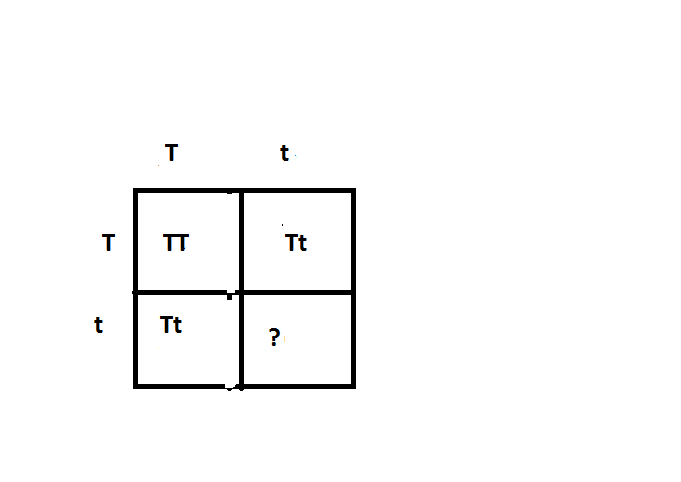
T - tall and t = short
In the punnett square below, what belongs in the missing square
a)
tt
b)
Tt
c)
Bb
d)
TT
5.
B = brown fur  b = white fur
In the punnett square, what is the probability for white fur? 
a)
0%
b)
25%
c)
50%
d)
75%
6.
In the punnett square shown, what must the genotype of the missing parent be?
a)
BB
b)
Bb
c)
bb
d)
Tt
7.
In the punnett square shown, what is the genotypes of the two parents?
a)
RW and RR
b)
RW and WW
c)
RR and WW
d)
RW and RR
8.
Which of the following is a phenotype?
a)
Aa
b)
black hair
c)
heterozygous genes
d)
mutated DNA
9.
Dominant or recessive?
tt
a)
Dominant 
b)
Recessive
10.
What is a dominant allele?
a)
A trait that is always shown (capital letter)
b)
A trait that can be hidden (lower case letter)
c)
Alleles that are the same
d)
Alleles that are different
11.
This image shows a...
a)
Punnett Square
b)
Phenotype
c)
Genotype
d)
Dominant allele
12.
What genotype is missing from this Punnett Square?
a)
RrYy
b)
RRYY
c)
rryy
d)
RrYY
13.
Cross Two Homozygous plants
(
RRYY x rryy)
R = round seeds, r  = wrinkled seeds Y = yellow seeds, y = green seeds
What percent will have Round and Yellow seeds? 
a)
0%
b)
25%
c)
50%
d)
100%
14.
What does heterozygous mean?
a)
An organism that has the same genes for a trait (TT or tt)
b)
An organism that has different genes for a trait (Tt)
c)
When neither gene is fully dominant; offspring is a mixture of both
d)
the different forms of a trait (hair color--> brown, blonde, red
15.
Which of the following genotypes is heterozygous?
a)
Bb
b)
BB
c)
bb
d)
B
16.
Dominant alleles are represented by a:
a)
Male gene
b)
lowercase letter
c)
recessive trait
d)
capital letter
17.
Aa, DD, bB, yy are all examples of
a)
genotypes
b)
phenotypes
18.
In a heterozygous genotype, the ___________ allele takes over in the phenotype.
a)
recessive
b)
dominant
c)
lower case letter
d)
both 
19.
What you see, or the physical appearance.
a)
Genotype
b)
Phenotype
c)
Homozygous
d)
Heterozygous
20.

T - tall and t = short

In the punnett square below, what belongs in the missing square

a)

tt

b)

Tt

c)

Bb

d)

TT

21.

The genotype Aa is called . . .

a)

Homozygous recessive

b)

Hybrid

c)

Purebred

d)

Homozygous dominant

22.

Which of the following would be a phenotype?

a)

Aa

b)

red hair

c)

heterozygous

d)

DNA

23.

Which of the following genotypes is Purebred? Select 2 answers.

a)

aA

b)

Aa

c)

AA

d)

aa

24.
Which of the following genotypes is heterozygous?
a)
Bb
b)
BB
c)
bb
d)
B
25.

Which of the following genotypes is homozygous dominant?

a)

Yy

b)

yY

c)

yy

d)

YY

26.

Which of the following genotypes is homozygous recessive?

a)

Tt

b)

tt

c)

TT

d)

tT

27.

Which of these characteristics would not be passed on to its offspring?

a)

fur color

b)

length of tail

c)

scars on leg

d)

body size

28.

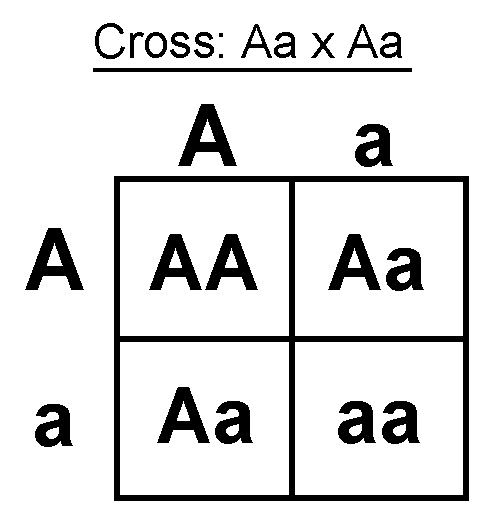
What is the genotypic ratio of the offspring?

a)

3:1

b)

1:3

c)

1:2:1

d)

2:2

29.

How many alleles (letters) does a child get from EACH parent for each trait?

a)

1

b)

2

c)

3

d)

4

30.

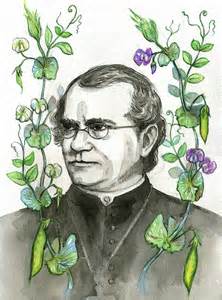
Who is considered the "father of genetics"?

a)

Reginald Punnett

b)

Gregor Mendel

c)

James Watson

d)

Charles Darwin

31.

What are the phenotype percentages of the offspring?

(A-Brown fur color; a-white fur color)

a)

50 % Brown fur and 50% White fur

b)

25 % Brown fur and 75% White fur

c)

75 % Brown fur and 25% White fur

d)

0% Brown fur and 100% White fur

32.
T - tall and t = short
In the punnett square below, what belongs in the missing square
a)
tt
b)
Tt
c)
Bb
d)
TT
33.
What you see, or the physical appearance.
a)
Genotype
b)
Phenotype
c)
Homozygous
d)
Heterozygous
34.
What is the probability of heterozygous offspring?
a)
25%
b)
50%
c)
0%
d)
100%
35.
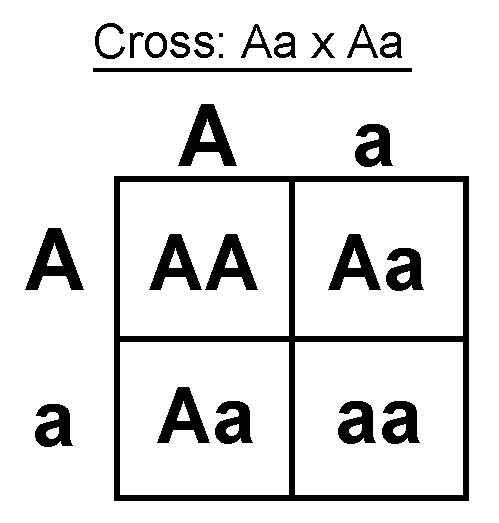
What allele combination should go in the missing box?
a)
AA
b)
Aa
c)
aa
d)
none of these
36.
Each one of the boxes on the Punnett Square represents what probability of an offsprings' genotype?
a)
25%
b)
1%
c)
10%
d)
0%
37.
Which of the following is homozygous recessive?
a)
Tt
b)
tt
c)
TT
d)
T
38.
G = green, g = yellow
The genotype for a yellow plant is...
a)
GG
b)
Gg
c)
gg
d)
all of the choices result in yellow
39.
Two brown eyed parents (Bb) have a baby. What is the chance the baby is blue eyed?
a)
0 %
b)
25%
c)
50%
d)
75%
40.
AA and Aa always show up as
a)
dominant
b)
recessive
41.
What is the dominant trait?
a)
yellow pea seeds
b)
green pea seeds
c)
there is no dominant seed
d)
Jolly green giant
42.

What gas do plants need to make their own food through photosynthesis?

a)

oxygen

b)

carbon dioxide

c)

helium

d)

neon

43.
What chemical found in plant cells is able to use the energy in sunlight to make food?
a)
cytoplasm
b)
chlorophyll
c)
lactic acid
d)
sulfuric acid
44.
In what part of a plant does the process of photosynthesis occur?
a)
flower
b)
xylem
c)
leaves
d)
roots
45.
Chlorophyll causes many plants to be what color?
a)
yellow
b)
green
c)
brown
d)
orange
46.
Energy from _____ helps with the process of photosynthesis.
a)
the Sun
b)
water
c)
food
d)
the ground
47.

Plants and animals break down sugar into energy they can use in a process called

a)

photosynthesis

b)

cellular respiration

c)

transpiration

d)

grocery shopping

48.
Which of the following carries materials throughout a vascular plant?
a)
nutrients and water
b)
xylem and phloem
c)
oxygen and carbon dioxide
d)
seeds and spores
49.
The main job of plant roots is _____.
a)
to conduct photosynthesis and to produce sugar
b)
to make seeds and prepare the plant for pollination
c)
to hold the plant in place and absorb water and minerals
d)
to provide a tasty treat for the animals that dig them up and eat them
50.

Mr. Pettengill notices that the plants in his window planter lean toward the Sun. This behavior is called _____.

a)

photosynthesis

b)

phototropism

c)

migration

d)

competition

51.
The loss of water through a plant's leaves is
a)
transpiration
b)
photosynthesis
c)
chlorophyll
d)
cellular respiration
52.
Which organelle performs PHOTOSYNTHESIS?
a)
Chloroplast
b)
Mitochondria
53.
Which of the following is the correct equation for PHOTOSYNTHESIS?
a)
CO2 + light + H2O --> O2 + Sugar
b)
CO2 + sugar + H2O --> O2 + light
c)
O2 + light + H2O --> CO2 + Sugar
d)
CO2 + O2 + H2O --> Light+ Sugar
54.
What process occurs when light energy is captured in autotrophs and converted into sugar?
a)
Photosynthesis
b)
Cellular Respiration
55.
What is the ultimate ORIGINAL source of energy for living things
a)
Sugar
b)
Sun
c)
Moon
d)
Carbon Dioxide
56.
What is the pigment in chloroplasts that performs photosynthesis?
a)
Chlorosynthesis
b)
Chlorophyll
c)
ADP
d)
Electron Transport
57.
Which gas is removed from the atmosphere during photosynthesis?
a)
hydrogen
b)
oxygen
c)
nitrogen
d)
carbon dioxide
58.
What are the products of photosynthesis?
a)
water and carbon dioxide
b)
oxygen and glucose
c)
oxygen and carbon dioxide
d)
oxygen and water
59.
Plants need ________ for photosynthesis
a)
oxygen
b)
soil
c)
carbon dioxide
d)
sugar
60.
What is photosynthesis?
a)
The process in which humans eat their food
b)
When a photographer takes a photo.
c)
To get your pictures from the photo lab.
d)
The process in which plants make their food.
61.
Chloroplasts are...
a)
Structures of animal cells to produce ATP
b)
Organelles where lipids are elaborated
c)
Specialized structures of plants where food is made
d)
Waste organelle of plants
62.
What is the pigment in chloroplasts that performs photosynthesis?
a)
Chlorosynthesis
b)
Chlorophyll
c)
ADP
d)
Electron Transport
63.
Leaves look green because.....
a)
they eat their vegetables
b)
to blend into their environment
c)
they contain a molecule named chlorophyll
d)
they are sick
64.
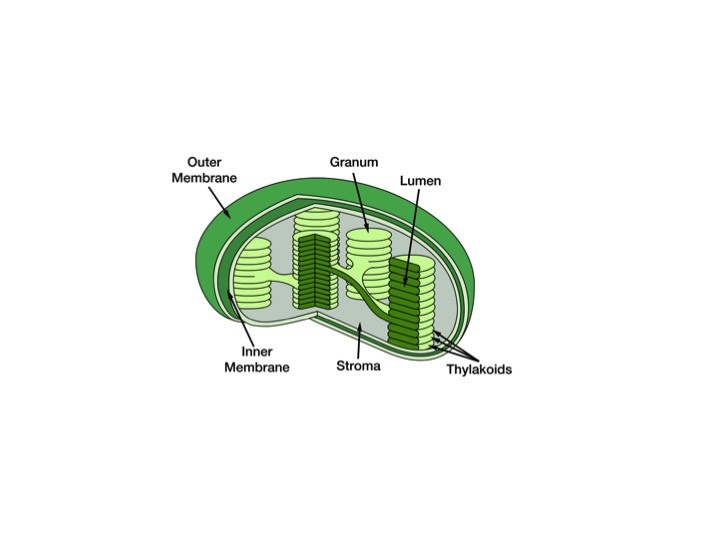
Which organelle from the plant cell is primarily responsible for converting sunlight to energy?
a)
Mitochonria
b)
Nucleus
c)
Vacuole
d)
Chloroplast
65.
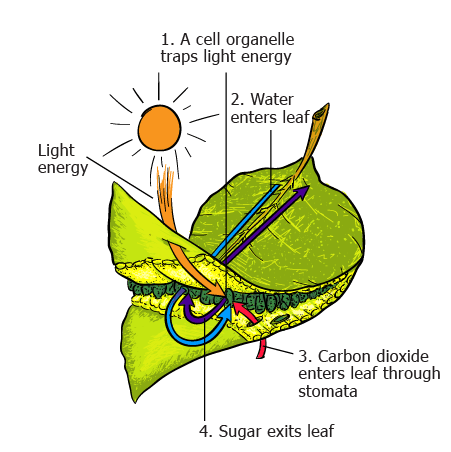
What process is the diagram representing?
a)
Photosynthesis
b)
Soil development
c)
Plant reproduction
d)
Nitrogen Cycle
Nitrogen cycle
66.
What is produced as a result of photosynthesis?
a)
Glucose and Chlorophyll
b)
Glucose and Oxygen
c)
Water and Light energy
d)
Carbon dioxide and Water
67.
Look at the image
What substances and organelle work together to absorb sunlight to perform photosynthesis in this example?
a)
cell wall and chloroplast
b)
mitochondria and water
c)
vacuole and carbon dioxide
d)
chloroplast and chlorophyll
68.
Which of the following go through the process of photosynthesis?
a)
bees
b)
algae
c)
humans
d)
mushrooms
69.
Which statement about photosynthesis is correct?
a)
Plants get the energy they need for photosynthesis from water.
b)
Plants get the energy they need for photosynthesis from soil.
c)
Plants get the energy they need for photosynthesis from sunlight.
d)
Plants do not require energy to perform photosynthesis.
70.
Why do we eat food?
a)
to provide energy/fuel
b)
to eliminate waste products
c)
to prevent diseases
d)
to kill pathogens
71.
Which of the following is not needed for photosynthesis to occur?
a)
sunlight
b)
carbon dioxide
c)
water
d)
oxygen
72.
This picture represents what type of cell transport?
a)
endocytosis
b)
exocytosis
c)
osmosis
d)
passive transport
73.
Osmosis is the movement of _____ across a membrane.
a)
food
b)
energy
c)
oxygen
d)
water
74.
Which is true about active transport?
a)
It requires energy
b)
it does not require energy
c)
It moves substances down the concentration gradient
d)
it moves material from high to low concentration
75.
The concentration of water is higher in the soil than in plant root cells. Water moves into root cells of a plant by...
a)
Facilitated Diffusion
b)
Simple Diffusion
c)
Active Transport
d)
Osmosis
76.
Food is moved into the cell by ________________________.
a)
endocytosis
b)
diffusion
c)
exocytosis
d)
osmosis
77.
A cell in an isotonic solution will
a)
swell
b)
shrink
c)
stay the same size
d)
impossible to tell
78.

The control center of the cell is the ________

a)

cell membrane

b)

nucleus

c)

mitochondria

d)

chloroplast

79.

Inside the nucleus of cells, you can find ________; the “instructions for life”

a)

nuclear membrane

b)

chromosomes

c)

mitosis

d)

mitochondria

80.

Human cells have _____ pairs of chromosomes- ____ chromosomes in total

a)

23, 46

b)

23, 23

c)

46, 46

d)

1, 2

81.

Mitosis takes place in _____

a)

sex cells (gametes)

b)

somatic cell (non sex cells)

82.

Mitosis turns a single parent cell into ____ new cells

a)

0

b)

1

c)

2

d)

4

83.

Meiosis turns a single parent cell into _______ new daughter cells

a)

0

b)

1

c)

2

d)

4

84.

Meiosis takes place in ____

a)

gametes (sex cells)

b)

somatic cells (non sex cells)

85.

The primary function of mitosis is _______

a)

to create genetic variety

b)

growth and repair of cells

86.

The primary function of meiosis is _______

a)

growth and repair

b)

to create genetic variety

87.

Mitosis creates daughter cells which are genetically identical to the parent cell

a)

True

b)

False

88.

Meiosis creates daughter cells which are genetically identical to the parent

a)

True

b)

False

89.
Fruit fly body cells have 8 chromosomes. After mitosis, you would expect a resulting fruit fly daughter cell to have ...
a)
16 chromosomes.
b)
46 chromosomes.
c)
8 chromosomes.
d)
4 chromosomes.
90.
In which type of cells will mitosis occur?
a)
egg cells
b)
sperm cells
c)
jail cells
d)
Body cells except the sperm and egg cells
91.
After meiosis is complete, the new cells:
a)
are all identical
b)
are all different
c)
are half identical and half different
d)
are all stretched out
92.
The female sex cell is called
a)
zygote
b)
sperm
c)
fertilization
d)
egg
93.
The male sex cell is called
a)
egg
b)
zygote
c)
sperm
d)
mitosis
94.
Most of the cells in the human body are produced by
a)
mitosis
b)
meiosis
95.
Why do we need meiosis?
a)
To double the number of chromosomes going into sex cells
b)
To halve the number of chromosomes going into sex cells
c)
To triple the number of chromosomes going into sex cells
d)
To not change the number of chromosomes going into sex cells
96.
The stages of mitosis in order
a)
Metaphase, Anaphase, Prophase, Telophase
b)
Prophase, Anaphase, Metaphase, Telophase
c)
Prophase, Metaphase, Anaphase, Telophase
d)
Anaphase, Prophase, Telophase, Metaphase
97.
A cat has a total of 38 chromosomes in its body cells.  How many in its gametes?
a)
38
b)
19
c)
76
d)
10
98.
If a human cell has 46 chromosomes, how many chromosomes are in each cell at the end of meiosis?
a)
23
b)
46
c)
92
d)
varies
99.
How many cells are produced at the end of mitosis?  At the end of meiosis?
a)
2, 4
b)
4,4
c)
4,2
d)
2,2
100.
The process of a sperm cell joining the egg cell is called...
a)
zygote
b)
gamete
c)
fertilization
d)
cellular respiration