
 Worksheets
Punnett Square
Total questions: 63
Worksheet time: 1hrs 23mins
Name
Class
Date
1.
Homozygous is when...
a)
the alleles are the same
b)
the alleles are different
c)
the alleles are absent
d)
the alleles are present
2.
Heterozygous is when...
a)
the alleles are the same
b)
the alleles are different
c)
the alleles are absent
d)
the alleles are present
3.
In a heterozygous genotype, the ___________ allele takes over in the phenotype.
a)
recessive
b)
dominant
c)
lower case letter
d)
both
4.

T - tall and t = short
In the punnett square below, what belongs in the missing square
In the punnett square below, what belongs in the missing square
a)
tt
b)
Tt
c)
Bb
d)
TT
5.

B = brown fur b = white fur
In the punnett square, what is the probability for white fur?
In the punnett square, what is the probability for white fur?
a)
0%
b)
25%
c)
50%
d)
75%
6.

In the punnett square shown, what must the genotype of the missing parent be?
a)
BB
b)
Bb
c)
bb
d)
Tt
7.

In the punnett square shown, what is the genotypes of the two parents?
a)
RW and RR
b)
RW and WW
c)
RR and WW
d)
RW and RR
8.
Which of the following is a phenotype?
a)
Aa
b)
black hair
c)
heterozygous genes
d)
mutated DNA
9.
What is a dominant allele?
a)
A trait that is always shown (capital letter)
b)
A trait that can be hidden (lower case letter)
c)
Alleles that are the same
d)
Alleles that are different
10.

This image shows a...
a)
Punnett Square
b)
Phenotype
c)
Genotype
d)
Dominant allele
11.
What does heterozygous mean?
a)
An organism that has the same genes for a trait (TT or tt)
b)
An organism that has different genes for a trait (Tt)
c)
When neither gene is fully dominant; offspring is a mixture of both
d)
the different forms of a trait (hair color--> brown, blonde, red
12.
Which of the following genotypes is heterozygous?
a)
Bb
b)
BB
c)
bb
d)
B
13.
A characteristic that an organism can pass on to its offspring through its genes is ___________
a)
Trait
b)
Gene
c)
Allele
d)
Dominant
14.
Punnett squares can be used to predict the probability of:
a)
being exposed to a contagious disease and contracting it
b)
having an inherited disease or a genetically determined physical trait
c)
Both
15.

In a certain species of plant, the color purple (P) is dominant to the color white (p).
According to the Punnett Square, what is the probability of an offspring being purple?
According to the Punnett Square, what is the probability of an offspring being purple?
a)
25%
b)
0%
c)
100%
d)
50%
16.
In a certain species of plant, the color purple (P) is dominant to the color white (p).
According to the Punnett Square, what is the probability of an offspring being purple?
According to the Punnett Square, what is the probability of an offspring being purple?
a)
25%
b)
0%
c)
100%
d)
50%
17.

In a certain species of plant, the color purple (P) is dominant to the color white (p).
According to the Punnett Square, what is the probability of an offspring being white?
According to the Punnett Square, what is the probability of an offspring being white?
a)
25%
b)
0%
c)
100%
d)
50%
18.
Is it possible for a visible trait to skip a generation? Example: Blue eyes
a)
Yes
b)
No
19.

What is the probability of heterozygous offspring?
a)
25%
b)
50%
c)
0%
d)
100%
20.

What allele combination should go in the missing box?
a)
AA
b)
Aa
c)
aa
d)
none of these
21.
In a flowering plant species, red flower color (R) is dominant over white flower color (r). What is the genotype of any red-flowering plant resulting from this species?
a)
rr
b)
R
c)
RR
d)
RR or Rr
22.
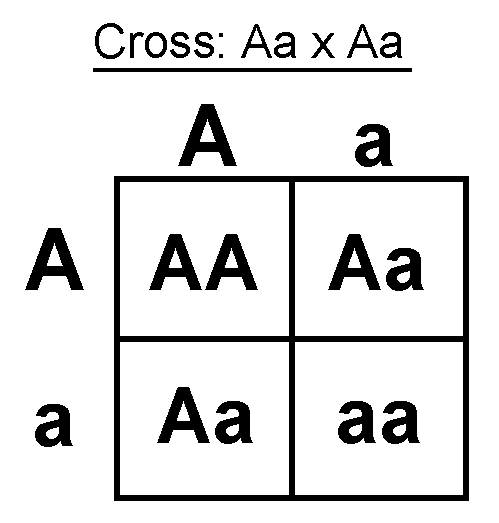
What is the phenotype of the offspring? (A-Brown hair; a-blond hair)
a)
50 % Brown Hair and 50% Blond Hair
b)
25 % Brown Hair and 75% Blond Hair
c)
75 % Brown Hair and 25% Blond Hair
d)
0% Brown Hair and 100% Blond Hair
23.
A homozygous dominant brown mouse is crossed with a heterozygous brown mouse (tan is the recessive color).
a)
100 % tan
b)
100 % brown
c)
50 % brown and 50% tan
d)
75 % brown and 25 % tan
24.
If a heterozygous parent and a homozygous recessive parent mate, what percentage of their offspring will be dominant?
a)
25%
b)
50%
c)
75%
d)
100%
25.
Two brown eyed parents (Bb) have a baby. What is the chance the baby is blue eyed?
a)
0 %
b)
25%
c)
50%
d)
75%
26.

If T=Tall & t=short, what is the genotypic ratio?
a)
1:3
b)
3:1
c)
1:2:1
d)
2:2
27.
B = brown fur b = white fur
In the Punnett square, what is the probability for white fur?
In the Punnett square, what is the probability for white fur?
a)
0%
b)
25%
c)
50%
d)
75%
28.

A heterozygous yellow pea plant's genotype would be:
a)
YY
b)
yy
c)
Yy
d)
Yg
29.
B - black, b - brown. Two black mice mate and have some black and some brown mice. What is the genotype of the parents?
a)
BB x Bb
b)
BB x bb
c)
Bb x Bb
d)
Bb x bb
30.
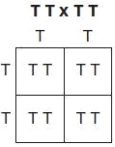
What ratio of the offspring from the cross shown will be homozygous recessive for the trait of tallness?
a)
0 in 4
b)
1 in 4
c)
2 in 4
d)
4 in 4
31.

What are the possible genotypes for this cross?
(Click the picture to see it without the text)
(Click the picture to see it without the text)
a)
TT = 25% Tt= 50% tt=25%
b)
all tall
c)
TT= 75% tt = 25%
d)
Tt = 100%
32.

In a certain species of plant, the color purple (P) is dominant to the color white (p).
According to the Punnett Square, what is the probability of an offspring being white?
According to the Punnett Square, what is the probability of an offspring being white?
a)
25%
b)
0%
c)
100%
d)
50%
33.

What is the yellow seed genotype?
a)
aa
b)
Aa
c)
AA
d)
AA or Aa
34.

Purple (P) is dominant to the white (p).
According to the Punnett Square, what is the probability of an offspring being purple?
According to the Punnett Square, what is the probability of an offspring being purple?
a)
25%
b)
0%
c)
100%
d)
50%
35.

What is the genotypic ratio here?
a)
25% blue eye 75 % brown eye
b)
BB = 25% Bb = 50% bb = 25%
c)
BB= 50 % bb = 50%
d)
All brown eye
36.

What does a Punnett Square do?
a)
tell you exactly what your offspring will look like
b)
increase the chance you pass on recessive traits
c)
predict genotypes and phenotypes in offspring
d)
have no purpose but for Taylor to give us extra assignments
37.
Which of the following is homozygous dominant?
a)
Jj
b)
Rr
c)
MM
d)
ee
38.
Which of the following is homozygous recessive?
a)
Tt
b)
tt
c)
TT
d)
T
39.
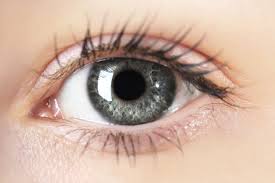
What you see, or the physical appearance.
a)
Genotype
b)
Phenotype
c)
Homozygous
d)
Heterozygous
40.
What is the probability of heterozygous offspring?
a)
25%
b)
50%
c)
0%
d)
100%
41.

Each one of the boxes on the Punnett Square represents what probability of an offsprings' genotype?
a)
25%
b)
1%
c)
10%
d)
0%
42.
G = green, g = yellow
The genotype for a yellow plant is...
The genotype for a yellow plant is...
a)
GG
b)
Gg
c)
gg
d)
all of the choices result in yellow
43.
Which of the following alleles is homozygous (purebred) recessive?
a)
Tt
b)
tt
c)
TT
d)
t
44.
What is a punnett square?
a)
graph used to predict the possible genotypes of offspring in a given cross
b)
a graph used to predict the possible birth rate of offspring.
c)
a graph used to predict the possible behavioral characteristics an offspring could have
d)
None of the above
45.

Genotype refers to the ...
a)
physical expression of the genes
b)
the possible combination of alleles in a gene
c)
whether an allele is dominant or recessive
d)
how an organism will appear
46.

A green pea plant (Gg) is crossed with a yellow pea plant (gg). Describe the genotype of the offspring. (Be sure to remember that the capital letter is dominant).
a)
50% heterozygous and 25% homozygous recessive
b)
50% heterozygous and 50% homozygous recessive
c)
100% homozygous recessive
d)
25% heterozygous and 50% homozygous
47.

A tall plant (TT) is crossed with a tall plant (Tt). What is the phenotype of the offspring?
a)
50% homozygous dominant; 50% heterozygous; 100% tall
b)
100% homozygous dominant; 100% tall
c)
25% homozygous dominant; 75% heterozygous; 100% short
d)
50% homozygous dominant; 50% heterozygous; 100% short
48.

A tall plant (Tt) is crossed with a short plant (tt). What is the genotype of the offspring?
a)
25% heterozygous; 75% homozygous
b)
100% homozygous dominant
c)
100% heterozygous
d)
50% heterozygous; 50% homozygous dominant
49.

A tall plant (Tt) is crossed with a short plant (tt). What is the phenotype of the offspring?
a)
75% tall; 25% short
b)
25% tall; 75% short
c)
50% tall; 50% short
d)
100% tall
50.
A white flower (rr) is crossed with a white flower (rr). What is the genotype of the offspring? Draw a Punnett square and answer the question.
a)
100% homozygous dominant
b)
100% heterozygous dominant
c)
100% homozygous recessive
d)
100% heterozygous recessive
51.
A black chicken (BB) is crossed with a black chicken (BB). What is the genotype and phenotype of the offspring? Draw a Punnet square and naswer this question.
a)
100% heterozygous; 50% black
b)
100% homozygous dominant; 100% black
52.
A red flower (Rd) is crossed with a white flower (rr). What is the genotype of the offspring? Draw a Punnett square and answer this question.
a)
50% heterozygous; 50% homozygous dominant
b)
100% homozygous dominant
c)
100% homozygous recessive
d)
50% heterozygous; 50% homozygous recessive
53.

A homozygous dominant brown mouse (BB) is crossed with a heterozygous brown mouse (tan is the recessive color). List the offspring genotype and phenotype.
a)
50% homozygous dominant; 50% heterozygous and 100% tan
b)
25% homozygous dominant; 75% heterozygous; 100% brown
c)
50% homozygous dominant; 50% heterozygous and 100% brown
d)
75% homozygous dominant; 25% heterozygous and 100% tan
54.

Two heterozygous white (brown fur is recessive) rabbits are crossed. What is their genotype?
a)
25% homozygous domestic; 25% homozygous recessive; 50% heterozygous
b)
50% homozygous dominant; 50% heterozygous
c)
25% homozygous domestic; 75% homozygous recessive
55.

Two heterozygous red flowers (white flowers are recessive) are crossed. What is the genotype of the offspring?
a)
75% homozygous dominant; 25% heterozygous
b)
50% homozygous dominant; 50% heterozygous
c)
25% homozygous dominant; 25% homozygous recessive; 50% heterozygous
56.

Two heterozygous red flowers (white flowers are recessive) are crossed. What is the phenotype of the offspring?
a)
50% red; 50% white
b)
75% white; 25% red
c)
25% red; 25% pink; 50% white
d)
75% red; 25% white
57.

A homozygous tall plant (TT) is crossed with a heterozygous tall plant (Tt) (short is the recessive phenotype). What are the genotypes and phenotypes of the offspring?
a)
100% homozygous dominant; 100% tall
b)
50% homozygous dominant; 50% heterozygous and 100% tall
c)
25% heterozygous; 75% homozygous dominant and 100% tall
58.
A heterozygous white rabbit is crossed with a homozygous black rabbit. List the parent genotypes; draw and fill and Punnett square, and then list the offspring genotypes and phenotypes.
a)
genotype-25% heterozygous; 75% homozygous recessive and phenotype-50% white and 50% black
b)
genotype- 50% heterozygous; 50% homozygous recessive and phenotype- 50% white and 50% black
59.
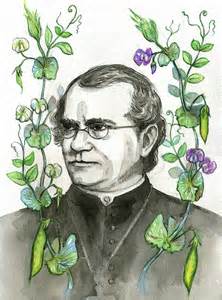
Who is considered the "father of genetics"?
a)
Reginald Punnett
b)
Gregor Mendel
c)
James Watson
d)
Charles Darwin
60.

In pea plants, the tall allele is dominant to the short allele. What key would demonstrate this?
a)
Tall = T
Short = S
Short = S
b)
Tall = T
Short = t
Short = t
c)
Tall = t
Short = T
Short = T
d)
Tall = TT
Short = tt
Short = tt
61.

A heterozygous long-tusked elephant is crossed with a homozygous recessive short-tusked elephant. What is the probability of the offspring having short tusks?
a)
0%
b)
25%
c)
50%
d)
75%
62.

Georgette wants to breed her pet phoenixes, but she isn't sure if the babies will burst into blue flames or red flames. Her documents show that her female phoenix is homozygous dominant for red flames, while her male phoenix is homozygous recessive for blue flames. What color flames will the babies have?
a)
Red
b)
Blue
c)
Purple
d)
50% Red, 50% Blue
63.

A brown-furred ewok has 12 babies with a black-furred ewok. 9 ewok babies have black fur, while 3 ewok babies have brown fur. What are the probable genotypes of the parents?
a)
BB and bb
b)
BB and Bb
c)
Bb and Bb
d)
Bb and bb
100 %

