Wayground logo

Free Printable Worksheets

Font size

S
M
L
XL
Worksheets

EarthMaterials

Total questions: 65

Worksheet time: 3hrs 45mins

Name
Class
Date
1.
What are the two kinds of crust that the Earth has?
a)
Oceanic and Crustatious Crust
b)
Oceanic and Continental Crust
c)
Optic and Continental Crust
2.
As scientists explore deeper and deeper into Earth's crust, what have they noticed about temperature and pressure?
a)
both temperature and pressure decrease
b)
both temperature and pressure increase
c)
pressure increases while temperature decreases
d)
temperature increases while pressure decreases
3.
What causes the waves that scientists have used to gain most of their understanding of the composition of Earth's interior?
a)
earthquakes
b)
magnetic fields
c)
meteor strikes
d)
winds
4.
Which layer of Earth would have the greatest density?
a)
upper mantle
b)
lower mantle
c)
inner core
d)
outer core
5.
Which layer of Earth is characterized by rock that is plastic, or soft enough to flow?
a)
asthenosphere
b)
crust
c)
lithosphere
d)
inner core
6.
True or False
The Earth's thin shell of hard rock is called the crust.
a)
True
b)
False
7.
True or FalseHeat rising from deep inside earth can move the crust’s plates.
a)
True
b)
False
8.
True or FalseThe most abundant elements in the Earth's crust are silicon and oxygen.
a)
True
b)
False
9.
4. What layer is the hottest?
a)
Core
b)
Crust
c)
Mantle
10.
5. Which layer is the thickest?
a)
Core
b)
Crust
c)
Mantle
11.
If you traveled from the center of Earth to the surface, the pressure would...
a)
increase
b)
decrease
c)
stay the same
d)
unsure
12.
Which layer is made up of iron and nickel?
a)
Crust
b)
Mantle
c)
Inner Core
d)
Lithosphere
13.
Which layer of Earth is the thinnest? 
a)
Crust
b)
Mantle
c)
Inner Core
d)
Outer Core
14.
Which sublayer is made up of the crust and upper mantle?
a)
Inner Core
b)
Outer Core
c)
Lithosphere
d)
Asthenosphere
15.
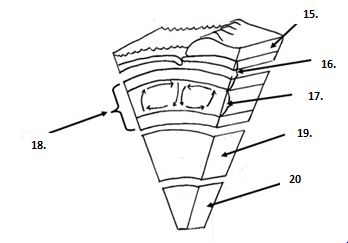
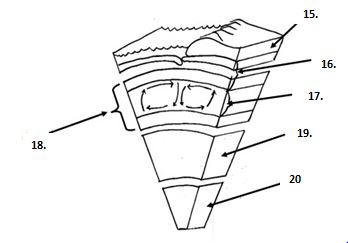
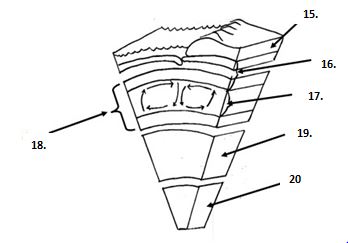
Identify each layer - #15.
a)
Lithosphere
b)
Mantle
c)
Crust
d)
Asthenosphere
16.
Identify each layer - #16.
a)
Crust
b)
Mantle
c)
Lithosphere
d)
Asthenosphere
17.
Identify each layer - #17.
a)
Crust
b)
Mantle
c)
Lithosphere
d)
Asthenosphere
18.
Identify each layer - #20.
a)
mantle
b)
asthenosphere
c)
inner core
d)
outer core
19.
Identify each layer - #19.
a)
mantle
b)
lithosphere
c)
inner core
d)
outer core
20.
The outermost solid layer of the Earth is called the
a)
mantle
b)
outer core
c)
inner core
d)
crust
21.
This layer of the Earth is found between the core and the crust.
a)
mantle
b)
outer core
c)
inner core
d)
crust
22.
The layer that lies beneath the mantle and surrounds the inner core. 
a)
mantle
b)
outer core
c)
inner core
d)
crust
23.
What layer has a solid inner part and a liquid outer part?
a)
Crust
b)
Mantle
c)
Core
d)
none
24.
What layer is the thinnest?
a)
Crust 
b)
Mantle
c)
Core
d)
They are all the same size
25.
What layer is made of plates that move around and bump into each other?
a)
Crust
b)
Mantle
c)
Core
d)
All of them
26.
Which layer has the highest density?
a)
Crust
b)
Mantle
c)
Core
d)
All the same
27.
Which layer has a part that is thick  with a clay-like consistency that transfers heat through convection?
a)
Crust
b)
Mantle
c)
Core
d)
All of them
28.
Which layer is the thickest?
a)
Crust
b)
Mantle
c)
Core
d)
All of them are the same size
29.

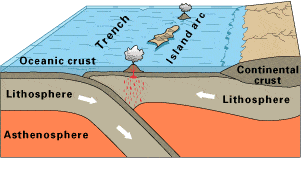
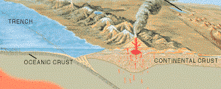
What kind of boundary is shown in this image?

a)

Divergent

b)

Convergent: Subduction

c)

Convergent: Collision

d)

Transform

30.

Which of the following is not a feature we could expect near a convergent subduction boundary?

a)

Volcanoes

b)

Mid Ocean Ridges

c)

Earthquakes

d)

Ocean Trenches

31.

Which of the following is a feature common with transform boundaries?

a)

Volcanoes

b)

Mountain chains

c)

Ocean Trenches

d)

Earthquakes

32.

Where would you find most volcanoes that are on a continent?

a)

Randomly scattered

b)

In the middle

c)

Along the coastlines (edges)

d)

Most volcanoes are not on continents

33.

The movement of the tectonic plates is caused by

a)

the rotation of the Earth.

b)

convection currents in the Asthenosphere

c)

the gravity of the iron-nickel core.

d)

the Moho discontinuity.

34.

In some areas of the world, like California and Japan, earthquakes are a common occurrence. How can this best be explained?

a)

The strong ocean currents are undermining both areas causing earthquakes.

b)

Both areas are located near the edge of the Pacific Ocean, the unstable sand causes earthquakes.

c)

Both areas are subjected to strong ocean wind and waves that causes earthquakes.

d)

Both areas are on the boundary of active plates, the motion of the plates causes earthquakes.
35.
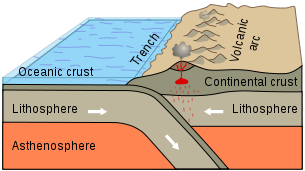
Subduction zones occur on Earth where dense oceanic crust dives under more buoyant continental crust. These boundaries are characterized by a deep ocean trench next to a high continental mountain range, large numbers of earthquakes and volcanoes. All of this is further evidence for the
a)
big bang theory.
b)
theory of plate tectonics.
c)
origin of the species.
d)
theory of natural selection.
36.

Observe this diagram of a plate boundary. One statement BEST describes what is happening. It is that

a)

the oceanic crust is melting.

b)

the denser ceanic crust is subducting under the less dense oceanic crust

c)

volcanic islands are forming.

d)

the tectonic plates are moving away from each other.
37.

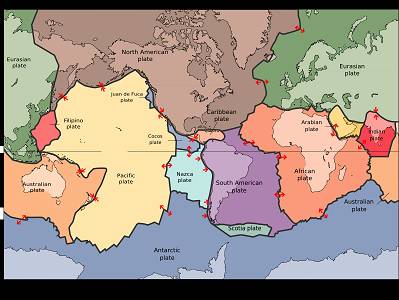
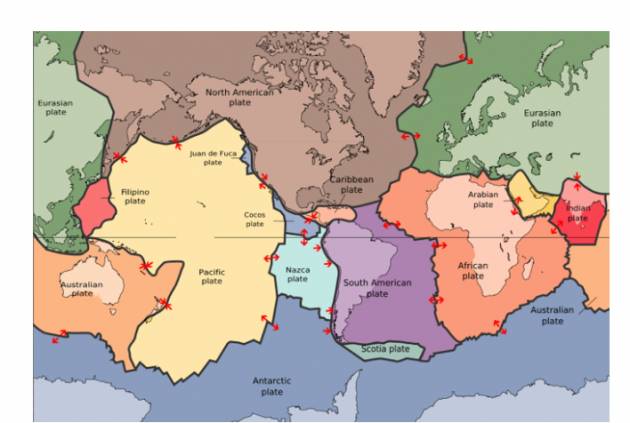
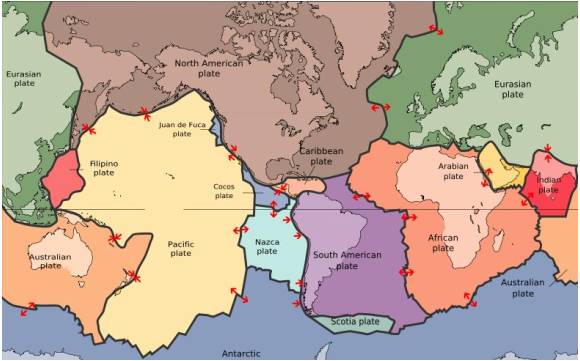
The map in the picture shows tectonic plate boundaries. This map would be useful in predicting the location of future

a)

droughts

b)

hurricanes

c)

earthquakes

d)

tornadoes

38.
What geological forces might be responsible for this range of mountains?
a)
diverging tectonic plates
b)
erosion of the land by the ocean
c)
converging tectonic plates
d)
deposition of sediments by the ocean
39.
Geologists have long recognized that earthquakes are not randomly distributed on Earth but occur in concentrated areas that coincide with __________ and provide evidence for the theory of ___________ .
a)
mountain ranges; fault zones.
b)
continental borders; supercontinents.
c)
plate boundaries; plate tectonics
d)
areas of liquid magma; sea floor spreading.
40.
Which geological features MOST LIKELY prompted the development of the theory of plate tectonics?
a)
river deltas
b)
mountain ranges
c)
glacier fields
d)
tropical rainforests
41.

Where are earthquakes MOST LIKELY to occur?

a)

close to the equator

b)

close to the center of tectonic plates

c)

at divergent or convergent plate boundaries

d)

at transform plate boundaries

42.
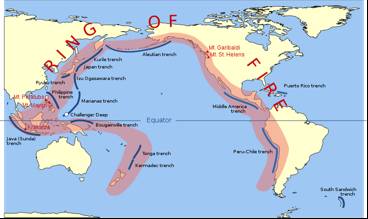
The image shows the Pacific Ring of Fire, a region of high tectonic activity. What evidence supports the theory that the tectonic activity of the region is due to the subduction of tectonic plates?
a)
The region is bound by many oceanic trenches.
b)
North America seems to be colliding with Asia at the north of the ring.
c)
The Asia-Pacific region is dotted by many small and large islands
d)
The landmasses look like they would fit together like the pieces of a jigsaw puzzle.
43.
The Atlantic Ocean gets about 3-5 ______ wider each year.
a)
centimeters
b)
kilometers
c)
miles
d)
meters
44.
Observe the plate boundary shown here. What type of plate boundary is this? Many geologic events occur at these boundaries. Some are shown, but one is missing. What geologic event would you predict would occur at this plate boundary?
a)
convergent oceanic-oceanic plate boundary; volcano
b)
divergent oceanic-oceanic plate boundary; sea floor spreading
c)
convergent oceanic-continental plate boundary; earthquake
d)
convergent continental-continental plate boundary; mountain building
45.

The Marianas Trench, where the Pacific Plate descends under the leading edge of the Eurasian Plate, is the deepest sea floor in the world. These ocean trenches form when two oceanic plates collide

a)

and the older, less dense of the two plates rides over the edge of the older plate.

b)

when convection currents in the mantle force the older plate downward.

c)

and the younger, denser of the two plates, rides over the edge of the older plate.

d)

and the plates are approximately the same age and density.

46.
The cracks in Earth's crust are called ___________.
a)
tectonic plates
b)
faults
c)
magma
d)
lava
47.
What are the puzzle pieces of the Earth's surface called?
a)
Tectonic plates
b)
Puzzles
c)
Earthquakes
48.

This famous fault in California has a lot of earthquakes!

a)

New Madrid

b)

Denali Fault

c)

Ramapo Seismic Zone

d)

San Andreas Fault

49.

What type of boundary is shown in the diagram?

a)

Divergent

b)

Convergent

c)

Transform

50.

What type of boundary is shown in the diagram?

a)

Divergent

b)

Convergent

c)

Slide/Transform

51.

What type of boundary is shown in the diagram?

a)

Divergent

b)

Convergent

c)

Slide/Transform

52.
What causes tectonic plates to move along the Earth's surface?
a)
wind
b)
ocean currents
c)
convection in the mantle
d)
expansion of the Earth
53.
What type of boundary occurs when two plates move away from each other?
a)
transform
b)
subduction
c)
convergent
d)
divergent
54.
What forms at a divergent boundary between two oceanic plates?
a)
rift valley
b)
mountain
c)
mid-ocean ridge
d)
trench
55.
Which type of crust is more dense?
a)
oceanic
b)
continental
c)
divergent
d)
pizza
56.
What type of boundary occurs when two plates move toward each other?
a)
convergent
b)
divergent
c)
transform
d)
lateral
57.
A rift valley occurs at a ____________ boundary.
a)
divergent
b)
convergent
c)
transform
d)
horizontal
58.
A trench forms at a _________ boundary.
a)
convergent
b)
divergent
c)
transform
d)
vertical
59.
Mountains form at a ___________ boundary.
a)
transform
b)
divergent
c)
convergent
d)
subduction
60.
What type of boundary occurs when two plates slide past each other?
a)
divergent
b)
transform
c)
lateral
d)
convergent
61.
What type of boundary is shown at A?
a)
transform
b)
convergent
c)
divergent
d)
subduction
62.
What is happening at point B?
a)
subduction
b)
a divergent boundary
c)
convection
d)
an earthquake
63.
What is the process in which two plates move toward each other but one sinks under the other?
a)
subduction
b)
convection
c)
divergence
d)
transformation
64.
The physical layer of Earth made of solid rock and soil is called the ___________. 
a)
mesosphere
b)
lithosphere
c)
asthenosphere
d)
mantle
65.
The type of plate boundary where two plates come together is a .....
a)
Convergent Boundary
b)
Divergent Boundary
c)
Transform Boundary
d)
Plate Boundary