
 Worksheets
Balancing equations quiz practice
Total questions: 59
Worksheet time: 2hrs 19mins
PCl5 + ___ H2O → ___ HCl + H3PO4
4, 5
1, 6
3, 8
2,2
__ Al + __ FeO → Al2O2 + __ Fe
1, 1, 2
2,1,2
2, 2, 2
2,4,2
_SnO2 +_H2-->_Sn +_H2O
_CF4 + _Br2 -- _CBr4 + _F2
H2SO4
Which is the correct chemical equation for the following: Solid Zn reacts with silver (I) chloride to produce Zinc (II) chloride and silver metal
Zn + AgCl → ZnCl2 + Ag
ZnCl2 + Ag → Zn + AgCl
ZnCl2 + Ag2 → Zn + AgCl
Zn2Cl + Ag → Zn + AgCl
Which is the correct chemical equation for the following: Barium Chloride combined with sodium sulfide yields barium sulfide and sodium chloride
BaCl + NaS → BaS+ NaCl
BaCl2 + Na2S → BaS+ NaCl
BaS+ NaCl → BaCl + NaS
BaCl2 + Na2S → BaS+ NaCl2

Which compounds are the PRODUCTS of this reaction?
CO2 + H2O
C6H12O6 + O2
C6H12O6 + CO2
H2O + O2


KClO3 → KCl + O2
Fe2(SO4)3 + KOH → K2SO4 + Fe(OH)3
Anthony is performing an experiment. He adds 0.25 grams of baking soda to 5 grams of water and stirs. Anthony watches as the baking soda dissolves in the water. If Anthony weighs the water and baking soda solution, what will its mass be?
4.75 grams
5.0 grams
5.25 grams
7.5 grams
A rock weighing 60 g is broken into 2 pieces. What are possible weights for the two pieces of rock?
20 g and 20 g
30 g and 20 g
30 g and 30 g
45 g and 10 g
Jackie creates a piece of artwork by melting crayons and mixing the colors together. She uses 10 crayons that weighed 5 grams each. What is most likely the weight of her artwork?
4 grams
20 grams
50 grams
100 grams
Mrs. Godfrey wants to prove to her students that when an object is burned, its total mass is the same before and after the reaction. What should Mrs. Godfrey do to make sure this is shown by the experiment?
burn the object in a closed container
burn the object outside on a nice day
add water to the object after it is burned
split the object into two equal pieces before burning


(Charles Law) There are 65 liters of helium in a balloon at 35 K. If the temperature of the balloon is increased to 40 K, what will the new volume of the balloon be? (number sense: use your little PTV card)
40 L
70 L
74.3 L
Tom Brady enjoys balloon animals from the carnival. He just received a balloon giraffe that has an initial temperature of 39.0°C and a volume of 1.28 L. If Gronkowski plays a trick on Tom, and puts his balloon giraffe into the freezer, what would be the new volume of the balloon if the temperature drops down to 8.0°C? (number sense: Use your PTV card)
(Don’t forget about what must be done to temperatures!)
1.15 L
6.85 x 10⁴ L
3.78 L
Tom wants his balloon back to normal size so he decides to put it on a heating vent. If the balloon initially has a volume of 0.6 L and a temperature of 293 K, what will the volume of the balloon be when it heats up to a temperature of 176°C? (number sense: Use your PTV card)
0.39 L
0.92 L
0.92 K
If 200 mL of a gas at 27°C is cooled to -33°C at a constant pressure, the volume will be (number sense: Use your PTV card)
250 mL
160mL
196 mL
A gas with a volume of 400 mL at 120 οC is heated until its volume is 700 mL. What is the new temperature ( in degree Celsius) of the gas if the pressure is constant? (number sense: Use your PTV card)
68.57 οC
687.75 οC
210 οC
A sample of hydrogen at 1.5 atm had its pressure decreased to 0.50 atm producing a new volume of 750 mL. What was its original volume? (number sense: Use your PTV card)
250 ml
751 mL
749 mL
A gas occupies 4.98 L at 2.6 atm of pressure. What volume does it occupy at 1.8 atm pressure? (number sense: Use your PTV card)
3.44 L
0.72 L
7.2 L
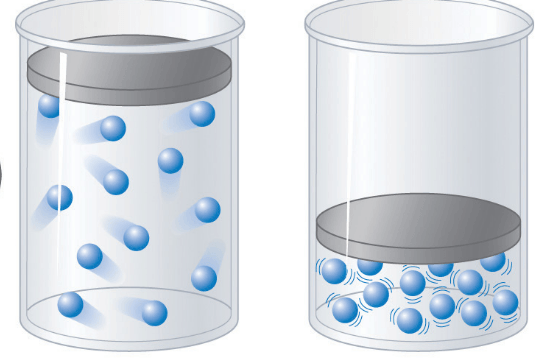
One goes up, one goes down is which of the following: PICK TWO
Inverse proportion
Charles' Law
Direct Proportion
Boyles' Law
BOTH goes up, BOTH goes down is which of the following: PICK TWO
Inverse proportion
Charles' Law
Direct Proportion
Boyles' Law
Gas pressure is caused by
Gas molecules heating up
Gas molecules reacting with other gas molecules
Gas molecules hitting the walls of a container
Gas molecules hitting other gas molecules
The temperature of gas is held constant, while its volume is decreased. The pressure exerted by the gas on the wall of the container increases, because its molecules
Strike the walls with higher velocities
Strike the walls with large farce
Strike the walls more frequently
Are in contact with the walls for a shorter time

A sample of a gas in a cylinder is shown. If the temperature is kept constant and the piston moves down to decrease volume, the pressure increases because the gas particles...
Expand
Become smaller
Lose velocity within the container
Collide more often within the container

What happened to the volume between the two steps?
Volume increased
Volume decreased
Volume stayed the same
If a balloon is cooled what will happen to the volume?
Volume will increase
Volume will decrease
Volume will not change
According to Charles' Law if temperature goes up...
Pressure goes down
Pressure goes up
Volume goes down
Volume goes up

Determine the initial temperature of a random gas when the initial volume is 2.2 L and it is cooled to 88K with a volume of 0.85 L.
0.029 K
0.021 K
227.76 K


Compare the particle movement between part C and Part D
Particles are increasing speed at point D, particles are at a CONSTANT speed at C, overall particle speed is higher at D because of a higher temperature.
Particles are increasing speed at point C, particles are at a CONSTANT speed at D, overall particle speed is higher at D because of a higher temperature.
Particles are increasing speed at point C, particles are at an INCREASING speed at D, overall particle speed is higher at D because of a higher temperature.
Particles are increasing speed at point D, particles are at an INCREASING speed at C, overall particle speed is higher at C because of a positive slope

