wayground logo

Free Printable Worksheets

Font size

S
M
L
XL
Worksheets

Spring Midterm Recovery 2020

Total questions: 100

Worksheet time: 1hrs 17mins

Name
Class
Date
1.
Bob was found dead in his home.  Crime scene analysis showed signs of a struggle.  Blood was collected from the crime scene, the victim, and three suspects.  Which suspect likely committed the crime? 
a)
Sue
b)
Lisa
c)
John
d)
None of these
2.
Based on these results whose blood was found in the blood stain at the crime scene?
a)
Bob
b)
Sue
c)
John
d)
Lisa
3.

An alternate form of a gene.

a)

Gene

b)

Chromosome

c)

Allele

4.

A method of separating molecules, such as DNA, according to their size and electrical charge.

a)

Electrophoresis

b)

DNA Fingerprint

c)

DNA Probe

5.
Which of the following is a circular DNA from bacteria that can hold a foreign gene?
a)
plasmid
b)
restriction enzyme
c)
ligase
d)
protein expression
6.
Cutting DNA from one organisms and placing it into the DNA strand of another organism is called:
a)
recombinant RNA technology
b)
recombinant DNA technology
c)
selective breeding
d)
gene cloning
7.
A small, circular piece of DNA used for inserting new genetic material into another organism.
a)
Mutation
b)
Proteiin
c)
Plasmid
d)
Bioinformatics
8.
What does the graph represent?
a)
Emigration
b)
Exponential growth
c)
Immigration
d)
Logistic Growth
9.

Name the 3° consumer(s) in the food web.

a)

hawk

b)

shrew

c)

frog

d)

snake

10.

What is the 10% rule?

a)

90% of energy is LOST as you move up the food chain

b)

10% of energy is LOST as you move up the food chain

c)

90% of energy is GAINED as you move up the food chain

11.

Which level do the snakes belong

a)

3rd level tertiary

b)

3rd level secondary consumer

c)

3rd level producers

d)

3rd level hervivores

12.
Pseudoscorpions often hitch rides on the backs of large beetles or true bugs. What is the ecological relationship?
a)
Mutualism
b)
Commensalism
c)
Parasitism
d)
Cooperation
13.
Ants protect soft bodied aphids and in return the aphids feed the ants a sugary drink. What is the ecological relationship?
a)
Cooperation
b)
Parasitism
c)
Commensalism
d)
Mutualism
14.

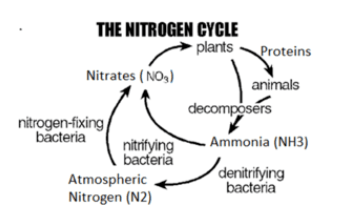
According to this diagram, plants absorb

a)

nitrates

b)

nitrogen fixing bacteria

c)

animals

d)

decomposers

15.

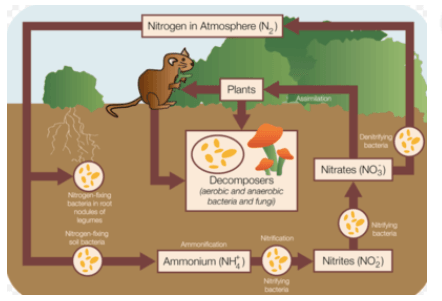
A correct path that nitrogen could take would be

a)

air -> animals -> plants -> bacteria

b)

animals -> air -> bacteria -> plants

c)

bacteria -> air -> plants -> animals

d)

air -> bacteria -> plants -> animals

16.

Bacteria fix nitrogen from the atmosphere into a form plants can use.

a)

True

b)

False

17.

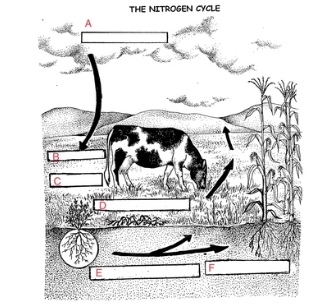
In the nitrogen cycle, what does label A in the diagram represent?

a)

Gas

b)

Clouds

c)

Carbon dioxide in the atmosphere

d)

Nitrogen in the atmosphere

18.
Translation is a process that produces
a)
mRNA
b)
Protein
c)
Polypeptide Chains
d)
tRNA
19.
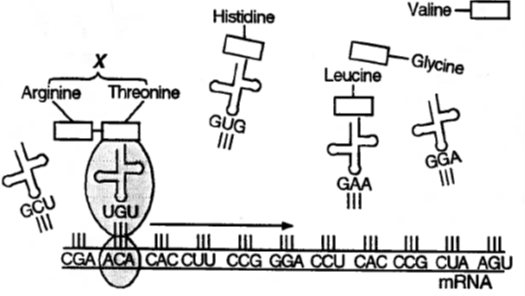
What process is going on in this photo? 
a)
Transcription 
b)
Translation 
c)
Replication 
d)
All the above 
20.
Amino acids are joined together in order to form
a)
DNA
b)
ribosomes
c)
proteins 
d)
RNA
21.
Which Seq could be found in RNA?
a)
ACCTGT
b)
CGCATT
c)
AUGCUU
22.
What is the location in the cell for translation?
a)
nucleus
b)
mitochondria
c)
ribosome
d)
chloroplast
23.
Which amino acid is coded from the mRNA codon:
AGU
a)
Arginine
b)
Serine
c)
Leucine
d)
Glycine
24.
How many amino acids are coded for by this sequence of nucleotides:
ATG GGA ACT CCA
a)
4
b)
2
c)
6
d)
12
25.
What is the correct amino acid sequence for the mRNA code AUGCCAGUAUGA?
a)
 Met-Pro-Val-Stop
b)
Met-Pro-Arg-Stop
c)
 Tyr-Gly-His
d)
Tyr-Gly-Arg-His
26.
Which RNA bases would pair with TACGAA in transcription? 
a)
AUGCUU 
b)
ATGCTT
c)
GCATCC
d)
GCAUCC
27.
Which of the following polypeptides is coded for by the mRNA sequence 5' AUGGUUAAA 3'?
a)
Val, Lys, Phe, Gly
b)
Met, Asp, Phe
c)
Met, Val, Lys
d)
Ile, Gln, Leu, Ser
28.
What is the correct amino acid for the following codon:
 GGU
a)
Gly
b)
Met
c)
Ser
d)
Ala
29.
What is the correct amino acid for the following codon:
 UGA
a)
Stop
b)
Met
c)
Asp
d)
Ala
30.
What are the three components of a nucleotide?
a)
sugar, hydrogen, nitrogen base
b)
sugar, oxygen, nitrogen base
c)
sugar, phosphate, nitrogen base
d)
sugar, phosphate, protein
31.
The following picture must be
a)
DNA because it's double stranded
b)
RNA because it's single stranded
c)
DNA because it's single stranded
d)
RNA because it's double stranded
32.
What does this picture represent?
a)
amino acid
b)
base pairing
c)
nucleotide
d)
the DNA molecule
33.
What mutation has occurred here? 
T-G-A-C-C-A
T-G-A-G-C-A
a)
Substitution
b)
Deletion
c)
Insertion
d)
Frameshift 
34.
Which of the following would result in a frameshift mutation?
a)
Insertions only
b)
Substitution only
c)
Deletion only
d)
Insertions and Deletions
35.
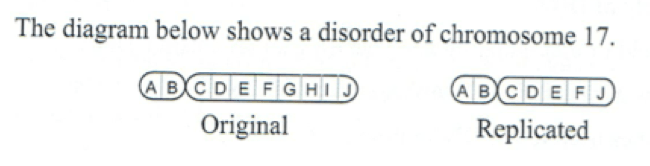
What type of chromosomal mutation has occurred?
a)
substitution
b)
insertion
c)
deletion
d)
nondisjunction
36.

A mutation in which only one nucleotide is altered is called a:

a)

Frameshift Mutation

b)

Deletion Mutation

c)

Point Mutation

d)

Insertion Mutation

37.
DNA molecule segment is : TTACGCAAG
The mutated DNA segment is TTCGCAAG. This is an example of ___ mutation.
a)
Substitution
b)
Deletion
c)
Insertion
d)
Inversion
38.

The rearrangement of whole blocks of genes.Involve changes to a triplet resulting in a different amino acid.

a)

translocation

b)

gene mutation

c)

deletion

d)

missive substitution

39.

A mutation is defined as:

a)

A change in the cell's structure

b)

Anything that changes in an embryo

c)

Any change in the physical features of a human

d)

A change in the DNA sequence

40.
ATTTGAGCC- Original
ATTGAGCC - Mutated
The example above is an example of a 
a)
Insertion- Frameshift
b)
Deletion- Substitution
c)
Deletion -Frameshift
d)
All of the above
41.
What mutation has occurred here? 
T-G-A-C-C-A
T-G-A-G-C-A
a)
Substitution
b)
Deletion
c)
Insertion
d)
Frameshift 
42.
Why are insertion and deletion (frameshift) mutations so harmful?
a)
They change all of the codons from the mutation on down the line, which changes the amino acid sequence
b)
They insert things that an organism doesn't need.
c)
They often delete things that organisms need.
d)
Insertion and deletions are not any more harmful than substitution mutations.
43.
Identify the DELETION mutation form the following: 
ATG CCA AAT
a)
ATG TCA AAT
b)
ATG CCT AAA T
c)
ATC CA  AT
d)
ATG CCA AAT
44.
Identify the SUBSTITUTION mutation form the following: 
ATG CCA AAT
a)
ATG TCA AAT
b)
ATG CCT AAA T
c)
ATC CA  AT
d)
ATG CCA AAT
45.

Would a mutation in the DNA of a skin cell be passed on to an organism's offspring?

a)

Yes, because any change to the DNA is passed on to the offspring

b)

Maybe. Sex cells only use half of the body's genetic code. It might get the copy of a gene that wasn't mutated.

c)

No. Only mutations that occur in the gametes (sex cells) are passed on to the offspring

d)

Without knowing the animal, it would be hard to tell whether or not the mutation would be passed on.

46.
Are all mutations bad?
a)
Yes
b)
No
47.

What are the building blocks of proteins called?

a)

DNA

b)

RNA

c)

Ribosomes

d)

Amino Acids

48.

Reproducing asexually will produce offspring ...

a)

genetically different from each other

b)

genetically identical to the parent

49.
What is a disadvantage of asexual reproduction?
a)
New species of organisms cannot come into being.
b)
The offspring does not multiply rapidly.
c)
The offspring does not live for long.
d)
All of these
50.
Which of the following describes the main advantages of sexual reproduction
a)
requires lots of time/energy
b)
no new gene combos can arise 
c)
diversity
d)
looks identical to the parent
51.
When comparing the offspring of sexually and asexually reproducing organisms, we would expect the genetic material (DNA) of the sexually reproducing organism to -
a)
contain fewer mutations
b)
be lesser in quantity
c)
be simpler overall
d)
show more variation
52.
During replication, what enzyme adds complimentary bases?
a)
helicase
b)
synthesase
c)
ligase
d)
polymerase
53.
What is a protein: 
a)
A polymer composed of many sugars.
b)
A polymer composed of many amino acids. 
c)
A polymer composed of fatty acids. 
d)
A polymer composed of nucleotides. 
54.
What is the monomer of proteins?
a)
amino acids
b)
polypeptides
c)
nucleotides
d)
monosaccharides
55.

Variation in the cells/organisms produced...

a)

Mitosis

b)

Meiosis

56.

An exact copy of a cell/organism is produced...

a)

Mitosis

b)

Meiosis

57.

Brown Bears reproduce sexually, so all the baby bears are...

a)

different.

b)

the same.

58.

Identical copies are most related to...

a)

Mitosis and Sexual Reproduction

b)

Meiosis and Asexual Reproduction

c)

Mitosis and Asexual Reproduction

d)

Meiosis and Sexual Reproduction

59.
a)
Mitosis
b)
Meiosis
60.
a)
Mitosis
b)
Meiosis
61.
If a trait was passed from one generation to the next in your family...
a)
Mitosis
b)
Meiosis
62.
Which of the following is the correct equation for PHOTOSYNTHESIS?
a)
CO+ light + H2O --> O+ Sugar
b)
CO+ sugar + H2O --> O+ light
c)
O2 + light + H2O --> CO+ Sugar
d)
CO+ O2 + H2O --> Light+ Sugar
63.
What is the ultimate ORIGINAL source of energy for living things
a)
Sugar
b)
Sun
c)
Moon
d)
Carbon Dioxide
64.
Which gas is removed from the atmosphere during photosynthesis?
a)
hydrogen
b)
oxygen
c)
nitrogen
d)
carbon dioxide
65.

Chloroplasts are...

a)

Structures of animal cells to produce ATP

b)

Organelles where lipids are elaborated

c)

Organelles in plant cells where photosynthesis takes place

d)

Waste organelle of plants

66.
The purpose of cellular respiration is to 
a)
make water
b)
make ATP
c)
make glucose
d)
make  oxygen
67.
What is the correct equation for cellular respiration?
a)
6O2 + C6H12O6 -> 6CO2 + 6H2O + Energy
b)
6O2 + C6H12O6 + Energy -> 6CO2 + 6H2O
c)
6CO2 + 6H2O -> 6O2 + C6H12O6 + Energy
d)
6CO2 + 6H2O + Energy -> 6O2 + C6H12O6
68.

Which of these is a product of cellular respiration?

a)

ATP

b)

Carbon dioxide

c)

Water

d)

All of these are a product of cellular respiration

69.
ATP is called a cell's "energy currency" because
a)
ATP catalyzes all metabolic reactions
b)
ATP allow one organelle to be exchanged for another between cells
c)
glucose is made of ATP
d)
most of the energy that drives metabolism is supplied by ATP
70.
Which structures shown in the Figure make up the ATP molecule?
a)
A and B
b)
A, B and C
c)
A, B, C, and D
d)
C and D
71.
Where is there a low concentration of perfume?
a)
in the bottle
b)
on the hand
c)
in the room
d)
in the top
72.
The picture is an example of...
a)
active tranport
b)
passive transport
c)
diffusion
d)
osmosis
73.

Which cell is in a hypertonic environment?

a)

A

b)

B

c)

C

d)

None of them are hypertonic

74.
The cells seem to be shriveled and dehydrated what type of solution are they most likely in?
a)
Hypertonic
b)
Isotonic
c)
Hypotonic
d)
Inertonic
75.

Movement of solute, NOT WATER, through the cell membrane from high to low concentration.

a)

diffusion

b)

active transport

c)

facilitated diffusion

d)

osmosis

76.
What type of transport is this?
a)
Diffusion
b)
Osmosis
c)
Facilitated Diffusion
d)
Active Transport
77.

What type of transport is pictured here?

a)

endocytosis

b)

exocytosis

c)

facilitated diffusion

d)

osmosis

78.

What type of transport is pictured here?

a)

endocytosis

b)

exocytosis

c)

diffusion

d)

osmosis

79.
My main goal is to produce a lot of ATP energy. 
a)
Chloroplast
b)
Mitochondria
80.

This type of inheritance pattern is a MIXTURE of two traits. This is known as ---

a)

incomplete dominance.

b)

codominance

81.

The blending of two traits is known as ---

a)

incomplete dominance

b)

codominance

82.

A condition in which both alleles for a gene are expressed so that both traits are visible is known as ---

a)

Codominance

b)

Incomplete dominance

83.

What type of inheritance pattern is shown here?

a)

Codominance

b)

Incomplete dominance

84.

A calico cat shows both the traits for orange fur and black fur. What kind of allele expression is this?

a)

Incomplete dominance

b)

Codominance

85.

If you cross a black chicken with a white chicken, only black and white checkered chickens would be produced. What kind of inheritance pattern does this follow?

a)

Incomplete dominance

b)

Codominance

86.

This is an example of ---

a)

Incomplete dominance

b)

Codominance

87.

Codominance occurs in calico cats, which allows for the Black and Tan colors to show. What percentage of the offspring will be calico (black and tan spotted)?

a)

25

b)

50

c)

75

d)

100

88.

Incomplete dominance occurs in cats, which allows them to be Black, White, or gray as shown on this Punnett square. What percentage of the offspring will be white?

a)

25

b)

50

c)

0

d)

100

89.
In chickens, feather color is codominant.  If a black chicken BB is mated with one that is black and white (BW), what is the probability of having a chicken that is black and white?
a)
1/4
b)
1/2
c)
3/4
d)
100%
90.
Hemophilia is a sex-linked recessive trait found on the x chromosome.  Complete a cross between a woman who is a carrier and a man who is normal.
What are the chances, if they have a daughter, that she is a carrier?
a)
100%
b)
75%
c)
50%
d)
25%
91.
Hemophilia is a sex-linked recessive trait found on the x chromosome.  Complete a cross between a woman who has hemophilia and a normal man.
What are the chances of a child having hemophilia?
a)
100%
b)
75%
c)
50%
d)
25%
92.
If a colorblind male marries a woman who is a carrier, what percentage of their FEMALE children will be colorblind?
a)
0%
b)
25%
c)
50%
d)
100%
93.
T - tall and t = short
In the punnett square below, what belongs in the missing square
a)
tt
b)
Tt
c)
Bb
d)
TT
94.
G = green, g = yellow
The genotype for a yellow plant is...
a)
GG
b)
Gg
c)
gg
d)
all of the choices result in yellow
95.
B = brown fur  b = white fur
In the punnett square, what is the probability for white fur? 
a)
0%
b)
25%
c)
50%
d)
75%
96.
Two brown eyed parents (Bb) have a baby. What is the chance the baby is blue eyed?
a)
0 %
b)
25%
c)
50%
d)
75%
97.
Aa, DD, bB, yy are all examples of
a)
genotypes
b)
phenotypes
98.
Which of the following is a phenotype?
a)
Aa
b)
red hair
c)
heterozygous
d)
DNA
99.
Genotype refers to the ...
a)
physical expression of the genes
b)
the possible combination of alleles in a gene
c)
whether an allele is dominant or recessive
d)
how an organism will appear
100.
What is the dominant trait?
a)
yellow pea seeds
b)
green pea seeds
c)
there is no dominant seed
d)
Jolly green giant