wayground logo

Free Printable Worksheets

Font size

S
M
L
XL
Worksheets

Review 3/6/2020

Total questions: 96

Worksheet time: 2hrs 13mins

Name
Class
Date
1.
Which of the following alleles is homozygous (purebred) recessive?
a)
Tt
b)
tt
c)
TT
d)
t
2.
Which of the following is a phenotype?
a)
Aa
b)
red hair
c)
heterozygous genes
d)
mutated DNA
3.
Aa is
a)
homozygous (purebred)
b)
heterozygous (hybrid)
4.
In a heterozygous genotype, the ___________ allele takes over in the phenotype.
a)
recessive
b)
dominant
c)
lower case letter
d)
both 
5.
G = green, g = yellow
The genotype for a yellow plant is...
a)
GG
b)
Gg
c)
gg
d)
all of the choices result in yellow
6.
Who is considered the "father of genetics"?
a)
Gregor Mendel
b)
Reginald Punnett
c)
James Watson
d)
Justin Bieber
7.
T = tall an t = short
What is the phenotype for Tt?
a)
short
b)
tall
c)
medium sized
d)
neither tall or short
8.
How many alleles (letters) do each person carry for a trait?
a)
1
b)
2
c)
3
d)
4
9.
How many alleles (letters) does a child get from each parent for each trait?
a)
1
b)
2
c)
3
d)
4
10.
T - tall and t = short
In the punnett square below, what belongs in the missing square
a)
tt
b)
Tt
c)
Bb
d)
TT
11.
Which of the following is homozygous dominant?
a)
Yy
b)
Y
c)
yy
d)
YY
12.
In a Punnett square each box represents a(n)....
a)
offspring
b)
parent
c)
gene
d)
trait
13.
The passing of physical characteristics from parent to offspring is __________.
a)
genetics
b)
heredity
c)
genes
d)
traits
14.
When two identical alleles for a trait are in an organism, the organism is said to be ____________?
a)
Heterozygous
b)
Homozygous
c)
allele
d)
resseive
15.
characteristic that is inherited; can be either dominant or recessive
a)
genes
b)
allele
c)
chromosome
d)
trait
16.
outward appearance of an organism, regardless of its genes.
a)
phenotype
b)
genotype
c)
haploid
d)
deploid
17.
The genetic characteristics of recessive genes
a)
tend to mask the characteristics of dominant genes.
b)
are always expressed in the phenotype.
c)
are usually codominant.
d)
tend to be masked by the characteristics of dominant genes.
18.
Which of the following is a phenotype?
a)
BB
b)
Bb
c)
bb
d)
Blue eyes
19.
What is a phenotype
a)
The genetic make up (code)
b)
The physical trait
20.
having two different genes for a trait (sometimes called hybrid).
a)
protein
b)
homozygous
c)
heterozygous
d)
genotype
21.

Plants and animal cells have...

a)

Mitochondria and chloroplasts

b)

Nucleus and chloroplast

c)

Cell wall and chloroplast

d)

Mitchochodria and cytoplasm

22.

Which organelle is the command center for eukaryotic (plant and animal) cells?

a)

Cell wall

b)

Nucleus

c)

Mitochondria

d)

Lysosome

23.

Which of the following are prokaryotic cells?

a)

Plant

b)

Animal

c)

Bacteria

d)

Plant and Animal

24.

What is the difference between a prokaryotic cell and a eukaryotic cell?

a)

Prokaryotes do not have a nucleus or organelles, but a eukaryotic cell does

b)

Eukaryotic cells do not have a nucleus or organelles, but prokaryotes do

25.

Which of the following is a eukaryotic cell?

a)

Bacteria

b)

Plant

c)

Plant and animal

d)

Animal

26.

How can you tell that this is a prokaryote or eukaryote cell?

a)

It is a prokaryote because it doesn't have a nucleus

b)

It is a eukaryotic cell because it has a cell wall and a nucleus

c)

It is eukaryotic because it does not a nucleus nor a cell membrane

d)

It is prokaryote because it has a cell wall
27.
Which of the following organisms are LEAST closely related?
a)
organisms that share a domain
b)
organisms that share a family 
c)
organisms that share a genus 
d)
organisms that share a species 
28.
The scientific name for an organism is made from the:
a)
class and family name
b)
genus and species name
c)
domain and kingdom name
d)
kingdom and phylum name
29.

The 8 levels of classification, from most broad to most specific.

a)

Domain, Genus, Family, Order, Class, Phylum, Kingdom, Species

b)

Domain, Species, Kingdom, Genus, Phylum, Family, Class, Order

c)

Domain, Kingdom, Phylum, Class, Order, Family, Genus, Species

d)

Order, Kingdom, Species, Domain, Phylum, Family, Class, Genus

30.
Cells that do not have a true nucleus are called....
a)
eukaryote
b)
prokaryote
c)
unicellular
d)
multicellular
31.
Who first proposed binomial nomenclature as a way of classifying organisms?
a)
Carl Linnaeus
b)
Carl's Jr.
c)
Charles Darwin
d)
Henry Groseclose
32.
Which organisms are closely related? 
a)
American badger and leopard
b)
coyote and gray wolf
c)
european otter and leopard
d)
coyote and american badger
33.
Cells that have a true nucleus are called....
a)
eukaryotes
b)
prokaryotes
c)
unicellular
d)
multicellular
34.
Organisms in this smallest taxonomic group share many characteristics.
a)
domain
b)
kingdom
c)
species
d)
class
35.
What kingdom do unicellular, prokaryotic organisms that live in extreme environments?
a)
Animal
b)
Archaebacteria
c)
Eubacteria
d)
Plant
36.
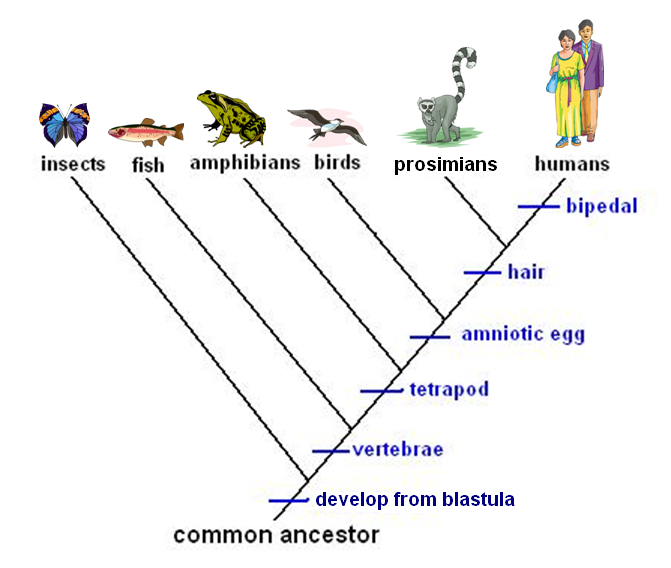
Which organisms pictured on the cladogram have hair?
a)
prosimians only
b)
prosimians and humans
c)
humans only
d)
prosimians and birds
37.

These help the plant to reproduce.

a)

flowers

b)

stems

c)

leaves

d)

roots

38.

What is pollination?

a)

how plants grow

b)

how pollen is made

c)

how plants reproduce

d)

how animals reproduce

39.

The yellow, powdery stuff on the anthers

a)

Pollen

b)

Dust

c)

dirt

d)

Germs

40.

What attracts insects for pollination?

a)

anther

b)

ovary

c)

pistil

d)

petals

41.

What part of the flower must the pollen go down to reach the egg?

a)

Pistil

b)

Stamen

c)

Flower

d)

Anther

42.
Pollination can occur within the same flower. 
a)
True 
b)
False 
43.

Pollination is the process by which the pollen grains are transferred from the ________ to the _________.

a)

anther... ovary

b)

anther ... pistil

c)

pistil ... ovary

d)

pistil ... filament

44.

What is part of some plants that have seeds and is usually sweet?

a)

The fruit

b)

Pistil

c)

pollen

d)

root

45.
If a bee does not come in contact with a flower's pollen...
a)
the plant is not likely to reproduce
b)
the plant is more likely to reproduce
46.
Fertilization is the process by which an 
a)
egg and pollen combine
b)
embryo grows into a plant
c)
animal carries pollen between plants
47.
The enlarged base of the pistil that stores the eggs of the plant is the ___.
a)
ovary
b)
ovule
c)
stigma
d)
style
48.
The part of the stamen that produces microspores that become pollen grains is the ___.
a)
anther
b)
pistil
c)
filament
d)
ovary
49.
Which of the following would represent a sudden environmental change?
a)
Wildfire
b)
Global Warming
c)
Competition for food
d)
Desert encroachment 
50.
Survival of the Fittest and Evolution were proposed by what scientist?
a)
Charles Darwin
b)
Albert Einstein
c)
Steven Hawking
d)
Isaac Newton
51.
Where the better adapted organisms survive to pass traits along to offspring.
a)
Evolution
b)
Natural Selection
c)
Extinction
d)
Artifical Selection
52.
What is the advantage of having different shaped beaks?
a)
To look different from other species.
b)
To be able to eat the food readily available in the environment.
c)
To protect itself against predators.
d)
To protect itself against prey.
53.
Why are advantageous traits more likely to be passed onto offspring?
a)
Because they are more likely to survive and reproduce.
b)
Because they come from dominant alleles.
c)
Because they come from recessive alleles.
d)
Because the trait is an acquired phenotype.
54.
Mutations are a change in what?
a)
DNA
b)
tRNA
c)
genotype
d)
phenotype
55.
Where humans have bred organisms together based on traits we like.
a)
Evolution
b)
Natural Selection
c)
Extinction 
d)
Artificial Selection
56.
Which of the following are examples of evidence for evolution?
a)
Fossils and Cellular Structure
b)
Biological Structures 
c)
Genetics/DNA
d)
All of the Above
57.
The law of superposition states
a)
the oldest rock layer is on the top, the younger rock layer is on the bottom
b)
rock layers are always in sequence from oldest to youngest
c)
the youngest rock layer is on the bottom and the oldest is on the top
d)
the oldest layer is on the bottom and the youngest is on the top when it is undisturbed
58.
Scientist find dinosaur fossils in the bottom of a cliff and mammals fossils in the middle layer, what can be inferred?
a)
dinosaurs ate plants
b)
dinosaurs were eaten by the mammals
c)
they lived at the same time
d)
dinosaurs lived before the mammals
59.
What was the name of the scientist who had the theory of evolution?
a)
Lamarck
b)
Einstein
c)
Washington
d)
Darwin
60.
The goal of every species on earth is...
a)
to survive and reproduce 
b)
divide and conquer 
c)
survive and conquer 
d)
reproduce and die 
61.
How do adaptations help animals?
a)
to hide from predators
b)
to hunt for food
c)
to survive in their habitats
d)
All of these are correct
62.
What is an adaptation?
a)
A feature or behavior that helps an animal survive.
b)
The food that an animal eats.
c)
How energy moves in a food web.
d)
How animals evolve throughout time.
63.
The phase change from water vapor to liquid water is known as...
a)
evaporation
b)
precipitation
c)
condensation
d)
sublimation
64.
2. A change of state from a liquid to a solid is called....
a)
Melting
b)
Freezing
c)
Evaporation
65.
4. What type of state of matter is a gas that has electrons flowing through it?
a)
Gas
b)
Liquid
c)
Plasma
d)
Solid
66.
5. What is it called when a solid turns directly into a gas?
a)
Sublimation
b)
Condensation
c)
Liquid
67.
7. All phase changes (changing states) requires energy to be added or taken away.
a)
True
b)
False
68.
Change from Gas to Solid is called........
a)
Sublimation
b)
Deposition
c)
Fusion
d)
condensation
69.
Change from gas to liquid...
a)
condensation
b)
evaporation
c)
expansion
d)
movement
70.
Change from Liquid to Solid is call......
a)
fusion
b)
Freezing
c)
sublimation
d)
evaporation
71.
change from liquid to gas is called....
a)
expansion
b)
evaporation
c)
condensation
d)
sublimation
72.
All changes in the state of matter of a substance requires
a)
vibration
b)
water
c)
permission
d)
energy
73.
What happens to particles when they are heated?
a)
They speed up and spread out
b)
They slow down and compress
c)
They stop moving
d)
They move closer together and speed up
74.
What is deposition?
a)
Phase change from gas to solid
b)
phase change from liquid to solid
c)
Phase change from solid to gas
d)
Phase change from liquid to gas
75.
What is sublimation?
a)
phase change between solid and liquid
b)
pahse change from gas to solid
c)
phase change from solid to gas
d)
phase change from solid to solid
76.
Melting is ...
a)
liquid to solid
b)
solid to liquid
c)
solid to gas
d)
gas to liquid
77.

Phase change going from Liquid to Solid...

a)

Melting

b)

Freezing

c)

Condensation

d)

Sublimation

78.

Phase change going from a Gas to a Liquid...

a)

Sublimation

b)

Deposition

c)

Ionization

d)

Condensation

79.

Phase change going from a Liquid to a Gas...

a)

Vaporization

b)

Deposition

c)

Condensation

d)

Melting

80.
Is burning wood a chemical or physical change?
a)
chemical
b)
physical
81.
Which of the following is NOT an example of chemical change?
a)
sour milk
b)
burning wood
c)
breaking a pencil
d)
rust
82.
When you break a cracker into pieces it is a 
a)
Chemical change
b)
Physical change
c)
Chemical Weathering
d)
Physical Weathering
83.
When baking soda and vinegar mix it creates a bubbly mess. Is this a chemical or physical change?
a)
Physical
b)
Chemical
84.
a piece of copper is cut in half
a)
physical change
b)
chemical change
85.
a sugar cube is ground up
a)
physical change
b)
chemical change
86.
water is heated and changed to steam
a)
physical change
b)
chemical change
87.
iron pipe rusts
a)
physical change
b)
chemical change
88.
ice cube melts
a)
physical change
b)
chemical change
89.
sodium and potassium react violently with water
a)
physical change
b)
chemical change
90.
water freezes at 0⁰C
a)
physical change
b)
chemical change
91.
What are the three states of matter?
a)
solid, volume, mass
b)
density, volume, mass
c)
solid, liquid, gas
d)
density, gas, volume
92.
Something that takes up space and has mass.
a)
volume
b)
matter
c)
mass
d)
density
93.
A state of matter that has a definite volume and shape.
a)
solid
b)
liquid
c)
gas
d)
matter
94.
The amount of space something takes up
a)
density
b)
volume
c)
mass
d)
matter
95.
Water in its solid form is _____________.
a)
a vapor
b)
ice
c)
a liquid
d)
boiling
96.
Characteristic that can be observed such as color, state, or hardness
a)
physical property
b)
chemical property
c)
density
d)
mass