Wayground logo

Free Printable Worksheets

Font size

S
M
L
XL
Worksheets

Spring Break Make-Up Work Opportunity (Limited Time Offer)

Total questions: 100

Worksheet time: 3hrs 20mins

Name
Class
Date
1.

Starches are...

a)

carbohydrates

b)

proteins

c)

lipid

d)

amino acids

2.
This nutrient helps build muscle mass, repair cartilage, skin and blood. Also known as the building block of life.
a)
Carbohydrates
b)
Fiber
c)
Calorie
d)
Protein
3.
The following are uses for lipids in the body.....
a)
insulation, long term energy store, cell membranes, steroids
b)
short term energy store, cell membranes, muscle repair
c)
insulation, bone growth, genetic information
d)
long term energy, genetic information, cell repair
4.
Carbohydrates are our body's initial energy source.  Which of the following foods are a good source of carbohydrates?
a)
Steak
b)
Potatoes
c)
Butter
d)
Fish
5.

Which of the following is represented in the image?

a)

Nucleotide

b)

Carbohydrate

c)

Lipid

d)

Protein

6.

What is a function of carbohydrates?

a)

To provide energy to living organisms

b)

The provide the structure in muscles

c)

Providing insulation

d)

Storing your genetic information

7.

What is a biomolecule?

a)

The dissolved particle in a solution

b)

One of the by-products of respiration

c)

Large molecule that is present in living organisms

d)

None of the above

8.

Which of the following are biomolecules?

a)

RNA, DNA, proteins, lipids

b)

Proteins, lipids, carbohydrates, polymers

c)

Nucleic acid, lipids, carbohydrates, monomers

d)

Proteins, lipids, carbohydrates, nucleic acids

9.

The function of the nucleic acid is --

a)

to store and transmit genetic information inherited from your parents

b)

to maintain our body temperature

c)

to build up muscles bones and other body parts

d)

to regulate sugar in your blood and give your cells energy

10.

Which biomolecule makes up cell membranes?

a)

Protein

b)

Carbohydrate

c)

Lipid

d)

Nucleic acid

11.
Choose the nucleotide sequence of the RNA strand that would be complementary to the following strand: 
GTAGTCA
a)
UATUAGA
b)
ACGACTG
c)
CAUCAGU
d)
CATCAGT
12.
What is the term for a three-nucleotide sequence that codes for an amino acid?
a)
base
b)
codon
c)
amine
d)
serine
13.

Which of the following is the site of transCription?

a)

vacuole

b)

lysosome

c)

nucleus

d)

ribosome

14.

Which of the following is the site of transLation?

a)

vacuole

b)

lysosome

c)

nucleus

d)

ribosome

15.
Which of the following is created in the nucleus and carries the genetic code to the cytoplasm?
a)
DNA
b)
tRNA
c)
mRNA
d)
rRNA
16.

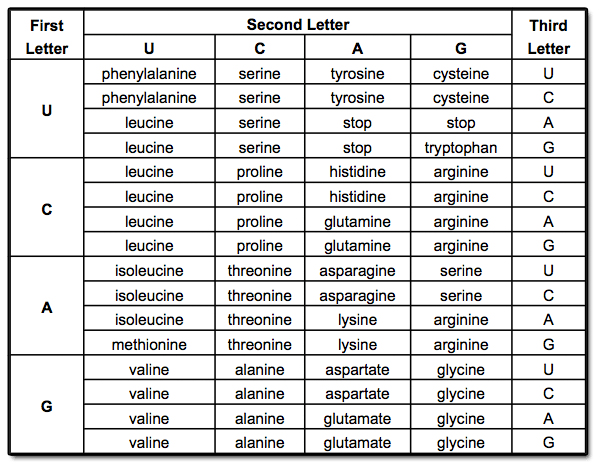
When using your codon chart, what sequence can you use to find the correct amino acid?

a)

DNA

b)

mRNA

c)

tRNA

d)

Any of these will do

17.

What organelle reads the mRNA and finds the correct amino acid?

a)

DNA

b)

Nucleus

c)

Ribosome

d)

Chloroplast

18.

How many nucleotides make up a codon?

a)

1

b)

3

c)

5

d)

15

19.

How many codons: AAU GCG AUG

a)

9

b)

1

c)

3

d)

15

20.

How many nitrogenous bases do you see? AAU GCG AUG

a)

9

b)

3

c)

1

d)

15

21.

What is the order for Protein Synthesis?

a)

Transcription -> Translation -> Protein

b)

Translation - > Transcription -> Protein

c)

Protein -> Transcription -> Translation

d)

Translation -> Protein -> Transcription

22.

Which sequence could be found in RNA?

a)

ACCTGT

b)

CGCATT

c)

AUGCUU

23.
Amino acids are joined together in order to form
a)
DNA
b)
ribosomes
c)
proteins 
d)
RNA
24.
What amino acid is represented by the codon UUA?
a)
Phenylalanine
b)
Tyrosine
c)
Leucine
d)
Stop codon
25.

What is the correct amino acid sequence for the mRNA code AUGCCAGUAUGA

a)

Met-Pro-Ala-Val

b)

Met-Pro-Val

c)

Tyr-Gly-His

d)

Tyr-Gly-Arg-His

26.
The codon CCU codes for what amino acid?
a)
Isoleucine
b)
Stop
c)
Methionine
d)
Proline
27.

The sequence of 3 nucleotides that code for amino acids.

a)

codon

b)

anti-codon

28.
What do helpful mutations do? 
a)
Increases chances of survival 
b)
Decreases changes of survival 
c)
Increases chances of developing cancer
d)
Decreases skills
29.

Mutation

a)

a DNA segment in a chromosome that is a copy of another segment

b)

the loss or excision of a section of genetic code, or its product

c)

the set of observable characteristics of an individual

d)

the changing of the structure of a gene, resulting in a variant form

30.

How many codons do you see? AAU GCG AUG

a)

9

b)

3

c)

1

d)

15

31.

A mutation is defined as:

a)

A change in the cell's structure

b)

Anything that changes in an embryo

c)

Any change in the physical features of a human

d)

A change in the DNA sequence

32.
Where do mutations occur?
a)
DNA and RNA
b)
DNA 
c)
RNA
d)
mRNA and tRNA
33.

A mutation can occur if a base pair is ____________, deleted, or substituted for another.

a)

modified

b)

added

c)

transferred

34.

A mutation in which only one nucleotide is altered is called a:

a)

Frameshift Mutation

b)

Deletion Mutation

c)

Point Mutation

d)

Insertion Mutation

35.

Another name for a point mutation is:

a)

Substitution

b)

Frameshift

c)

Insertion

d)

Deletion

36.

ATTTGAGCC- Original

ATTGAGCC - Mutated

The example above is an example of a

a)

Insertion

b)

Point mutation

c)

Deletion

d)

Substitution

37.

Mutations are random.

a)

True

b)

False

38.

Mutations are SOMETIMES helpful to the organism.

a)

true

b)

false

39.

True or false, mutations create genetic diversity?

a)

True

b)

False

40.

In order for offspring to get a genetic mutation, the mutation must occur in what type of cell?

a)

Cells with no nucleus.

b)

Any body cell after birth.

c)

Cells with no cell wall or cell membrane.

d)

Cells like eggs or sperm cells that are undergoing reproduction.

41.

What mutation has occurred here?

T-G-A-C-C-A

T-G-A-G-C-A

a)

Substitution

b)

Deletion

c)

Insertion

d)

Frameshift

42.

Which organelle is DNA usually found in?

a)

cell membrane

b)

vacuole

c)

chloroplast

d)

nucleus

43.

What are the building blocks of proteins called?

a)

DNA

b)

RNA

c)

Ribosomes

d)

Amino Acids

44.

ATT-TGA-GCC- Original

ATT-GAG-CC - Mutated

The example above is an example of a

a)

Insertion- Frameshift

b)

Deletion- Substitution

c)

Deletion -Frameshift

d)

All of the above

45.

Original DNA: CAT GAT CCA

New DNA: CAT TGA TCC A

What mutation occurred?

a)

deletion

b)

substitution

c)

tranverse

d)

insertion

46.
Are all mutations bad?
a)
Yes
b)
No
c)
Maybe?
47.
Which characteristic would most likely be inherited by a baby?
a)
brown hair
b)
crying a lot
c)
ability to jump high
d)
his ability to talk
48.
The following are inherited traits of humans EXCEPT...
a)
long hair
b)
blue eyes
c)
long eyelashes
d)
small dimples
49.
Which characteristic is inherited?
a)
hair color
b)
sleeping late
c)
enjoying hiking
d)
loving to read
50.
Which of the following cell types is formed by meiosis?
a)
muscle cells
b)
skin cells
c)
sperm cells
d)
blood cells
51.
What is one advantage of sexual reproduction?
a)
offspring are identical to parents
b)
offspring are resistant to viruses
c)
offspring are born live, rather thna from eggs
d)
offspring inherit a wider variety of genetic information
52.
What is a phenotype?
a)
The expression of a trait; what you see.
b)
refers to the genetic makeup of an individual
c)
An organism that has the same genes for a trait (ex. TT or tt)
d)
the passing of traits from parent to offspring
53.
The inherited combination of alleles is known as the offspring's
a)
heredity
b)
phenotype
c)
genotype
d)
redigree
54.
An organism's appearance is known as its
a)
heredity
b)
phenotype
c)
genotype
d)
pedigree
55.
Sex cells are produced through the process of
a)
mitosis
b)
cytokinesis
c)
binary fission
d)
meiosis
56.
What does heterozygous mean?
a)
An organism that has the same genes for a trait (TT or tt)
b)
An organism that has different genes for a trait (Tt)
c)
When neither gene is fully dominant; offspring is a mixture of both
d)
the different forms of a trait (hair color--> brown, blonde, red
57.

A nucleotide consists of

a)

DNA

b)

adenine and thymine

c)

A phosphate, sugar and nitrogenous base

d)

genes

58.

In a DNA molecule, nucleotides are linked together to make up a single strand of DNA then bonded to a second strand. This structure is known as a

a)

RNA

b)

double helix

c)

watson-crick

d)

double nucleotide

59.

In a double strand of DNA, the nitrogen bases only pair in a certain combination. Which combination is correct?

a)

A-C and T-G

b)

C-T and A-G

c)

A-T and G-C

d)

A-A C-C

60.
when you have two different genes
a)
heterozygous
b)
dominant
c)
homozygous
61.
when you have two of the same genes
a)
heterozygous
b)
recessive
c)
homozygous
62.
phenotypes that shows both traits
a)
semi-dominant
b)
heterozygous
c)
codominance
63.
having two of the same genes for the trait (sometimes called purebred).
a)
homozygous
b)
hetrozygous
c)
protein
d)
chromosome
64.
having two different genes for a trait (sometimes called hybrid).
a)
protein
b)
homozygous
c)
heterozygous
d)
genotype
65.
G = green, g = yellow
The genotype for a yellow plant is...
a)
GG
b)
Gg
c)
gg
d)
all of the choices result in yellow
66.
Where, in the eukaryotic cell, is DNA located?
a)
ribosomes
b)
nucleus
c)
E.R.
d)
cytoplasm
67.
Term for an organism that display two dominant phenotypes at the same time
a)
codominance
b)
incomplete dominance
c)
multiple alleles
d)
linked genes
68.
Which of the following is homozygous dominant?
a)
Yy
b)
Y
c)
yy
d)
YY
69.
T - tall and t = short
In the punnett square below, what belongs in the missing square
a)
tt
b)
Tt
c)
Bb
d)
TT
70.
In the punnett square shown, what must the genotype of the missing parent be?
a)
BB
b)
Bb
c)
bb
d)
Tt
71.
This image shows a...
a)
Punnett Square
b)
Phenotype
c)
Genotype
d)
Dominant allele
72.
What genotype is missing from this Punnett Square?
a)
RrYy
b)
RRYY
c)
rryy
d)
RrYY
73.

A dihybrid cross shows the possible outcomes of _______

a)

two alleles

b)

two parents

c)

two traits/characteristics

d)

a self pollination

74.
What gamete possibilities could come from this parent's genotype?
a)
AB, AB, aB, aB
b)
Ab, AB, Ab, ab
c)
Ab, Ab, Ab, Ab
d)
AB, aB, ab, aB
75.
What gamete possibilities could come from this parent's genotype?
a)
aB, ab, AB, Ab
b)
aB, Ab, AB, AB
c)
AB, aB, AB, Ab
d)
aB, ab, aB, ab
76.
What goes in box 1
a)
AABb
b)
AABB
c)
aabb
d)
AaBb
77.
What goes in box 3
a)
Aabb
b)
AABB
c)
AAbb
d)
aaBb
78.
Adenine bonds with ______________.
a)
Guanine
b)
Thymine
c)
Cytosine
d)
Adenine
79.
Guanine bonds with ______________.
a)
Adenine
b)
Guanine
c)
Cytosine
d)
Thymine
80.
Which 2 molecules form the sides (backbone) of the DNA ladder?
a)
deoxyribose sugar and adenine
b)
deoxyribose sugar and a hydrogen bond
c)
deoxyribose sugar and the nucleus
d)
deoxyribose sugar and phosphate
81.
Which of the following units are repeatedly joined together to form a strand of DNA?
a)
amino acids
b)
nucleotides
c)
fatty acids
d)
polysaccharides
82.
Which of the following units are repeatedly joined together to form a strand of DNA?
a)
amino acids
b)
nucleotides
c)
fatty acids
d)
polysaccharides
83.
What is the shape of DNA?
a)
Double helix
b)
Triple helix
c)
Flat, bilayer
d)
Three-pronged rigid ladder
84.
What is the sugar in the DNA molecule?
a)
deoxyribose
b)
ribose
c)
glucose
d)
fructose
85.

Identify the name of this structure.

a)

Phosphate

b)

Sugar

c)

Deoxyribose

d)

Nucleic Acid

e)

Nucleotide

86.

What part of the nucleotide holds your genetic makeup?

a)

Phosphate

b)

Sugar

c)

Nitrogenous base

87.

A nucleotide is made up of how many parts?

a)

0

b)

1

c)

2

d)

3

e)

4

88.

A nucleotide is made up of a ______________, sugar, and a nitrogenous base.

a)

purine

b)

porphyrin

c)

phosphate

d)

philtrum

89.
How many kids did the mother and father from the first generation have?
a)
2
b)
4
c)
5
d)
6
90.
How many females are in this pedigree?
a)
3
b)
4
c)
6
d)
7
91.
What is this?
a)
Pedigree
b)
Karyotype
c)
Venn diagram
d)
Punnett Square
92.

Plants need ________ to conduct photosynthesis

a)

Oxygen

b)

Soil

c)

Carbon dioxide

d)

Sugar

93.
Why do plants conduct photosynthesis?
a)
To make light
b)
To make mitochondria
c)
To make glucose
d)
To release carbon dioxide
94.
Which organelle in the plant cell performs photosynthesis?
a)
Chloroplast
b)
Mitochondria
c)
Nucleus
d)
Cytoplasm
95.
What are the products of photosynthesis (what is made)?
a)
Glucose and Chlorophyll
b)
Glucose and Oxygen
c)
Water and Light
d)
Carbon dioxide and Water
96.
What is the source of energy for photosynthesis?
a)
Carbohydrates (chemical energy)
b)
Light (radiant energy)
c)
Heat (thermal energy)
d)
Wind (kinetic energy)
97.
Which of these conditions would decrease the rate of photosynthesis in a plant?
a)
Above average precipitation
b)
Changing the daylight hours from 14 hrs to 10 hrs
c)
Changing the CO2 concentration from 380 ppm to 410 ppm
d)
All of these choices
98.
Which choice correctly shows the gases that enter and exit plants during photosynthesis?
a)
Enter: Oxygen
Exit: Carbon dioxide
b)
Enter: Water vapor
Exit: Glucose
c)
Enter: Carbon dioxide
Exit: Oxygen
d)
Enter: Light
Exit: Water vapor
99.

Which of the following organelles is responsible for cellular respiration?

a)

Mitochondria

b)

Nucleus

c)

Endoplasmic Reticulum

d)

Ribosome

100.

O2 is the chemical formula for

a)

Oxygen

b)

Carbon Dioxide

c)

Glucose

d)

Water