Wayground logo

Free Printable Worksheets

Font size

S
M
L
XL
Worksheets

Waves

Total questions: 104

Worksheet time: 4hrs 59mins

Name
Class
Date
1.
Waves that require a medium are called 
a)
mechanical waves
b)
transverse waves
c)
light waves
d)
gamma rays
2.
What happens when you increase the amplitude of a sound?
a)
it makes the sound louder
b)
it makes the sound travel faster
c)
it increases the wavelength of the sound
d)
it increases the frequency of the sound
3.

What kind of wave is pictured below?

a)

compressional wave

b)

transverse wave

c)

sound wave

d)

mechanical wave

4.
What can electromagnetic waves travel through?
a)
mediums
b)
empty space
c)
solely solids
d)
both mediums and empty space
5.
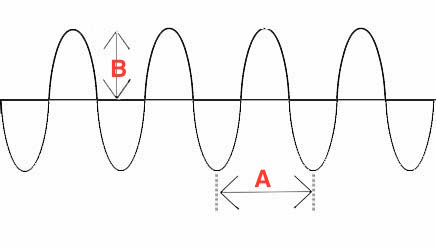
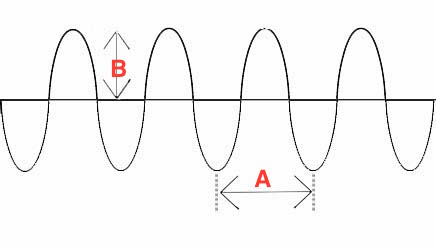
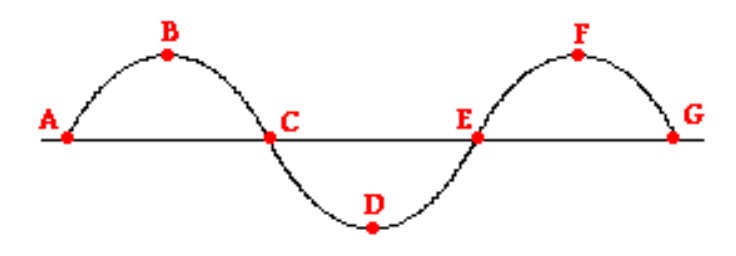
What property of this wave is represented by the letter "A"
a)
amplitude
b)
crest
c)
trough
d)
wavelength
6.
What property of the wave is represented by the letter "B"?
a)
amplitude
b)
crest
c)
trough
d)
wavelength
7.
What do waves carry from place to place?
a)
Energy, but not matter or particles
b)
Energy and matter or particles
c)
Matter or particles but not energy
d)
Neither energy nor matter or particles
8.
Which wave is pictured?
a)
Transverse
b)
Longitudinal
c)
Both
d)
Neither
9.
A wave carries...?
a)
energy only
b)
matter only
c)
energy and matter
d)
neither
10.
What type of wave move a slinky back and forth?
a)
longitudinal
b)
transverse
11.
Which vocabulary term is used to identify the distance between points C & G?
a)
Amplitude
b)
Crest
c)
Frequency
d)
Wavelength
12.
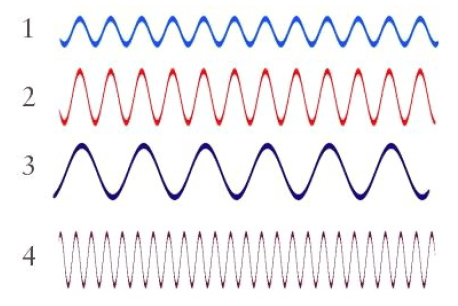
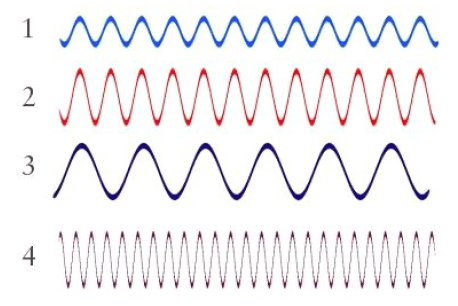
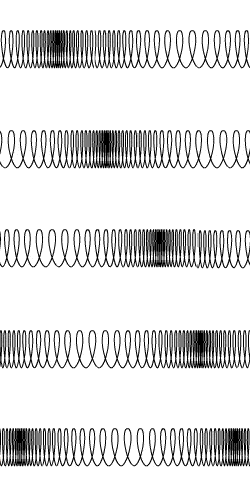
Which wave in the diagram has the greatest frequency?
a)
1
b)
2
c)
3
d)
4
13.
Which wave in the diagram has the greatest wavelength?
a)
1
b)
2
c)
3
d)
4
14.
Which of the following can sound travel through?
a)
solid
b)
liquid
c)
gas
d)
all of the above
15.
What type of wave is this?
a)
Longitudinal
b)
Transverse
16.

The highest point on a wave is:

a)

the crest

b)

the trough

c)

the top

d)

the coast

17.

Which letter(s) represent the trough of the wave?

a)

A

b)

B & D

c)

D

d)

C & G

18.
Which wave has a greater frequency?
a)
A
b)
B
19.
What kind of wave is pictured below?
a)
compressional wave
b)
transverse wave
c)
sound wave
d)
mechanical wave
20.
How would a person measure the wavelength on this sound wave?
a)
dense to less dense
b)
trough to crest
c)
compression to compression
d)
beginning of illustration to the end
21.

You can't hear sounds in outer space because there is no

a)

medium

b)

light

c)

energy

d)

heat

22.

What property of the wave is represented by the letter "B"?

a)

amplitude

b)

crest

c)

trough

d)

wavelength

23.

a disturbance caused by energy moving through a system in a cyclical pattern

a)

Wave

b)

Amplitude

c)

Frequency

d)

Speed

24.

Number of waves passing a given point in a certain amount of time, measured in Hertz (Hz)

a)

wavelength

b)

frequency

c)

amplitude

d)

wave speed

25.

When a wave bounces off of something and moves in a different direction

a)

reflection

b)

refraction

c)

absorption

d)

propagation

26.

when a wave is bent by traveling from one medium to another

a)

reflection

b)

refraction

c)

absorption

d)

propagation

27.

when a wave hits a medium and transfers its energy to the particles of that medium

a)

reflection

b)

absorption

c)

refraction

d)

propagation

28.

The substance that a wave is passing through

a)

medium

b)

frequency

c)

wavelength

d)

gravy

29.
What happens to frequency when the energy increases?
a)
it increases
b)
it decreases
c)
it stays the same
30.
If there is no wave, the particles would be at the _____________________.
a)
wavelength
b)
resting point
c)
trough
d)
beach
31.
When wavelength increases, what happens to the frequency?
a)
it increases
b)
it decreases
c)
it stays the same
32.
Which wave has a longer wavelength?
a)
wave C
b)
wave D
33.
Which wave has a greater frequency?
a)
wave B
b)
wave C
34.
Which wave has the most energy?
a)
top wave
b)
bottom wave
35.
What three things may happen to light that strikes an object? 
a)
The light may be reflected, transmitted or absorbed.
b)
The light may be reflected and refracted.
c)
The light may be absorbed and transmitted.
36.

Which of these provides the best explanation for why the pencil appears broken?

a)

The pencil absorbs the light rays that hit it.

b)

Water reflects light rays away from the pencil.

c)

Light rays are bent by the water in the glass.

d)

The surface of the water reflects the light rays.

37.

Caleb is sitting near the window on a sunny day. When he closes the curtain, the room becomes darker. What property of the curtain allows it to make the room darker?

a)

The curtain absorbs light.

b)

The curtain is brightly colored.

c)

The curtain folds easily.

d)

The curtain is rectangular shape.

38.

At what point is the laser being reflected?

a)

A

b)

B

c)

C

d)

D

39.

Light travels in straight lines until reflected by another object. Which illustration best shows the light being reflected?

a)
b)
c)
d)
40.

Which of the following is the best example of an object absorbing light?

a)

A black sweater in the sun.

b)

A clean window in the sun.

c)

A curved mirror in the sun.

d)

A long shadow in the sun.

41.

Light rays from any light source travel outward in all directions along a straight path until they hit something. which of the following best represents what occurs when light rays hit a glass of water?

a)

The light rays will pass straight through from air to water.

b)

The water absorbs the light, and it will no longer be seen.

c)

The light rays will bend at the boundary of air and water.

d)

The surface of the water will reflect the light off the water.

42.

Which illustration best shows light being refracted?

a)
b)
c)
d)
43.

Which object refracted the laser beam?

a)

Silver locket

b)

Picture frame

c)

Glass marble

d)

Notebook

44.

What makes it possible to see an object when looking through a periscope?

a)

It contains mirrors that reflect the object.

b)

It magnifies small objects so they can be seen.

c)

It absorbs the light rays passing through it.

d)

It separates the light into different colors.

45.

Which of the following is demonstrated when light bounces off of mirrors or shiny surfaces?

a)

Scattering

b)

Refraction

c)

Absorption

d)

Reflection

46.

Which of the following types of electromagnetic radiation has the shortest wavelengths?

a)

Infrared

b)

Ultraviolet

c)

Visible light

d)

Radio waves

47.

Which portion has the longest wavelengths?

a)

A

b)

B

c)

C

d)

D

48.

Our eyes perceive colors because of differences in which of the following properties of light?

a)

Intensity

b)

Wavelength

c)

Angle

d)

Source

49.

Adrian is observing a piece of white paper. His eye perceives the paper to be white because his eye is receiving what kind of light?

a)

Light in all the colors of the visible spectrum.

b)

Light mostly at the ultraviolet end of the spectrum.

c)

Light mostly at the infrared end of the spectrum.

d)

Light the paper produces when heated by the Sun.

50.

The energy that is radiated to Earth by the Sun includes visible light, infrared radiation, ultraviolet radiation, and other types. These different forms of radiation are distinguished based on what property?

a)

Amplitude

b)

Wavelength

c)

Speed

d)

Intensity

51.

Sunlight is a mixture of electromagnetic waves, ranging from infrared to ultraviolet. Which of the following types of electromagnetic radiation has the longest wavelengths?

a)

Infrared

b)

Ultraviolet

c)

Visible light

d)

Radio waves

52.

Which portion can be detected by the human eye?

a)

A

b)

B

c)

C

d)

D

53.

Brooke wakes up in the morning to rind a rainbow produced by light shining through the fish tank near her window. Which of the following types of electromagnetic radiation produced the rainbow that Brooke saw?

a)

Ultraviolet

b)

Infrared

c)

White light

d)

Gamma rays

54.

A combination of all the wavelengths with in the visible light portion of the electromagnetic spectrum will result in which of the following colors?

a)

White

b)

Red

c)

Violet

d)

Blue

55.

Which of the following best describes the radiation our planet receives from the Sun?

a)

All the radiation is infrared radiation.

b)

The radiation is in many different wavelengths.

c)

All the radiation is ultraviolet radiation.

d)

The radiation includes all wavelengths except visible light.

56.
The bending of light when it moves through one kind of matter to another is.....
a)
absorption
b)
reflection
c)
refraction
d)
a rainbow
57.
The bouncing of light off an object is ....
a)
a mirror
b)
absorption
c)
reflection
d)
refraction
58.
The taking in of light by a material....
a)
absorption
b)
reflection
c)
refraction
d)
dark colors
59.
Light is a kind of.....
a)
reflection
b)
energy
c)
heat
d)
matter
60.
Which of these describes how light travels through an empty space?
a)
It travels straight but may change direction to avoid objects.
b)
It changes direction often even if there are no objects. 
c)
It comes to a stop after it travels a certain distance. 
d)
It travels in a straight line without stopping. 
61.
What surface best reflects light?
a)
dull
b)
shiny
c)
clear
d)
black
62.
What kind of path does light take?
a)
It travels in a straight line until it hits something or goes through it.
b)
It bounces off all objects.
c)
It curves around all objects.
d)
It goes through all objects.
63.
What happens to light passing through a prism?
a)
It goes right through it.
b)
It bends and the light separates.
c)
It bounces off it
d)
It goes around it.
64.
How is refraction different from reflection.
a)
Reflection is the bouncing of light off an object and refraction is the bending of light when it moves through one kind of matter to another.
b)
Reflections is the bending of light when it moves through one kind of matter to another and refraction is the bouncing of light off an object.
65.
If a black and white car were in the parking lot all day. Compare the temperatures of the two cars.
a)
The black car would be cooler.
b)
The white car would be hotter.
c)
The black car would be hotter.
d)
They would be the same
66.
A region that contains few or no particles
a)
Vacuum
b)
Velocity
c)
Velcro
d)
Volcano
67.
Allows little to no light through.
a)
Transparent
b)
Translucent
c)
Opal
d)
Opaque
68.
Band of color in a rainbow, or from a light passing through a prism.
a)
Spectrum
b)
Space
c)
Prism
d)
Refraction
69.
Transfer of energy when a wave disappears into a surface
a)
Transparent
b)
Refraction
c)
Reflection
d)
Absorption
70.
Allows most light through
a)
eflection
b)
Refraction
c)
Translucent
d)
Transparent
71.
The number of vibrations a wave makes in a given amount of time is a 
a)
Absorption
b)
Medium
c)
Frequency
d)
Photon
72.

Sound travels fastest in...

a)

solids

b)

liquids

c)

gases

d)

air

73.
Sound is a form of? 
a)
energy
b)
pitch
c)
volume
74.
An object that does not vibrate cannot produce
a)
sound
b)
light
c)
heat
d)
electricity
75.

A place where no sound exists is...

a)

in the air

b)

under water

c)

space

d)

all of the above

76.
Sound is a form of energy produced by ______________.
a)
vibrations
b)
distances
c)
prisms
d)
Ms. Crews
77.
Sound waves travel the SLOWEST through _____________.
a)
gases
b)
solids
c)
liquids
78.
The volume of a sound is measured in units called ________
a)
decibels
b)
liters
c)
sound waves
d)
inches per minute
79.
Why is sound able to travel faster through a solid than a gas?
a)
Gas molecules are packed tightly.
b)
Sound does not travel faster through a solid than a gas.
c)
Solid molecules are packed tightly.
d)
Gas molecules move slowly.
80.
Sound does not travel in space because
a)
Space is too far away.
b)
There is no matter in space.
c)
Space is the final frontier
d)
Space has planets.
81.
You stand outside a room that has the doors and windows closed. Why can you still hear sounds made inside the room?
a)
Vibrations are absorbed in the doors and windows
b)
Vibrations are reflected inside the room
c)
Vibrations travel through the door and the window
d)
Vibrations echo in the room
82.
Why do we see lightning before we hear the thunder?
a)
Our eyes trick us
b)
Light travels faster than sound
c)
they're two separate things
83.

Which of these is NOT a medium?

a)

light

b)

air

c)

wood

d)

metal

84.

Which sentence BEST describes how sound moves?

a)

Sound can move through solids, liquids, or gases.

b)

Sound can move through empty space or through matter.

c)

Sound can move through solids and liquids but not through gases.

d)

Sound can move through liquids and gases but not through solids.

85.

How can I produce a sound?

a)

heating an object

b)

hitting an object

c)

moving the mouth

d)

looking an object

86.
Which of the following is an example of sound traveling through a solid?
a)
When you hear people in another room
b)
When you hear things underwater
c)
When you are talking to the person next to you
d)
Sound cannot travel through solids
87.

Sarah and Maria made a telephone using two cans and a string. It was a very long string. Maria went upstairs in her house and Sarah stayed downstairs. Maria spoke softly into the can. "I can hear you!' Sarah said back. How can this happen?

a)

Sound waves travel through a vacuum.

b)

Sound waves travel from high to low.

c)

Sound waves travel through solids like the string.

d)

Maria talked so loudly that Sarah could hear her without the phone.

88.

Will a homemade telephone made of two cans and a string work better with a tightly-woven string or a loosely-woven string?

a)

a tightly woven string because it will not come apart as easily

b)

a loosely woven string because the sound waves have more room to move

c)

a tightly woven string because sound waves travel best through dense materials

d)

a loosely woven string because sound waves travel best through less dense materials

89.

Sound travels faster in objects that have a greater.....

a)

Mass

b)

Density

c)

Volume

d)

Yards

90.
Digital offers better clarity, but analog gives you richer quality.
a)
True
b)
False
91.
This is how analog signal looks like.
a)
True
b)
False
92.
A big advantages of digital technology is the recording does degrade over time.
a)
True
b)
False
93.
An analog signal is sent in Discrete pulses in two states, on= 1 or off= 0.
a)
True
b)
False
94.
Is this digital or analog?
a)
Digital 
b)
Analog
95.
Is this digital or analog?
a)
Digital 
b)
Analog
96.

Which of the following is an example of an Digital signal storage?

a)
b)
c)
d)

All of these

97.
Why are digital signals more reliable in transmitting information than analog signals? 
a)
They are more powerful
b)
They carry less information
c)
They have less interference over long distances
d)
They have more interference over long distances
98.
An analog signal is...
a)
continuous
b)
in pulses
99.

Identify a disadvantage of an analog signal:

a)

Requires low power

b)

Doesn't get interference

c)

When copied, quality goes down

d)

Hardware is usually small

100.
What is true about a digital signal?
a)
They are easily distorted or affected by interference
b)
They take up more space
c)
They require more information
d)
They are generally considered more reliable
101.
How can a signal be transmitted?
a)
Tone
b)
Light
c)
Electric Pulses
d)
All of the Above
102.
Which of the following is an advantage of analog signals
a)
Less prone to interference
b)
Requires less power
c)
Travels Farther
d)
Carries more detailed information
103.

This is a signal that fluctuates exactly like the original signal.

a)

Analog

b)

Digital

c)

High Definition

d)

Binary

104.

This is a signal where the data is represented by binary digits.

a)

Digital

b)

Analog

c)

NTSC

d)

CRT