wayground logo

Free Printable Worksheets

NEW

Font size

S
M
L
XL
Worksheets

Edexcel Biology B Topic 3 Review

Total questions: 70

Worksheet time: 35mins

Name
Class
Date
1.
All of the different species of microscopic organisms living in and on your body would be called a(n)
a)
community
b)
ecosystem
c)
species
d)
population
2.
Which statement best describes a contribution that decomposers make to an ecosystem?
a)
They reduce the atomic mass of carbon atoms
b)
They increase the recycling of carbon-containing molecules.
c)
They reduce the total number of carbon atoms in the atmosphere.
d)
They increase the total number of carbon nuclei within the atoms.
3.
Strep throat is a common human illness often caused by the bacterium Streptococcus pyogenes. Which term best classifies the colonies of Streptococcus pyogenes in a person with strep throat?
a)
 a population
b)
an organelle
c)
a community
d)
an ecosystem
4.
Which statement describes how a mutation would most likely affect a population?
a)
Genotypic variation will increase in the population.
b)
Genotypic variation will decrease in the population.
c)
The occurrence of a preexisting gene will increase in the population.
d)
The occurrence of a preexisting gene will decrease in the population.
5.
The Isthmus of Panama is a narrow strip of land that lies between the Caribbean Sea and the Pacific Ocean. It forms a land bridge that links North and South America. The formation of this isthmus separated two bodies of water that had previously been connected. How did the formation of this land bridge most likely influence the development of distinct marine species on either side of the land bridge?
a)
by decreasing genetic drift
b)
 by causing a founder effect
c)
by increasing the rate of genetic mutation
d)
 by preventing related populations from interacting
6.
The graph represents the number of light brown and dark brown organisms living on the bottom of a clear, sandy lake 20 years ago. Over time, the lake bottom has become covered with dark sand and sediment. Which change has most likely occurred in the population?
a)
The number of light-brown individuals increased.
b)
 The number of dark-brown individuals increased.
c)
The number of light-brown and dark-brown individuals increased.
d)
The number of light-brown and dark-brown individuals became equal.
7.
The presence of a specific trait is genetically inherited. There are only two possible outcomes for this trait: an individual either inherits the trait or does not inherit the trait. Which statement best describes how parents influence this trait?
a)
Each parent contributes two genes for this trait.
b)
Each parent contributes one allele for this trait
c)
Each parent contributes two chromosomes for this trait.
d)
Each parent contributes one nitrogenous base for this trait.
8.
Which statement best describes the process by which the millions of body cells that form a housefly can all contain the same genetic information?
a)
Original DNA is duplicated during replication and then distributed into two new cells.
b)
Original RNA is duplicated during replication and then distributed into two new cells.
c)
Original DNA is duplicated during replication and then distributed into four new cells.
d)
Original RNA is duplicated during replication and then distributed into four new cells.
9.
Two organisms that are closely related would have
a)
very similar DNA sequence
b)
exactly the same DNA sequences
c)
no proteins in common
d)
completely different DNA sequence
10.
When Hurricane Marilyn struck the Caribbean islands in 1995, a group of about 15 green iguanas floated on storm debris from the island of Guadeloupe to the island of Anguilla. No other iguanas lived on Anguilla. Because the iguanas are geographically isolated from others of their species, the iguanas will MOST LIKELY
a)
develop new traits.
b)
be unable to breed.
c)
be unable to survive.
d)
interbreed with other species.
11.

The drastic reduction in genetic variation that results when a new, isolated population is established by a very small number of individuals from a larger population is known as

a)

the founder effect.

b)

speciation.

c)

natural selection.

d)

gene flow.

12.
Prokaryotes used to be classified as a single kingdom. New technology allowed them to be split into...
a)
Protista and Prokaryota
b)
Protista and Bacteria
c)
Eubacteria and Archaea
d)
Archaea and Eukarya
13.
According to the diagram, when did the common ancestor of giant pandas and spectacled bears exist? 
a)
5-10 mya
b)
10-15 mya
c)
15-20 mya
d)
20-25 mya
14.
Which list includes only structures that would be found in a prokaryotic cell? 
a)
Cell wall, plasma membrane, mitochondria
b)
Central vacuole, cell wall, lysosome
c)
Cell wall, plasma membrane, cytoplasm
d)
Plasma membrane, nucleus, mitochondria
15.
Which statement best describes how the use of antibiotics on certain bacteria affects natural selection? 
a)
Natural Selection is altered because bacteria are killed
b)
The rate of selection is decreased because antibiotics kill only young bacteria
c)
Antibiotics alter natural selection by causing bacterial DNA to mutate 
d)
The rate of selection is increased because antibiotics do not kill bacteria that are naturally resistant to them. 
16.

A process in nature in which organisms possessing certain inherited traits are better able to survive and reproduce compared to others of their species.

a)

Isolating Mechanisms

b)

Natural Selection

c)

Punctuated Equilibrium

d)

Speciation

17.

The measure of the frequency of an allele at a genetic locus in a population; expressed as a proportion of percentage.

a)

Allele Frequency

b)

Embryology

c)

Evolution

d)

Extinction

18.

Tail length in mice varies within a population. Scientists observed change in the distribution of tail lengths in a mouse population over time. At the genetic level, what has most likely happened to the allele of the shortest tail lengths?

a)

The allele changed from being dominant to being recessive.

b)

The allele changed from being autosomal to being sex-linked.

c)

The allele became less frequent than the alleles for longer-tail lengths.

d)

The allele began to code for long tail lengths instead of the shortest ones.

19.

The frequency of an allele in a fly population changes from 89% to 20% after three generations. Which other events most likely occurred during the same time period?

a)

An environmental change and a fly population increase

b)

An environmental change and a fly population decrease

c)

Interbreeding of flies with an invasive species and fly population speciation

d)

Interbreeding of flies with an established local species and fly population speciation

20.

A population of squirrels was separated during the formation of the Grand Canyon. Over time the squirrels, separated by the canyon walls and the Colorado River, became unique species. Which mechanism most likely caused the development of the new species?

a)

habitat preference

b)

increased gene flow

c)

geographic isolation

d)

behavioral isolation

21.

A researcher observes two species of frogs in the same area. Both species have a similar diet. One species breeds in fast-moving streams, while the other species breeds in ponds. Both species are similar in appearance and have very similar DNA. Which information provides the best evidence that these two species descended from a common ancestor?

a)

the species' similar diets

b)

the species' shared habitat

c)

the species' mating behaviors

d)

the species' physical characteristics

22.

Overuse of antibiotics has caused antibiotic resistance in some bacteria in a population. Which statement describes the most likely impact of natural selection on the bacterial population?

a)

Beneficial mutations have deceased, resulting in a larger population than normal.

b)

Only the genes for antibiotic resistance are now expressed, eliminating other genes.

c)

More antibiotic-resistant bacteria have survived, resulting in more offspring with this trait.

d)

The bacteria have become genetically isolated, resulting in decreased reproductive rates.

23.

The graphs illustrate change in a lizard population over time. Which process most likely led to the change in the lizard population?

a)

Natural selection acting on a harmful trait.

b)

Natural selection acting on a beneficial trait.

c)

Natural selection acting on a dominant trait.

d)

Natural selection acting on a recessive trait.

24.

An aye-aye is a small nocturnal lemur that weighs about four pounds. This endangered species is found in Madagascar, a large island off the east coast of southern Africa. The main food for aye-ayes is larvae that live in wood. Aye-ayes find the larvae by tapping on tree branches. They also eat nuts and fruit. Aye-ayes spend most of their time alone. Each animal occupies about 15 acres and marks the territory, which alerts other aye-ayes of the boundary.


For the aye-aye species, what is most likely the primary value of individuals living alone?

a)

decreased space needs for the species

b)

increased survival rates with habitat loss

c)

reduced competition for natural resources

d)

greater genetic variability within the species

25.

The skeletons of mammalian forelimbs represent variations of a structure that was present in their common ancestor. What has most likely caused the variation in forelimbs?

a)

changes in muscle structure

b)

changes in the genetic code

c)

trait formation due to behaviors

d)

development of vestigial structures

26.

An aye-aye is a small nocturnal lemur that weighs about four pounds. This endangered species is found in Madagascar, a large island off the east coast of southern Africa. The main food for aye-ayes is larvae that live in wood. Aye-ayes find the larvae by tapping on tree branches. They also eat nuts and fruit. Aye-ayes spend most of their time alone. Each animal occupies about 15 acres and marks the territory, which alerts other aye-ayes of the boundary.


The map indicates four locations of aye-aye populations. Which location would most likely have an aye-aye population with the greatest variation in allele frequencies?

a)

location 1

b)

location 2

c)

location 3

d)

location 4

27.

Why is it when habitat is fragmented, smaller population sizes lead to extinction?

a)

small populations are unable to breed

b)

individuals will always migrate out of the area

c)

there are too many individuals in one habitat

d)

gene flow is restricted and inbreeding occurs

28.
The place where an organism lives is its __________.
a)
habitat
b)
ecosystem
c)
organism
d)
population
29.
All of the nonliving parts of an ecosystem are __________.
a)
biotic
b)
biology
c)
abiotic
d)
biography
30.
A group of organisms of the same species living in the same area are called a/an __________.
a)
community
b)
habitat
c)
population
d)
ecosystem
31.
All of the living AND non-living things in an area that interact with each other are called a/an __________.
a)
community
b)
habitat
c)
population
d)
ecosystem
32.
The number of species within a specific habitat.
a)
Conservation
b)
Sustainable development
c)
Biodiversity
d)
Preservation
33.
Which of the following is an example of an ecosystem service?
a)
water filtration
b)
food 
c)
oxygen
d)
they all are!
34.

Which of the following is NOT and ecosystem service?

a)

Provisioning Services

b)

Regulating Services

c)

Cultural Services

d)

Economic Services

35.

Fruits, fish, and livestock are all examples of what type of ecosystem service?

a)

Economic

b)

Provisioning

c)

Regulating

d)

Cultural

36.

Music, art, and architecture born from interactions with nature are all examples of what type of ecosystem service?

a)

Provisioning

b)

Regulating

c)

Cultural

d)

Supporting

37.

Natural processes such as nutrient cycling and the creation of soils are all examples of what type of ecosystem service?

a)

Provisioning

b)

Regulating

c)

Cultural

d)

Supporting

38.

Which of the following would be an example of a regulating service?

a)

Nutrient cycling

b)

Photosynthesis

c)

Drinking water from a creek

d)

Bees pollinating flowers

39.

Bacteria decomposing waste is an example of what type of ecosystem service?

a)

economic

b)

regulating

c)

provisioning

d)

supporting

40.
Which of the following organisms are LEAST closely related?
a)
organisms that share a domain
b)
organisms that share a family 
c)
organisms that share a genus 
d)
organisms that share a species 
41.
The 8 levels of classification, most broad to most specific.
a)
Domain, Genus, Family, Order, Class, Phylum, Kingdom, Species
b)
Domain, Species, Kingdom, Genus, Phylum, Family, Class, Order
c)
Domain, Kingdom, Phylum, Class, Order, Family, Genus, Species
d)
Order, Kingdom, Species, Domain, Phylum, Family, Class, Genus
42.
Who first proposed binomial nomenclature as a way of classifying organisms?
a)
Carl Linnaeus
b)
Carl's Jr.
c)
Charles Darwin
d)
Henry Groseclose
43.
Cells that do not have a true nucleus are called....
a)
eukaryote
b)
prokaryote
c)
unicellular
d)
multicellular
44.
Which organisms are most closely related?
a)
Equus caballas (Horse) & Equus burchellii (Zebra)
b)
Cyanea artica (Jellyfish) &
Ctenodiscus crispatus (Mud Starfish)
c)
Naja naja (cobra) & Glycine max (soya bean)
d)
Ophiocomina nigra (black brittle star) & Brassica nigra (black mustard)
45.
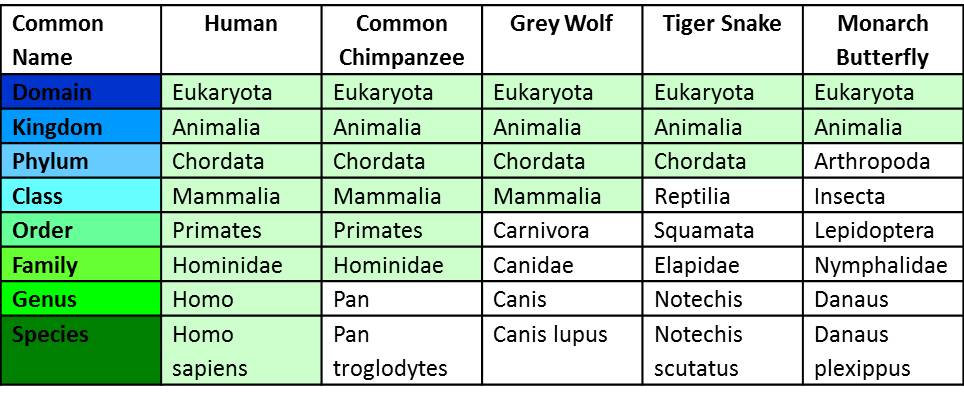
Which organism in the table is least closely related to the chimpanzee?
a)
human
b)
grey wolf
c)
tiger snake
d)
monarch butterfly
46.

Choose the correct way to write the scientific name for humans:

a)

homo sapiens

b)

Homosapiens

c)

Homo sapiens

d)

Homo Sapiens

47.
Which of the six kingdoms correspond to the domain Eukarya?
a)
the kingdoms Eubacteria and Archaebacteria only
b)
the kingdoms Eubacteria, Archaebacteria, Protista, and Fungi only
c)
the kingdoms Plantae and Animalia only
d)
the kingdoms Protista, Fungi, Plantae, and Animalia only
48.
Fungi are different from plants primarily because they
a)
are nonmotile.
b)
contain chlorophyll.
c)
are heterotrophic.
d)
have cell walls.
49.
The image shows a multicellular organism. This organism lives in water and can best be viewed using a microscope. It often reproduces asexually by budding, has no cell walls, and obtains energy by eating other organisms. Into what kingdom would you classify this organism?
a)
Animalia
b)
Fungi
c)
Plantae
d)
Protista
50.

Which of the following are homologous structures?

a)

whale flipper and bat wing

b)

legs on a beetle and legs on a cat

51.
The diagram illustrates an embryonic stage of two organisms.

Which of the following can be determined by observing the embryos shown in the diagram
a)
The organisms share a common ancestry.
b)
The organisms belong to the same genus.
c)
The organisms are native to the same geographic areas.
d)
The organisms will grow into anatomically similar adults.
52.
Which of the following pieces of evolution evidence deals with similar molecules in related individual species?
a)
fossil record
b)
comparative embryology
c)
DNA comparison
d)
comparative anatomy
53.
Which of the following pieces of evolution evidence deals with comparing similar structures in various species?
a)
fossil record
b)
comparing embryology
c)
comparing biochemistry
d)
comparing anatomy
54.
When has speciation occurred?
a)
When populations no longer look the same
b)
When populations no longer have the same frequency of alleles
c)
When populations are living in different environments
d)
When populations can no longer interbreed
55.
A horse and a donkey can successfully mate to produce offspring known as a mule.  Mules are sterile .  Would mules be classified as a species?
a)
Yes, mules have enough of their own traits to be considered a species.
b)
Yes, the fact that have different number of chromosomes makes them a different species
c)
No, mules are too similar to the parent species
d)
No, due to their inability to reproduce successfully.
56.
A chance occurrence that negatively affects a population because the population is small is 
a)
genetic drift
b)
mutation
c)
speciation
d)
migration
57.
Why would a population with a large amount of genetic variation be more likely to survive a severe climate change in its environment?
a)
Individuals will only create offspring well-suited to the climate change
b)
The individuals would produce more offspring
c)
Individuals better suited to the new climate will help less-suited individuals survive
d)
Some individuals will posses traits better suited to the new climate and be more likely to pass them on
58.
What type of genetic drift occurs when the population size is greatly decreased due to a random event?
a)
Founder's Effect
b)
Bottleneck Effect
c)
Intrasexual Selection
d)
Intersexual Selection
59.
Which of the following is NOT part of the Biological Species Concept?
a)
Must meet in nature & have gene flow
b)
Must be able to reproduce & share a gene pool
c)
Offspring must be sterile
d)
Offspring must be fertile
60.
Fruit flies are beginning to live & mate on different types of fruit on the floor of the Amazon. Bigger fruit flies prefer rotting mangos, while smaller fruit flies prefer rotting bananas. What type of reproductive barrier is this?
a)
habitat isolation
b)
temporal isolation 
c)
gametic isolation
d)
mechanical isolation 
61.
A flash flood carried a raft of Amazon ants away from their original population. There is enough distance between the two groups, that they will never meet in nature again. What type of reproductive barrier is this?
a)
behavioral isolation
b)
temporal isolation 
c)
gametic isolation
d)
geographic isolation 
62.
The pollen (sperm) of a flowering plant cannot fertilize the egg cell of a nearby flowering plant of its kind. What type of reproductive barrier is this?
a)
behavioral isolation
b)
temporal isolation 
c)
gametic isolation
d)
geographic isolation 
63.
When reproductive barriers separate a population of a species in nature, the species no longer share a... 
a)
taxa
b)
gene pool 
c)
phylogenetic tree
d)
species 
64.
The genitalia of the male damselfly varies in shape. Certain males can only hold onto & mate with females whose genitalia fit.  What type of reproductive barrier is this?
a)
behavioral isolation
b)
temporal isolation 
c)
gametic isolation
d)
mechanical isolation 
65.
When a zebra & horse mate, they create a zorse. Zorses are most often sterile. What type of reproductive barrier is this?
a)
behavioral isolation
b)
hybrid sterility 
c)
gametic isolation
d)
mechanical isolation 
66.
Some female peacocks prefer males with large, colorful tales while other female peacocks prefer males with no tail at all. Females are beginning to only mate with the type of males with the tail they prefer. What type of reproductive barrier is this?
a)
behavioral isolation
b)
hybrid sterility 
c)
temporal isolation
d)
mechanical isolation 
67.
The flowers of pink tulips open in the morning, while the flowers of lavender tulips open in the early afternoon. The bees that pollinate these tulips cannot carry pollen back & forth between the two types of tulips because of their flowers being closed at different times of day. What type of reproductive barrier is this?
a)
behavioral isolation
b)
hybrid sterility 
c)
temporal isolation
d)
mechanical isolation 
68.
The term for the formation of new and distinct species over the course of evolution is...
a)
speciation
b)
biological species concept
c)
reproductive barrier
d)
natural selection
69.
What evidence does speciation provide for the theory of evolution by natural selection?
a)
Speciation can show us that new species don't choose to adapt, but have changed due to diverging from an original species due to reproductive barriers.
b)
Speciation can show us that new biological species can come from divergence (separating) due to reproductive barriers.
c)
Speciation can show us that environmental changes & genetic variation play a role in the process of a new species diverging from an original species due to reproductive barriers. 
d)
All of the above fit!
70.

when populations are separated by geographic barriers

a)

allopatric

b)

peripatric

c)

sympatric

d)

parapatric