wayground logo

Free Printable Worksheets

NEW

Font size

S
M
L
XL
Worksheets

Inheritance & Variation

Total questions: 80

Worksheet time: 2hrs 32mins

Name
Class
Date
1.

What are chromosomes?

a)

Long strands of DNA that contain lots of genes.

b)

Different versions of a gene.

c)

The basic unit of heredity; controls a specific trait.

d)

A characteristic passed from parent to offspring

e)

The differences that occur from a mixture of genes

2.

What are alleles?

a)

Long strands of DNA that contain lots of genes.

b)

Different versions of a gene.

c)

The basic unit of heredity; controls a specific trait.

d)

A characteristic passed from parent to offspring

e)

The differences that occur from a mixture of genes

3.

What is a gene?

a)

Long strands of DNA that contain lots of genes.

b)

Different versions of a gene.

c)

The basic unit of heredity; controls a specific trait.

d)

A characteristic passed from parent to offspring

e)

The differences that occur from a mixture of genes

4.

What is an inherited trait?

a)

Long strands of DNA that contain lots of genes.

b)

Different versions of a gene.

c)

The basic unit of heredity; controls a specific trait.

d)

A characteristic passed from parent to offspring

e)

The differences that occur from a mixture of genes

5.

What is genetic variation?

a)

Long strands of DNA that contain lots of genes.

b)

Different versions of a gene.

c)

The basic unit of heredity; controls a specific trait.

d)

A characteristic passed from parent to offspring

e)

The differences that occur from a mixture of genes

6.

The offspring of asexually reproducing organisms have genes that are ____________ to that of their parent.

a)

different

b)

same

c)

dominant

d)

recessive

7.

The offspring of sexually reproducing organisms have genes that are _____________ from that of their parents.

a)

different

b)

same

c)

dominant

d)

recessive

8.

In sexually reproducing organisms, each parent contributes _____________ of the genes acquired by the offspring.

a)

an eighth

b)

a quarter

c)

a half

d)

three quarters

9.

The difference between genotype and phenotype is :

a)

Genotype shows the combination of alleles that provides the genes for a trait, while phenotype is the expression of the trait, what it will look like.

b)

Phenotype shows the combination of alleles that provides the genes for a trait, while genotype is the expression of the trait, what it will look like.

10.

Why do human siblings look similar, but not always identical if they have the same parents?

a)

The reason that siblings can look similar without being identical is that there is always a mutation in the chromosomes.

b)

The reason that siblings can look similar without being identical is that they have the exact same DNA, but it is in a different order.

c)

The reason that siblings can look similar without being identical is that there are multiple combinations of alleles that code for genes, that express as traits that can be inherited.

11.

How can you tell if an offspring is the result of asexual or sexual reproduction?

a)

If the offspring is genetically identical to its parent then it will be the result of asexual reproduction, and if it is genetically different to its parents, then it will be the result of sexual reproduction.

b)

If the offspring is genetically different to its parent then it will be the result of asexual reproduction, and if it is genetically identical to its parents, then it will be the result of sexual reproduction.

12.

A Punnett square showing the cross between two pea plants is shown. In pea plants, the smooth coat allele is (R) the wrinkled coat allele is (r). Which is the dominant allele?

a)

smooth coat (R)

b)

wrinkled coat (r)

13.

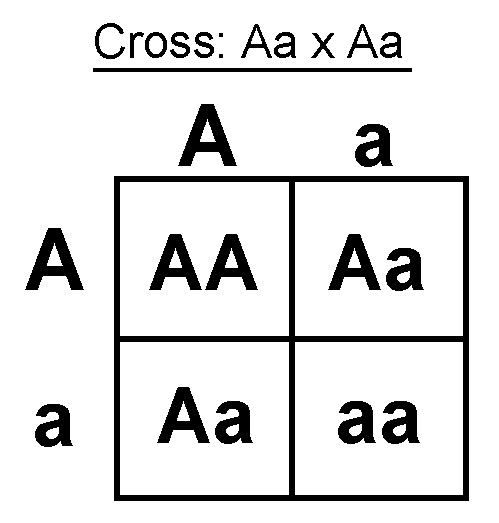
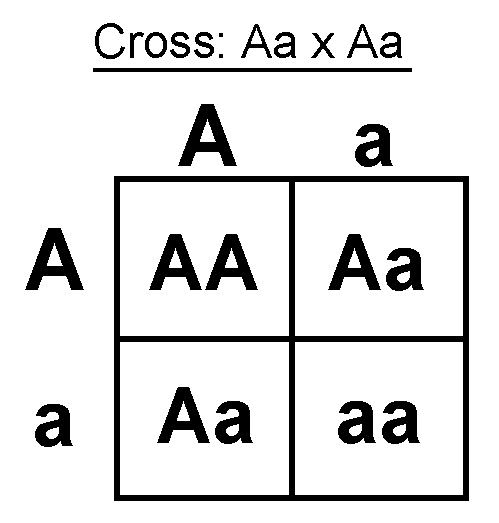
A complete Punnett square here shows a cross between two mice with different fur color, agouti (A) and black (a). What is the probability of the recessive phenotype being expressed?

a)

25%

b)

50%

c)

75%

d)

100%

14.

How is it genetically possible for parents with both natural brown hair, a dominant phenotype have an offspring with blonde hair, a recessive phenotype?

a)

Both parents have blonde, but have dyed their hair brown.

b)

Both parents have the allele for blonde hair that they passed down to their offspring.

c)

The offspring is not their child.

15.

Passing of features from the offsprings are called as...

a)

Keys

b)

DNA

c)

Genes

d)

Inheritance

16.

What term is used to describe a genotype with two of the same alleles?

a)

Homozygous

b)

Heterozygous

17.

What term is used to describe a genotype with two different alleles?

a)

Homozygous

b)

Heterozygous

18.

What would the genotype Tt be termed as?

a)

Heterozygous

b)

Homozygous Dominant

c)

Homozygous Recessive

19.

What would the genotype tt be termed as?

a)

Heterozygous

b)

Homozygous Dominant

c)

Homozygous Recessive

20.

What would the genotype AA be termed as?

a)

Heterozygous

b)

Homozygous Dominant

c)

Homozygous Recessive

21.

What is the definition of a genotype?

a)

An individuals alleles for a particular characteristic

b)

An individuals physical appearance

c)

The differences between members of the same species

d)

Variation that can be measured

22.

What is the definition of a phenotype?

a)

An individuals alleles for a particular characteristic

b)

An individuals physical appearance

c)

The differences between members of the same species

d)

Variation that can be measured

23.

Describe why offspring will not necessarily follow the expected genotype ratio

a)

Fertilisation is random

b)

Fertilisation is inaccurate

c)

Punnet squares are not reliable

d)

Different alleles appear during fertilisation

24.

The reproductive process in which a single cell makes a copy of itself

a)

Variation

b)

Inherited trait

c)

Inherited trait

d)

Asexual reproduction

25.

When someone says that a daughter looks just like her mother, is it possible that the daughter is an exact copy of her mother?

a)

No, because a daughter gets all of her alleles from her father.

b)

Yes, because a daughter gets alleles from her mother.

c)

No, because a daughter receives half of her genetic make up from her father.

d)

Yes, because humans can practice asexual reproduction under certain circumstances.

26.
The cells produced via meiosis are called:
a)
sex cells
b)
somatic cells
c)
body cells
d)
skin cells
27.
This produces 2 identical cells.
a)
mitosis
b)
meiosis
28.

A human usually has xx amount of chromosomes.

a)

6

b)

23

c)

4

d)

46

e)

92

29.
What kind of cells are made in MEIOSIS?
a)
Haploid cells
b)
Diploid Cells
c)
Skin Cells
d)
Liver Cells
30.
If the Diploid number of Carrots is 18, the haploid number is
a)
18
b)
9
c)
27
d)
36
31.
The process of crossing over occurs in what phase of meiosis?
a)
anaphase 1
b)
prophase 1
c)
prophase 2
d)
telophase 1
32.
The chromosomes that pair up during meiosis, are called __________ chromosomes.  
a)
homozygous 
b)
asexual
c)
homologous
d)
genes
33.
When homologous chromosomes match up, they form a structure call a ___________.
a)
tetrad (pair of chromosomes, one from mom and one from dad)
b)
triad
c)
diploid
d)
quad (group of 4 replicated chromosomes, 2 from mom and 2 from dad)
34.
Crossing over creates
a)
male genotype
b)
genetic variation (differences)
c)
DNA replication
d)
mitosis
35.
Which cellular process is shown?
a)
meiosis
b)
endocytosis
c)
mitosis
d)
phagocytosis
36.
Which of the following best describes meiosis?
a)
It is carried out in all tissues theat require cell replacement
b)
It occurs only in cells in the reproductive structures of an organism
c)
It happens in all of the tissues except the brain and spinal cord
d)
It is the first stage of mitosis
37.
products of meiosis are genetically
a)
different
b)
identical
38.

A cat has a total of 40 chromosomes in its body cells. How many in its sex cells?

a)

38

b)

20

c)

76

d)

10

39.

In humans, sperm cell have ___________ chromosomes and are ___________________, while skin cells have _____________ chromosomes are are diploid.

a)

23. haploid. 46 diploid

b)

46. haploid. 23. diploid

c)

23 diploid. 46 haploid

d)

46. diploid. 23. haploid.

40.
You get one homologous chromosome from your ________ and one from your _______.  
a)
dad, mom
b)
brother, sister
c)
grandmother, grandfather
d)
dog, cat
41.
With mitosis you get ___, _________ cells, but with meiosis, you get ___, ____________.
a)
4 different, 2 identical
b)
4 identical, 2 different
c)
2 different, 4 identical
d)
2 identical, 4 different
42.
The purpose of meiosis is to form ________ cells.
a)
body
b)
sex
c)
somatic
d)
brain
43.
What is it called when a sperm and egg meet?
a)
meiosis
b)
fertilization
c)
cell division
d)
mitosis
44.
Chromosomes exchange genetic material during 
a)
crossing over
b)
replication
c)
synthesis
d)
translation
45.
What do experts say is the most common form of Down Syndrome?
a)
Trisomy 47
b)
Trisomy 46
c)
Trisomy 21
d)
Trisomy 23
46.
What is this?
a)
Trisomy 13
b)
Monosomy 21
c)
47, XXY
d)
Trisomy 21
47.
Nondisjunction can result in 
a)
trisomy conditions
b)
monosomy conditions
c)
additional sex chromosomes
d)
all of these
48.
What is the sex of this individual?
a)
female
b)
male
49.
Determine the sex of the individual whose karyotype is displayed in the image.
a)
female
b)
male
50.
Klinefelter's Syndrome has the karyotype notation of 
a)
47XX+21
b)
47XXY
c)
45XO
d)
44XX
51.

Chromosome pairs 1-22 are referred to as

a)

sex chromosomes

b)

sister chromatids

c)

a karyotype

d)

autosomes

52.
A person with Turner syndrome has only one X chromosome. This means one of their gametes was missing a chromosome.
Which of the following is why gametes sometimes lack a complete chromosome?
a)
Incomplete dominance
b)
Nondisjunction
c)
Inversion mutation
d)
Substitution mutation
53.
In pea plants, the tall allele is dominant to the short allele. What key would demonstrate this?
a)
Tall = T
Short = S
b)
Tall = T
Short = t
c)
Tall = t
Short = T
d)
Tall = TT
Short = tt
54.
A heterozygous long-tusked elephant is crossed with a homozygous recessive short-tusked elephant. What is the probability of the offspring having short tusks?
a)
0%
b)
25%
c)
50%
d)
75%
55.
What is the probability of a purple-horned unicorn if a heterozygous pink-horned unicorn is crossed with a heterozygous pink-horned unicorn?
a)
0%
b)
25%
c)
50%
d)
75%
56.
Georgette wants to breed her pet phoenixes, but she isn't sure if the babies will burst into blue flames or red flames. Her documents show that her female phoenix is homozygous dominant for red flames, while her male phoenix is homozygous recessive for blue flames. What color flames will the babies have?
a)
Red
b)
Blue
c)
Purple
d)
50% Red, 50% Blue
57.
A brown-furred ewok has 12 babies with a black-furred ewok. 9 ewok babies have black fur, while 3 ewok babies have brown fur. What are the probable genotypes of the parents?
a)
BB and bb
b)
BB and Bb
c)
Bb and Bb
d)
Bb and bb
58.
Jabba the Hutt has finally decided to settle down and have a family. He has undergone genetic testing and learned that he is heterozygous for Hutt Fungal Syndrome, which is caused by recessive alleles. He is worried that his children might suffer from this syndrome. His Hutt mate has undergone genetic testing and discovered she is homozygous dominant for the syndrome. Should Jabba be worried?
a)
Yes
b)
No
59.
A Jawa notices that his beloved pet desert rat, who has brown fur, just had several rat babies, some of which had white fur and some which had brown fur. Brown fur is the dominant trait. This means his rat must have what genotype?
a)
Homozygous Dominant
b)
Heterozygous
c)
Homozygous Recessive
60.
What phenotype would result from crossing a homozygous dominant purple-flowered pea plant with a homozygous recessive white-flowered pea plant?
a)
Pp
b)
Purple
c)
White
d)
PP and pp
61.

What is the genotypic ratio of the offspring?

a)

3:1

b)

1:3

c)

1:2:1

d)

2:2

62.

What are the phenotype percentages of the offspring?

(A-Brown fur color; a-white fur color)

a)

50 % Brown fur and 50% White fur

b)

25 % Brown fur and 75% White fur

c)

75 % Brown fur and 25% White fur

d)

0% Brown fur and 100% White fur

63.
Which of the characteristics is a lion least likely to pass on to its offspring?
a)
fur color
b)
length of tail
c)
scars on leg
d)
body size
64.
What you see, or the physical appearance.
a)
Genotype
b)
Phenotype
c)
Homozygous
d)
Heterozygous
65.
Aa, DD, bB, yy are all examples of
a)
genotypes
b)
phenotypes
66.
B = brown fur  b = white fur
In the punnett square, what is the probability for white fur? 
a)
0%
b)
25%
c)
50%
d)
75%
67.
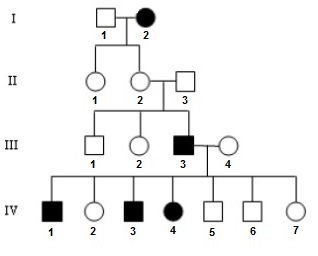
What does a filled in square represent?
a)
Not affected Female
b)
Not affected Male
c)
Affected Male
d)
Affected Female
68.
How many generations are shown in this pedigree?
a)
1
b)
2
c)
3
d)
4
69.
How many kids did the mother and father from the first generation have?
a)
2
b)
4
c)
5
d)
6
70.
This pedigree represents the inheritance of hemophilia in this family. How many of the females have the hemophilia trait?
a)
8
b)
5
c)
2
d)
3
71.
What do half colored symbols represent?
a)
The individual is a carrier (heterozygous).
b)
The individual expresses the trait.
c)
The individual has both recessive alleles.
d)
The individual has both dominant alleles.
72.
Is this trait (the shaded individuals) dominant or recessive?
a)
dominant
b)
recessive
73.
In the second generation-how many people are carriers of the trait?
a)
2
b)
3
c)
5
d)
6
74.
Which individual in the first generation is a carrier?
a)
The male
b)
The female
c)
individual 1
d)
None of the above
75.
Which gender can be carriers of colorblindness and not have it?
a)
Just males
b)
Just females
c)
Both genders
76.
What would the genotype be for the blonde son in generation 2?
a)
BB
b)
Bb
c)
bb
d)
Not enough information 
77.
How many affected females are deceased? 
a)
0
b)
2
c)
4
d)
All 
78.
Give the genotype for person II-1, for this autosomal trait.
a)
GG
b)
Gg
c)
gg
d)
we cannot be 100% sure of the genotype
79.
If this pedigree shows an autosomal recessive disorder, what MUST the genotype of individual II-3 be?
a)
HH
b)
Hh
c)
hh
d)
None of the above
80.

Objective #13

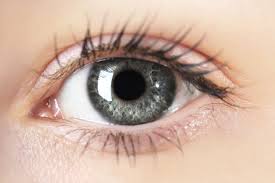
This is a pedigree that follows blue eyes which is a recessive trait. What is the genotype of the father (square) in generation 1?

a)

Aa

b)

AA

c)

aa

d)

A?