
 Worksheets
The Senses. The Ear. Hearing.
Total questions: 60
Worksheet time: 38mins

The sense organs send information to the brain through the ________________________.
Brain
Nerves
Eyes
Blood
Our ears have got three parts: Outer ear, ______________ and inner ear.
Sense ear
Little ear
Middle ear


Name for the inner ear that is filled with fluid and looks like a snail...
Anvil
Hammer
Stirrup
Cochlea

This is the smallest bone in the body and is located in your middle ear...
Hammer
Anvil
Stirrup
Ear Drum
This form of deafness generally requires the use of cochlear implants in order to be able to hear certain frequencies...
Conductive
Sensorineural
Fractured
Frequency
This sense works via sensory organs in the ear that monitor the body’s motion and position in relation to gravity.
Vestibular
Kinesthesis
Gravitas
Levity


What is unique about the hammer, stirrup, and anvil?
They are the smallest bones in your body
They are the only bones in your body that move
They are the only bones located in your head
They are the only bones that cannot be broken
What does the Auditory canal do?
Makes ear wax
Pulls sound waves into the ear
End the journey of the sound waves
What happens in the eardrum?
Sound waves vibrate the skin and delivers vibrations
Sound waves make the tiny hairs in your ear move
Carries the message to the brain
What does the fluid inside your ears doing?
Vibrates the skin in your ear
Sends sound waves to the brain
Vibrates the cilia (tiny hairs).
What does the Auditory nerve do?
Carries the message to the brain
Carries the message to the Semi-Circular canal
Send the message to the Eustachian tube
Name the 3 bones in your ear
Hammer, Stirrup, Anvil
Hammer, Anvil, Stirrup
Rods, Cones, Anvil
Where is the Cochlea located
The Inner Ear
The Middle Ear
The Outer Ear

What is this?
Anvil
Hammer
Stirrup
Cochlea
Ear drum
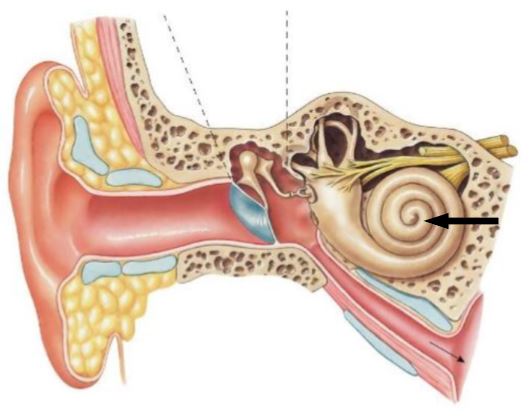
What is this?
Pinna
Hearing Nerve
Cochlea
Ear Drum
Anvil

What is this?
Cochlea
Pinna
Hearing Nerve
Stirrup
Ear drum

What is this?
Anvil
Hammer
Stirrup
Ear Canal
Ear drum
Which part(s) of the ear are found in the middle ear?
eardrum
hammer
anvil
cochlea
stirrup

outermost part of ear; funnels sound to meatus; pinna
auricle
cochlea
fovea
stapes
The scientific name for the sense of smell is:
osmosis
dialysis
olfaction
gustation
The term tactile refers to the sense of:
pain
touch
taste
temperature
The two senses located in the ear are:
hearing and equilibrium
hearing and vision
balance and taste
equilibrium and pressure
Based on the sensory receptors, there are 2 types of the senses: generalized and localized
Ture
False
Is the sense of pain localized or generalized?
localized
generalized
Is the sense of equilibrium localized or generalized?
localized
generalized
What is sense of taste called?
(a)
The root -algesia means (a)
The root -esthesia means:
suffering
hearing
aesthetics
sensation
What is the term for the lack of taste sensation?
atastia
dysesthesia
ageusia
pseudogeusia
The medical term for lack of sensation is (a)
The Latin names for hammer, anvil, stirrup are:
malleus, incus, stapes
stapes, malleus, incus
incus, stapes, malleus
What is the name for the brownish, wax-like secretion formed in the external ear canal to protect the ear and prevent infection
(a)
What is a medical term for earwax?
incus
cerumen
pinna
vestibule
What is the projecting part of the outer ear called?
(a)
The portion of the inner ear that is concerned with the sense of equilibrium; consists of the vestibule and the semicircular canals is called ________
equilibrium system
the inner ear
vestibular apparatus
What does the vestibular apparatus include? (Check all that apply)
utricle
saccule
tympanic membrane
three semicircular canals
What's the root which means hearing? (Check all that apply)
audi/o
ot/o
cus
acous
acus
What does the root -ot/o mean?
hearing
sensation
ear
otter
What does the root -myring/o mean?
(a)
What is the term for pain in the ear?
(a)
What is the term for incision of the tympanic membrane? (Check all that apply)
tympaectomy
myringotomy
myringoplasty
tympanotomy
What is stapedectomy?
(a)
A disease associated with increased fluid pressure in the inner ear and characterized by hearing loss, vertigo, and tinnitus is called:
otosclerosis
Ménière disease
acoustic neuroma
Inflammation of the middle ear with accumulation of serous (watery) or mucoid fluid is called ______
otitis media
otitis
tinnitus
vertigo
A condition characterized by noises, such as ringing or tinkling, in the ear is called (a)
Measurement of hearing is ____
otorhinolaryngology (ORL)
otoscope
electronystagmography (ENG)
audiometry

Which diagnostic test is being administered ?
Rinne test
Weber test
spondee
electronystagmography

Which diagnostic test is being administered ?
Rinne test
Weber test
spondee
electronystagmography

