wayground logo

Free Printable Worksheets

Font size

S
M
L
XL
Worksheets

chapter 4 biological chemical

Total questions: 100

Worksheet time: 2hrs 42mins

Name
Class
Date
1.

Which simple molecules are the basic units of protein?

a)

amino acids

b)

fatty acids

c)

glucose

d)

vitamins

2.

Small molecules are used as the basic units in the synthesis of large food molecules.

Which statement is correct?

a)

Amino acids are basic units of carbohydrates.

b)

Fatty acids are basic units of glycogen.

c)

Glycerol is a basic unit of oils.

d)

Simple sugar is a basic unit of protein.

3.

A student set up a test-tube containing starch, water and amylase.


How could the student test whether the amylase had digested all the starch?

a)

Add Biuret solution.

b)

Add dilute hydrochloric acid.

c)

Add iodine solution.

d)

Weigh the test-tubes and contents before and after the experiment.

4.

Water is a good solvent.


What does this mean?

a)

It dissolves well in many other substances.

b)

It flows easily through vessels.

c)

It is permeable to gases.

d)

Many substances dissolve well in it.

5.

Which elements do carbohydrates contain?

a)

carbon, hydrogen and oxygen

b)

carbon, hydrogen and sulphur

c)

carbon, nitrogen and oxygen

d)

carbon, nitrogen and sulphur

6.

Which of the following is NOT a reducing sugar?

a)

lactose

b)

sucrose

c)

maltose

d)

glucose

7.

Which of the following the example of monosaccharides?

a)

starch

b)

sucrose

c)

glucose

d)

cellulose

8.

What will you observe in the positive test for starch?

a)

The brown solution turns purple.

b)

The brown solution turns blue black.

c)

The blue solution turns purple.

d)

The blue solution turns blue black.

9.

The diagram represents a protein molecule.

What do the small circles represent?

a)

fatty acids

b)

amino acids

c)

glycerol

d)

simple sugars

10.

Which macromolecule is shown in the diagram above?

a)

lipid

b)

nucleic acid

c)

protein

d)

carbohydrate

11.

What are the four nitrogenous bases in DNA?

a)

A, T, C, U

b)

A, G, T, B

c)

A, T, C, G

d)

A, C, G, D

12.
What two elements make up water?
a)
Helium and oxygen
b)
Hydrogen and oxygen
c)
helium and carbon
d)
oxygen and carbon
13.
In a water molecule the hydrogen and oxygen atoms hold together by sharing _________.
a)
protons 
b)
neutrons
c)
electrons
d)
nuclei
14.
What word describes when water is attracted to other substances?
a)
cohesion
b)
adhesion
c)
capillary action
d)
surface tension
15.
When water molecules stick easily to other water molecules, this is called what?
a)
cohesion
b)
adhesion
c)
solution
d)
polar molecule
16.
Water is a universal solvent because it...
a)
It can be found anywhere
b)
It freezes when it gets cold
c)
floats when frozen
d)
Dissolves most substances
17.
Water molecules are attracted to other kinds of molecules because of the property.
a)
Cohesion
b)
Adhesion
c)
Surface Tension
d)
Universal Solvent
18.
What two elements make up water?
a)
Helium and oxygen
b)
Hydrogen and oxygen
c)
helium and carbon
d)
oxygen and carbon
19.

When water and other liquids stick together to form drops or thin films called ________________.

a)

adhesion

b)

capillary action

c)

cohesion

d)

surface tension

20.
Water striders can walk across the surface of calm water. Their feet push the surface of the water down slightly, but they do not break the surface. Why?
a)
The insects are light enough so they do not break the hydrogen bonds holding the water molecules together
b)
The insects actually use their wings to hover slightly above the water’s surface and they only skim it with their feet.
c)
The insect’s feet are non-polar, so they are repelled by the polar water molecules and are pushed away from the water’s surface.
d)
The insects are small enough to see the individual water molecules, so they are able to step carefully from one molecule to the next
21.
A general definition of cohesion is the attraction of:
a)
particles of the same substance
b)
particles of a different substance
c)
particles of both the same and different substances
d)
particles of neither the same or different substances
22.
Which term refers to water having partial positive and a partial negative charge?
a)
cohesion
b)
surface tension
c)
polarity
d)
adhesion
23.

What do you call any substance that dissolves another substance?

a)

Solvent

b)

Height

c)

Atoms

d)

Oxygen

24.

Capillary Action

a)

The property of water that allows ice to float on the surface of liquid water

b)

The property of water that allows it to dissolve polar substances

c)

When water molecules stick to other surfaces

d)

The property of water that allows water to move up a thin tube (or the stem of a plant) by itself

25.
What is the gaseous form of water called?
a)
Steam
b)
Water vapor
c)
Vapor
d)
Water mist
26.
What is the boiling point of water
a)
0 C
b)
100 F
c)
50 C
d)
100 C
27.
What is water's freezing point?
a)
0 F
b)
32 C
c)
50 C
d)
0 C
28.
 Small insects can walk across the surface of calm water. Their feet push the surface of the water down slightly, somewhat like a person walking across a trampoline, but they do not break the surface. What is the best explanation for why this happens?
a)
The insects are light enough so that they do not break the hydrogen bonds holding the water molecules together
b)
The insects actually use their wings to hover slightly above the water's surface and they only skim it with their feet
c)
The insects' feet are non-polar, so they are repelled by the polar water molecules and are pushed away from the water's surface
d)
The insects are small enough to see the individual water molecules, so they are able to step carefully from one molecule to the next
29.
an organic compound is a compound that contains________
a)
carbon
b)
hydrogen
c)
oxygen
d)
sodium
30.
Which is an example of a solute
a)
soil suspended in water
b)
sugar that is dissolved in water
c)
water that dissolves salt
d)
water with undissolved soil
31.
Capillary action is the result of adhesion. Which aspect of water is responsible for this?
a)
Nonpolar covalent bonds that enable water to dissolve other substances
b)
Polar covalent bonds that join molecules of water to other substances
c)
Hydrogen bonds between water and another substance
d)
Ionic bonds that enable electrons to flow through water and into another substance
32.
What property of water helps to moderate earth's temperature?
a)
adhesion
b)
chohesion
c)
Specific heat capacity
d)
Latent heat of vaporization
33.
Carbohydrates are the first source of _______ for the body?
a)
repair
b)
hygiene
c)
fuel
34.
If we eat too much carbohydrate it is stored in the body as ___?
a)
fat
b)
extra cells
c)
flouride
35.
Some carbohydrate foods are ________
a)
fruits
b)
grains
c)
vegetables
d)
all the above
36.
_____________ carbohydrates come from sugar. They do not supply many nutrients.
a)
complex
b)
optional
c)
simple
d)
loaded
37.
Different sugars all end in the suffix _____
a)
ly
b)
itis
c)
ose
d)
ion
38.
The simple sugar from fruit is called_____.
a)
sucrose
b)
lactose
c)
fructose
d)
maltose
39.
The simple sugar in milk is ________.
a)
lactose
b)
maltose
c)
sucrose
d)
fructose
40.
______________ carbohydrates supply longer lasting energy.
a)
simple
b)
complex
c)
generic
41.
What elements make up carbohydrates?
a)
Carbon, hydrogen, nitrogen, oxygen
b)
sulfur, carbon, hydrogen
c)
glucose and fructose
d)
carbon, hydrogen, oxygen
42.
The 3 categories of carbohydrates are:
a)
Monosaccharide, disaccharide, polysaccharide
b)
glucose, fructose, galatose
c)
starch, cellulose, chitin
d)
There are no categories of carbohydrates
43.

All carbohydrate names end with which ending:

a)

-ise

b)

-ase

c)

-ese

d)

-ose

44.
What happens if you eat more carbohydrates then your body needs?
a)
becomes DNA 
b)
turns to fat 
c)
creates extra energy 
d)
becomes waste
45.
What type of carbohydrate is this?
a)
polysaccharide
b)
disaccharide
c)
monosaccharide
d)
it isn't a carbohydrate
46.
How many sugar units make up monosaccharides?
a)
one
b)
two
c)
three
d)
zero
47.
How many sugar units make up disaccharides?
a)
one
b)
two
c)
three
d)
zero
48.
How many sugar units make up polysaccharides?
a)
one
b)
two
c)
more than two
d)
zero
49.
Which do all carbohydrates do for us?
a)
provide energy
b)
make muscle
c)
make brains
d)
make hair
50.
What molecule is this
a)
sucrose
b)
protein
c)
glucose
d)
cellulose
51.
These are all properties of a disaccharide EXCEPT:
a)
made up of two sugars
b)
sucrose
c)
2 monosaccharides joined by dehydration synthesis
d)
ratio of 1:2:1
52.
Which of these are examples of carbohydrates?
a)
DNA, RNA
b)
Fats, hormones
c)
amino acids
d)
starches, glucose, chitin
53.
How many categories of carbohydrates are there? 
a)
1
b)

2

c)
3
d)
There are no categories
54.
What two groups are removed from monosaccharides to form disaccharides or polysaccharides
a)
water and oxygen
b)
hydrogen and hydroxyl group
c)
carbon and hydrogen
d)
water and carbon
55.
These are all properties of a monosaccharide EXCEPT:
a)
simple sugar
b)
1:2:1 ratio
c)
double sugar
d)
used for energy
56.
C6H12O6 is the molecular formula for what carbohydrate?
a)
Sucrose
b)
Glucose
c)
Fructose
d)
Both glucose and fructose
57.
Molecules primarily made of elements found in living organisms. Organic molecules make up living organisms. Organic molecules are made of the elements of life: CHNOPS
a)
Inorganic
b)
Carbonic
c)
Organic
d)
Hydraulic
58.
Many monomers bonded together create a polymer.
a)
Polymer
b)
Monomer
59.
Polymers form when a single water molecule is removed from between two monomers
a)
Dehydration synthesis
b)
Hydrolysis 
60.
Carbohydrates
a)
1:3:1 ratio
b)
2:2:2 ratio
c)
1:2:1 ratio
d)
1:2:3 ratio
61.
Which is a simple sugar
a)
sucrose
b)
glucose
62.
Sucrose (table sugar)
Lactose (Milk Sugar)
Maltose (Grain sugar) 
are examples of 
a)
polysaccharides 
b)
monosaccarides 
c)
disaccharides
63.
______+_____= lactose
a)
glucose + glucose
b)
glucose+ fructose
c)
glucose + galactose
64.
Examples are starch, glycogen, and cellulose
a)
polysaccharides 
b)
monosaccarides 
c)
disaccharides
65.
______+_____= Maltose
a)
glucose + glucose
b)
glucose+ fructose
c)
glucose + galactose
66.
Eggs are a complete protein.
a)
True
b)
False
67.
Non-meat examples of protein include
a)
broccoli, kale, carrots
b)
beans, legumes, eggs
c)
tofu, apples, spinach
68.
_ is/are used to build and repair muscle.
a)
carbohydrates
b)
fiber
c)
protein
d)
fat
69.
Amino Acids:
a)
are a type of marinade.
b)
help transport fats in the body.
c)
are the building blocks from which proteins are made.
d)
are only found in plants.
70.

The difference between tertiary and quartenary structure is:

a)

Tertiary structure has double bond whereas quartenary structure does not have double bond

b)

Tertiary structure consists of one polypeptide chain whereas quartenary structure consists of more than one polypeptide chains

c)

Tertiary structure is fibrous whereas quartenary structure is globular

d)

Tertiary structure is water-soluble whereas quartenary structure is lipid soluble

71.

The polypeptide in the diagram consists of;

a)

3 amino acids and 3 peptide bonds

b)

3 amino acids and 2 peptide bonds

c)

4 amino acids and 2 phosphodiester bonds

d)

3 amino acids and 2 phosphodiester bonds

72.

The diagram shows the structure of collagen. Based on the diagram, what is the structural level of collagen?

a)

Primary

b)

Secondary

c)

Tertiary

d)

Quartenary

73.

During the formation of the peptide bond which of the following takes place?

a)

Hydroxyl group is lost from its carboxyl group of one amino acid and a hydrogen atom is lost from its amino group of another amino acid

b)

Hydrogen atom is lost from its carboxyl group of one amino acid and a hydroxyl group is lost from its amino group of another amino acid

c)

Hydroxyl group is lost from its carboxyl group of one amino acid and a hydroxyl group is lost from its amino group of another amino acid

d)

Hydrogen atom is lost from its carboxyl group of one amino acid and a hydrogen atom is lost from its amino group of another amino acid

74.

Tertiary structure is formed due to

a)

interaction between the functional groups of different amino acids within a polypeptide chain

b)

interaction between the side chain of different amino acids within a polypeptide chain

c)

interaction between the functional groups of different amino acids between two polypeptide chains

d)

interaction between the side chain of different amino acids between two polypeptide chains

75.

Which of the following bond(s) can be found in a tertiary structure?

a)

hydrogen bond

b)

disulphide bridge

c)

hydrophobic interaction

d)

all of the above

76.

Haemoglobin is a quartenary protein because;

a)

It has more than one peptide bonds

b)

Its shape is globular

c)

It consists of more than one polypeptide chains

d)

It has iron in each heme group

77.

How many amino acids does our body need in a day to function properly?

a)

11

b)

20

c)

9

d)

4

e)

36

78.

What is the role of protein in the body?

a)

Is the main source of energy for the body

b)

Helps to build and repair body tissue

c)

Provide warmth and cushioning to the body's organs

d)

Helps to transport vitamins through the body

e)

All of the above are roles of protein in the body

79.

How many amino acids do you need to take in from food on a daily basis?

a)

20

b)

9

c)

11

d)

4

e)

2

80.

If I am taking in too much protein what could happen to me? (Select all that apply)

a)

Extra protein can be converted into stored energy

b)

May lead to kidney problems

c)

It can cause weight loss

d)

It can cause weight gain

e)

It can cause issues with the breakdown of muscle and body tissue

81.
What is the monomer of a lipid?
a)
monosaccharide
b)
nucleic acid
c)
fatty acid
d)
amino acid
82.
Steroids have what kind of structure?
a)
long chain of hydrogen/carbons with a glycerol group
b)
CHO in a hexagonal shape
c)
4 fused rings
d)
polar head and two fatty acid tails
83.
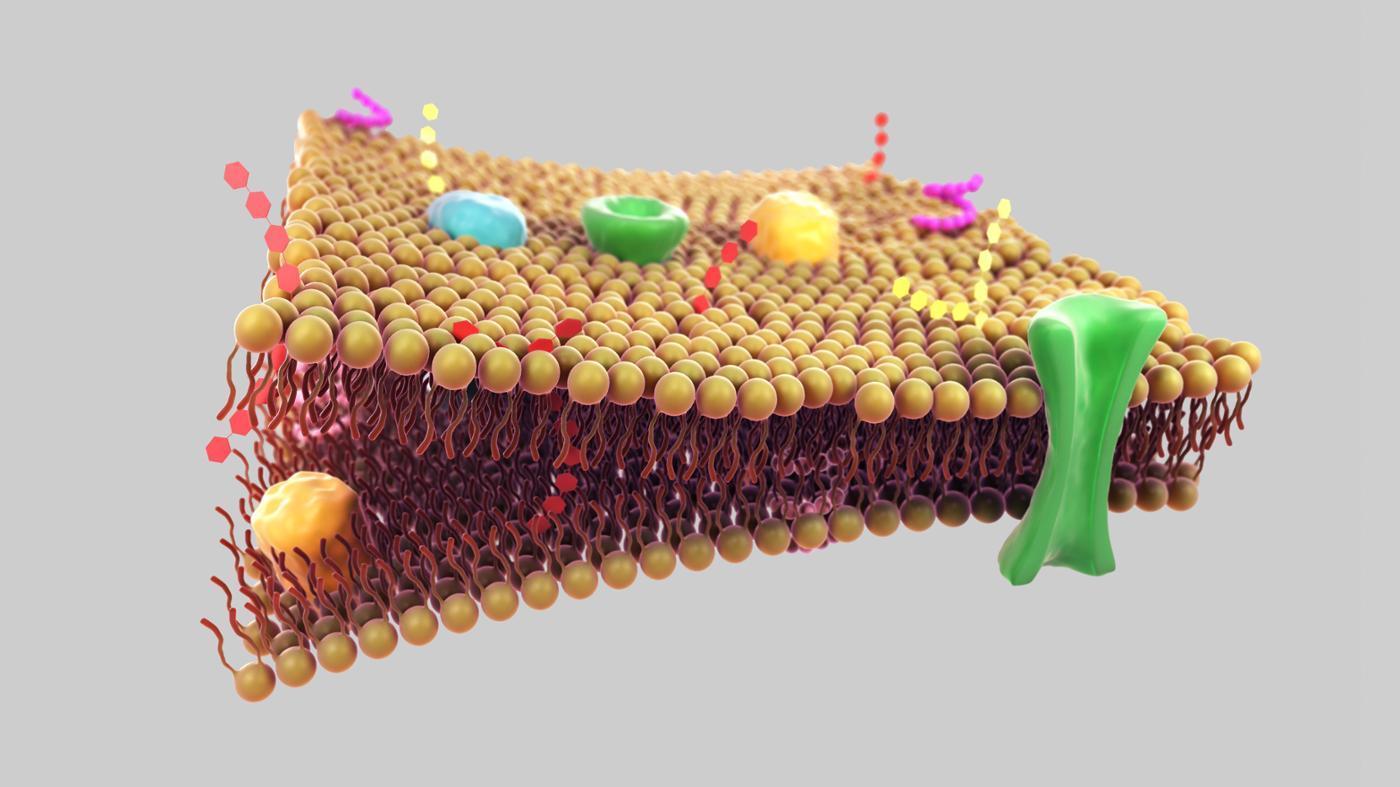
The phospholipid bilayer comprises what part of the cell?
a)
cytoplasm
b)
cell membrane
c)
cytoskeleton
d)
nuclear membrane
84.
What type of fat is this?
a)
saturated fatty acid
b)
unsaturated fatty acid
c)
steroid
d)
wax
85.
What type of lipid is this?
a)
steroid
b)
cholesterol
c)
phospholipid
d)
triglyceride
86.
In the phospholipid, the polar head is considered what type of structure?
a)
hydrophobic
b)
insoluble
c)
hydrophilic
87.
Which of the following molecules is not a lipid? 
a)
testosterone
b)
triglycerides
c)
cellulose
d)
phospholipids
88.
What molecule should a bear eat the most before hibernating?
a)
carbohydrates
b)
lipids
c)
proteins
d)
nucleic acid
89.
Lipids do not dissolve in water because they are _______________
a)
polar
b)
water soluble
c)
non-polar
90.
Saturated fats have _______________
a)
straight structure
b)
single bonds
c)
solidity at room temperature
d)
all of the above
91.
A lipid is a polymer that is made of what kind of monomers?
a)
monosacchirides
b)
amino acids
c)
fatty acids and a glycerol
d)
nucleic acid
92.
All of the following are lipids except __________
a)
ear wax
b)
saturated fats
c)
cholesterol
d)
starch
93.

Lipids are made up of carbon, hydrogen and ___________.

a)

Chlorine

b)

Nitrogen

c)

Oxygen

d)

Helium

94.

Lipids are soluble in ___________ only

a)

water

b)

water and organic solvents

c)

organic solvents

95.

Which fatty acid has double bonds between two carbon atoms?

a)

saturated fatty acid

b)

unsaturated fatty acid

96.
Carbon chains are principal features of both carbohydrates and lipids.  What is the primary difference between these two types of macromolecules?
a)
Lipids always have longer carbon chains than carbohydrates.
b)
Carbohydrates cannot form rings like lipids can.
c)
Lipids provide energy, but carbohydrates cannot.
d)
Carbohydrates form ring structures, lipids form long chains
97.
How do lipids function for cells?
a)
store information
b)
store energy
c)
breakdown wastes
d)
join with substrates
98.
Which biomolecule is often stored in the body's tissues as energy?
a)
proteins
b)
carbohydrates
c)
lipids
d)
nucleic acids
99.
What are different examples of lipids?
a)
monosaccahrides, disaccharides, starch, cellulose
b)
dipetide, polypeptide, amino acids
c)
DNA, RNA, ATP
d)
triglycerides, waxes, steroids, phospholipds
100.
Which of the following is a lipid?
a)
cholesterol
b)
cellulose
c)
glucose
d)
protein