wayground logo

Free Printable Worksheets

Font size

S
M
L
XL
Worksheets

Acid, Base, and Solutions

Total questions: 115

Worksheet time: 3hrs 46mins

Name
Class
Date
1.
What property do all three of these common household substances have in common?
a)
they are all basic
b)
they taste sour
c)
they have a pH below 7
d)
they all turn litmus paper red
2.
What does this solubility curve show?
a)
Solubility increases as temperature increases
b)
Solubility decreases as temperature decreases
c)
Solubility decreases as concentration increases
d)
Solubility is not affected by temperature
3.
When Sally tested an unknown substance, her red litmus paper turned blue but her blue litmus paper did not change color. What is the solution?
a)
Acid
b)
Base
c)
neutral
d)
world peace
4.
Palmer puts 10 grams of salt in 100 grams of water. He then puts 50 grams of salt in 100 grams of water. Compare the concentrations of the two solutions
a)
both mixtures are acids
b)
both mixtures are bases
c)
the first solution is more diluted while the second one is more concentrated
d)
the first one is more concentrated while the second one is more diluted
5.
Which characteristics describe a base?
a)
sour, indicator turns red, pH less than 7, produces hydrogen ions (H+)
b)
bitter, slippery, indicator turns blue, pH greater than 7, produces hydroxide ions (OH-)
c)
neutral, pH of 7
d)
sour, indicator turns red, pH greater than 7
6.
Which characteristics describe an acid?
a)
sour, indicator turns red, pH less than 7, produces hydrogen ions (H+)
b)
bitter, slippery, indicator turns blue, pH greater than 7, produces hydroxide ions (OH-)
c)
neutral, pH of 7
d)
sour, indicator turns red, pH greater than 7
7.
What might happen if you mixed a strong acid with an equally strong base?
a)
explosive chemical reaction
b)
a pH neutral substance
c)
the base would destroy the acid
d)
the acid would destroy the base
8.
An extremely strong base would have a pH of...
a)
1
b)
7
c)
9
d)
14
9.
An extremely strong acid would have a pH of...
a)
1
b)
7
c)
9
d)
14
10.
A weak acid would have a pH of...
a)
1
b)
7
c)
6
d)
14
11.
A weak base would have a pH of...
a)
8
b)
7
c)
6
d)
14
12.
A neutral substance would have pH of...
a)
8
b)
7
c)
6
d)
14
13.
This piece of pH paper has been dipped into:
a)
An acid
b)
A base
c)
A pH-neutral substance
d)
A buffer
14.
What is a property of bases?
a)
Slippery touch
b)
Sour taste
c)
Ability to dissolve metal
d)
Ability to form hydronium ions
15.
How do acidic solutions taste?
a)
Delicious
b)
Sweet
c)
Bitter
d)
Sour
16.
What do acids and bases have in common?
a)
They both eat away at metal.
b)
They can both conduct electricity.
c)
They both have a sour taste.
d)
They both form positively charged ions when dissolved in water.
17.
Electrolyte
a)
Acids
b)
Bases
c)
Salts
d)
All
18.
All solutions that fall between 0 and 6.9 are
a)
Acids
b)
Bases
c)
Neutral
d)
Phytoplankton
19.
What is the range of pH values in a basic solution?
a)
0-6
b)
8-14
c)
7
d)
0-14
20.
BASE + ACID ----> SALT +?
a)
water
b)
oxygen
c)
hydrogen ion
d)
hydroxide ion
21.

Look at the solubility curve - as a GENERAL rule (that means there are exceptions, as always, in science) what trend can be states about how temperature affects the solubility of the compounds shown.

a)

Temperature has NO affect.

b)

The relationship is inversely proportional - as temperature increases, the solubility decreases.

c)

The relationship is directly proportional - as temperature increases, the solubility increases.

d)

It varies - the solubility will increase and then decrease when it reaches a certain temperature.

22.
Zn(OH)2 is an example of a...
a)
acid
b)
base
c)
salt
23.
If there is excess hydroxide ions, the solution will be...
a)
acidic
b)
basic
24.
H3PO4 is an example of a ...
a)
acid
b)
base
c)
salt
25.

How is a solute different from a solvent in a solution?

a)

The solute is present in a smaller amount.

b)

The solute is present in a greater amount.

c)

The solute is a solid and the solvent is a liquid.

d)

The solute is a liquid and the solvent is a gas.

26.

When you add so much solute that no more dissolves, you have a(n)

a)

saturated solution.

b)

unsaturated solution.

c)

neutralization.

d)

suspension.

27.

What is one way to increase the solubility of sugar in water?

a)

Heat the water.

b)

Chill the water.

c)

Increase the amount of sugar.

d)

Decrease the amount of water.

28.

A _______________ is two or more substances that are physically blended but are not chemically bonded together.

a)

substance

b)

solute

c)

solution

d)

mixture

29.

A _______________ mixture is a mixture in which substances are not evenly mixed.

a)

homogeneous

b)

heterogeneous

30.

A ________________ mixture is a mixture in which two or more substances are evenly mixed on the atomic level but not bonded together.

a)

homogeneous

b)

heterogeneous

31.

A ____________ is another name for a homogeneous mixture.

a)

solute

b)

solution

32.

The ____________ in a solution would be what is dissolved into a solvent.

a)

solute

b)

solution

33.

The _________________ is the amount of a particular solute in a given amount of solution.

a)

solvent

b)

concentration

c)

substance

34.

The maximum amount of solute that can dissolve in a given amount of solvent at a given temperature and pressure is called the __________________.

a)

solution

b)

concentration

c)

solubility

35.

An ______________ is a compound that changes color at different pH values when it reacts with acidic or basic solutions.

a)

indicator

b)

substance

c)

mixture

36.
How many liters would you need to make a 1 M solution if you have 6 mol of Sodium Hydroxide? 
a)
2
b)
3
c)
4
d)
37.
What is the molarity of 4 g of NaCl (MM=58.45) in 3,800 mL of solution?
a)
0.018 M
b)
0.0011 M
c)
1.052 M
d)
0.062 M
38.
How many grams of solute are dissolved in 125.0 mL of 5.00 M NaCl (MM = 58.45)?
a)
0.625 g NaCl
b)
625 g NaCl
c)
36.5 g NaCl
d)
0.04 mol NaCl
39.
Find the molarity of 186.55 g of sucrose, C12H22O11 (MM = 342) in 250 mL of water.
a)
2.18 M
b)
0.746 M
c)
1.18 M
d)
0.545 M
40.
How many moles of NaCl are present in a solution with a molarity of 8.59 M and a volume of 125 mL?
a)
1074 mol
b)
0.069 mol
c)
1.07 mol
d)
62.7 mol
41.
Calculate the molarity of the following solution:  1.0 mole of KCl in 750.0 mL of solution.
a)
0.750 M
b)
99 M
c)
1.3 M
d)
2.0 M
42.
What is the molarity of a solution made by adding 1.565 moles of PbNO3 to 500 mL?
a)
300. M
b)
31.3 M
c)
3.13 M
d)
1.56 M
43.
How many moles are needed to make 2.5 L of a 3.8 M solution? 
a)
9.5 mol
b)
0.66 mol
c)
1.5 mol
d)
15 mol
44.
If the [H+] of a solution is 1 x 10⁻² mol/L the pH is
a)
2
b)
12
c)
-2
d)
1
45.
If the pH of a solution is 5 the [H+] is
a)
1.0 x 10 M
b)
1.0 x 10 M
c)
5.0 x 10 M
d)
1.0 x 10⁻⁵  M
46.
If the pH of a solution is 5.6 the pOH is
a)
6.5
b)
12.4
c)
8.4
d)
5.6
47.
A  pH and a pOH will add up to:
a)
0
b)
7
c)
14
d)
1.0 x 10⁻¹⁴
48.
if the [H+] of a solution is 1.0 x 10⁻² mol/L the pH is
a)
2
b)
-2
c)
1
d)
12
49.
If the [OH-] of a solution is 2.7 x 10⁻⁴ mol/L the pOH of the solution is
a)
10.44
b)
3.56
c)
1.00
d)
-4.43
50.
A solution with a [H+] of 9.4 x 10⁻⁵ mol/L is said to be
a)
Acidic
b)
Basic
c)
Neutral
d)
negative number, no solution.
51.
If the [H+] of a solution is 6.8 x 10⁻⁹ mol/L the pH is
a)
8.17
b)
8.2
c)
9.99
d)
8.62
52.
if the [H+] of a solution is 8.4 x 10⁻³ mol/L the pOH of the solution will be
a)
2.08
b)
11.92
c)
1.02
d)
12.98
53.
if a solution has a pOH of 5.2 the [OH-] of the solution is
a)
6 x 10 -6 M
b)
6.3 x 10 -6 M
c)
1.58 x 10⁻⁵ M
d)
2 x 10⁻⁵ M
54.

If the pH of a solution is 4.0, what is the pOH?

a)

4.0

b)

1.0 E-4

c)

10

d)

Cannot be determined from the information

55.
The pH scale is a range from:
a)
1-7
b)
0-14
c)
1-5
d)
1-20
56.
If the pH of a solution is 5.6 the pOH is
a)
6.5
b)
12.4
c)
8.4
d)
5.6
57.
Ammonia has a pH of 12.  Ammonia is __________.
a)
an acid
b)
a base
c)
an element
d)
a metal
58.

Acids have a ______ pH and a _________ pOH

a)

low, high

b)

high, low

c)

An acid will not have a pOH

59.
KOH will release which ion?
a)
OH-
b)
H+
c)
OH+
d)
H-
60.
Is HNO3 an acid or base?
a)
Acid
b)
Base
61.
Select the name of the following acid: HCl
a)
Hydrochloric acid
b)
Chlorous acid
c)
Chloric acid
62.
Select the formula for the following acid: hydroiodic acid
a)
HI
b)
HIO4
c)
HIO3
d)
H2I
63.
Select the name for the following acid: H3PO4
a)
Phosphoric acid
b)
Phosphorous acid
c)
Hydrophosphoric acid
64.
If you have an oxyacid and it contains an -ate polyatomic ion, then acid's ending will change to _____. 
a)
-ic 
b)
-ous
c)
-ite 
65.

NH3 is:

a)

a Bronsted Lowry base

b)

an Arrhenius base

c)

an acid

d)

both an Arrhenius and a Bronsted Lowry base

66.
What is the formula for nitric acid?
a)
HNO2
b)
HNO3
c)
HNO4
d)
H2NO3
67.
What is the formula for phosphorous acid?
a)
H3PO4
b)
H2PO4
c)
H3P
d)
H3PO3
68.
Name HF
a)
hydrofluoric acid
b)
Hypofluoric acid
c)
hydrogen fluorine acid
d)
fluoric acid
69.
HNO2
a)
hydronitrogen
b)
hydrogen nitrogen oxygen
c)
nitrous acid
d)
nitric acid
70.
HBr
a)
hydrogen bromine acid
b)
hydrobromide acid
c)
hydrobromic acid
71.
Name the acid: HC2H3O2
a)
Acetic Acid
b)
Acetous Acid
c)
Hydrogen Acetate
d)
Hydrogen Dicarbon Trihydrogen Dioxygen
72.
carbonic acid
a)
H2CO3
b)
H2CrO4
c)
H2C2O4
d)
HCO3
73.
chlorous acid
a)
HClO3
b)
HClO2
c)
HClO
d)
HCl
74.
H2SO3
a)
sulfuric acid
b)
hydrosulfuric acid
c)
sulfurous acid
d)
persulfuric acid
75.

NaOH is:

a)

an Arrhenius base

b)

an Arrhenius acid

c)

neither an acid nor a base

d)

both an acid and a base

76.

An Arrhenius acid:

a)

donates H+ to another substance

b)

accepts H+ from another substance

c)

produces H+

d)

produces OH-

77.

An Arrhenius base:

a)

donates H+

b)

accepts H+

c)

produces H+

d)

produces OH-

78.

A Bronsted Lowry base:

a)

donates H+ to another substance

b)

accepts H+ from another substance

c)

produces H+

d)

produces OH-

79.
The Acid-Base classification system that defined __________ is any compound that can donate a proton (an H+ ion) to an appropriate acceptor. A _________ is a compound that can remove (or accept) a proton.
a)
Bronsted-Lowry
b)
Arrhenius acid-base
c)
Lewis acid-base
d)
Monoprotic and Polyprotic Acids
80.
The Acid-Base classification system that defined acids as those that release H+ and bases as release OH- is known as ________.
a)
Bronsted-Lowry
b)
Arrhenius acid-base
c)
Lewis acid-base
d)
Monoprotic and Polyprotic Acids
81.
The Acid-Base classification system that defined any chemical species that accepts a pair of electrons as a _______, and a _________ is a chemical species that donates a pair of electrons.
a)
Bronsted-Lowry
b)
Arrhenius acid-base
c)
Lewis acid-base
d)
Monoprotic and Polyprotic Acids
82.
Accepts a pair of electrons
a)
Lewis Acid
b)
Arrhenius Acid 
c)
Bronsted Lowry Acid 
d)
Arrhenius Base
83.

Lewis bases are defined as

a)

H+ acceptors

b)

electron pair acceptors

c)

H+ donors

d)

electron pair donors

84.

A student is preparing solutions for a laboratory experiment by dissolving solid solutes in liquid solvents. Which action will increase the rate of solubility

a)

lowering the temperature of the solvent

b)

stirring the solute in the solution

c)

increasing the pressure on the solution

d)

increasing the particle size of the solute

85.

Which of the following is the correct formula for calculating molarity?

a)

moles/liters of solution

b)

moles/kg of solvent

c)

# particles/Avogadro's #

d)

theoretical yield/actual yield

86.

Which of the following types of solutions has more room to dissolve solute?

a)

supersaturated

b)

saturated

c)

unsaturated

87.

When calculating molality, Kg of the following are included in the calculation?

a)

solvent

b)

solute

c)

none of these

d)

solvent & solute

88.

What is the molality of a solution in which 3.0 moles of NaCl is dissolved in 1.5 Kg of water?

a)

2.0 M

b)

0.22 m

c)

135 m

d)

2.0m

89.
What is a solvent?
a)
The substance that does the dissolving in a solution.
b)
The substance that is being dissolved in a solution.
c)
The mixing of different substances.
d)
The process in which neutral molecules lose or gain electrons
90.

Since "like dissolves like", water and oil will not mix because

a)

both of them are polar

b)

both of them are nonpolar

c)

oil is polar and water is nonpolar

d)

oil is nonpolar and water is polar

91.

Molality (m) = moles of solute / _________________________.

a)

kilogram of solvent

b)

kiloliter of solvent

c)

kilometer of solvent

d)

ounces of solvent

92.

What is the molality of a solution made by dissolving 2 moles of NaOH in 400 grams of water?

a)

5 mol/kg. solvent

b)

4 mol/kg solvent

c)

3 mol/kg. solvent

d)

2.5 moles /kg solvent

93.

As we dilute a solution.....

a)

The volume increases and the molarity (M) increases

b)

The volume increases and the molarity (M) decreases

c)

The volume decreases and the molarity (M) increases

d)

The volume decreases and the molarity (M) decreases

94.

How many mL of stock solution of 2M NaCl do you need to prepare 100 mL of 0.150M NaCl?

a)

7.5 mL

b)

15 mL

c)

1333 mL

d)

200 mL

95.

How many mL of 1.0M KBr solution would you need to prepare 250 mL of a 0.2M dilution?

a)

175 mL

b)

250 mL

c)

50 mL

d)

5 mL

96.

How does this factor affect the solubility of a SOLID?


Increasing the air pressure

a)

More soluble

b)

Less soluble

c)

No effect

97.

How does this factor affect the solubility of a SOLID?


Increasing temperature

a)

More soluble

b)

Less soluble

c)

No effect

98.

Which of the following statements is true?

a)

An increase in temperature decreases the solubility of most solids, but increases the solubility of gases.

b)

An increase in temperature increases the solubility of most solids and gases.

c)

An increase in temperature decreases the solubility of most solids and gases.

d)

An increase in temperature increases the solubility of most solids, but decreases the solubility of gases.

99.

What is the concentration, in percent by mass, of 0.62 g of solute in 45.0 g of solvent?

a)

0.014 %

b)

1.36%

c)

1.38%

d)

1.29%

100.

Henry's law

a)

explains why air bubbles decrease in volume as they ascend underwater.

b)

explains how increasing pressure can increase the solubility of a gas in a solution

c)

states that the amount of dissolved gas is indirectly proportional to its partial pressure in the gas phase

101.
acid + base ₋>
a)
salt + hydrogen
b)
salt + water
c)
salt + carbon dioxide + water
d)
salt
102.
What is the endpoint of a titration
a)
Where the amount of acid and base are balanced according to the equation
b)
Where there is no base
c)
At the end
103.
I am titrating 1M HCl with 1M NaOH.  I have 25mL of HCl. How much NaOH will I need?
a)
2.5mL
b)
5mL
c)
25mL
d)
50mL
104.
what is the reading on this burette?
a)
4.40mL
b)
3.50mL
c)
3.60mL
d)
4.50mL
105.
Identify the products of the chemical equation
3 LiOH + H3PO4
a)
Li3PO4 + 3 H2O
b)
LiPO4 + 3 H2O
c)
Li(PO4)3 + 3 H2O
d)
BOY + La + N2
106.
If phenolphthalein turns bright pink, it indicates
a)
an acid 
b)
a base
c)
a neutral
107.
What does pH measure?
a)
Amount of Oxygen Ions
b)
Amount of Hydrogen Ions
c)
The amount of salt in a solution
d)
The density
108.

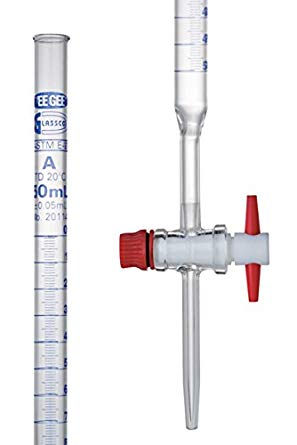
What is this piece of apparatus called

a)

Pipette

b)

Burette

c)

Janette

d)

Cuvette

109.

Why do we perform a titration?

a)

To determine the concentration of an unknown solution

b)

To see if a reaction will occur between an acid and base

c)

To find the mass of an unknown acid

d)

To find the molar mass of an unknown solution

e)

To calculate the viscosity of the solution

110.

If it takes 54 mL of 0.1 M NaOH to neutralize 125 mL of an HCl solution, what is the concentration of the HCl? (record you answer with the correct unit)

a)

0.043 M

b)

0.034 M

c)

0.065 M

d)

0.77 M

111.
Colligative properties depend on the _____ of solute particles in solution.
a)
type
b)
number
c)
pH
d)
nature
112.
The freezing point of a solution is ____ the freezing point of the pure solvent.
a)
the same as
b)
lower than
c)
higher than
d)
no relation to
113.
The boiling point of a solution is ______ the boiling point of the pure solvent.
a)
higher than
b)
the same as
c)
lower than
d)
higher or lower than
114.

The van't Hoff factor measures the number of particles formed in solution. What is the van't Hoff factor for the compound Na2SO4?

a)

1

b)

3

c)

5

d)

7

115.
Colligative properties depend on the _________ of the solute but not the __________ of the solute.
a)
 concentration; identity
b)
identity; concentration
c)
reactivity; nature
d)
nature; reactivity