wayground logo

Free Printable Worksheets

Font size

S
M
L
XL
Worksheets

Final Assessment Review

Total questions: 83

Worksheet time: 1hrs 7mins

Name
Class
Date
1.
A few deer wander out of their native woods into a completely new park where no deer had ever been before. They go on to create an entirely new population.
a)
Genetic Drift
b)
Natural Selection
c)
Non-random mating
d)
Mutation
2.
In a population of ladybugs, black bugs are more successful in escaping predators. Overtime, this gene becomes more popular in the population and the ladybug population loses its red color.  
a)
Natural Selection
b)
Mutation
c)
Genetic Drift
d)
Gene Flow
3.

Gene pool

a)

Total number of alleles of the genes that are present in a population of a particular species of organism at a given time

b)

The condition of a population in which allele and genotype frequencies remain constant from one generation to the next

c)

The number of phenotypes present in a population of a species at a given time
4.
Who created the theory of evolution?
a)
Charles Darwin
b)
Charles Derwin
c)
Charlie Darwin
d)
Chris Darwin
5.
What was the name of the ship Charles Darwin sailed on?
a)
Boaty McBoaty Face
b)
HMS Beagle
c)
HMS Britannia
d)
HMS Bulldog
6.

Gradualism means Natural Selection would normally happen over many generations and very

a)

slowly

b)

quickly

c)

in space

d)

beyond time

7.

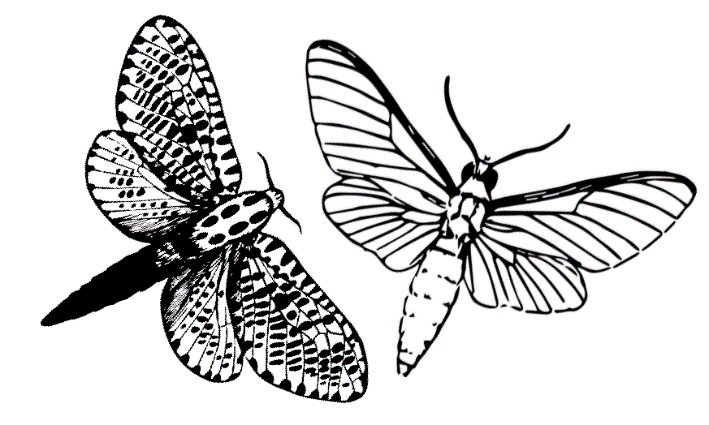
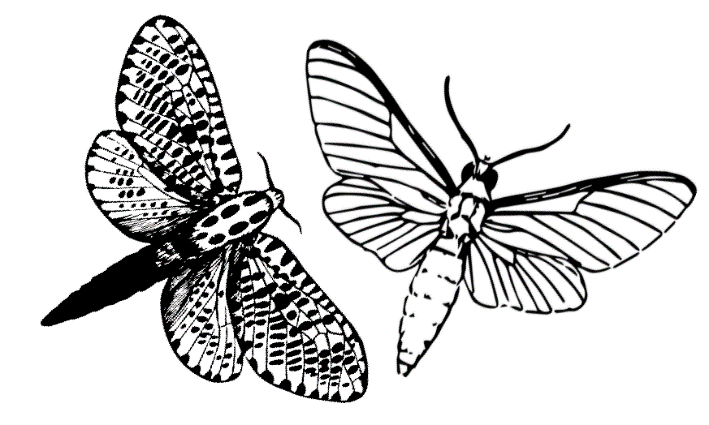
According to natural selection, light colored tree trunks would favor

a)

light colored moths

b)

dark colored moths

c)

red colored moths

d)

red and light colored moths

8.

Genetic diversity in a species makes long term survival of some members

a)

impossible

b)

improvable

c)

more likely

d)

less likely

9.

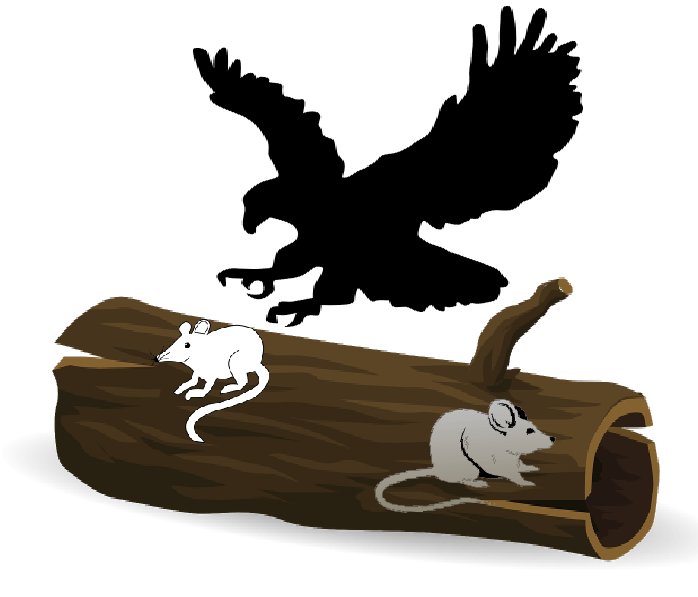
Over the years, white mice became extinct and darker mice survived. This is

a)

stabilizing selection

b)

directional selection

c)

disruptive selection

d)

due to exercise

10.

A physical trait favored by an environmental change can be called an

a)

adaptation

b)

extinction

c)

possibility

d)

mutation

11.

Flying squirrels and sugar gliders are very similar species, but the the sugar glider lives in Australia and the flying squirrel lives in North America. What is the explanation for their similarities?

a)

They share a common ancestor that was separated by the movement of tectonic plates

b)

The ancestors of the sugar glider took a boat from California to Australia

c)

They are not related at all, it is a coincidence that they are similar to each other

d)

American tourists liked sugar gliders, so they brought some to North America, where they turned into flying squirrels

12.
____ is when members of a species that are best suited for their environment survive and reproduce at a higher rate than other members of the species
a)
natural selection
b)
artificial selection
c)
speciation
d)
adaptation
13.
Which of the following means "change over time"
a)
natural selection
b)
speciation
c)
evolution
d)
isolation
14.
The differences among a species, like different bird beaks, are called
a)
theories
b)
variations
c)
adaptations
d)
genes
15.
___ are mistakes in the DNA that cause variation within a species.
a)
mutations
b)
adaptations
c)
speciations
d)
isolations
16.
Any inherited trait that gives an organism an advantage in its environment is called ___.
a)
a mutation
b)
an adaptation
c)
evolution
d)
natural selection
17.
Most organisms have more offspring than will survive 
a)
True
b)
False
18.
Gel electrophoresis enables scientists to
a)
separate DNA fragments.
b)
combine DNA fragments.
c)
count the genes in DNA.
d)
insert DNA in cells.
19.
Genetic engineering has been used to produce
a)
medicines.
b)
food animals.
c)
improved crops.
d)
all of these.
20.
Polymerase chain reaction is used to
a)
determine the sequence of DNA.
b)
make copies of a DNA sequence.
c)
selectively breed plants and animals.
d)
produce mutations in bacteria.
21.
Which is used to cut DNA molecules at specific points?
a)
gel electrophoresis
b)
PCR analysis
c)
a restriction enzyme
d)
recombinant DNA
22.
Which produces offspring from a single cell of an adult?
a)
inbreeding.
b)
mutations.
c)
hybridization.
d)
cloning.
23.
Transgenic organisms contain
a)
genes from other species.
b)
cells of another organism.
c)
genes of only one parent.
d)
one or more human genes.
24.
Genes found on DNA contain the instructions for making  
a)
pyrimidines 
b)
pyrimidines
c)
proteins
d)
purines
25.
Any change or mistake in DNA replication can cause a ________  
a)
cancer cell 
b)
virus
c)
disease
d)
mutation
26.
simple ring of DNA from prokaryotes
a)
plasmid
b)
restriction enzymes
c)
recombinant DNA
d)
gene
27.
molecular scissors that "cut' DNA
a)
plasmid
b)
restriction enzymes
c)
recombinant DNA
d)
gene
28.
DNA containing genes from a foreign donor
a)
plasmid
b)
restriction enzymes
c)
recombinant DNA
d)
gene
29.
Which sequence of DNA bases would pair with this partial strand
ATG TGA CAG
a)
ATG TGA CAG
b)
TAC ACT GTC
c)
GTA AGT GAC
d)
CAT TCA CTG
30.
Which of the following best describes a DNA molecule?
a)
double helix
b)
contains ribose
c)
made of amino acids
d)
contains Uracil
31.
Which of the following units are repeatedly joined together to form a strand of DNA?
a)
amino acids
b)
nucleotides
c)
fatty acids
d)
polysaccharides
32.
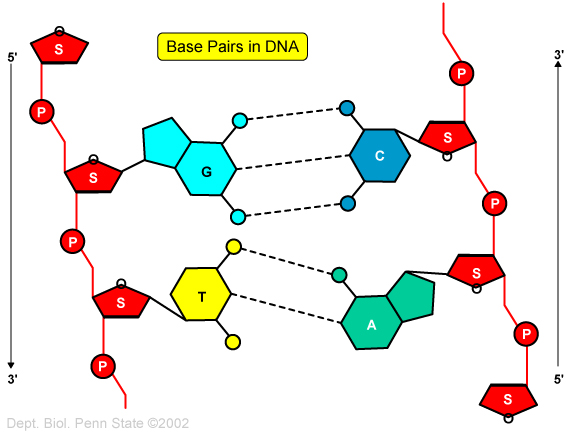
In a molecule of double-stranded DNA, the amount of Adenine present is always equal to the amount of
a)
cytosine
b)
guanine
c)
thymine
d)
uracil
33.
Adenine bonds with ______________.
a)
Guanine
b)
Thymine
c)
Cytosine
d)
Adenine
34.
Guanine bonds with ______________.
a)
Adenine
b)
Guanine
c)
Cytosine
d)
Thymine
35.
Why is DNA important?
a)
it is very small and very complicated
b)
it's in everything
c)
it serves as the blueprint for traits of all living things
d)
because we eat it every day for energy
36.
Which 2 molecules form the sides (backbone) of the DNA ladder?
a)
deoxyribose sugar and adenine
b)
deoxyribose sugar and a hydrogen bond
c)
deoxyribose sugar and the nucleus
d)
deoxyribose sugar and phosphate
37.
What determines the code, or information, of a DNA molecule?
a)
the shape (structure) of the nitrogen bases
b)
the order (sequence) of the nitrogen bases
c)
the color of the nitrogen bases
d)
the frequency (number) of nitrogen bases
38.
Nitrogenous bases are joined by which type of bond?
a)
polar bonds
b)
ionic bonds
c)
covalent bonds
d)
hydrogen bonds
39.
Which organelle is DNA usually found in?
a)
cell membrane
b)
vacuole
c)
chloroplast
d)
nucleus
40.
DNA replication results in two DNA molecules,
a)
each one with two original strands
b)
each one with two new strands
c)
each one with one new strand and one original strand
d)
one with two new strands and the other with two original strands
41.
A process in which DNA has the unique ability to make an exact copy of itself.
a)
Replication
b)
Translation
c)
Transcription
42.

In what process is mRNA synthesized?

a)

Transcription

b)

Translation

c)

DNA Replication

d)

Mitosis

43.

Where does TRANSCRIPTION occur?

a)

Nucleus

b)

Ribosome

c)

Cytoplasm

d)

Mitochondria

44.

Why must transcription occur where DNA can be found?

a)

because DNA can't leave

b)

because ribosomes are in the nucleus

c)

because DNA polymerase is found there

d)

because helicase unzips the DNA

45.

How many codons equals 1 amino acid?

a)

1

b)

2

c)

3

d)

4

46.

On which molecule can an anticodon be found?

a)

mRNA

b)

DNA

c)

tRNA

d)

rRNA

47.

How do you know when to begin translating a strand of mRNA?

a)

look for AUG

b)

start at the beginning

c)

look for ATG

d)

when Ms. H tells me to

48.

TRANSLATE this RNA sequence: AUGCAAUGA

a)

Met-Glu-Stop

b)

Met-His-Stop

c)

Thr-Glu-Stop

d)

Thr-Pro-Stop

49.
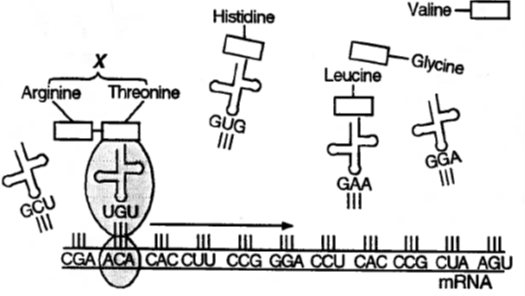
What process is going on in this photo? 
a)
Transcription 
b)
Translation 
c)
Replication 
d)
All the above 
50.
Does the order of amino acids in a protein matter?
a)
YES!
b)
NO!
51.

The important enzyme related with transcription is;

a)

gyrase

b)

DNA polymerase

c)

RNA polymerase

d)

ligase

52.
The unpaired nucleotides produced by the action of restriction enzymes are referred to as
a)
sticky end.
b)
base sequence.
c)
single strands.
d)
restriction fragments.
53.
In order to insert a human gene into plasmid, both must 
a)
code for the same gene product.
b)
be cut by the same restriction enzyme.
c)
originate from the same type of cell.
d)
have identical sequences.
54.
What is this
a)
plasmid
b)
recombinant bacterium
c)
recombinant DNA
d)
sticky ends
55.
One of the goals of the Human Genome Project is to
a)
increase the number of genes in the human genome
b)
map the location of only the most important genes on each chromosome
c)
clone the entire human genome in bacteria
d)
determine the nucleotide sequence of the entire human genome
56.

What a hypothesis?

a)

an explanation about what you observed

b)

using your 5 senses to gather data

c)

the thing changed on purpose in the experiment

d)

an educated guess about what will happen in the experiment.

57.

When is a hypothesis written?

a)

before you decide on a question

b)

after the experiment

c)

after the conclusion

d)

before the experiment

58.

A hypothesis is never wrong.

a)

True

b)

False

59.

Which hypothesis is correct?

a)

If you study longer then you will do better on the quiz.

b)

If the amount of time you study is changed then studying 2 hours will help you do better on the quiz.

c)

If the amount of time you study is changed then 2 hours will affect your quiz grade.

60.
Research question: does the distance a person kicks a soccer ball effect how well they will do on their math test.  What is the dependent variable?
a)
How far they kick the soccer ball
b)
who the person is
c)
how well they do on the math test
d)
Type of soccer ball.
61.
Which variable depends on what is done at the beginning of an experiment?
a)
Dependent
b)
Independent
c)
Control
d)
Following
62.
What would the INDEPENDENT variable be in an experiment testing which types of paper airplane goes furthest?
a)
the paper used
b)
the type of paper airplane
c)
the distance of each plane's flight
d)
how hard the plane is thrown
63.
Research Question: Does the type of gasoline put in a car effect how fast the car can drive. What is the independent variable?
a)
Type of gasoline
b)
which car the gas is put into
c)
how fast the car can drive
d)
how much gas is put into the car
64.
An experiment is performed on plants to see how different liquids affect plant growth. Each plant in the experiment is given a different liquid; water, apple juice, or milk. Each plant has the same amount of soil, sunlight, and listens to the same music. In this investigation, the independent variable is ...
a)
The type of plant
b)
The amount of sunlight
c)
The type of music
d)
The type of liquid
65.
Ms. S set up an experiment to see how the mass of a ball affects the distance it rolls off a ramp. Identify the independent variable.
a)
Distance traveled by the ball
b)
Height of the ramp
c)
Mass of the ball
d)
Who set up the experiment (Ms. S, etc)
66.

What Domain do I belong in?

I am unicellular.

I am prokaryotic.

I reproduce asexually.

I am autotrophic.

I live everywhere!

a)

Eukarya

b)

Archaea

c)

Bacteria

67.

What Domain do I belong to?

I am multicellular.

I am eukaryotic.

I reproduce sexually.

I am heterotrophic.

I thrive on a dark, moist ground.

a)

Eukarya

b)

Bacteria

c)

Archaea

68.

What Kingdom do I belong in?

I am unicellular.

I am prokaryotic.

I reproduce asexually.

I am autotrophic.

I live everywhere!

a)

Eubacteria

b)

Archaeabacteria

c)

Animalia

d)

Plantae

e)

Protista

69.

What Domain do I belong to?

I am made of only one cell.

I make my own food.

I reproduce asexually.

I have a nucleus.

You can find me swimming in water.

a)

Archaea

b)

Bacteria

c)

Eukarya

70.

What Domain do I belong to?

I am multicelled.

My cells do have a nucleus.

I reproduce sexually.

I love the sun! It helps me make my food through photosynthesis.

I can be found anywhere in the world.

a)

Archaea

b)

Bacteria

c)

Eukarya

71.

The most broad / general in the order of classification is?

a)

Kingdom

b)

Domain

c)

Class

d)

Order

72.

Binomial Nomenclature means?

a)

classification

b)

characteristics

c)

2 name naming system

73.

What kingdom's organisms often live in super harsh (extreme) environments?

a)

archea

b)

animalia

c)

plantae

d)

protista

74.
Mutations are a change in what?
a)
DNA
b)
tRNA
c)
genotype
d)
phenotype
75.

In which ways can genetic engineering can improve crops

a)

Make them pest or drought resistant

b)

Make them more nutritious

c)

Make them larger

d)

All answers are correct

76.
A clone is 
a)
recombinant DNA
b)
a transgenic organsim
c)
plasmid
d)
genetically identical 
77.
What term is used to express creating an identical copy of a gene or organism?
a)
hybridization
b)
inbreeding 
c)
cloning 
d)
gene splicing 
78.
What process is shown in the picture?
a)
Gene therapy
b)
Cloning
c)
DNA Fingerprinting
d)
Gene Splicing
79.
Putting the gene for bioluminescence into a fish is an example of...
a)
Genetic Engineering
b)
Selective Breeding
c)
Artificial Selection
d)
Gene Mutation
80.
Advantages of genetically modified crops include(s)
a)
insect resistance
b)
drought/freeze resistance
c)
higher yield
d)
all of these are reasons for using GMOs
81.
Dolly the sheep 
a)
Genetic engineering
b)
Cloning
82.

When was Dolly the sheep cloned?

a)

1996

b)

1987

c)

1808

d)

2018

83.
A clone can be BEST thought of as a(n)  _____ created in the lab. 
a)
identical twin
b)
GMO
c)
science fiction experiment