wayground logo

Free Printable Worksheets

Font size

S
M
L
XL
Worksheets

10 Science Mid-Semester Revision

Total questions: 120

Worksheet time: 4hrs 53mins

Name
Class
Date
1.
The independent variable is the ONE thing you _____.
a)
change
b)
keep the same
c)
experiment with
d)
investigate
2.

In a controlled experiment, the variable that is changed to test the hypothesis is called the –

a)

Controlled Variable

b)

Responsive Variable

c)

Dependent Variable

d)

Independent Variable

3.
The measurable factor in an experiment is known as the: 
a)
Control
b)
Independent Variable
c)
Constant
d)
Dependent Variable
4.
A possible explanation to a problem that has not yet been tested. 
a)
data
b)
theory
c)
hypothesis
d)
fact
5.
A series of steps used by scientists to solve a problem or answer a question. 
a)
scientific method
b)
recipe
c)
data collection
d)
metric system
6.

A procedure carried out to gather data about an object or event.

a)

evidence

b)

inquiry

c)

investigation

d)

experiment

7.

The parts of an investigation that remain the same so that the dependent variable can be measured.

a)

independent variable

b)

dependent variable

c)

hypothesis

d)

control variable

8.

Information, collected during an investigation, to support a hypothesis.

a)

evidence

b)

inquiry

c)

experiment

d)

control variable

9.

A procedure you carry out under controlled conditions to test a hypothesis.

a)

hypothesis

b)

inquiry

c)

experiment

d)

investigation

10.

Which of these contains steps in the right order?

a)

Ask a question, form a hypothesis, research, plan and conduct an investigation, draw conclusions, report and share results, make a conclusion

b)

Form a hypothesis, ask a question, research, plan and conduct an investigation, draw conclusions, report and share results

c)

Observe and ask questions, form a hypothesis, plan and conduct an investigation, draw conclusions, report and share results

d)

Form a hypothesis, ask a question, research, report and share results, plan and conduct an investigation, draw conclusions

11.
What type of graph is this?
a)
Line Graph
b)
Pictograph
c)
Bar Graph
d)
Histogram
12.
What type of graph is this?
a)
Line Graph
b)
Pictograph
c)
Bar Graph
d)
Histogram
13.

What type of graph is this?

a)

Bar graph

b)

Histogram

c)

Pie Chart/Circle Graph

d)

Stem Chart

14.
Research question: does the distance a person kicks a soccer ball effect how well they will do on their math test.  What is the dependent variable?
a)
How far they kick the soccer ball
b)
who the person is
c)
how well they do on the math test
d)
Type of soccer ball.
15.
When experimenting with the growth of a plant, a scientist uses three (of the same type of) plants, two different fertilizers, equal light, and equal water. What type of variable is the fertilizer?
a)
Dependent
b)
Independent
c)
Control
d)
Compound
16.
What would the INDEPENDENT variable be in an experiment testing which types of paper airplane goes furthest?
a)
the paper used
b)
the type of paper airplane
c)
the distance of each plane's flight
d)
how hard the plane is thrown
17.
Research Question: Does the type of gasoline put in a car effect how fast the car can drive. What is the independent variable?
a)
Type of gasoline
b)
which car the gas is put into
c)
how fast the car can drive
d)
how much gas is put into the car
18.
An experiment is performed on plants to see how different liquids affect plant growth. Each plant in the experiment is given a different liquid; water, apple juice, or milk. Each plant has the same amount of soil, sunlight, and listens to the same music. In this investigation, the independent variable is ...
a)
The type of plant
b)
The amount of sunlight
c)
The type of music
d)
The type of liquid
19.
An experiment is performed on plants to see how different liquids affect plant growth. Each plant in the experiment is given a different liquid; water, apple juice, or milk. Each plant has the same amount of soil, sunlight, and listens to the same music. In this investigation, what is the dependent variable?
a)
Type of plant
b)
Water, apple juice, milk
c)
Plant growth
d)
Color of the plant's leaves
20.
Ms. S set up an experiment to see how the mass of a ball affects the distance it rolls off a ramp. Identify the independent variable.
a)
Distance traveled by the ball
b)
Height of the ramp
c)
Mass of the ball
d)
Who set up the experiment (Ms. S, etc)
21.
Ms. S set up an experiment to see how the mass of a ball affects the distance it rolls off a ramp. What is the dependent variable?
a)
Distance traveled by the ball
b)
Height of the ramp
c)
Mass of the ball
d)
Where the experiment took place.
22.
Maria wants to know if birds prefer to eat in one place over another. She makes three feeders out of 2-liter bottles and paints all of them red. She fills each of the feeders with the same amount of mixed birdseed, and plans to keep the feeders out for 10 days before measuring how much seed is eaten from each feeder. She puts each of the feeders in her back yard: one feeder in a large dead tree, another feeder she sits on the dog house, and the last she sits in a small bushy tree.
What is the dependent variable?
a)
Length of the birdfeeders
b)
Amount of time feeders are outside
c)
Amount of seed eaten
d)
Location the feeders are put in.
23.
A magician pulls a tablecloth out from under dishes and glasses on a table without disturbing them.
a)
Newton's 1st Law
b)
Newton's 2nd Law
c)
Newton's 3rd Law
d)
None of them
24.
A person’s body is thrown outward as a car rounds a curve on a highway.
a)
Newton's 1st Law
b)
Newton's 2nd Law
c)
Newton's 3rd Law
d)
None of them
25.
Rockets are launched into space using jet propulsion where exhaust accelerates out from the rocket and the rocket accelerates in an opposite direction.
a)
Newton's 1st Law
b)
Newton's 2nd Law
c)
Newton's 3rd Law
d)
None of them
26.
A picture is hanging on a wall and does not move.
a)
Newton's 1st Law
b)
Newton's 2nd Law
c)
Newton's 3rd Law
d)
None of them
27.
A person not wearing a seatbelt flies through a car window when someone slams on the breaks because the person’s body wants to remain in continuous motion even when the car stops.
a)
Newton's 1st Law
b)
Newton's 2nd Law
c)
Newton's 3rd Law
d)
None of them
28.
Pushing a child on a swing is easier than pushing an adult on the same swing, because the adult has more inertia.
a)
Newton's 1st Law
b)
Newton's 2nd Law
c)
Newton's 3rd Law
d)
None of them
29.
Pushing a child on a swing is easier than pushing an adult on the same swing, because the adult has more inertia.
a)
Newton's 1st Law
b)
Newton's 2nd Law
c)
Newton's 3rd Law
d)
None of them
30.
Acceleration is produced when a force acts on a mass. The greater the mass (of the object being accelerated) the greater the amount of force needed (to accelerate the object).
a)
Newton's 1st Law
b)
Newton's 2nd Law
c)
Newton's 3rd Law
d)
None of them
31.
An object at rest will remain at rest unless acted on by an unbalanced force. An object in motion continues in motion with the same speed and in the same direction unless acted upon by an unbalanced force.
a)
Newton's 1st Law
b)
Newton's 2nd Law
c)
Newton's 3rd Law
d)
None of them
32.
This law is often called "the law of inertia."
a)
Newton's 1st Law
b)
Newton's 2nd Law
c)
Newton's 3rd Law
d)
None of them
33.
A soccer ball accelerates more than a bowling ball when thrown with the same force.
a)
Newton's 1st Law
b)
Newton's 2nd Law
c)
Newton's 3rd Law
d)
None of them
34.
A student leaves a pencil on a desk and the pencil stays in the same spot until another student picks it up.
a)
Newton's 1st Law
b)
Newton's 2nd Law
c)
Newton's 3rd Law
d)
None of them
35.
Two students are in a baseball game. The first student hits a ball very hard and it has a greater acceleration than the second student who bunts the ball lightly.
a)
Newton's 1st Law
b)
Newton's 2nd Law
c)
Newton's 3rd Law
d)
None of them
36.
For every action there is an equal and opposite reaction.
a)
Newton's 1st Law
b)
Newton's 2nd Law
c)
Newton's 3rd Law
d)
None of them
37.
The swimmer moves her hand down and to the left and her body goes forward to the right.
a)
Newton's 1st Law
b)
Newton's 2nd Law
c)
Newton's 3rd Law
38.
A rocket is sent into space.  When the power dies out, the rocket will just keep floating and moving in space forever (unless an unbalanced force, such as a meteor, runs into it).
a)
Newton's 1st Law
b)
Newton's 2nd Law
c)
Newton's 3rd Law
d)
None of them
39.

When two equal forces act in opposite directions on an object, they are called ______________________.

a)

frictional force

b)

balanced force

c)

centripetal force

d)

gravitational force

40.

When an unbalanced force acts on an object, the force ______________________.

a)

changes the motion of the object

b)

is cancelled by another force

c)

does not change the motion of an object

d)

is equal to the weight of the object

41.

The resistance of an object to any change in its motion is called ______________________.

a)

inertia

b)

friction

c)

gravity

d)

weight

42.

According to Newton’s second law of motion, force is equal to mass times ______________________.

a)

inertia

b)

weight

c)

acceleration

d)

direction

43.
If a 10 kilogram object accelerates suddenly at 15 m/s^2, how much force was applied to the object?
a)
150 Newtons
b)
15 Newtons
c)
150 kilograms
d)
100 kilograms
44.
If a force of 50 Newton's was applied to an object with a mass of 500 grams, what will the object's acceleration be?
a)
10 m/s^2
b)
.1 m/s^2
c)
100 m/s^2
d)
1 m/s^2
45.
45 m/s2 is the... 
a)
Mass
b)
Force 
c)
Acceleration
d)
weight
46.
If a force of 26 N is exerted on two balls, one with a mass of 0.52 kg and the other with a mass of 0.78 kg, which ball will have the greater acceleration?  (F=ma)
a)
The one with a mass of .78 kg will have the greatest acceleration.
b)
The one with a mass of .52 kg will have the greatest acceleration.
c)
They will both accelerate at the same rate.
47.
A 20 kg bike accelerates at 10 m/s2.  what was the force?
a)
25 Newtons
b)
20 Newtons
c)
200 Newtons
d)
10 Newtons
48.
Unit of mass
a)
m/s 2
b)
m/s
c)
newtons
d)
kg
49.
The mass of a car is 1000 kg.  How much force would be required to accelerate the car at a rate of 3 m/s2? 
a)
1000 ÷ 3
b)
3 ÷ 1000
c)
1000 x 3
50.
A force of 250 N is applied to an object that accelerates at a rate of 5 m/s2.  What is the mass of the object? To solve this problem you must do - 
a)
250 ÷ 5
b)
5 ÷ 250
c)
250 x 5
51.
A 5 kg block is pulled across a table by a net force of 32 N. Calculate the acceleration of the object. To solve this problem you must do - 
a)
32 ÷ 5
b)
5 ÷ 32
c)
32 x 5
52.
A skier needs to apply a force of 132 N to accelerate at a rate of 2 m/s2. What is the mass of the skier? To solve this problem you must do - 
a)
132 ÷ 2
b)
2 ÷ 132
c)
132 x 2
53.
A skier needs to apply a force of 132 N to accelerate at a rate of 2 m/s2. What is the mass of the skier? The answer to this question is most likely (HINT: Look at the units!!!) - 
a)
66 N
b)
66 m/s2
c)
66 kg
54.
The masses of four objects are given in this table. If all objects are struck with the same amount of force, which one will have the greatest acceleration?
a)
Object 1
b)
Object 2
c)
Object 3
d)
Object 4
55.
Examine the table provided. Which of the objects is producing the greatest force?
a)
Soccer Ball
b)
Tennis Ball
c)
Marble
d)
Ping-Pong Ball
56.
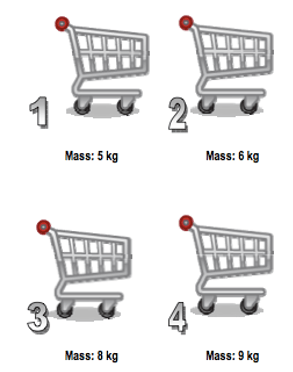
A force of 90N is applied to each cart below, which one will accelerate the fastest?
a)
Cart 1
b)
Cart 2
c)
Cart 3 
d)
Cart 4
57.
What is the SI unit used to measure force? 
a)
pounds 
b)
grams 
c)
newtons 
d)
kg/ m2
58.
A basketball with a mass of 0.60 kg is accelerated with a force of 10.8 N. If resisting forces are ignored, what is the acceleration of the basketball to the nearest m/s2?
a)
16 m/s2
b)
17 m/s2
c)
18 m/s2
d)
19 m/s2
59.
The Law of Conservation of Energy states:
a)
Energy can created or destroyed but not transformed 
b)
Energy cannot be created or destroyed, it can only transformed
c)
Energy can't be created, destroyed or transformed
60.
According to the Law of Conservation of energy, the amount of energy before and after a reaction must be the same. Which statement below is true?
a)
The total amount of energy is conserved
b)
The total amount of energy is less after a reaction
c)
The total amount of energy is more after a reaction
61.
Which energy transformation below matches?
A book falling?
a)
chemical to sound and heat
b)
kinetic to sound and heat
c)
electrical to sound and heat
62.
Which energy transformation below matches?
Water moving over a dam to move a generator?
a)
kinetic to chemical
b)
kinetic to electrical
c)
solar to electrical
63.
Which energy transformation below matches?
Green plants?
a)
chemical to mechanical
b)
chemical to heat
c)
solar to chemical
64.
Which energy transformation below matches?
Animals eating food?
a)
electrical to potential
b)
chemical to kinetic
c)
potential to chemical
65.
Which energy transformation below matches?
Burning coal or carbon-based fuel at a powerplant?
a)
chemical to heat to electrical
b)
mechanical to chemical to sound
c)
electrical to chemical to heat
66.
Which energy transformation below matches?
An electrical circuit?
a)
chemical to heat, sound, light, mechanical
b)
solar to heat, sound, light, mechanical
c)
electrical to heat, sound, light, mechanical
67.
Potential or kinetic?
Stretched bow and arrow?
a)
kinetic
b)
potential
68.
Potential or kinetic?
Running?
a)
potential
b)
kinetic
69.
Kinetic energy is energy due to...
a)
interactions between objects or particles
b)
motion
c)
elasticity
d)
mass
70.
Potential energy is energy that is...
a)
stored
b)
already used
c)
being used currently
d)
never going to be used
71.
What are the nucleotides made of?
a)
Sugar, Phosphate, nitrogen base
b)
Phosphate, Adenine, nitrogen base
c)
Thymine, Adenine, Cytomine
d)
Phosphate, Nitrogen, Adenine
72.
Which of the following best describes a DNA molecule?
a)
double helix
b)
contains ribose
c)
made of amino acids
d)
contains Uracil
73.
Adenine bonds with ______________.
a)
Guanine
b)
Thymine
c)
Cytosine
d)
Adenine
74.
Guanine bonds with ______________.
a)
Adenine
b)
Guanine
c)
Cytosine
d)
Thymine
75.
Why is DNA important?
a)
it is very small and very complicated
b)
it's in everything
c)
it serves as the blueprint for traits of all living things
d)
because we eat it every day for energy
76.
What are the 4 nitrogen bases?
a)
adenine, thymine, cytoplasm, and guanine
b)
adenine, thymine cytosine, and guanine
c)
adenine, thymine, cytosine, and gylcerol
d)
adenine, thymine, cytosine, and glucose
77.
Which sequence of DNA bases would pair with this partial strand
ATG TGA CAG
a)
ATG TGA CAG
b)
TAC ACT GTC
c)
GTA AGT GAC
d)
CAT TCA CTG
78.
Which organelle is DNA usually found in?
a)
cell membrane
b)
vacuole
c)
chloroplast
d)
nucleus
79.
Which 2 molecules forms the sides (backbone) of the DNA ladder?
a)
deoxyribose and adenine
b)
deoxyribose and a hydrogen bond
c)
sugar and the nucleus
d)
deoxyribose (sugar) and phosphate
80.
What does DNA stand for?
a)
Deoxyribonucleic acid
b)
Denitrogenous acid
c)
Deribonucleic acid
d)
Diribonucleic acid
81.

How many chromosomes do human cells have?

a)

46

b)

23

c)

2

d)

44

82.
What is a gene?
a)
A bundle (like a hot dog bun) that the DNA is packed into
b)
something inside the nucleus
c)
a piece of DNA
d)
all of your DNA
83.

Bundled up, organized DNA is called a

a)

gene

b)

trait

c)

chromosome

d)

nucleotide

84.

Complex molecule that carries genetic information that defines an organism's traits. It is stored in the nucleus.

a)

Protein

b)

DNA

c)

RNA

d)

Glucose nucleic acid (GNA)

85.
Dominant alleles are represented by a:
a)
Male gene
b)
lowercase letter
c)
recessive trait
d)
capital letter
86.
Aa, DD, bB, yy are all examples of
a)
genotypes
b)
phenotypes
87.
In a heterozygous genotype, the ___________ allele takes over in the phenotype.
a)
recessive
b)
dominant
c)
lower case letter
d)
both 
88.
What you see, or the physical appearance.
a)
Genotype
b)
Phenotype
c)
Homozygous
d)
Heterozygous
89.

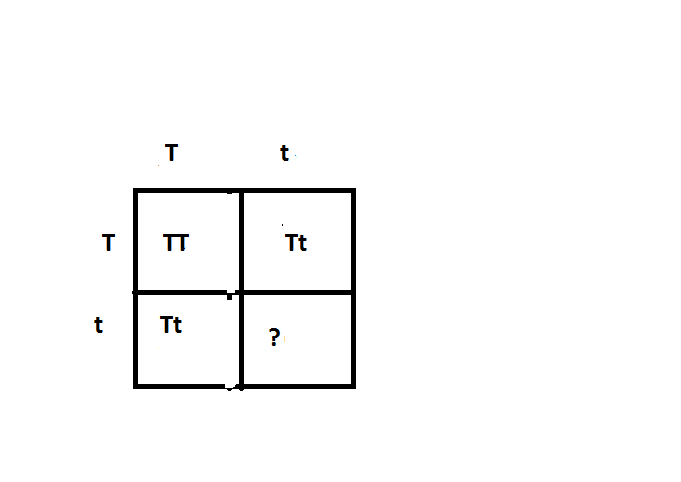
T - tall and t = short

In the punnett square below, what belongs in the missing square

a)

tt

b)

Tt

c)

Bb

d)

TT

90.

B = brown eyes

b = blue eyes

One brother has genotype BB and the other brother has genotype Bb.

Which statement is true about these two brothers?

a)

They have same phenotype and genotype

b)

They have different phenotypes and genotypes

c)

They have same phenotype, but different genotypes

d)

They have different phenotypes, but the same genotype

91.

Which of the following would be a phenotype?

a)

Aa

b)

red hair

c)

heterozygous

d)

DNA

92.
Which of the following genotypes is heterozygous?
a)
Bb
b)
BB
c)
bb
d)
B
93.

Which of the following genotypes is homozygous dominant?

a)

Yy

b)

yY

c)

yy

d)

YY

94.

Which of the following genotypes is homozygous recessive?

a)

Tt

b)

tt

c)

TT

d)

tT

95.

In a flowering plant species, red flower color (R) is dominant over white flower color (r). What is the genotype of any white-flowering plant resulting from this species?

a)

rr

b)

rR

c)

RR

d)

Rr

96.

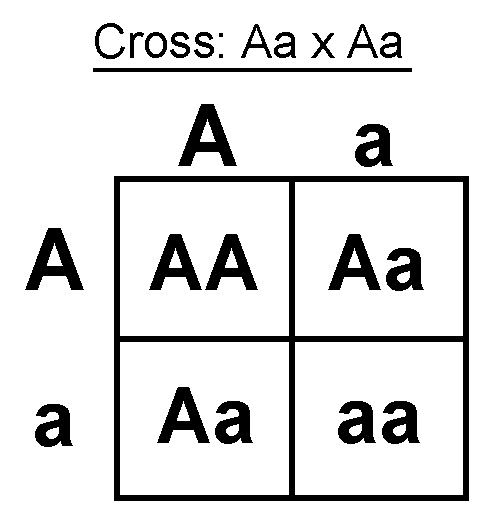
What is the genotypic ratio of the offspring?

a)

3:1

b)

1:3

c)

1:2:1

d)

2:2

97.

How many alleles are in the genotype for a simple trait?

a)

1

b)

2

c)

3

d)

4

98.

How many alleles (letters) does a child get from EACH parent for each trait?

a)

1

b)

2

c)

3

d)

4

99.

What are the phenotype percentages of the offspring?

(A-Brown fur color; a-white fur color)

a)

50 % Brown fur and 50% White fur

b)

25 % Brown fur and 75% White fur

c)

75 % Brown fur and 25% White fur

d)

0% Brown fur and 100% White fur

100.
A ________________________ is used to predict the possible genotype from certain parents
a)
Mendel Grid
b)
Genetic Tic Tac Toe
c)
Punnett Square
d)
Pedigree Plot
101.
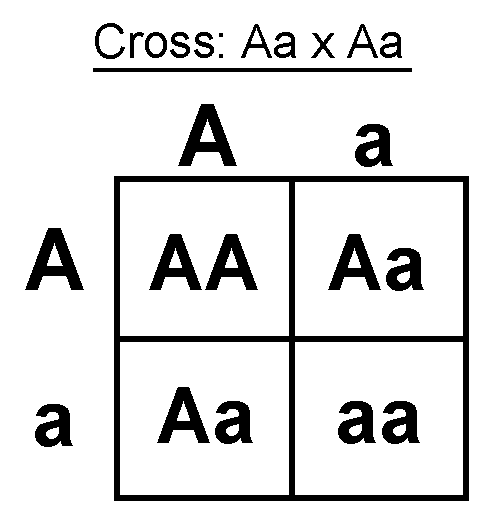
The genotypic ratio here is
a)
25% blue eye 75 % brown eye 
b)
BB = 25% Bb = 50% bb = 25%
c)
BB= 50 % bb = 50%
d)
All brown eye
102.
How many boxes would say BB?
a)
1
b)
2
c)
4
d)
0
103.

Brown is dominant to green. What is the probability of these parents having green offspring?

a)

1/4

b)

2/4

c)

3/4

d)

4/4

104.
The dominant trait is
a)
yellow pea seeds
b)
green pea seeds
c)
there is no dominant seed
d)
Jolly green giant
105.
To be a yellow seed genotype must be
a)
aa
b)
Aa
c)
AA
d)
AA or Aa
106.
What allele combination should go in the missing box?
a)
AA
b)
Aa
c)
aa
d)
none of these
107.
Where the better adapted organisms survive to pass traits along to offspring.
a)
Evolution
b)
Natural Selection
c)
Extinction
d)
Artifical Selection
108.
What is the advantage of having different shaped beaks?
a)
To look different from other species.
b)
To be able to eat the food readily available in the environment.
c)
To protect itself against predators.
d)
To protect itself against prey.
109.
Why are advantageous traits more likely to be passed onto offspring?
a)
Because they are more likely to survive and reproduce.
b)
Because they come from dominant alleles.
c)
Because they come from recessive alleles.
d)
Because the trait is an acquired phenotype.
110.
Mutations are a change in what?
a)
DNA
b)
tRNA
c)
genotype
d)
phenotype
111.
Genetic differences between organisms of the same species
a)
Variation
b)
Adaptation
c)
Behavior
d)
Environment
112.
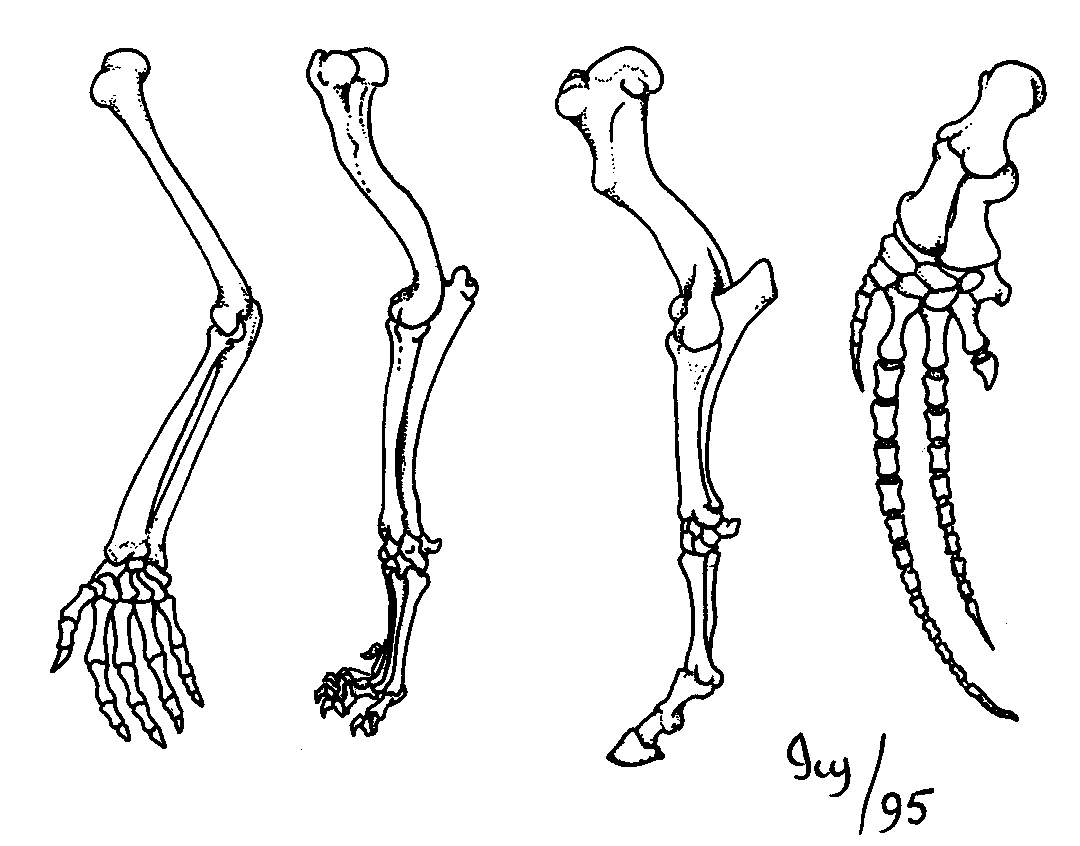
Structures with the same parts have different functions; suggests that organisms share a common ancestry
a)
vestigial structures
b)
homologous structures
c)
adaptive radiation
d)
fossil
113.
Study of embryos of various organisms to show a common ancestor because of similarities in development
a)
natural selection
b)
embryology
c)
speciation
d)
evolution
114.
Some organisms that share a common ancestor have features that have different functions, but similar structures.  These are known as
a)
vestigial structures
b)
analogous structures
c)
homologous structures
d)
fossil structures
115.
A fossil of an extinct dinosaur is found and the anatomy of the fossil shows similarities to that of a bird. What could this mean?
a)
This is purely by chance and isn't significant
b)
The extinct dinosaur and modern bird share a common ancestor
c)
All dinosaurs evolved into birds and that's why there aren't any dinosaurs alive today
d)
Dinosaurs choose to fly, and evolved into birds to escape predation and capture food
116.
Which of the following organisms the kingdom animalia are not closely related?
a)
mouse and hagfish
b)
mouse and lizard
c)
mouse and pigeon
d)
mouse and chimp
117.
Two organisms that are closely related would have
a)
very similar DNA sequence
b)
exactly the same DNA sequences
c)
no proteins in common
d)
completely different DNA sequence
118.
Which of the following are examples of evidence for evolution?
a)
Fossils and Cellular Structure
b)
Biological Structures 
c)
Genetics/DNA
d)
All of the Above
119.
These cause variations.
a)
mutations
b)
adaptations
c)
a desire to change
d)
injuries
120.
The theory of evolution by natural selection means that what is changing over time?
a)
The inherited traits of a population.
b)
The acquired traits of a population.
c)
Hair color and eye color
d)
Attractive features.