
Font size
 Worksheets
6th Grade Midterm
Total questions: 66
Worksheet time: 1hrs 1mins

The ___ is the basic unit of structure and function of organisms
atom
cell
matter
all other answers are correct

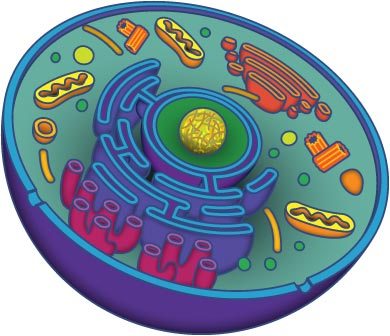
What type of cell is an animal cell?
Prokaryotic
Eukaryotic
What type of cell is a plant cell?
Prokaryotic
Eukaryotic
What type of cell is a bacterial cell?
Prokaryotic
Eukaryotic
Which of the following converts food into energy for the cell?
vacuole
mitochondria
cytoplasm
cell membrane
The fluid that surrounds the organelles is... (hint... "Try to pull a fast one and..."
chloroplast
cytoplasm
vacuole
cell wall


This part helps trap light to make food during photosynthesis in plants.
Mitochondria
Chloroplast
Cell Wall
Ribosome

This part may be smooth or rough (if covered with ribosomes). It is a tube network that transports proteins.
Ribosomes
Endoplasmic Reticulum
Golgi apparatus
Nuclear Membrane

What type of cell is this?
Prokaryotic
Eukaryotic
Plant
Animal


What organelle is number 5?
Cell wall
Nucleus
Chloroplast
Large Vacuole
What organelle is number 6?
Cell wall
Nucleus
Chloroplast
Large Vacuole

Which number is pointing to the mitochondria?
1
2
3
4
11

Which number is pointing to the
ribosomes?
6
5 & 7
8
9
10
one cell
unicellular
multicellular
neither
Which statement was NOT included in cell theory?
All living things are composed of cells.
Living cells come only from other living cells.
Each cell contains a cell membrane, cytoplasm, nucleus, mitochondria, and endoplasmic reticulum.
Cells are the smallest structure of living things that can perform the functions necessary for life.

These little sacs contain enzymes that break down food molecules like lipids, carbohydrates and proteins that enter the cell.
lysosomes
vacuoles
vesicles
nucleus

This type of cell has no nucleus, no organelles, smaller less complex
Prokaryotes
Eukaryotes
This type of cell has a nucleus, organelles, multi-cellular, complex
Prokaryotes
Eukaryotes
A population of panthers lives in the southeastern United States. Over 50 years, the size of the panther population in the region increased. What best explains the increase in the size of the panther population?
The panther population is always increasing because no animal eats panthers.
Fewer panthers were born than died.
More panthers were born than died.
A lot of panthers were born and none of them died.

Scientists have been studying the size of three populations in a grassland. In this ecosystem, snakes eat rats, and rats eat grasshoppers. The data showed that all three populations were stable. Then the grasshopper population decreased suddenly. What will likely happen to the size of the rat population as a result?
stay the same. The size of their consumer population did not change, so the number of deaths in the rat population did not change. There will be the same number of births and deaths in the rat population.
increase. The smaller grasshopper population will need fewer energy storage molecules so there will be more energy storage molecules available for the rat population to reproduce. This will lead to more births in the rat population.
decrease. A decrease in any population leads to a decrease in the sizes of all other populations in the ecosystem.
decrease. The smaller grasshopper population provides fewer energy storage molecules for the rat population, so the rat population will reproduce less. This will lead to fewer births than deaths in the rat population.


Which is the primary source of energy for plants?
producer
consumer
decomposer
sun

Which of the following would be the most likely effect, if there were a sudden increase in the cricket population?
There would be a decrease in the small bird population.
There would be a decrease in the grass/flowers population.
There would be a decrease in the mice population.
There would be an increase in the grass/flowers population.


A symbiotic relationship where both organisms benefit.
Mutualism
Commensalism
Parasitism
In the ocean, algae lives on the back of spider crabs. Spider crabs then blend in with the environment (thanks to the algae), and the algae gets a home.
Mutualism
Commensalism
Parasitism
Human skin is itchy and cracked from the athele foot fungus. The fungus is feeding on the foot.
Mutualism
Commensalism
Parasitism
Spanish moss will grow on oak trees. They do not have roots, so they will get water from the oak tree but they do not hurt the tree.
Mutualism
Commensalism
Parasitism
A symbiotic relationship where one organism benefits and the other one doesn't benefit and isn't harmed.
Mutualism
Commensalism
Parasitism
Relationship between a moutain lion and a deer.
parasitism
commensalism
mutualism
predator-prey

Which transverse wave has the highest frequency?
1
2
3
4
Which diagram shows the wavelength of a wave?


What does a wave carry from place to place?
energy
matter
people


Mia, Abigail, and Anika are conducting a science experiment. They shine a light through a glass of water and observe the light bending. What does this phenomenon demonstrate?
absorption
reflection
refraction
scattering

Which type of light has the highest energy of this group? Assume all these waves have the same amplitude.
red
yellow
green
blue


What part of the atom is the arrow pointing to?
Proton
Neutron
Electron

What part of the atom is the arrow pointing to?
Proton
Neutron
Electron

What part of the atom is the arrow pointing to?
Proton
Neutron
Electron
An element is determined by the number of ________ in its nucleus (also known as its atomic number).
neutrons
electrons
protons

What is the atomic number of this element?
O
8
16
How many protons does this element have?
16
8
0



