Wayground logo

Free Printable Worksheets

Font size

S
M
L
XL
Worksheets

Biology Unit 3 Revision

Total questions: 57

Worksheet time: 1hrs 1mins

Name
Class
Date
1.
What is the difference between biotic and abiotic?
a)
Biotic are non-living things
b)
Abiotic are living organisms
c)
Biotic is life,
Abiotic is non-living
d)
Biotic is non-living, Abiotic is living
2.
What does biodiversity mean?
a)
Only one species in an area.
b)
The different amount of species in an area
c)
All abiotic life
d)
Nitrogen fixation
3.
Food, water, sunlight, shelter, and space are resources that are often __________.
a)
limiting factors
b)
wet
c)
messy
d)
found in rocks
4.
If there is more food than usual in an ecosystem, then the population will mostly likely...
a)
stay the same
b)
decrease
c)
increase
5.
Any thing or organism that regulates the size of a population of another organism is known as __________.
a)
a limiting measure
b)
a limiting factor
c)
factorization
d)
materialization of precipitation
6.
number of organisms per certain area
a)
carrying capacity
b)
limiting factor
c)
total population
d)
population density
7.

A population is

a)

a group of similar species in different areas

b)

a group of the same species in the same geographic area.

c)

a group of several species in the same geographic area

d)

a group of several species along with their abiotic factors in a small area.
8.
Which of the following will increase the size of a population?
a)
emigration and births
b)
immigration and deaths
c)
immigration and births
d)
emigration and deaths
9.
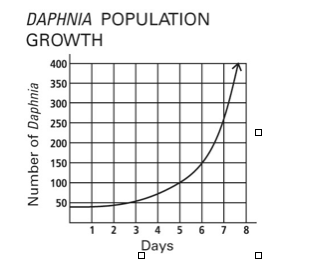
What type of growth is shown on this graph?
a)
logistic
b)
exponential
c)
average
d)
density-independent
10.
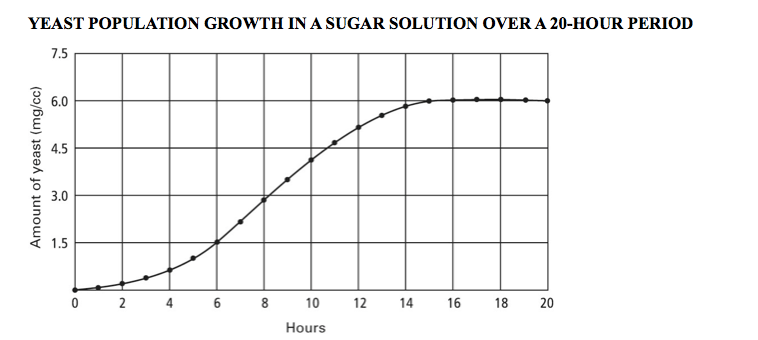
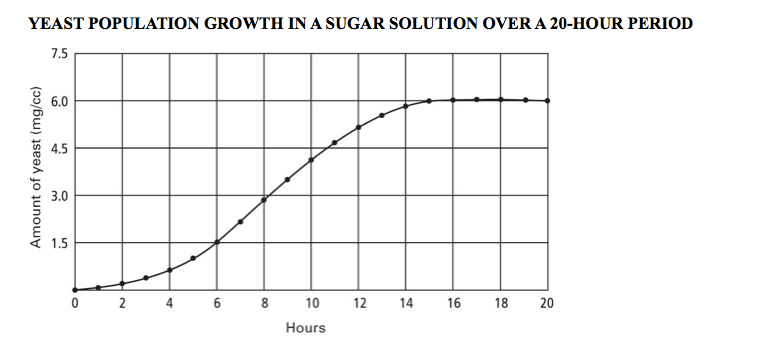
What type of population growth is shown in the graph?  
a)
logistic growth
b)
logical growth
c)
exponential growth
d)
density-dependent growth
11.
 What is the name for this leveling off shown in the graph?
a)
logistic line
b)
carrying capacity
c)
climax point
d)
mediocre
12.
When a population grows past the ecosystem's carrying capacity, what happens to the population?
a)
Continues to grow
b)
The population starts to die off to return to carrying capcity
c)
The population will go extinct due to lack of resources
d)
The population grows then finds a new carrying capacity
13.

Change in allele frequency in a population due to random sampling is

a)

Genetic drift

b)

Co-evolution

c)

Artificial selection

d)

Genetic resistance

e)

None of these

14.

an evolutionary event in which a significant percentage of a population or species is killed or otherwise prevented from reproducing

a)

population bottleneck

b)

mutation

c)

genetic resistance

d)

differential reproduction

e)

genetic recombination

15.

The BEST definition of evolution is

a)

Change in genetic composition of a population over time

b)

Mutations in individuals

c)

Changes in chromosomes

d)

Individuals adapting to an environment

e)

All of these

16.

Which is true of the location above?

a)

It has low species richness

b)

It has low species evenness

c)

It has high species evenness

d)

It has both low species evenness and richness

e)

None of these

17.

Which below is NOT FALSE?

a)

reproductive isolation leads to geographic isolation

b)

a population in the same location can be geographically isolated

c)

geographic isolation leads to reproductive isolation

d)

reproductive isolation leads to separate species becoming common species

e)

geographic isolation occurs when two different species are brought together

18.

all the genotypes within a population

a)

ecosystem service

b)

gene pool

c)

phenotype

d)

ecological niche

e)

reproductive isolation

19.

A small sample of the population is relocated to a new spot and starts a new population with genetics different from the original population

a)

Doppler effect

b)

Founder effect

c)

Reverse population bottleneck

d)

Artificial selection

e)

Mass extinction

20.
What is an invasive species?
a)
A native (naturally found) species which are added to an area. 
b)
A non-native (not naturally found) species added to an area. 
c)
A keystone species in an environment
d)
none of the above
21.

Which of the following is the equation used to calculate Simpson's Index of Diversity?

a)
b)
c)
22.

What is species richness?

a)

the number of different species in a sample

b)

the abundance (number of individuals) of each species in a sample
23.

What is species evenness?

a)

the number of different species in a sample

b)

the abundance (number of individuals) of each species in a sample

24.
When multiple organisms seek the same limited resource, this is referred to as?
a)
Tolerence
b)
Competetion
c)
Predation
d)
Parasitism
25.

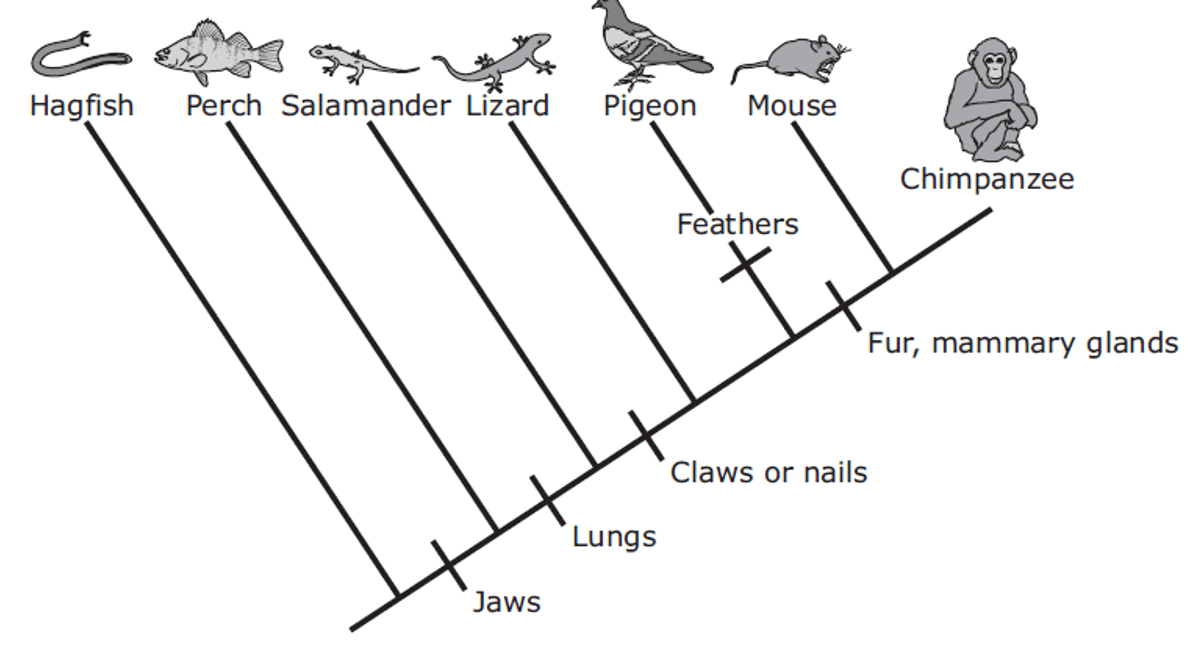
All the animals to the right of the salamander would have the common characteristic of...

a)

Fur

b)

Claws or nails

c)

Lungs

d)

Jaws

26.

short life span

a)

K-selected

b)

r-selected

27.

few reproductive events

a)

K-selected

b)

r-selected

28.

Fungi was separated from kingdom Plantae and introduced as a new kingdom because fungi

i) have cell wall which is made of Chitin

ii) are mostly unicellular

iii) are prokaryotic

iv) have heterotrophic mode of nutrition


Chose the correct combination from below

a)

i) and ii)

b)

i) and iii)

c)

i) and iv)

d)

ii) and iv)

29.
What trait separates sharks from ray-finned fish?
a)
Vertebrae
b)
Bony skeleton
c)
Four limbs
d)
None
30.
According to the cladogram, which organism is most distantly related to the human?
a)
crayfish
b)
grasshopper
c)
perch
d)
frog
31.
During ____________, _____________ convert light energy into the chemical energy in sugar molecules. 
a)
chemosynthesis, consumers
b)
chemosynthesis, producers
c)
photosynthesis, producers
32.
Organisms use energy to heal and repair themselves and grow or to stay warm. Organisms take food to release its energy and use it for ____________ and ___________ or transform it into _________.
a)
maintenance, growth, heat
b)
photosynthesis, chemosynthesis, producers
c)
chemosynthesis, photosynthesis, heat
33.
What type of organisms are the first step in a food chain?
a)
Consumers
b)
Predators
c)
Producers
34.
What do the arrows indicate in a food web?
a)
What eats what
b)
Where the energy is being transferred
c)
How the animals are related
35.
The efficiency of energy transfer from a lower trophic level to the next highest level is roughly
a)
1%
b)
10%
c)
100%
d)
1000%
36.

320,000 kCals of energy are found at the producer level in an energy pyramid. How much energy is available for consumers in the primary consumer level? (Hint: use the Rule of 10s)

a)

320,000 kCals

b)

32,000 kCals

c)

3,200 kCals

d)

320 kCals

37.
After the rain falls down onto Earth's surface, what most likely happens?
What is it called?
a)
1. The remains of the water is soaked into the ground.
2.Groundwater
b)
1. Groundwater
2. The remains of the water is soaked into the ground.
c)
1. Groundwater
2. Transpiration happens to the plants.
d)
1. The liquid turns into a gas or water vapor
2. Evaporation
38.

________________________ is part of the air, rocks, soil, and all living things.

a)

Nitrogen

b)

Carbon

c)

Water

d)

Silver

39.
What is the process of combining nitrogen gas with other elements to make nitrogen into usable compounds?
a)
nitrogen composition
b)
ammonia 
c)
nitrogen fixation
d)
denitrification
40.
Organisms that break down dead plants & animals and release nitrogen back into atmosphere...
a)
bacteria
b)
plants
c)
animals
d)
producers
41.
If the atmosphere is 78% N2, why can't we just get our nitrogen by breathing?
a)
We have no mechanism to break the triple bond of nitrogen between the atoms.
b)
Our lungs would be damaged by the N2.
c)
We need Oxygen for cellular respiration.
d)
The legumes take it up first.
42.
_____ is the conversion of organic nitrogen into ammonia
a)
Nitrogen Fixation
b)
Ammonification
c)
Denitrification
d)
Assimilation 
43.
Nitrification happens in the ______
a)
Air 
b)
Soil 
c)
Ground Water 
d)
Plants 
44.

What would happen to the animals in this aquarium if all the bacteria died?

a)

They would live longer because the bacteria couldn't harm them

b)

They would die because there would be excess ammonia in the tank.

c)

They would just move to another tank

d)

They would start eating their own poop to clean the tank

45.

The ecological role an organism performs in their specific environment is considered the organism's...

a)

Habitat

b)

Population

c)

Biome

d)

Niche

46.

the differentiation of niches that enables similar species to coexist in a community

a)

character displacement

b)

climax community

c)

resource partitioning

d)

pioneer species

47.
The ecological niches of three bird species are shown in the diagram. What is the advantage of each bird species having a different niche?
a)
As more birds feed higher in the tree, available energy increases.
b)
More abiotic resources are available for each bird.
c)
Predators are less likely to feed on birds in a variety of locations.
d)
There is less competition for food.
48.
No two species can occupy the same niche
a)
Competitive Exclusion Principle 
b)
Limiting Exclusion Theory
c)
Competitive Limiting Principle
d)
Limiting Competitive Theory 
49.
Type of growth typical of invasive species...
a)
exponential
b)
logistic
c)
S-shaped
d)
predator-prey cycle
50.
The graph of logistic growth can be described as...
a)
S-shaped
b)
J-shaped
c)
U-shaped
51.
succession that occurs in an area with no soil
a)
ecological succession 
b)
primary succession 
c)
secondary succession
d)
pioneer speciles
52.
the first organisms that appear in an ecological community
a)
ecological succession 
b)
primary succession 
c)
secondary succession
d)
pioneer speciles
53.
a stable ecological community that has reached equilibrium
a)
ecological succession 
b)
climax community
c)
secondary succession
d)
pioneer speciles
54.
starts with bare rock followed by lichen
a)
primary succession 
b)
secondary succession
c)
both types of succession
55.

many reproductive events

a)

K-selected

b)

r-selected

56.

If 50 crabs were captured and marked and then released and then a few days later 25 were caught and of those 5 were marked. What would the estimate of the population be?

a)

500

b)

250

c)

75

d)

200

57.

What is this method called?

a)

Sampling

b)

Mark-Release

c)

Capture-Recapture

d)

Random sampling