
 Worksheets
Phase Diagrams and Heating/cooling curves
Total questions: 40
Worksheet time: 49mins
Name
Class
Date
1.
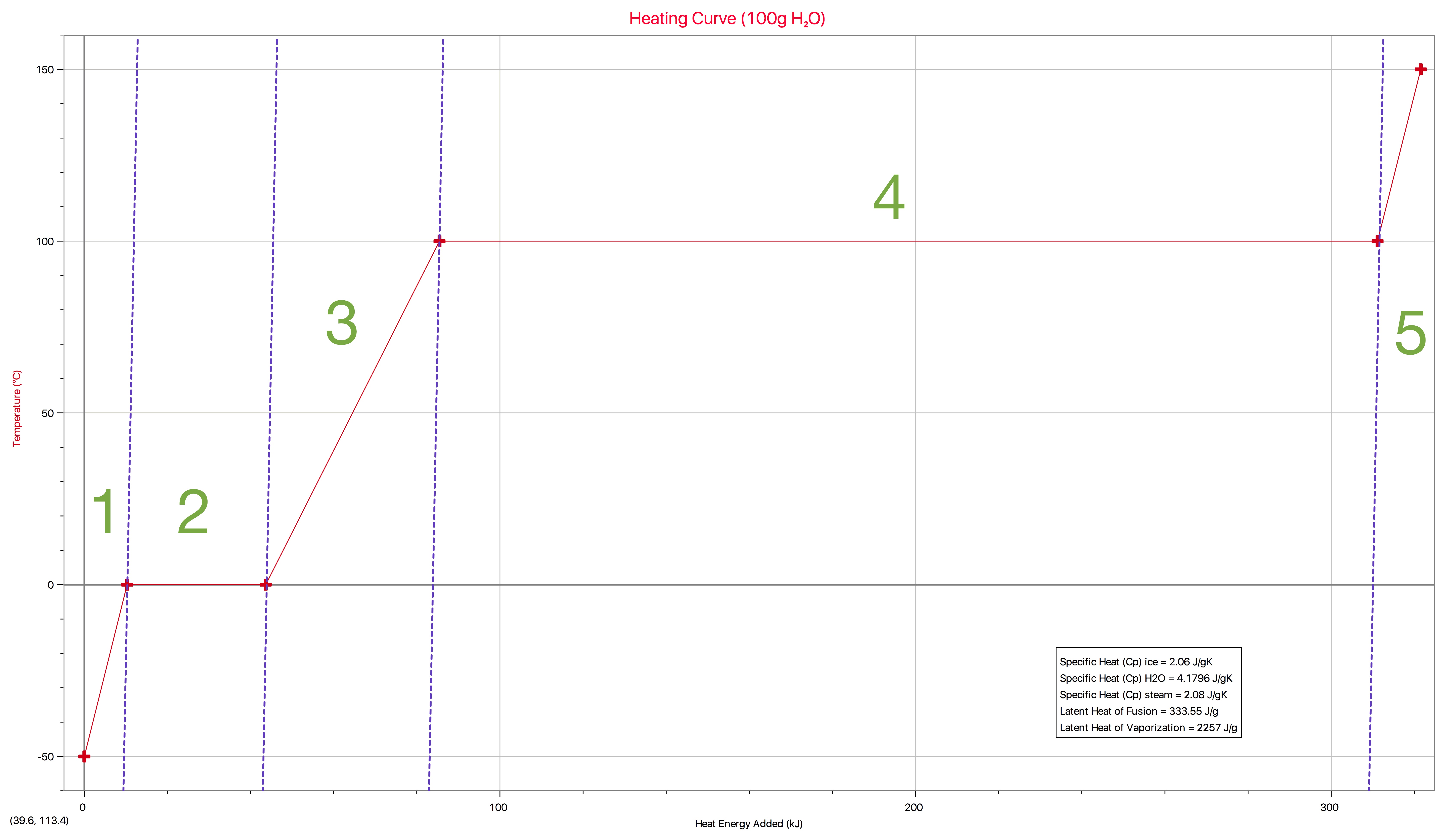
In which region(s) does temperature remain constant?
a)
Region 1, 3, & 5
b)
Region 2 & 4
c)
Region 1 only
d)
Region 1 & 2
2.
In which region(s) does temperature increase?
a)
Region 1, 3, & 5
b)
Region 2 & 4
c)
Region 1 only
d)
Region 1 & 2
3.
This curve indicates what about the heat energy?
a)
heat energy is being added or absorbed
b)
heat energy is being removed
4.
In which region(s) of the graph does a phase change occur?
a)
Region 1, 3, & 5
b)
Region 2 & 4
c)
Region 1 only
d)
Region 1 & 2
5.
In which region(s) of the graph would the substance only be in one phase?
a)
Region 1, 3, & 5
b)
Region 2 & 4
c)
Region 1 only
d)
Region 1 & 2
6.
In which region(s) of the graph would the substance be a solid only?
a)
Region 1
b)
Region 2
c)
Region 3
d)
Region 4
7.
In which region(s) of the graph would the substance be a solid and a liquid?
a)
Region 1
b)
Region 2
c)
Region 3
d)
Region 4
8.
In which region(s) of the graph would the substance be a gas only?
a)
Region 2
b)
Region 3
c)
Region 4
d)
Region 5
9.
In which region(s) of the graph does boiling take place?
a)
Region 2
b)
Region 3
c)
Region 4
d)
Region 5
10.

Describe the substance between letters A and B.
a)
Solid
b)
Liquid
c)
Melting
d)
Evaporating
11.

Describe the substance between letters D and E.
a)
Gas
b)
Liquid
c)
Melting
d)
Evaporating
12.
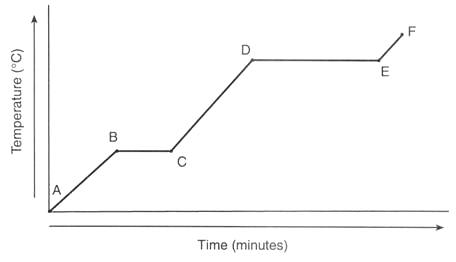
Between which points is the temperature of the substance remaining constant?
a)
A-B only.
b)
A-B, C-D, E-F
c)
B-C only.
d)
B-C, D-E
13.

The melting point of the sample is
a)
-60 ºC
b)
-100 ºC
c)
60 ºC
d)
100 ºC
14.
The freezing and melting points of water are the same.
a)
True
b)
False
15.

What state of matter is X?
a)
solid
b)
liquid
c)
gas
d)
supercritical fluid
16.
What state of matter is Y?
a)
solid
b)
liquid
c)
gas
d)
supercritical fluid
17.
What is the normal boiling point of this substance?
a)
150 °C
b)
100 °C
c)
-50 °C
d)
0 °C
18.
What change occurs from E to C?
a)
sublimation
b)
freezing
c)
melting
d)
boiling
19.

Water exists as a _____________ at 3 mmHg and 50 °C.
a)
solid
b)
liquid
c)
gas
d)
supercritical fluid
20.
Water exists as a _____________ at 700 mmHg and 50 °C.
a)
solid
b)
liquid
c)
gas
d)
supercritical fluid
21.
What phase change(s) may occur at pressures below 4.58 mmHg?
a)
sublimation/deposition
b)
melting/freezing
c)
all phase changes are possible at these pressures
d)
vaporization/condensation
22.
The pressure is increased on a sample of water at 0 °C from 0 mmHg to 800 mmHg. In order, what changes occur?
a)
deposition, melting
b)
sublimation, melting
c)
condensation, freezing
d)
deposition, freezing
23.
Water will boil at temperatures above 100 °C at pressures __________ 760 mmHg.
a)
below
b)
above
c)
equal to
d)
significantly below
24.

Which statement is true for carbon dioxide at -60 °C?
a)
All three phases are possible.
b)
It can exist as a solid or a gas, depending on pressure.
c)
It is a solid.
d)
With enough pressure it can be melted.
25.
Based on its phase diagram, which is the most dense state for CO2?
a)
gas
b)
liquid
c)
solid
d)
supercritical fluid
26.
What is true regarding CO2 for temperatures above 31 °C?
a)
It can never be liquified.
b)
It decomposes.
c)
It has a high pressure.
d)
It is a plasma.
27.
At 10 atm, dry ice is heated from -100 °C to 30 °C. What changes occur?
a)
freezing, then condensation
b)
melting only
c)
sublimation only
d)
melting, then boiling
28.
What is the normal melting point of CO2?
a)
-78.5 °C
b)
-56.7 °C
c)
31 °C
d)
It doesn't have a normal melting point.
29.
What is the normal boiling point of CO2?
a)
-78.5 °C
b)
-56.7 °C
c)
31 °C
d)
It doesn't have a normal boiling point.
30.
What state of matter is Z?
a)
solid
b)
liquid
c)
gas
d)
supercritical fluid
31.
What is the normal boiling point of this substance?
a)
150 °C
b)
100 °C
c)
-50 °C
d)
0 °C
32.
What is the normal melting point of this substance?
a)
150 °C
b)
100 °C
c)
-50 °C
d)
0 °C
33.
Below the temperature of point B, this substance can exist as a ____________.
a)
solid only
b)
liquid only
c)
gas only
d)
either a solid, liquid or gas
34.
At 0.10 atm, what phase(s) can exist?
a)
solid, liquid or gas
b)
liquid or gas
c)
solid only
d)
gas only
35.

This curve indicates what about the heat energy?
a)
Heat energy is being added or absorbed
b)
Heat energy is being released
36.

In which region(s) of the graph would the substance be melting?
a)
No melting occurs on this graph
b)
Region C-E
c)
Region E-G
d)
Region G-I
e)
Region I-K
37.
In which region(s) of the graph would the substance be freezing?
a)
Region A-C
b)
Region C-E
c)
Region E-G
d)
Region G-I
e)
Region I-K
38.
In which region(s) of the graph would condensation occur?
a)
Region A-C
b)
Region C-E
c)
Region E-G
d)
Region G-I
e)
Region I-K
39.

What is the boiling point for this substance?
a)
40 °C
b)
60 °C
c)
120 °C
d)
140 °C
40.
What is the freezing point of the substance?
a)
0oC
b)
60oC
c)
120oC
d)
180oC
100 %

